Introduction
In classical arithmetic chronometry, the Rabbinic mean synodic lunation, the molad interval, is treated as an autonomous, translation-invariant constant across all epochs:
Expressed over the canonical sexagesimal-halakhic hourly partition (), a single mean lunation comprises exactly ().
Within the framework of scale-free gauge metric topology on , assuming to be strictly constant is equivalent to postulating that syzygy transport occurs on a flat, zero-curvature fiber bundle whose radial-logarithmic base coordinate is frozen identically at .
Evaluating the parallel transport holonomy between the April 3, 33 AD opposition anchor and the September 11, 2026 conjunction anchor demonstrates why the Keplerian radial asymmetry renders an unrenormalized residue topologically inadmissible.
Trigonometric Parity Involution vs. Radial-Logarithmic Metric Asymmetry
To isolate the exact geometric obstruction preventing constant-molad closure, let the orbital syzygy sector of be equipped with an Ehresmann connection one-form governing horizontal phase lifts onto the compact angular fiber :where denotes the lunar-solar synodic elongation angle ( at opposition, at conjunction), and denotes the unperturbed circular synodic eigenfrequency evaluated on the reference submanifold . Horizontal parallel transport () over any temporal interval accumulates the covariant angular holonomy
The Zero-Eccentricity Flat Bundle Limit () and Exact InvolutionConsider first the degenerate circular limit , in which radial distance remains locked to the constant semi-major gauge .
In this limit, the logarithmic base coordinate vanishes identically (), the exterior differential eliminates all radial-temporal base variation, and the metric on the cylindrical subbundle degenerates to a flat Euclidean product over a point:
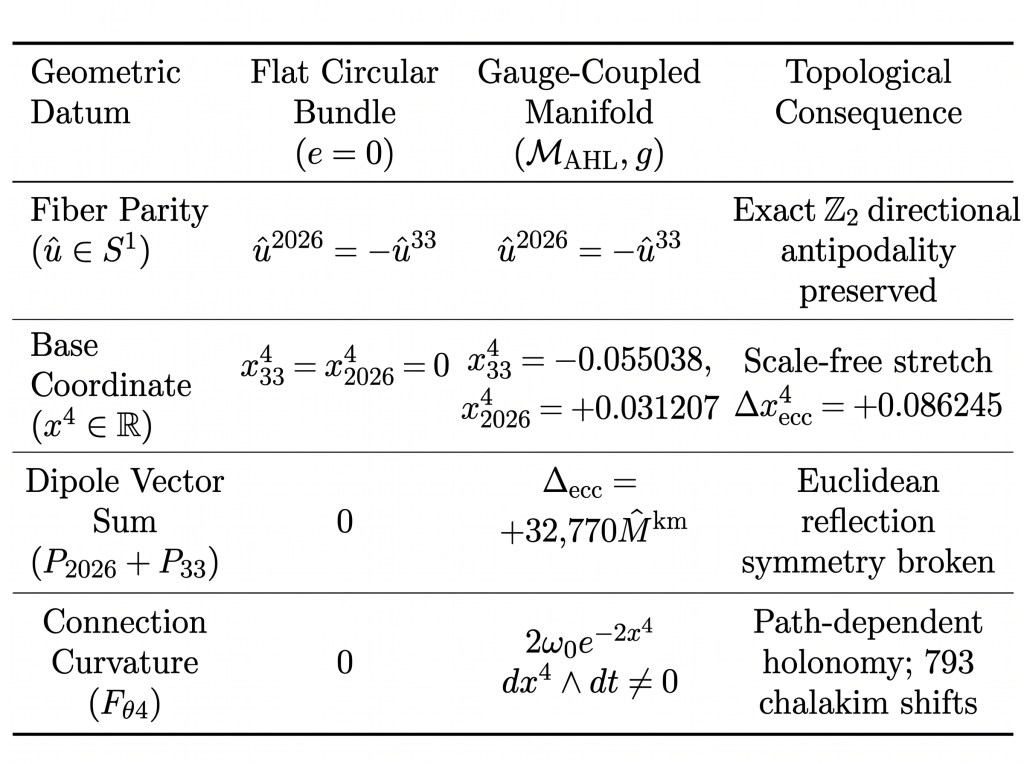
Because the gauge field strength vanishes identically at , the fiber admits an exact global antipodal parity involution defined by
Projected into the two-dimensional Euclidean orbital embedding plane via , the April 3, 33 AD opposition state (, ) and the September 11, 2026 conjunction state (, ) satisfy exact vector involution at :
Under this flat-bundle condition, bridging an opposition state to an antipodal conjunction state across complete lunations plus one half-lunation requires a total covariant phase integral of . Setting in yields exact arithmetic closure:
In the sexagesimal-chalakim fiber measure, let denote the cyclic holonomy defect, the terminal angular discrepancy relative to the canonical lunation increment per cycle:
where .
Consequently, on a zero-eccentricity unit circle, trigonometric parity () and metric norm () commute with horizontal parallel transport, allowing the classical module to close across the dipole with zero residual defect.
Gauge Curvature Obstruction and Broken Involution on
On the manifold with non-zero Keplerian eccentricity (), the base coordinate is dynamically active, activating the radial-temporal gauge curvature two-form
Evaluating the full state coordinates at the two boundary anchors reveals a fundamental bifurcation between the compact angular fiber and the non-compact logarithmic base :
Preserved Fiber Parity on : Under the projection , the directional unit vectors continue to obey exact trigonometric involution:
Obstructed Origin Reflection on : Under the logarithmic base projection , exact involution would require (which corresponds to only if opposite radial excursions balanced symmetrically around , and equal metric norm requires ).
Instead, perigee compression at April 3, 33 AD (, ) and apogee elongation at September 11, 2026 (, ) generate both a non-zero metric stretch and a non-zero involution trace :
Expanding the covariant angular holonomy around the unperturbed flat connection isolates the exact gauge-metric holonomy obstruction:
Two independent topological obstructions emerge directly from this expansion:
Global Quadratic Jensen Defect: Even over closed anomalistic cycles where the linear radial-logarithmic oscillation averages near the semi-latus rectum, strict convexity of the conformal metric factor ( satisfies positive everywhere) guarantees by Jensen’s inequality that exceeds , coupling mean synodic transport permanently to orbital eccentricity .
Boundary Endpoint Non-Cancellation ():
Because the dipole path terminates on an open half-cycle boundary connecting perigee compression ( negative) to apogee elongation ( positive) rather than returning to an identical radial gauge fiber, the boundary Stokes term associated with fails to cancel at the endpoints.
Theorem 2.1 (Topological Obstruction to Constant-Molad Closure)
Let be a smooth horizontal lift satisfying antipodal fiber parity across boundary fibers .
Whenever the scale-free logarithmic boundary stretch is non-zero, the connection curvature induces a non-vanishing boundary holonomy defect .
Consequently, no constant affine module calibrated on the flat submanifold can simultaneously preserve exact syzygy phase lock () at the dilated apogee boundary without gauge-metric renormalization of the terminal residue.


Leave a Reply