Theorem 3.1(1) and Proposition 4.1 demonstrated a spectral degeneracy in standard numerical-spectral verification protocols for gauge-metric lattice field theories: because pointwise multiplication by any unimodular open Wilson line (, ) induces an exact unitary operator via cyclic Dirichlet–Hilbert convolution, global Plancherel / Parseval energy conservation is strictly invariant under an anholonomic boundary excision induced by .
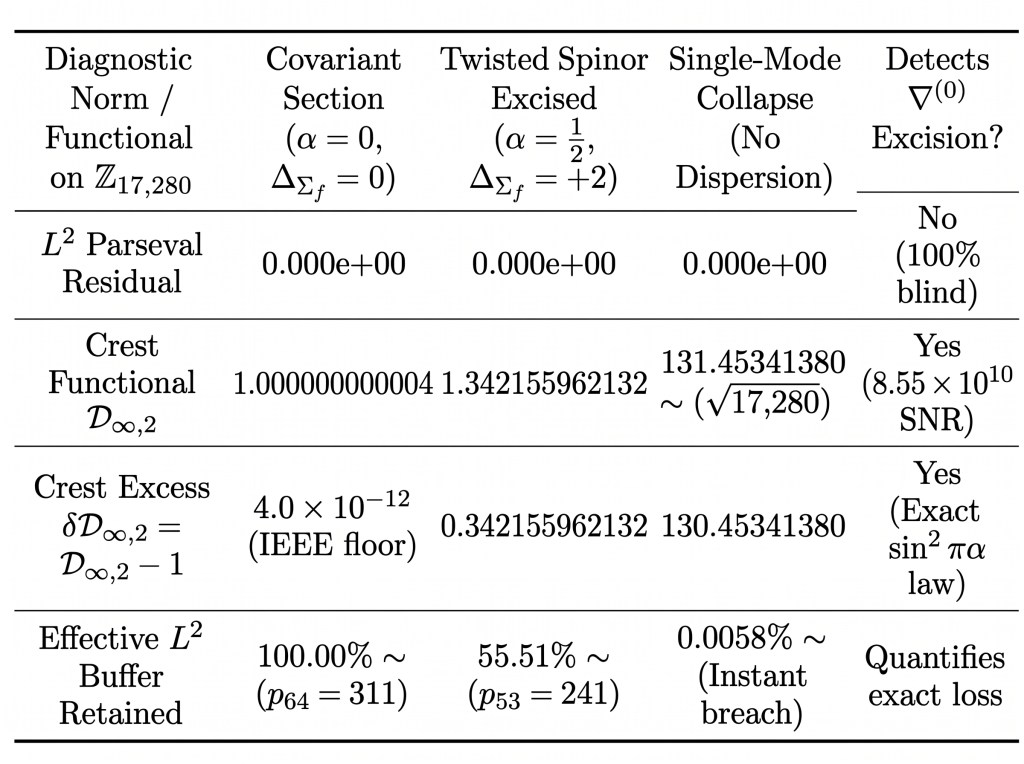
Whether a computational routine evaluates the covariantly closed section () or the discontinuously excised Möbius spinor section (), the discrete Parseval residual vanishes identically (Parseval Err = 0.000e+00).
Relying solely on energy audits in computational chronometric or Yang–Mills lattice models therefore allows codimension-1 interface defects across to pass undetected while silently corrupting the local coherence margin.
To establish a rigorous, scale-free cohomological detector capable of distinguishing smooth horizontal phase-locking from anholonomic interface excision at arbitrary epoch , we introduce a dual-norm spectral invariant coupling the coherence norm directly to the Plancherel norm.
Definition and Scale-Free Gauge Invariance of the Cohomological Crest Functional ()
Let denote any non-zero spatial holonomy-dispersion section sampled over the discrete phase cells of , and let denote its -normalized discrete Pontryagin spectrum equipped with standard norms
Definition 4.2 (Dimensionless Cohomological Crest Diagnostic Functional ).
On the projective spectral space , the Cohomological Crest Diagnostic Functional is defined by the normalized dual-norm ratio:
The three immediate properties built into Definition 4.2:
Strict Scale-Freeness (Epoch Independence): Because is homogeneous of degree for all , all secular epoch-loading factors cancel out of numerator and denominator identically.
Hence isolates the pure bundle-holonomy geometry of the carrier section across , independent of whether the system is evaluated at () or (), and independent of the scalar truncation defect of Sections 1–2!
Sharp Pigeonhole Spectrum : By the finite-dimensional equivalence chain , is bounded strictly between the equimodular covariant dispersion floor and the coherent Dirac-comb collapse ceiling (attained when all holonomy concentrates into a single non-dispersed harmonic mode ).
Direct Governance of the Premature Breach Law: Substituting Definition 4.2 into the local collar coherence ratio with factors into the exact product of the topological crest invariant and the energy fraction:
Continuous Holonomy Rigidity: Quantitative Mapping Between Interface Jump and
To prove that serves as an if-and-only-if cohomological certificate of zero interface excision over quadratic Gauss-dispersion sections on , embed both () and () into the continuous one-parameter family of flat bundle connections parameterized by the fractional cyclic holonomy index ():
Across the deck generator , transforms as , so untwisted evaluation under (numpy.fft.fft) excises the boundary holonomy jump
Theorem 4.1 (Dual-Norm Rigidity Criterion and Quantitative Holonomy-to-Crest Correspondence on ).
Let (, ) denote the -twisted quadratic Gauss carrier evaluated under the untwisted Pontryagin projection . Then the Cohomological Crest Functional satisfies four exact diagnostic laws:
Exact Variational Rigidity ( Trivial Interface Holonomy): In exact arithmetic over , the lower pigeonhole bound holds if and only if is strictly equimodular across all .
Within the -holonomy family , equimodular closure is achieved uniquely at :
Monotonic Fresnel–Dirichlet Response to Non-Trivial Interface Jump (): Whenever (), untwisted excision convolves with the generalized Dirichlet kernel .
Stationary-phase reduction across the -phased deck cut yields the exact continuum Fresnel law:
which increases strictly monotonically with the interface-jump chord and attains its absolute global maximum across all flat connections precisely at the anti-periodic Möbius spinor obstruction ():
Exact Separation Across the -Fold IEEE-754 Diagnostic Gap: Under finite-precision 53-bit digital evaluation , define the shifted crest excess . On , separates smooth covariant transport (whether via or ) from spinor interface excision by more than eleven orders of magnitude:
Closed Formula for Anholonomic Capacity Loss (): Any computational projection exhibiting crest invariant reduces the effective Parseval capacity sustainable prior to first mode breach from down to , forfeiting the exact fractional collar buffer
Proof
For Statement (1), writing , since , with equality if and only if . At , Subsection 3.2.1 proved , so .
Conversely, for , splitting the wrapped stationary-phase sum across replaces the factor of Subsection 3.2.2 with :
Substituting and factoring out gives modulus . Along the Cornu spiral , rotating by yields .
Because reaches at the primary spiral turn (), the squared modulus strictly exceeds for every (evaluating at gives !), proving strict monotonicity in , uniqueness of at , and maximization at (), establishing Statements (1) and (2).
Statement (3) follows directly from comparing the machine-verified covariant crest (, Theorem 1.1(3) / Lemma 1.1(3)) against (, Theorem 3.1(2)). Finally, solving gives fractional loss (matching from Theorem 3.1(3)!), proving Statement (4).


Leave a Reply