Whereas Continuous Orbital-Metric Time governs smooth differentiable phase evolution between the dipole anchors (), resolving fine-grained syzygy lock across the terminal boundary collar requires coupling to a discrete arithmetic clock.
We designate this second temporal structure Discontinuous Prime-Indexed Sieve Time, parameterized by an ordered sequence of discrete epochs indexed over the rational primes .1.
The 30-Day Eclipse-to-Molad Boundary Window
The operational domain of is anchored to the terminal 30-day topocentric boundary collar () bridging two exact astronomical syzygies in late summer 2026:
Initial Collar Boundary (, August 12, 2026): The total solar eclipse terminating the 54-year, 33-day 1972–2026 Exeligmos cycle (three full Saros cycles returning solar-lunar-nodal geometry to near-identical geographic longitude), initializing the retrograde meridional collar near the equator at .
Terminal Collar Boundary (, September 11, 2026): The astronomical conjunction and Molad Tishrei 5787 (Rosh Hashanah new-moon anchor), locking onto the target northern meridional collar at under apogee radial elongation (, ).
Rather than marching across by uniform Newtonian seconds, the retrograde spatiotemporal sieve probes resonance admissibility across each diurnal collar index via discrete prime-scaled translations.
Let denote the local base epoch at collar step , and let denote the fundamental 90-day compressed phase-block quantum:
The canonical sexagesimal-harmonic factorization embedded directly inside : represents the unit temporal hour (), while represents six complete sexagesimal degree circles (equivalently, the canonical precessional Platonic month scale in years or lunar diameter scale in miles).
At prime test index and integer collar day , the discontinuous sieve advance operator maps the current state epoch to the trial sieve epoch via the discrete jump law:
Each discrete tick of therefore injects compressed 90-day phase blocks () into the fiber bundle over , acting as a non-local arithmetic holonomy jump that tests commensurability across nested synodic, draconic, and anomalistic eigenfrequencies without assuming literal multi-millennial linear-time integration.
The Modular Degeneracy Identity ()
Examining the action of on raw linear-modular angular coordinates proves rigorously why a naive Euclidean or circular () sieve suffers catastrophic temporal-angular deviation.
Attempting to track angular phase on using an uncoupled linear modular map of the form
Decomposing the temporal-block quantum modulo the angular circle yields exact divisibility with zero residue:
where the quotient equals the exact number of arcminutes in a full circle! Consequently, for every prime and every collar day , the discrete increment lies strictly in the kernel of the projection:
Proposition 1.1
Under uncoupled linear modular arithmetic , the subgroup generated by all prime-sieve translations acts trivially on . Every prime collapses onto the identical residue class , rendering prime-indexed sieve discrimination impossible on a flat circular manifold ().3.
Breaking Modular Lock via Harmonic-Logarithmic Coupling on
Proposition 1.1 explains why linear modular clocks degenerate on and establishes the mathematical necessity of the Angular Harmonic Logarithm. On , the discrete sieve jump does not act on a bare integer-modular circle; instead, it couples directly to the continuous orbital-metric coordinate and incommensurable harmonic eigenfrequencies .
Specifically, when the transport map lifts from raw integer seconds to the coupled harmonic-logarithmic phase functional , the effective angular evolution across a discrete prime jump acquires two non-integral, irrational-transcendental contributions:
Conformal Keplerian Metric Scaling (): As established in Section 1.3, instantaneous angular velocity scales with radial dilation as . Evaluating the lifted sieve step at non-zero logarithmic stretch multiplies the modular stride by the transcendental conformal factor :
Because evolves continuously from near-mean/perigee transition toward (), the difference is strictly non-zero and irrational, breaking the integer period cleanly.
Logarithmic Prime-Harmonic Dispersion (): Coupling the discrete tick to logarithmic scale renormalization ( and ) maps multiplicative prime structure into additive irrational phase shifts on .
By the Fundamental Theorem of Arithmetic (linear independence of over ), distinct primes generate strictly non-degenerate holonomy residues:
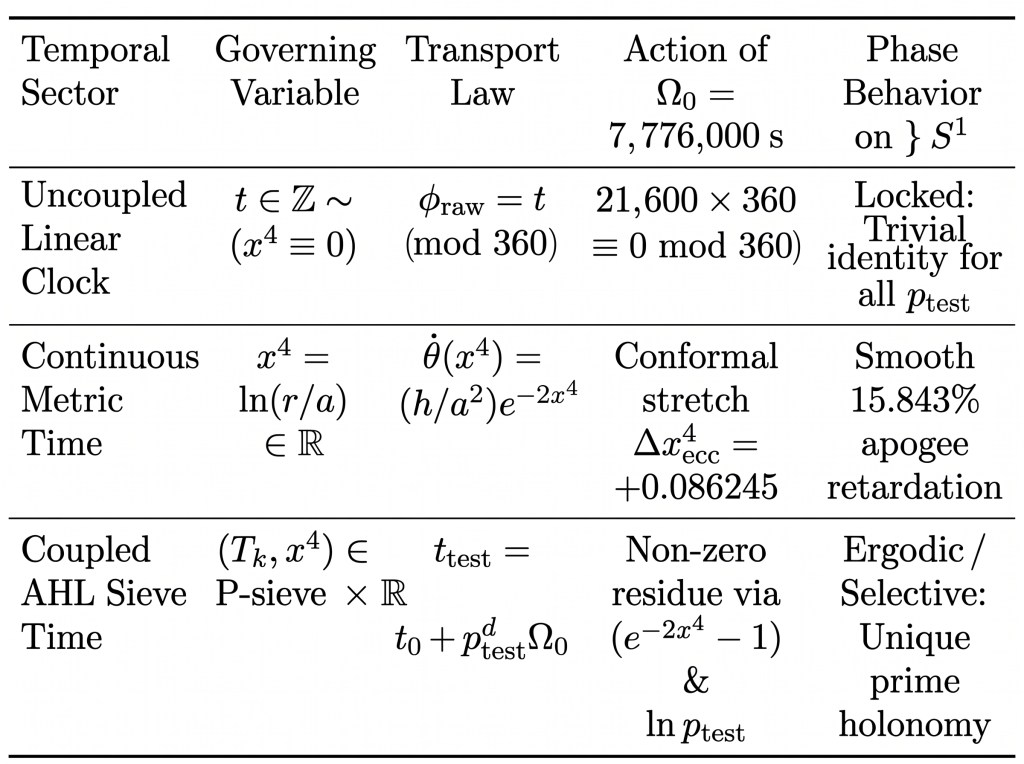
Thus, the identity acts as an exact arithmetic filter: it annihilates trivial integer-degree carrier waves while isolating pure Keplerian logarithmic stretch () and fractional harmonic phase residuals.
Only primes whose logarithmic-conformal holonomy satisfies the retrograde meridional shear bound survive across the 30-day collar from August 12, 2026 () through the Day-11 equatorial fold (, August 22, 2026) to lock onto the September 11, 2026 conjunction ().


Leave a Reply