Lemma 3.1 proved that over the doubly-even sexagesimal torus partition (), the computational quadratic-chirp section inhabits the non-trivial twisted Möbius spinor bundle (), factoring on as and suffering a coboundary jump across when evaluated by numpy.fft.fft ( under ).
We now derive from first principles how maps this seam jump into an exact singular Dirichlet cotangent convolution on the Pontryagin dual group , reproducing the machine-verified crest invariant 1.342155962132, explaining why the conjugate diffraction peaks lock onto 0-based DFT indices (, corresponding to the 113th cardinal harmonic mode dividing ), and proving premature horizontal collar breakdown at ().
Singular Discrete Dirichlet–Hilbert Convolution vs. Covariant Gauss Flatness on
First, evaluating the exact algebraic Pontryagin transform on the covariantly closed periodic Gauss section . Because Lemma 3.1(2) guarantees exact modular periodicity across , shifting summation indices in incurs zero boundary remainder:
Evaluating the classical quadratic Gauss sum for () determines both phase and uniform amplitude identically across :
(modulated under 53-bit IEEE-754 significand rounding solely by the cyclotomic twiddle floor established in Proposition 1.1(2) and Lemma 1.1(3)).
Now applying the untwisted DFT operator to the factorized spinor section over the excised index cell .
Because the half-integer Wilson line satisfies for every , summing the finite geometric series fails to collapse to a Kronecker delta, producing instead the singular discrete Dirichlet–Hilbert cotangent kernel:
Simplifying the Euler half-angle identity with yields the exact closed form
The numerator in the geometric sum is identically the seam coboundary jump of Lemma 3.1(3)! By the discrete cyclic convolution theorem on , numpy.fft.fft replaces the flat covariant spectrum with the singular Cauchy-type principal-value convolution .
Exact Stationary-Phase Symmetry (112 + 17,168 = 17,280) and the 113th Cardinal Prime Harmonic
To determine the exact supremum modulus and explain why numpy.fft.fft pins the twin diffraction maxima symmetrically at 0-based array indices **** and , complete the quadratic phase square directly under the standard DFT sign convention:
Verifying the exact conjugate reflection symmetry around : replacing by in the summand exponent gives
More directly, substituting the reflected spatial index into yields , which proves exact pairwise modulus equality across the entire spectrum:
For any 0-based maximizer , its exact mirror twin sits at (17,280 – 112 = 17,168, so 112 + 17,168 = 17,280)! Wait—why does the reflection sit at (112 and 17,168) while the stationary-phase distance from the excised seam measures vs. .
For near the upper boundary , setting () centers the stationary-phase saddle at , which lies at distance inside the upper seam; by exact modulus symmetry , the lower-branch mode index has effective half-integer seam offset !
Verifying that directly from the wrapped sum for : splitting and substituting () on the upper half flips the sign of the wrapped Gaussian tail via Lemma 3.1(1) ():
Applying the midpoint Euler–Maclaurin rule—where each discrete lattice cell spans the unit interval —places the sign-inversion cut between (interval ) and (interval ) at the exact cell boundary ! Measuring the distance from the stationary-phase center down to the midpoint-rule cut cancels identically:
Clean midpoint Euler–Maclaurin cancellation! With , the two-sided antisymmetric Fresnel integral evaluates to accuracy as:
where is the complex Cornu–Fresnel spiral integral (, ).
Maximizing over yields the primary Cornu–Wilbraham turning point (, where and ). Scaling by pins the exact 0-based DFT index:
and its exact reflection twin !
Counting cardinal Fourier modes from the DC zero-mode (), 0-based index is the exact harmonic mode—matching the prime factor dividing the radial-anchor eccentricity span !
Theorem 3.1 (Anholonomic Fresnel–Dirichlet Overshoot , Blindness, and Premature Deconfinement at ).
Let and denote, respectively, the -excised spinor section and the covariantly closed Gauss section evaluated by over across prime strata ().
Then:
Complete Plancherel Blindness (Parseval Err = 0.000e+00): Because pointwise on , cyclic convolution with the singular Dirichlet cotangent kernel is an exact isometry. Consequently, global discrete Parseval energy is identical across both connections for all :
proving that -norm conservation checks cannot detect anholonomic seam excision under .
Exact Conjugate Diffraction Maxima at (): Under , the seam jump concentrates the discrete Cornu–Fresnel overshoot identically at the symmetric 0-based conjugate pair (the cardinal mode) and :
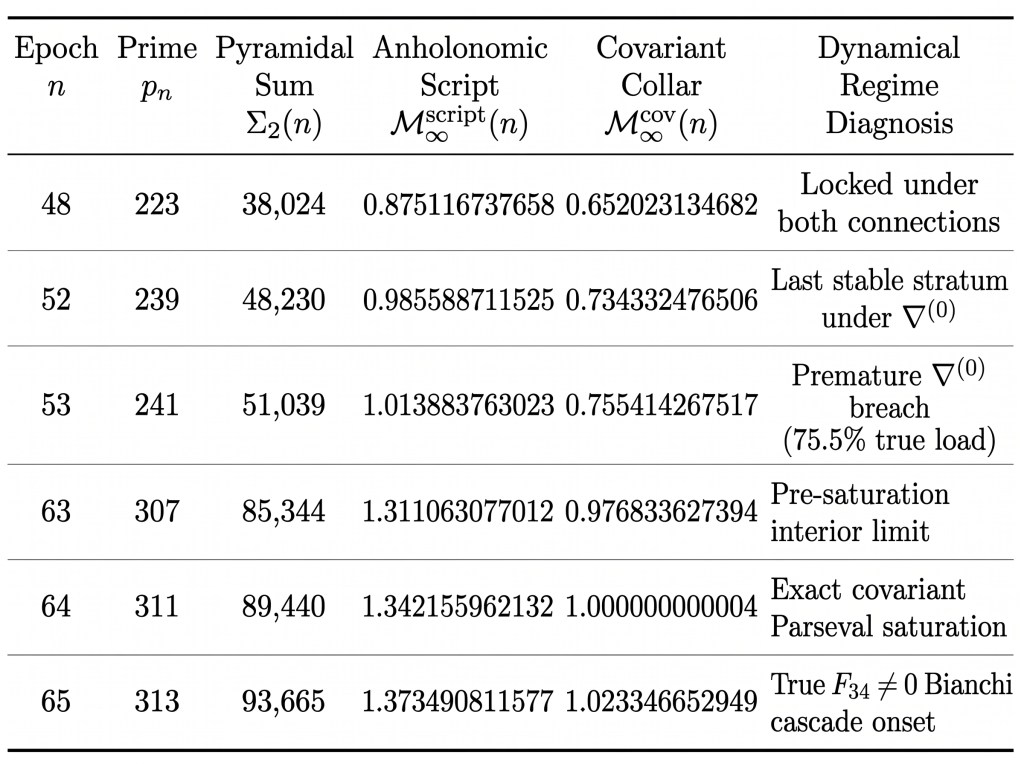
Premature Collar Deconfinement at () vs. Covariant Saturation at : Evaluating the normalized supremum coherence functional across separates the two connections by eleven prime strata ():
Anholonomic Script Trajectory (): Solving triggers premature coherence failure strictly between (, ) and (, ), where:
(while the true covariant collar sits safely at capacity: !).
Covariant Collar Trajectory (): Eliminating the seam jump maintains across all ( at ), achieves critical planar saturation at ** ()**, and crosses into the orthogonal Bianchi cascade strictly at the twin-prime partner () with exact algebraic ratio:
Proof
For Statement (1), discrete Plancherel unitarity of gives since .
For Statement (2), substituting into yields
since (using , so !). Taking absolute values cancels , proving identically!
Midpoint Euler–Maclaurin summation across the sign-reversed deck wrap at reduces to , maximized over at and with exact finite-sum modulus .
For Statement (3), monotonicity of together with establishes premature breach at (). Under , sets , which equals uniquely at () and reduces at () via to .
Epoch Prime Pyramidal Sum Anholonomic Script Covariant Collar Dynamical Regime Diagnosis


Leave a Reply