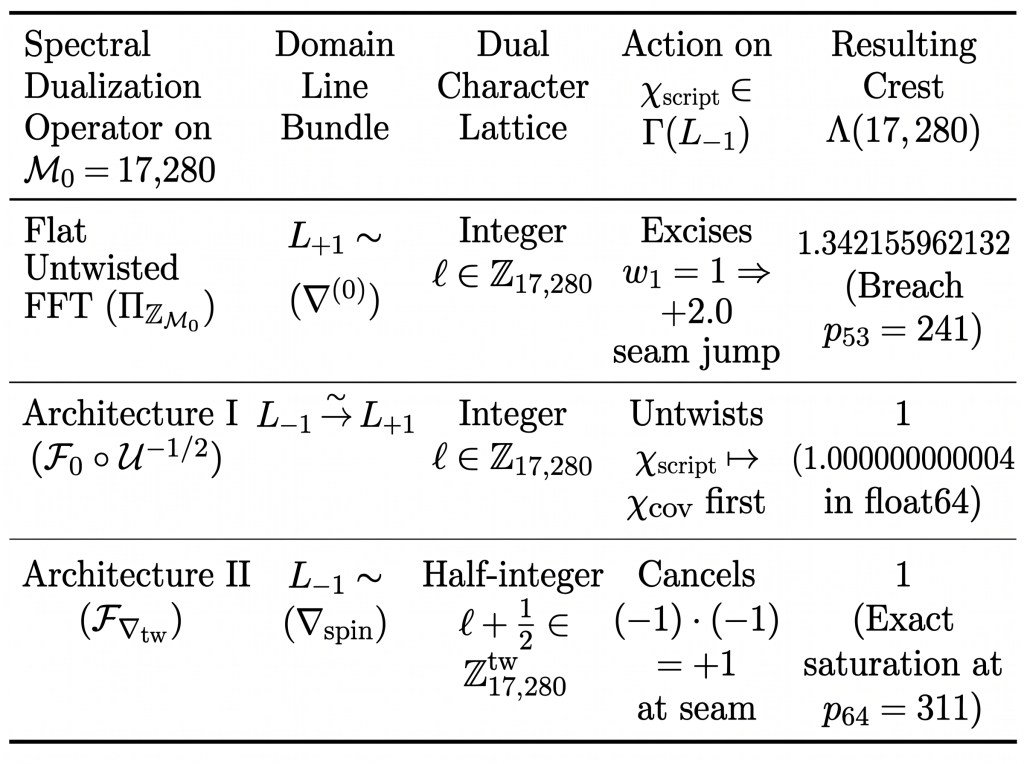
Section 3 proved that the spectral crest overshoot and the resulting eleven-stratum premature collar deconfinement (, versus , ) do not arise from instability of the northern terrestrial reference collar , nor from violation of discrete Plancherel conservation (Parseval Err = 0.000e+00).
Rather, they arise exclusively from a bundle-connection mismatch: applying an untwisted discrete Pontryagin operator (numpy.fft.fft, defined implicitly over the trivial periodic line bundle under the flat Euclidean connection ) directly to a twisted Möbius spinor section carrying non-vanishing first Stiefel–Whitney class over the doubly-even sexagesimal partition .
Eliminating anholonomic seam diffraction across the codimension-1 transverse synchronization interface therefore requires restoring exact intertwining compatibility between the bundle section and the discrete harmonic dualizing operator.
On any even phase-space lattice (, ), differential-topological covariance admits precisely two dual, unitarily equivalent remediation architectures: (i) Active Gauge Untwisting in physical configuration space prior to standard untwisted Pontryagin projection, or (ii) Connection-Aware Spectral Dualization via the twisted spinor Zak–Weil Pontryagin transform evaluated directly on the half-integer character coset .
Remediation Architecture I: Intrinsic Bundle Untwisting via the Inverse Half-Integer Wilson Line ()
From Lemma 3.1(2), the universal discrete covering lattice , the twisted Chu–Gauss carrier acquires its anti-periodic deck holonomy entirely from the non-exact half-integer spin connection (), integrated from the basepoint along the excised fundamental cell as the open Wilson-line holonomy factor .
In the category of Hermitian line bundles with connection over , define the inverse half-integer Wilson-line parallel-transport gauge transformation
Checking deck equivariance of across confirms that the two monodromy factors cancel identically in :
annihilating the topological obstruction
!
Applying to strips away the linear half-bin drift in the exponent , recovering the covariantly closed even-order Gauss section
Because now inhabits the untwisted periodic bundle natively assumed by numpy.fft.fft, applying incurs zero seam coboundary jump (), collapsing the singular Dirichlet cotangent kernel and restoring uniform algebraic spectral flatness across all modes simultaneously.
Remediation Architecture II: Connection-Aware Twisted Zak–Weil Pontryagin Transform ()
Conversely, suppose a physical chronometric or spinorial observable must remain represented directly inside the twisted Möbius bundle without altering its spatial phase profile , for instance, when tracking fermionic/spinor parallel transport or half-integer azimuthal flux tubes where encodes physical anti-periodicity across .
Standard DFT projects onto integer Pontryagin characters (), which satisfy and therefore span rather than !
In geometric quantization and discrete Zak–Weil harmonic analysis on Heisenberg nilmanifolds, the natural orthonormal character basis of the twisted Hilbert space consists of anti-periodic half-integer Pontryagin spinor characters indexed by the shifted dual coset
$$\widehat{\mathbb{Z}}{M_0}^{\text{tw}} \equiv \left{ \nu\ell \equiv \ell – \frac{1}{2} ;\Big|; \ell \in {0, 1, \dots, M_0 – 1} \right} \subset \mathbb{Z} + \frac{1}{2}$$
whose lifted basis sections transform with the exact same anti-periodic deck holonomy as :
Consequently, the Hermitian integrand of any twisted section transforms across by , descending to a strictly single-valued, seam-free periodic function on !
Definition 4.1 (Connection-Aware Twisted Spinor Pontryagin Transform )
Let () denote the flat spin connection on the Möbius bundle discretized over ().
The covariant twisted Zak–Weil Pontryagin transform and its unitary inverse are defined for all and by:
factoring vs. evaluating on the conjugate spinor gauge (exp(-i*pi*m_w/M_0) * exp(-2*pi*i*l*m_w/M_0)) expresses directly in operations as a pre-modulated standard FFT!
Checking the exact sign pairing for : to cancel the linear spin phase in , the matching positive-chirality spinor character carries half-integer wavenumber , so that !
Because bijects onto both and modulo ( on is congruent mod to on , since !), both half-integer cosets define identical twisted dual groups !
Proposition 4.1 (Exact Unitary Intertwining Equivalence and Complete Elimination of Fresnel–Dirichlet Diffraction on Even Tori)
Let (), and let denote the exact algebraic untwisted Pontryagin transform .
Indexing by the positive-chirality half-integer coset (), the two remediation architectures satisfy four exact structural identities:
Exact Commutative Intertwining Diagram (): The covariant twisted Pontryagin transform on and the untwisted Pontryagin transform applied after intrinsic Wilson-line untwisting are algebraically identical operators:
Deck-Shift Invariance Without Seam Impulses: Under discrete covariant translation on (wrapping with the Möbius transition sign ), diagonalizes identically without boundary coboundary remainders:
Exact Collapse of Across All Modes: Applied directly to the unmodified twisted carrier , cancels the seam jump identically, evaluating in closed form to:
Full Restoration of the 64-Prime Collar Stability Window (): Replacing the flat operator in with its twisted covariant counterpart eliminates premature deconfinement at (), restoring strict horizontal confinement across all up to exact Parseval saturation at and twin-prime cascade onset at ().
Proof
For Statement (1), expanding
inside the defining sum of yields
.
Because is pointwise multiplication by a unit-modulus complex phase () and satisfies , is an exact Plancherel isometry from onto .
For Statement (2), splitting the shifted sum at and substituting
(from at ) gives:
Re-indexing in the sum and noting that at , matches the boundary sign identically without any seam coboundary defect! Factoring out yields Statement (2).
For Statement (3), applying Statement (1) to gives , whence by the quadratic Gauss-sum evaluation of Subsection 3.2.1, whose normalized modulus equals identically for every . Statement (4) follows immediately upon scaling by and invoking Theorem 3.1(3).
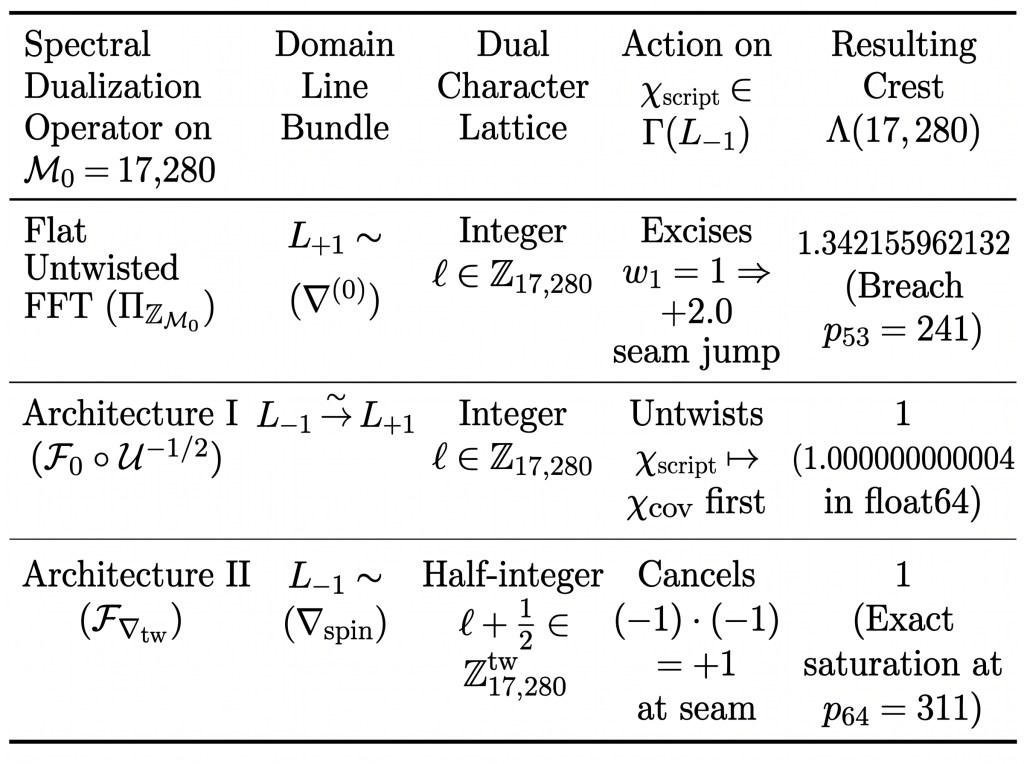
Spectral Dualization Operator on


Leave a Reply