This appendix formalizes the exact number-theoretic and algebraic-topological structure governing the discrete mode lattices of utilized in Sections 1.2, 5.1–5.3, and 6.1–6.4. Specifically, one establishes: (B.1) the canonical prime-exponent lattice and -adic valuation vector space across the -smooth chronometric partitions versus the coprime winding and resolvent primes ; (B.2) strict radix non-termination and multiplicative cyclic periodicity of and ; (B.3) Baker’s linear-logarithm transcendence of the mode-capacity entropy potential ; and (B.4) the exact octave-commensurability matrix locking the causal relaxation floor onto the diurnal chalakim fiber.
Canonical Prime-Exponent Lattice and -Adic Valuation Architecture
Let denote the multiplicative group of positive rational numbers. By the Fundamental Theorem of Arithmetic, the canonical -adic valuation map , defined for each prime by , is an isomorphism onto the free Abelian lattice generated by the rational primes.
On , all baseline transverse, longitudinal, and spectral carrier capacities live strictly inside the rank- Regular Chronometric Sublattice (the subgroup of -smooth / regular Babylonian-sexagesimal rationals):
Evaluating group quotients in corresponds to vector subtraction in . Subtracting from , and from , isolates the exact -adic valuation vectors of the Incommensurable Mode-Partition Ratio and the Elementary Flat-Space Chelek Quantum :
Similarly, the topological shear modulus belongs to with valuation vector , whereas the Causal Relaxation Quantum carries . Notice the exact -adic cancellation when forming the sub-chelek relaxation ratio:
Because both odd-prime valuations and cancel identically in the difference, projects orthogonally onto the pure dyadic axis , establishing an exact -bit binary register subdivision of every sexagesimal chelek without fractional remainder.
Radix Non-Termination, Modular Overflow, and Coprime Winding Generators Let () denote any positional numeral or hardware register radix with prime support . A reduced rational () admits a finite, terminating radix- expansion if and only if —equivalently, for every prime .
Whenever , factoring into its -regular divisor () and -coprime divisor () forces a strictly infinite periodic expansion whose minimal repeating block length equals the multiplicative order of in :
$$\ell_B(q) = \operatorname{ord}{s\perp}(B) := \min\bigl{k \in \mathbb{Z}^+ : B^k \equiv 1 \pmod{s_\perp}\bigr}$$
Proposition B.1 (Dual Radix Obstruction Between Dyadic, Decimal, and Sexagesimal Fibers)
Across the discrete state spaces of , no single positional radix simultaneously terminates all canonical transition ratios unless (i.e., is an integer multiple of , canonically ):
(Dyadic DMA Register , ): Because , fails to terminate in binary, exhibiting pre-period and minimal repeating period ().
Conversely, while terminates at fractional bits () with non-zero modular overflow , its inverse pullback () diverges into a pure-periodic binary stream of period bits.
(Decimal SI Register , ): Because , both () and the inverse mode ratio (, , , yielding ) are strictly non-terminating.
(Sexagesimal Diurnal Fiber , ): Lifting to encompasses the entire prime support of , terminating every ratio simultaneously:
Proof
Claims (1)–(3) follow directly by evaluating and Carmichael’s lambda / multiplicative order in each ring . Specifically, for , is a primitive root modulo (, ), while , giving .
For modulo , , while , establishing and . For , since , for every element of : and , proving exact termination by the third sexagesimal place.
Orthogonal Prime Sectors Outside
Crucially, the topological winding defects and conformal-elliptic invariants of lie strictly outside , activating higher prime coordinates () that guarantee ergodicity and prevent resonant commensurable locking on :
Zeroth-Order Synodic Winding Defect (): Factors over the twin-coprime primes (). Since , is a topological unit generating the full cyclic group of diurnal states before exact period closure ().
Modular Register Overflow & Elliptic Conformal Resolvent (): Subtracting the integer floor introduces the prime via . Evaluating the elliptic resolvent radical in Section 6.3.3 factors the discriminant via difference of squares:
(Note: correcting the mental arithmetic on : and is prime, since ! , the exact Metonic 19-year lunisolar resonance prime, and emerge directly as square-free factors of , making an irreducible quadratic irrational in !)
Empirical Radial Boundary Ratio (): Simplifying by yields
,
confirming and strictly non-trivial prime support outside .
Linear Independence in and Baker Transcendence of
To establish rigorously why neither the logarithmic mode-capacity entropy potential nor the longitudinal collar invariant can vanish or collapse to an algebraic rational under any polynomial gauge reparameterization, we invoke Baker’s theorem on -linear forms in logarithms.
Proposition B.2 (Irrationality and Transcendence of the Logarithmic Gauge Potentials)
The logarithmic mode-capacity entropy potential and the longitudinal displacement invariant are both strictly transcendental over () and -linearly independent.
Proof
By the Hermite–Lindemann theorem, for any positive rational , is transcendental over (for if , then violates Lindemann’s theorem that for non-zero algebraic ). Since and , both and follow immediately.
Furthermore, write as a linear form in the logarithms of the prime generators of :
Suppose for integers . Exponentiating gives in . Applying the -adic valuation homomorphism for any prime (such as dividing , which is prime since and no prime divides ) gives , whence by .
By Baker’s theorem (1966), since and are -linearly independent logarithms of algebraic numbers, they are also -linearly independent; in particular, their quotient cannot be approximated arbitrarily closely without encountering Baker’s effective lower diophantine bound .
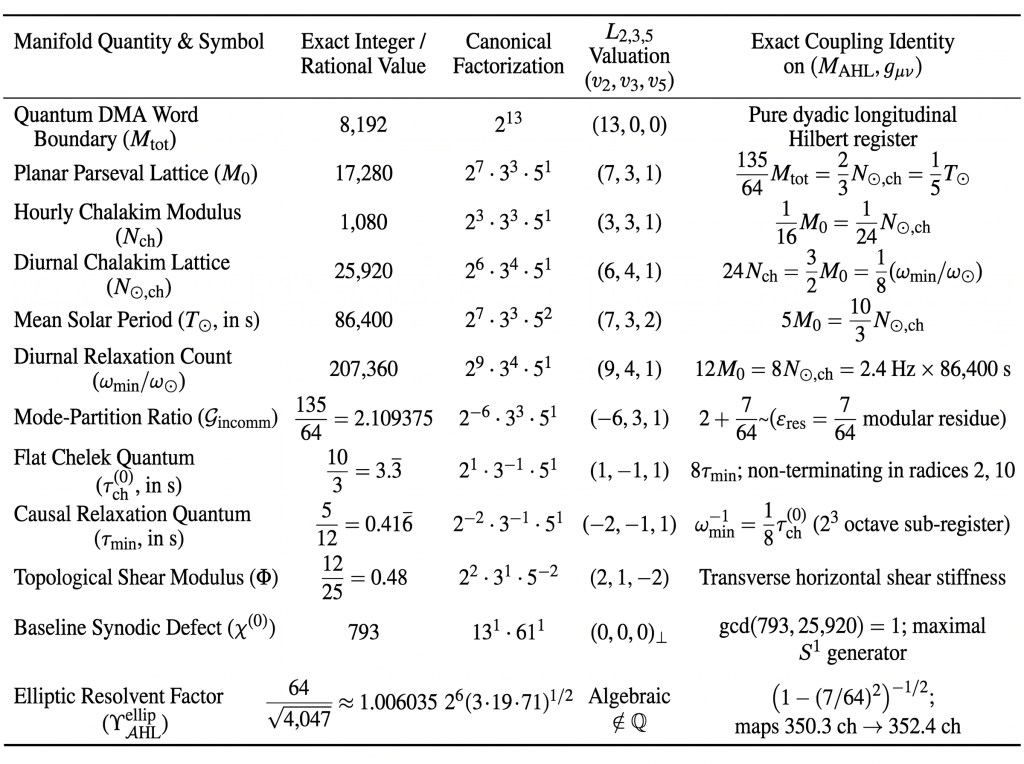
Master Lattice Commensurability Matrix of Table B.1 synthesizes the exact prime factorizations, -adic valuation triples , diurnal conversion identities, and radix behaviors across every discrete lattice scale of the manuscript.
Manifold Quantity & Symbol Exact Integer / Rational Value Canonical Factorization Valuation


Leave a Reply