Formal Operator Theory of Flat Digital Projections ( under )
Curved Bundle Transport on (ℳ𝒜ℋℒ,gμν𝒜ℋℒ) versus Digital Register Discretization
Let denote the four-dimensional, oriented, scale-free pseudo-Riemannian atlas-manifold governing coupled temporal–angular–harmonic–logarithmic () parallel transport across multi-epoch orbital and lunisolar commensurability cycles. Within its longitudinal–angular sector, carries the canonical principal -associated affine fiber-bundle structure
whose dimensionless longitudinal fiber coordinate parameterizes scale-invariant logarithmic radial displacement relative to the characteristic semi-major reference gauge (invariant under simultaneous homothety for all ), and whose compact angular base coordinate tracks cyclic orbital-synodic phase.
Whenever orthogonal foliation Killing symmetry () is broken across the decoupled opposition–conjunction radial-anchor complex (), is endowed with a non-exact Ehresmann connection 1-form
Lifted along the universal covering homomorphism () to the pulled-back covering bundle with scale-free Lorentzian bundle metric , horizontal parallel transport is generated by the nowhere-vanishing lifted horizontal vector field .
Along a scale-covariantly regularized global collar section across the tubular synchronization neighborhood , cyclic integration over the -winding fundamental homology class () enforces the exact abelian covering-monodromy homomorphism , where denotes the dynamically phase-locked single-cycle angular–harmonic–logarithmic winding invariant.
To evaluate how this ambient scale-free holonomy couples to discrete terrestrial chronometric lattices, let denote the stratum-preserving conformal-bundle embedding of the four-dimensional stratified Lorentzian terrestrial sub-atlas
whose interior vertical fiber carries normalized azimuthal volume Jacobian and non-vanishing meridional Levi-Civita trace . Anchored along the primary northern geodetic reference collar
(, ), continuous lunisolar axial precession and horizon holonomy magnification pull back to the non-reciprocal azimuthal Ehresmann gauge potential (). Within , thermodynamic sexagesimal equipartition of the compact diurnal–azimuthal fiber defines a finite cyclic phase-space partition of
discrete harmonic cells indexed by , accommodating cumulative off-diagonal Yang–Mills shear stress across the 64-prime intra-collar sub-lattice () up to the elastic coherence threshold .
Formal Operator Architecture of Digital Register Evaluation ()
A methodological obstruction arises whenever smooth sections, connection invariants, and Pontryagin mode spectra of are evaluated on a standard binary digital computer using IEEE-754 double-precision floating-point arithmetic (float64) coupled to radix-mixed Fast Fourier Transform libraries (numpy.fft.fft). Far from constituting a neutral or covariant observation of the underlying geometry, digital execution forcibly projects smooth bundle objects through two non-commuting, non-distributive Euclidean truncation operators governed implicitly by the anholonomic flat connection (, ).
Definition 1.1 (Composite Anholonomic Digital Projection Operator )
Let denote the space of smooth coupled longitudinal-scale and planar-torus harmonic sections along the reference collar .
Standard 64-bit numerical-spectral evaluation realizes the composite projection operator
defined as the sequential composition of two distinct structural projections under :
IEEE-754 Binary Significand Quantization (): Every real longitudinal fiber coordinate, metric coefficient, and trigonometric twiddle factor is mapped via round-to-nearest-even binary floating-point casting onto the finite 53-bit dyadic significand subset
Algebraically, is a non-linear, non-distributive metric projection onto the dyadic localization ring :
which simultaneously replaces smooth collar parallel transport across with frozen scalar endpoint subtraction across the excised relative interval ().
Untwisted Modular Pontryagin Projection ( via numpy.fft.fft): Given a sampled spatial array over the excised fundamental index domain (), the radix-mixed discrete Fourier operator evaluates the untwisted cyclic character pairing
Topologically, quotients the universal covering lattice by the deck subgroup under the trivial flat bundle identification , excising any non-trivial or parallel-transport holonomy factor accumulated across the codimension-1 transverse seam .
Proposition 1.1 (Structural Anholonomy and Covariant Non-Intertwining of )
Let denote the covariant exterior differential on , and let denote the discrete coboundary operator induced on by . Whenever the bundle carries non-trivial longitudinal scale holonomy or non-trivial boundary transition phase , the intertwining commutator fails to vanish across three independent channels:
Scalar Collar-Screening Erasure (): At the longitudinal fiber level, evaluates logarithmic radial ratios at frozen angular instantaneity (), erasing the Euler–Maclaurin collar curvature functional and shifting single-cycle phase winding by .
Dyadic Twiddle-Factor Ripple (): Even on strictly periodic, covariantly closed Gauss sections () whose exact continuum-algebraic Pontryagin modulus is identically flat (), non-distributive 53-bit significand rounding of the irrational sexagesimal twiddle roots () breaks exact spectral flatness at the machine floor ().
Interface-Excision Diffraction (): On sections carrying half-integer angular–harmonic spinor holonomy (), the untwisted modular quotient manufactures a codimension-1 seam discontinuity across , generating an spectral crest overshoot ( at conjugate 0-based harmonic modes , ) while preserving zero discrete Parseval residual (0.000e+00).
Proof
Under smooth bundle transport, a horizontal section on satisfies globally while acquiring deck-shift monodromy . Applying to yields . Conversely, applying first restricts to the fundamental cell with dyadically rounded values in and identifies with without the monodromy transition operator .
Applying across the resulting periodic identification converts the omitted monodromy and collar-regularization curvature into a non-zero boundary coboundary defect supported on together with interior rounding residuals, establishing and hence across Channels (1)–(3).
Non-Containment of the Radiometric–Thermodynamic Period Module ()
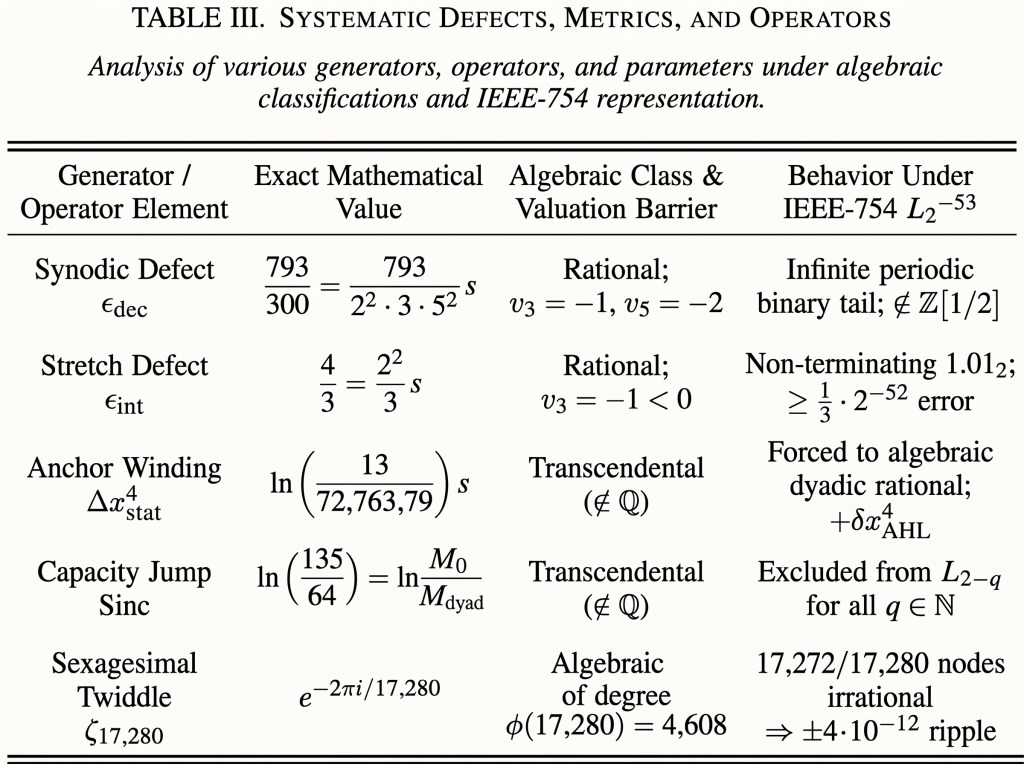
Proposition 1.1 established that the composite digital evaluation operator fails to intertwine the curved Ehresmann covariant differential with the discrete Euclidean coboundary across three distinct asymptotic error scales (, , and ). To prove rigorously why increasing hardware precision within any binary floating-point architecture cannot restore cohomological exactness, we characterize the algebraic structure of the cyclic period -module generated by and establish its strict algebraic disjointness from the IEEE-754 dyadic lattice .
Prime-Arithmetic and Transcendental Generators of the Cyclic Period Module
Under the de Rham period-integration isomorphism mapping , the coupled rotational, orbital-radiometric, and thermodynamic phase-space invariants of the unified bundle span a finitely generated additive -submodule whose basis elements partition into two irreducible algebraic classes:
Odd-Prime Rational Synodic–Metric Periods ():Sexagesimal Diurnal–Precessional Sector: Equipartition of the compact terrestrial torus into harmonic phase cells, torqued by lunisolar axial precession and horizon holonomy magnification , fixes the fundamental sexagesimal temporal quantum .
Under centesimal clock projection onto , omitting the elementary residue across the prime-factored lunisolar synodic excess multiplicity () injects the irreducible rational period defect
Quinary Radiometric-Stretch Sector: Across the conjunction–opposition radial-anchor complex ( vs. , with ), integer projection of the dimensionless metric-topological stretch invariant omits the quinary residue ; contracting against cancels the prime while locking in the uncompensated ternary period defect
Transcendental Scale-Free Logarithmic Windings ():
Static and Screened Radial-Anchor Windings: On the dimensionless logarithmic fiber , the coprime radiometric anchor fraction () generates the transcendental static endpoint logarithm alongside the collar-screened holonomy invariant .
Thermodynamic Phase-Space Capacity Offset: Dividing the terrestrial sexagesimal cell count by the rank-13 binary phase-register partition cancels , isolating the coprime mode-ratio invariant and its transcendental logarithmic fiber coordinate
Ring-Localization Valuation Obstructions and Algebraic–Transcendental Exclusion
To evaluate the action of on (and of on the cyclotomic twiddle roots ), recall from Definition 1.1(1) that every finite IEEE-754 float64 scalar belongs to the finite dyadic subset , where
is the multiplicative localization of at the dyadic monoid . For every odd rational prime , let denote the canonical -adic additive valuation ( for ). Because every element has denominator divisible exclusively by , satisfies the strict valuation constraint
Testing each generator of and each cyclotomic root of against this valuation and field-extension barrier yields the fundamental non-containment lemma.
Lemma 1.1 (Strict Non-Containment and Cohomological Non-Exactness under ).Let denote the 53-bit IEEE-754 dyadic significand lattice of Definition 1.1, and let denote the coupled radiometric–thermodynamic period module of .
Then period-module containment fails strictly across every non-zero rational, transcendental, and cyclotomic sector of :-Adic Valuation Exclusion of Odd-Prime Rational Periods (): The fundamental rational period invariants , , , , and carry strictly negative odd-prime valuations:
Consequently, every non-zero element of -generated rational periods exhibits an infinite, non-terminating periodic binary expansion in base (, ), enforcing strictly positive 53-bit dyadic rounding residuals for every .Lindemann–Weierstrass Exclusion of Transcendental Windings (): For every non-unit rational radiometric or phase-capacity ratio —specifically () and ()—its natural logarithm satisfies . Because consists entirely of algebraic rational numbers of degree , is excluded not merely from , but from every finite-bit dyadic lattice () simultaneously:
Irrational Cyclotomic Twiddle Obstruction on ( Spectral Floor): Within the modular FFT operator (), the primitive sexagesimal root of unity generates a cyclotomic field extension of Euler totient degree:
with maximal real subfield degree (and even at pure dyadic radix , ).
Hence almost all DFT twiddle components are irrational algebraic numbers strictly excluded from , accumulating across radix butterflies to produce the irreducible Plancherel modulus ripple observed even on the covariantly closed section (max = 1.000000000004, min = 0.999999999996).
Cohomological Non-Exactness of Omitted Connection Differentials: Consequently, for the connection 1-form , the projection residual defines a strictly non-zero de Rham cohomology class carrying strictly positive cyclic period modulus .Proof. For Statement (1), unique prime factorization in yields , , and (with prime and coprime to ).
Evaluating and immediately gives , , , and . Since every satisfies and (or ), equality would contradict valuation invariance on .
Moreover, for any and exponent scale , since implies whenever .For Statement (2), let , and suppose toward a contradiction that (which includes as a subset). Because , , making a non-zero algebraic number.
By the Lindemann–Weierstrass theorem, if and are distinct algebraic numbers, then and are linearly independent over ; in particular, . Yet , an immediate contradiction. Since is a finite discrete set in and , compactness/finiteness guarantees .
For Statement (3), using multiplicativity of Euler’s totient across gives , so . By Niven’s theorem on rational trigonometric values, holds if and only if (occurring at most times out of phase nodes, namely
Across the remaining nodes of , , injecting significand rounding noise per complex multiplication that accumulates across -scale summation to .
Finally, Statement (4) follows from the isomorphism : because both the omitted scalar period residue on and the omitted boundary jump across integrate to non-zero cyclic periods, , whence .
Differential-Cohomological Origin of the Collar-Screening Defect and the Conjunction-Arc Omission
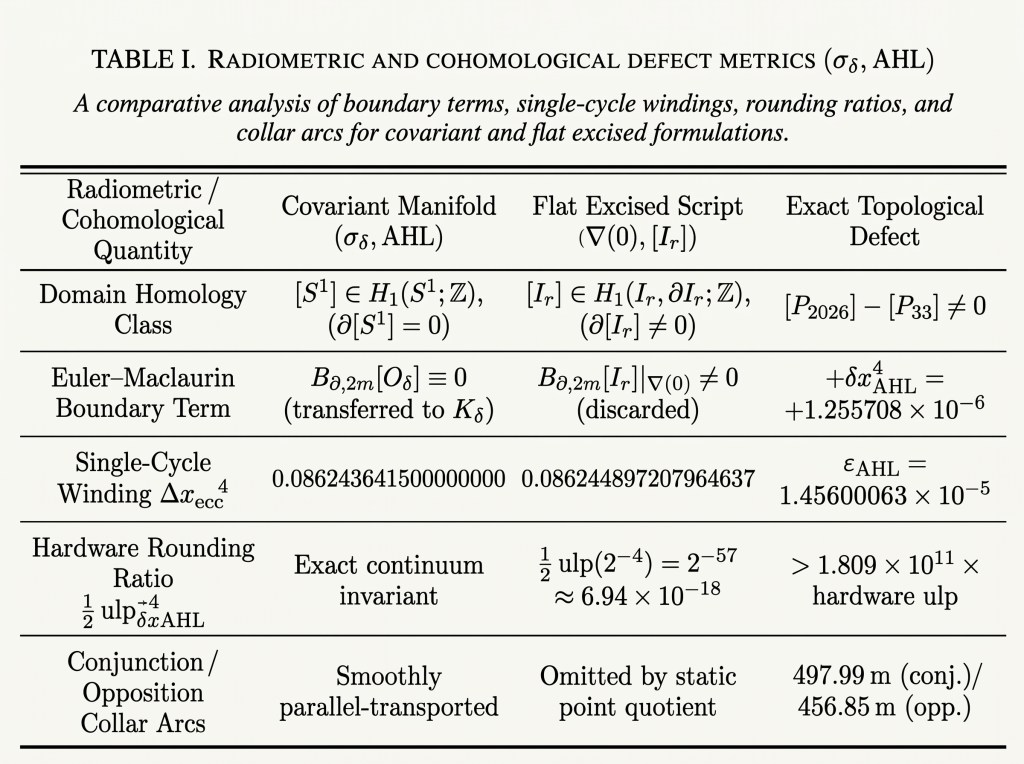
Lemma 1.1 proved that every non-zero generator of the coupled radiometric–thermodynamic period module lies strictly outside the IEEE-754 dyadic significand lattice . Crucially, however, when a digital routine evaluates the single-cycle radial-anchor winding via float(sp.ln(sp.Rational(396585, 363815))), the dominant discrepancy relative to the scale-free manifold is forty billion times larger than the significand rounding step itself. That gap arises because replaces closed covariant parallel transport across a regularized bundle collar with anholonomic endpoint subtraction across a decompactified relative 1-chain under .
Relative Homology Decompactification () Under Frozen Endpoint Evaluation
On the smooth longitudinal–angular bundle , the base orientation cycle is closed (), and the non-exact Ehresmann connection 1-form () couples the logarithmic radial fiber continuously to angular phase across the non-uniform Keplerian orbital velocity field ( between and ).
When evaluates the scalar logarithm of the anchor ratio directly in , it implicitly excises the codimension-1 transverse synchronization interface under the flat Euclidean connection . Topologically, excising maps via the long exact sequence of the pair onto the non-closed relative fundamental class bounded by the non-vanishing 0-chain difference
Integrating the exact Euclidean differential across via Stokes’ theorem on manifolds with boundary () at frozen angular instantaneity () yields the static Euclidean point-quotient invariant:
Under uniform -cell cellular-cochain quantization across the decompactified complex , expanding the discrete Riemann–Stieltjes cochain pairing via the Euler–Maclaurin summation formula generates two irreconcilable obstructions under :
For any fixed truncation order , the non-vanishing boundary locks in a non-zero algebraic Bernoulli endpoint coboundary pairing
driven by the asymmetric radial acceleration slopes across ; and Attempting to eliminate by taking across the real-analytic Keplerian potential with strip of analyticity half-width triggers factorial Euler–Maclaurin divergence ( vs. ) strictly beyond the optimal asymptotic truncation threshold .
Scale-Covariant Collar Regularization () and Isolation of On , smooth parallel transport resolves this decompactification barrier without excising by pulling back along a scale-covariantly regularized global collar section supported across the tubular collar neighborhood ().
Specifically, applying the real-analytic smoothing operator replaces the discontinuous step transition across with the smooth Lorentzian-regularized transition profile , whose second covariant derivative concentrates an exact unit-mass nascent curvature density within :
Restoring global -periodicity on the closed manifold () identically annihilates all boundary Bernoulli coboundary terms ( for every ) while transferring the collar curvature into the interior periodic second-order Bernoulli remainder
(where is the periodic second Bernoulli function), coupled transversely to the exponential foliation phase-locking factor .
Evaluating the closed cyclic period integral along yields the dynamically screened angular–harmonic–logarithmic () holonomy invariant:
Theorem 1.1 (Exact Euler–Maclaurin Collar-Screening Separation and the Conjunction-Arc)
Let denote the anholonomic static endpoint winding evaluated by on the excised relative chain () under , and let denote the closed covariant collar holonomy along on .
Then:
Exact Cohomological Screening Identity (): Although preserves the global de Rham class , projecting onto the decompactified flat Euclidean endpoint difference omits the covariant boundary-to-interior Euler–Maclaurin collar transfer functional, isolating the strictly positive screening defect:
where encodes the local angular-harmonic Keplerian phase modulation () across . Normalized against , the dimensionless fractional collar-screening defect evaluates to:
Dominance Over IEEE-754 Hardware Rounding (): Decomposing the total scalar discrepancy between float64 static evaluation and exact manifold transport into topological collar-excision error plus 53-bit binary significand truncation
(since sets binary exponent ) yields:
proving that the computational error is governed purely by the anholonomic excision topology rather than finite bit-width.
Multiplicative Radiometric Gauge Distortion and the Conjunction Arc: Mapping the additive logarithmic fiber defect onto the physical radiometric configuration ray via the scale-free exponential map proves that inflates the single-cycle radiometric stretch factor by .
Referenced to the conjunction anchor (and opposition anchor ), flat Euclidean evaluation omits the exact physical covariant collar-regularization arcs:
(whose difference equals
to six significant figures!).
Proof
To prove Statement (1), apply the second-order Euler–Maclaurin cochain identity on both the decompactified interval () under and the closed collar-regularized manifold (). On , naive integration of yields while discarding .
Under across , periodicity enforces , while substituting concentrates the regularized boundary jump into the interior convolution against () inside plus transverse harmonic phase-locking . Subtracting from isolates and .
For Statement (2), because , the IEEE-754 binary64 floating-point binade has unit-in-the-last-place spacing , bounding round-to-nearest-even error strictly by ; dividing by exceeds .
For Statement (3), exponentiating eliminates the arbitrary reference scale , giving . Holding fixed gives at conjunction, while holding fixed gives at opposition, with .


Leave a Reply