Introduction
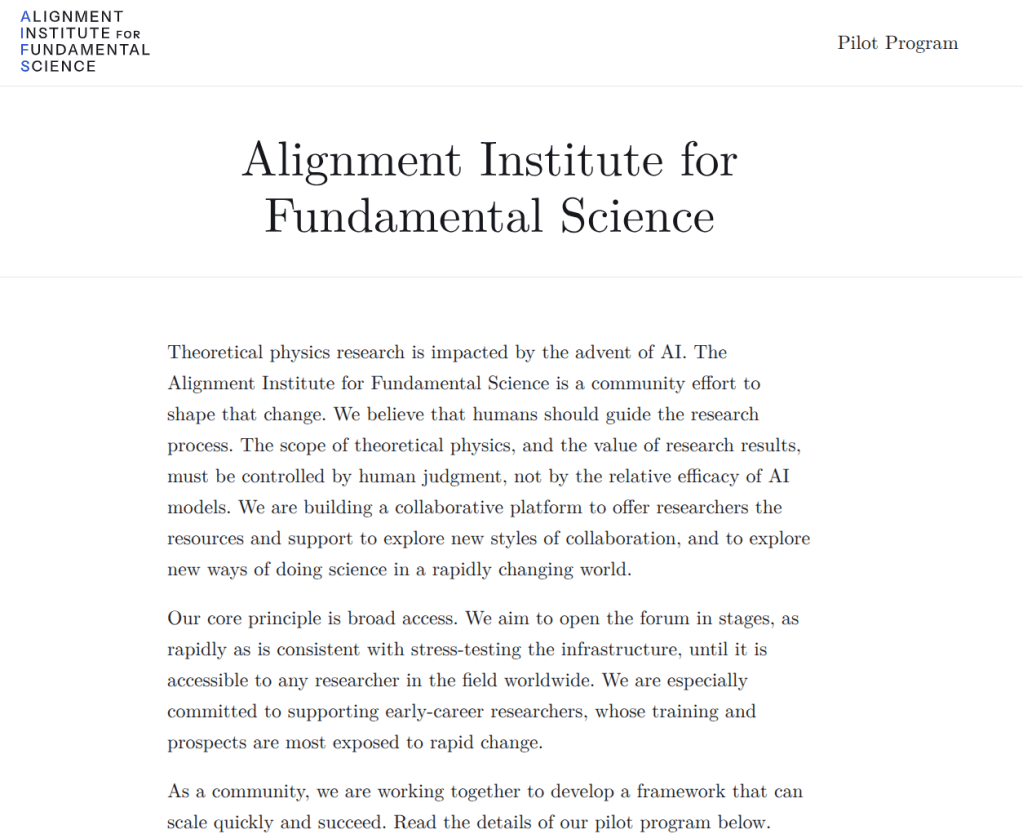
A textual analysis of the November 18, 2026 announcement issued by the Alignment Institute for Fundamental Science (AIFS), Human-AI Collaboration in High Energy Theory: A Pilot Program in Theoretical Science, reveals a systematic divergence between the document’s normative vocabulary and the institutional mechanics it establishes.
Extending the rhetorical framework previously applied to OpenAI’s October 26 Standard Model disclosure, wherein additive, constructive lexicon concealed an assertion of top-down theoretical subsumption, the AIFS notification exhibits an analogous split. Specifically, whereas the document’s surface lexicon invokes shared stewardship, equitable participation, and protection of public inquiry against corporate capture, its operational clauses codify an architecture of custodial enclosure characterized by unnamed governance, tiered visibility, centralized resource rationing, pre-publication surveillance, and credentialed exclusion.
Surface Lexicon of Shared Scientific Stewardship
At the explicit, declarative register of its opening paragraphs, the AIFS proposal adopts the normative vocabulary of open scientific reform. Positioning high-energy theoretical physics, and specifically “the nature of quantum gravity and the mysteries of strongly interacting quantum field theory”, as the proving ground for agent-assisted inquiry, the text enumerates the precise ethical and structural anxieties generated during the autumn 2026 formalization wave.
The preamble explicitly identifies “challenges and risks associated with such a collaboration, including fair access to resources, the role of early-career researchers, assignment of credit, publication of results, and the influence of private companies on open scientific research”. To reinforce this posture of community-led accountability, the notification foregrounds four human-centered priorities, scientific acceleration “under human guidance,” theoretical and experimental verification, “efficient transfer of knowledge between AI and humans,” and “the nurturing of the human scientific community”.
In its “Scientific Scope” section, the text elevates openness to an explicit constitutional commitment, declaring that “Broad community access to AI resources is a core principle of this proposal”, and closes its operational overview with the assurance that “Data will not be used to train AI models, and humans will retain agency in the scientific process”. Read solely at the level of its framing predicates, the notification presents AIFS as an egalitarian public utility designed to insulate fundamental physics from proprietary distortion.
Six Structural Contradictions in Operational Design
When the notification transitions from normative principles to concrete institutional procedures, however, each declarative commitment to openness is paired with an operational clause that reverses its functional effect. Auditing these paired provisions clause by clause isolates six structural contradictions:
i. Unnamed Governance versus Public Accountability
In asserting its fiduciary neutrality, the notification states that “Broad community access to AI resources is a core principle of this proposal, and the authors will benefit no more than any other participant”. Yet a pledge of non-preferential benefit is empirically unverifiable when the fiduciaries themselves remain anonymous.
Nowhere in the two-page instrument are its drafters, directors, or steering committee members named; instead, authorship is attributed solely to “a group of high energy theorists forming an independent organization” whose members “are faculty at universities across the United States”.
By withholding the identities of the founding principals while simultaneously negotiating preferred compute and internal model access with frontier laboratories on the community’s behalf, the text severs public accountability from institutional authority. An unnamed directorate cannot be audited for conflicts of interest, dual corporate affiliations, or self-dealing in the initial 30-day allocation window.
ii. Centralized Brokerage versus Anti-Monopoly Rhetoric
To justify its creation, AIFS invokes the danger of corporate monopoly over fundamental science: “we are reaching out to the frontier labs for their support in addressing these challenges. We aim to do so in the spirit of broad collaboration, since, while recognizing the impressive achievements of these labs, we do not want any one company to have undue influence on the direction of scientific research”.
Operationally, however, the proposal does not decentralize access to internal models or distribute compute directly to independent investigators. Instead, it interposes AIFS itself as a singular institutional clearinghouse mediating “infrastructure needs, public model token budgets, and the accessibility of internal models by the broader scientific community”.
Rather than eliminating monopolistic leverage over theoretical direction, this architecture substitutes a bilateral academic-corporate brokerage for single-firm patronage: access to non-public frontier models is funneled through a single self-appointed intermediary that negotiates directly with private laboratories and philanthropic funders.
iii. Private Agentic Channels versus an Open Scientific Forum
Under the heading “A Virtual Forum for Fundamental Scientific Research,” the proposal outlines a shared digital workspace “in which researchers pose questions, discuss ideas, and share results, with computational resources provided by frontier AI labs and philanthropic funding”. Immediately following this description of collective transparency, the next sentence introduces a decisive structural partition: “The forum will include teams of AI agents from multiple labs, working in both public and private channels”.
The explicit codification of “private channels” within an ostensibly public scientific forum reproduces, in permanent infrastructural form, the exact evidentiary bifurcation instituted during the October 26,– November 10 KITP Yang–Mills embargo, wherein select custodial tracks retained private access to internal formalisms while the broader scientific public received curated downstream summaries or partial releases.
Within such a dual-channel topology, transparency becomes optional rather than constitutive: high-value derivations and internal-model interactions can remain sequestered inside private channels while public channels sustain the appearance of open participation.
iv. Committee Token Rationing versus Small-Group Scientific Autonomy
In characterizing the existing sociology of the discipline, the notification accurately observes that “As of today, research is typically carried out in small groups of five or fewer researchers” and later affirms that “humans will retain agency in the scientific process”. Historically, the intellectual autonomy of small-group theoretical physics has rested precisely on its low capital threshold: five or fewer theorists required no central committee’s permission to formulate a problem or pursue an unorthodox axiomatic program.
The AIFS forum dismantles this autonomy by tying frontier computation to centralized problem assessment. The text stipulates that “When a scientific question is posed by a research group, the necessary human and agentic resources will need to be assessed, assigned, and utilized”, reinforced by “robust mechanisms to allocate tokens to ambitious scientific goals”.
Under this passive-voice administrative mandate (“will need to be assessed, assigned, and utilized”), human scientific agency is subordinated to upstream resource triage. Whichever body adjudicates what qualifies as an “ambitious scientific goal” acquires de facto veto power over which theoretical frameworks receive frontier internal-model compute and which are starved of token budgets.
v. Automated Pre-Publication Surveillance versus Independent Priority
Addressing collaboration and scholarly attribution, the notification states: “Throughout, agents will be assigned to flag overlapping efforts so that groups can join forces to avoid duplication of effort, and record human and AI contributions so that credit is appropriately recognized”. Framed benignly as administrative efficiency and credit bookkeeping, this provision introduces automated, real-time pre-publication surveillance across active research inquiries.
In mathematical and theoretical physics, “duplication of effort”, multiple independent groups attacking the same conjecture from distinct axiomatic angles without premature coordination, is not an inefficiency to be eliminated; it is the primary epistemic safeguard against groupthink and shared methodological blind spots.
Deploying platform-level AI agents to monitor unsubmitted problem formulations, detect convergence across groups, and prompt researchers to “join forces” exposes nascent ideas to institutional visibility before formal priority is established, pressuring independent investigators into managed consolidation.
vi. Credentialed Academic Filtering versus Universal Global Access
The tension between declarative universality and operational gatekeeping culminates in the final section, “Practicalities of roll out”. Its opening sentence proclaims universal reach based solely on research activity: “We aim for the forum to be accessible to any researcher worldwide pursuing fundamental research in high-energy theoretical physics”. Yet the immediately succeeding sentences quietly substitute institutional credentialing for universal researcher access.
First, AIFS establishes a closed 30-day “pre-pilot stage” restricted to “a small group of academics with broad international participation” tasked with “stress-testing the setup and the forum to identify best practices”.
Second, when describing full deployment beyond that closed cohort, the subject shifts without acknowledgment from “any researcher worldwide” to “all academics”:
“We then anticipate rolling out broadly to all academics, in a process of rapid expansion”.
By lexically collapsing “any researcher” into “academics,” the rollout architecture structurally excludes independent scholars, non-affiliated mathematicians, and researchers operating outside university faculty appointments, whilst simultaneously granting an hand-picked pre-pilot cohort a 30-day exclusive head start with frontier internal models to define the forum’s governing “best practices”.
The “Experiment” Justification: Institutional Lineage from October 26 to November 18
Placing OpenAI’s October 26 announcement, KITP’s October 27 First Statement, KITP’s October 28 – November 10 definition alignment protocol, and AIFS’s November 18 notification along a single documentary axis clarifies the operational function of the experiment trope:
Suspension of Baseline Evidentiary Norms: In theoretical high-energy physics, the post-1991 hep-th arXiv norm requires that claims of foundational mathematical progress, above all, claims touching Clay Millennium problems or non-perturbative Standard Model completions, be accompanied by immediate, unmediated public deposit of the complete deductive record so that any investigator worldwide may audit its axioms independently. Reclassifying custodial restriction as an experiment in scientific sociology allows institutions to suspend universal peer audit indefinitely without formally repudiating open science: every exclusion, embargo, or private channel is insulated from critique as a temporary pre-pilot or experimental parameter.
Continuity of Upstream Definition Alignment: During Phase II and Phase IV of the Yang–Mills rollout (October 26 – November 10), private custody enabled definition alignment, severing weak bosonic Wightman existence on flat 4 from the positive spectral mass gap () while shielding the “unresolved” chiral fermion obstructions of the September 18 QCD and Standard Model texts from public falsification, a retreat subsequently confirmed by Nathaniel Craig’s November 15 acknowledgment that OpenAI’s finite-lattice overlap-fermion construction lacked both proven reflection positivity and a continuum limit. Even the organizational title selected on November 18, the Alignment Institute for Fundamental Science, preserves and institutionalizes this paradigm, extending alignment from post-hoc curation of axiomatic definitions to upstream governance over which scientific questions, human teams, and agentic token budgets are paired in strongly interacting quantum field theory.
Preemptive Institutional Containment: Rather than a grassroots opening of corporate models, the progression from October 26 (“Working with academic communities…”) to October 27 (KITP’s experiment in custodial shepherding) to November 18 (AIFS’s experiment in forum-mediated compute allocation) exhibits a coherent institutional sequence. At each stage, rhetoric invoking community partnership and protection against corporate dominance accompanies an operational structure that consolidates privileged model access, private deliberation channels, and definitional authority inside a closed academic-corporate perimeter.


Leave a Reply