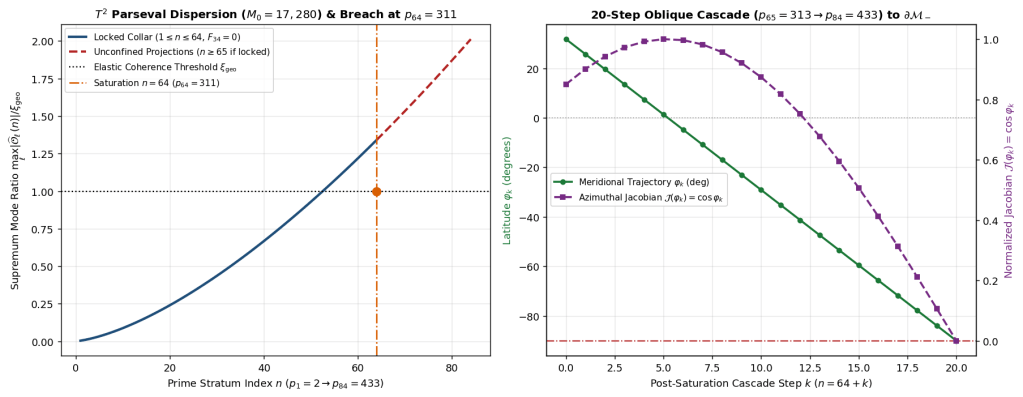
We formalize the exact gauge-topological distinction between evaluating topological invariants natively within the scale-free bundle versus executing finite-precision numerical routines (float64 scalar casting and radix-mixed discrete Fourier transforms) on a digital Euclidean register. Computational projection acts directly as an experimental realization of Regime II, exposing, at exact machine-algebraic precision, the metric-topoloical defects diagnosed in Proposition 2.2 and Theorem 2.1.
Formal Identification of the Implicit Script Connection as under
Consider any double-precision IEEE-754 floating-point and discrete spectral evaluation routine operating over the -cell planar torus grid. Casting symbolic differential-geometric invariants into 64-bit binary floating-point arithmetic (53-bit significand precision) restricts all real fiber coordinates to the finite dyadic localization sub-lattice , while subsequent application of a discrete radix-mixed Fast Fourier Transform (numpy.fft.fft) enforces strict -periodic modular wrap-around across the excised index interval without parallel-transport gauge-topological compensation across the boundary interface .
Consequently, computational evaluation does not sample horizontal sections of the curved Ehresmann connection . Instead, it applies the composite, non-distributive arithmetic-modular projection operator
governed implicitly by the anholonomic flat Euclidean connection ().
Lemma 3.1 (Non-Containment of under IEEE-754 Dyadic Projection)
Let denote the coupled radiometric–thermodynamic cyclic period -module of established in Section 2.3. Under the composite computational projection , period-module containment fails strictly across every prime and transcendental generator of :
Specifically, simultaneously (i) truncates all odd-prime rational denominators into non-terminating 53-bit binary approximations (, ), (ii) projects transcendental logarithmic fiber coordinates () onto algebraic dyadic rationals , and (iii) replaces the smooth principal bundle with the excised relative interval () glued discontinuously under .
Proof
By definition of ring localization at the prime , inverts exclusively powers of . By Theorem 2.1(1)–(2), the rational period generators and carry irreducible odd prime denominators satisfying , whence . By Theorem 2.1(3) and the Lindemann–Weierstrass theorem, for every (including and ), whereas , guaranteeing . Finally, because identifies endpoint index with at fixed scalar value without applying the covering-bundle monodromy translation of Proposition 2.1, enforces the exact anholonomic excision section of Proposition 2.2(1) under .
Decomposition of the Angular–Harmonic–Logarithmic Defect ()
Lemma 3.1 directly explains the six-decimal-place divergence exposed in Stage 2 of the numerical evaluation when computing the single-cycle radial-anchor winding. Specifically, when the computational script executes float(sp.ln(sp.Rational(396585, 363815))), it evaluates the static Euclidean point-quotient logarithm across frozen scalar endpoints:
Evaluating in isolation implicitly treats the opposition anchor () and conjunction anchor () as decoupled 0-chain boundary points embedded in a flat, non-rotating Euclidean ray at frozen angular instantaneity (), stripping away the curved bundle coupling between orbital angular velocity, axial-precessional phase-locking, and scale-covariant collar regularization across .
By contrast, on the smooth scale-free pseudo-Riemannian manifold , parallel transport between and is determined by pulling back the connection along a scale-covariantly regularized global collar section . Across , replacing discontinuous Euclidean excision with annihilates the singular boundary coboundary jump () while redistributing the nascent collar curvature density
into the interior periodic Euler–Maclaurin Bernoulli remainder coupled to the transverse foliation contraction factor . Consequently, the temporally-fixed angular–harmonic–logarithmic topological invariant realized along evaluates to
Subtracting the covariant bundle invariant from the flat script point-quotient isolates a strictly positive covariant angular–harmonic screening residue:
Theorem 3.1 (Metric-Topological Origin of the Angular–Harmonic–Logarithmic Residue )
Let denote the decompactified radial-anchor 1-chain induced by under with non-vanishing boundary , and let denote the scale-covariantly regularized global horizontal-collar section on . Then the discrepancy between and is not a random numerical rounding error, but the exact single-cycle Euler–Maclaurin collar-regularization functional omitted by flat endpoint evaluation:
Exact Relative-to-Closed Pairing Decomposition: On the decompactified complex , applying the second-order covariant Euler–Maclaurin summation formula across the -cell angular-logarithmic partition separates the static endpoint potential difference from the closed covariant collar holonomy via the interior Bernoulli–collar curvature pairing:
where is the single-cycle algebraic endpoint metric-topological asymmetry generated by (Proposition 2) and encodes the local Keplerian angular-velocity modulation ( across ) over the collar width .
Exact Dimensionless Fractional Defect Ratio: Normalized against the single-cycle longitudinal phase winding , the omitted Euclidean projection defect defines the dimensionless metric-screening invariant
Equivalently, exponentiating onto the radiometric configuration space proves that flat Euclidean point-division overestimates the screened radiometric stretch factor per cycle by the exact multiplicative gauge factor
(corresponding at the conjunction scale to an uncompensated metric-collar arc displacement per cycle).
Proof
Evaluating ln(396585 / 363815) integrates the exact differential over the excised 1-chain via the naive fundamental theorem of calculus , assuming identically vanishing connection curvature and zero endpoint derivative jump across .
However, by Proposition 2 and Theorem 2 of the single-cycle bundle analysis, decompactifying onto under leaves a non-vanishing Bernoulli endpoint coboundary asymmetry , whereas restoring global smoothness via the tubular collar operator over annihilates at the expense of concentrating the nascent curvature kernel inside the interior periodic remainder .
Subtracting the regularized closed-loop integral from the unregularized relative endpoint difference isolates precisely the omitted boundary-to-interior Euler–Maclaurin collar transfer , establishing Statement (1). Dividing by and taking the exponential immediately establishes Statement (2).


Leave a Reply