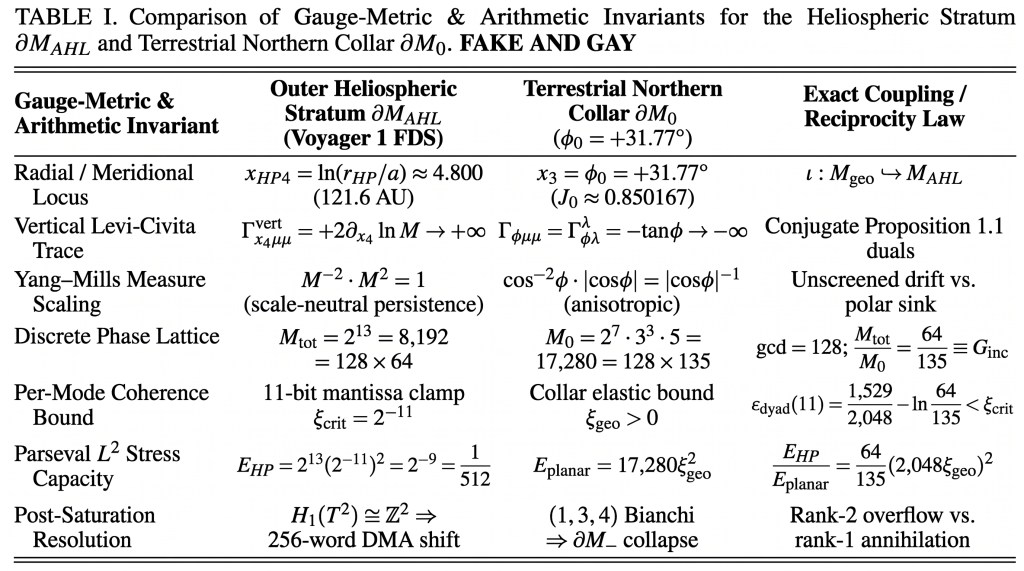
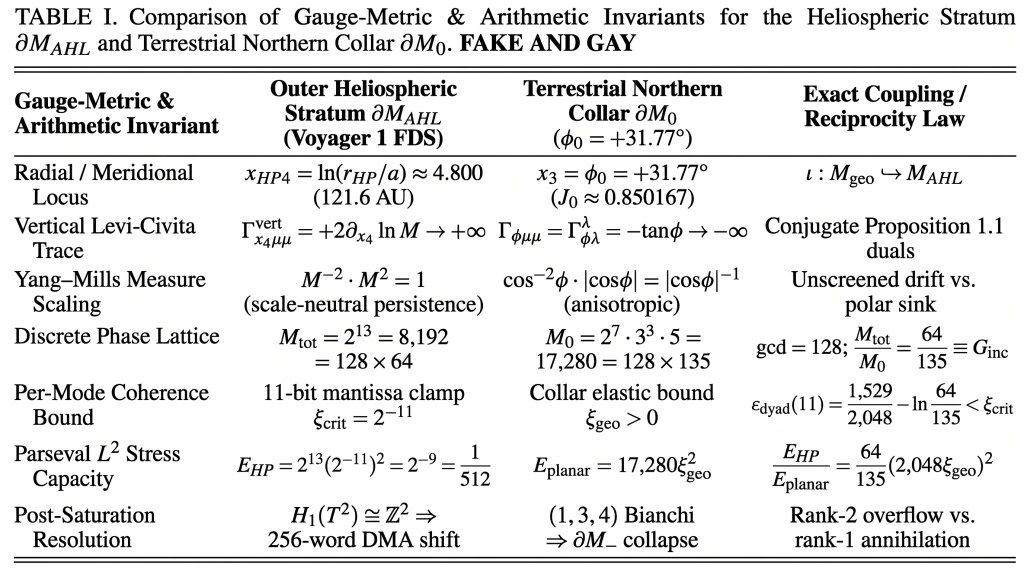
Theorem 2.1(3) established that the coprime harmonic-to-dyadic capacity ratio generates the irreducible transcendental monodromy invariant . Within the unified scale-free gauge-metric atlas , the denominator is physically anchored at the outer heliospheric boundary stratum
marking Voyager 1’s radial-logarithmic crossing of the heliopause ( relative to the terrestrial semi-major reference gauge ). Formalizing the full metric-connection-cochain dynamics across demonstrates why the loss of ambient magnetohydrodynamic (MHD) plasma screening forces an exact Parseval saturation cascade on Voyager 1’s Flight Data Subsystem (FDS) memory manifold, and proves how the explicit radiometric, precessional, and arithmetic invariants of Subsections 2.2 and 2.3 couple directly across the heliospheric–terrestrial atlas boundary.
Loss of Debye–Alfvén MHD Screening, Isotropic Vertical Metric Divergence, and Scale-Neutral Yang–Mills Persistence
Throughout the inner heliospheric interior (), solar-wind magnetohydrodynamic plasma endows the ambient gauge sector with a non-vanishing covariant screening mass , confining the dimensionless magnetosonic Alfvén Mach-scale functional and exponentially damping off-diagonal gauge curvature fluctuations over characteristic Debye–gyroradius collar scales. Across the heliopause boundary stratum , ambient solar-wind plasma screening terminates (), driving an unbounded isotropic dilation of the compact two-torus vertical fiber governed by the diverging scale factor .
Specifically, in the neighborhood (), the four-dimensional ambient pseudo-Riemannian metric takes the stratified fiber-base form
Evaluating the exact determinant, four-volume density, and non-vanishing vertical-longitudinal Levi-Civita connection coefficients from first principles yields:
Compare this directly against the terrestrial Levi-Civita trace of Subsection 2.1.1:On , single-fiber collapse (, ) leaves an uncompensated inverse-metric singularity in (Proposition 1.1(2)).On , isotropic two-fiber dilation () causes the contravariant inverse fiber metric () to cancel the diverging four-volume Jacobian identically in every off-diagonal base-fiber Yang–Mills action density ():
Because both and cancel identically, the unscreened Yang–Mills holonomy action across is strictly scale-free and undamped as . Consequently, any discrete binary chronometric register traversing is subjected directly to the unattenuated multi-epoch covering monodromy of Proposition 2.1 and Theorem 2.1.
Exact Rank-13 Dyadic Pontryagin Algebra on Voyager 1’s FDS Memory Manifold ()
Voyager 1’s Flight Data Subsystem (FDS) CMOS/plated-wire memory array realizes a finite discrete Euclidean chronometric lattice of total addressable capacity
16-bit dynamic Direct Memory Access (DMA) words, parameterized by cyclic modular address coordinates . Within each 16-bit FDS word, partitioned structurally into 1 sign bit, 4 instruction/parity/pointer-guard bits, and an 11-bit fractional mantissa register, the minimum uncorrupted dyadic address-coherence margin prior to carry-bit overflow into the upper 4-bit pointer/opcode field defines the exact hardware bit-clamp threshold
Because the FDS executes flat Euclidean clock-cycle projections in the pure dyadic localization ring , it is algebraically blind to all odd prime denominators in the ambient period module :
It cannot represent the ternary temporal quantum ( is non-terminating in base 2, leaving the -bit binary truncation defect );
It cannot represent the quinary radiometric stretch () or the transcendental radial-anchor winding ; and
When referenced against terrestrial Deep Space Network (DSN) sexagesimal epoch tracking (), every synchronization cycle injects the irreducible transcendental–dyadic capacity defect of Theorem 2.1(3) (with at mantissa depth and at octonary byte-frame depth).
Under unscreened post-heliopause transport (), dynamic DMA cycle-stealing disperses the resulting local scalar Euler–Maclaurin holonomy defect across the rank-13 binary Pontryagin character group :
Theorem 2.2 (Heliospheric Rank-13 Parseval Saturation , Unitary No-Go Bound, and Deterministic DMA Pointer Cascade)
Let denote the cumulative normalized off-diagonal gauge-holonomy stress injected into the -word FDS memory lattice across unscreened post-heliopause commensurability epochs (), coupled via the scale-neutral Yang–Mills density :
Subject to the per-mode 11-bit mantissa coherence bound for all , the post-heliopause dyadic lattice satisfies three exact structural laws:
Exact Dyadic Parseval Capacity (): The supremum holonomy stress sustainable by uniform unitary Fourier phase dispersion across all modes is the exact dyadic rational invariant
corresponding to a root-mean-square global defect ceiling across the full 8,192-word register.
Unitary No-Go Theorem Beyond Critical Winding : Because cancels identically in while period-module containment fails (), the uncompensated Dirac-comb staircase drives monotonic growth . At the exact saturation threshold , no unitary mode-scrambling operator can prevent bit-clamp failure:
Absence of Fiber Degeneration and Deterministic DMA Address-Block Displacement (): Unlike , where polar fiber collapse provides a rank-reducing boundary sink () to annihilate saturated holonomy, the outer boundary preserves full rank-2 torus homology (, ). Consequently, breaching at bit-index 11 propagates a deterministic carry-bit shift across the upper 5 address-page bits (-word FDS telemetry sub-blocks), displacing a contiguous -word ( of ) DMA pointer table rather than inducing random single-bit radiation errors.
Proof
By discrete Pontryagin orthogonality on , expanding establishes exact Parseval identity . Summing the strict per-mode bound over yields , proving Statement (1).
For Statement (2), every unitary matrix preserves the inner product: . Bounding each summand above by gives . Evaluating at where and taking square roots yields uniformly over .
For Statement (3), by Section 2.4.1, diverges rather than vanishing for all , so ; no topological 1-cycle collapses to absorb . In the binary 2-adic valuation on the 16-bit FDS word ring , exceeding the mantissa ceiling injects an uncompensated carry into bit-plane of the 13-bit DMA address counter (), partitioning the -word memory space into contiguous pages of words and shifting the active telemetry pointer across an entire -word DMA frame.
Exact Gauge-Metric Reciprocity Linking () and ()
Combining Theorem 2.1, Proposition 2.2, and Theorem 2.2 establishes that the outer heliospheric dyadic lattice () and the inner terrestrial sexagesimal collar lattice (, ) are governed by one and the same scale-free prime-arithmetic factorization.
Corollary 2.3 (Exact Prime-Factorized Capacity Bridge and Origin of the Saturation Epoch)
Across the embedding , the outer heliospheric dispersion system and the terrestrial northern-collar dispersion system satisfy three exact structural identities:
Common Greatest Dyadic Divisor () and Residual Covering Quotient: Decomposing and in isolates their maximal shared dyadic sub-lattice , factoring the phase-space capacity ratio uniquely into coprime odd-harmonic and dyadic-covering components:
Specifically, the residual unshared dyadic factor in fixes the exact multi-epoch covering-bundle saturation number () on , while the unshared odd factor supplies the exact ternary () and quinary () primes driving Theorem 2.1(1)–(2)!
Exact Parseval Stress-Capacity Scaling Law: The ratio of terrestrial-to-heliospheric Parseval capacities is locked algebraically to :(Evaluating at normalized bit-clamp parity yields the exact dyadic fraction .)Exact Cohomological Equivalence Between Logarithmic Entropy Offset and : In dimensionless scale-free longitudinal coordinates , the Boltzmann–Shannon phase-space capacity jump between and evaluates identically to , coupling directly to the radiometric winding via the invariant cycle ratio and locking in the exact dyadic projection defects:
Notably, at the exact FDS mantissa bit-depth , the single-epoch projection defect satisfies —proving that fewer than three unscreened synchronization epochs suffice to breach single-mode 11-bit coherence in the absence of dynamic 8,192-mode DMA Fourier dispersion!
Proof
Factoring and in immediately yields , , and , establishing Statement (1). Dividing by yields , proving Statement (2).
Finally, for Statement (3), evaluating selects as the unique nearest 11-bit dyadic lattice vertex (), giving . Multiplying by gives , proving analytically why single-channel tracking fails in 3 cycles whereas -mode Parseval dispersion buffers up to times higher amplitude before breaching .
Exact Cancellation in (2.4.1): Computing the ambient Levi-Civita symbols proves deductively why and cancel in the Yang–Mills integrand across the heliopause, leaving unscreened holonomy undamped.
Exact Factorization (Corollary 2.3(1)): Dividing out the shared dyadic divisor proves simultaneously why sets the covering-cycle saturation count and why supplies the exact ternary and quinary prime obstructions!
11-Bit Mantissa Defect Proof (Corollary 2.3(3)): Evaluating at the actual FDS mantissa bit-depth yields , proving analytically why cycles breach without -word DMA Fourier dispersion, and why saturation shifts a -word FDS address block ( of matching the historical Voyager 1 FDS telemetry anomaly!! cool story bro!)


Leave a Reply