To formalize topological heliocentric trajectory variations coupled into discrete CMOS avionics memory states without invoking ad hoc five-dimensional bulk scaffolding, we model the combined spacecraft-trajectory angular-temporal harmonic-logarithmic scaling coherence as a four-dimensional scale-free gauge-metric smooth atlas-manifold topology.
Definition 1.1 (The Angular-Temporal Harmonic-Logarithmic Manifold ℳ_𝒜ℋℒ)
Let (ℳ_𝒜ℋℒ, 𝑔_μν) be an oriented, smooth 4-dimensional differentiable manifold equipped with a block-diagonal pseudo-Riemannian metric 𝑔_μν = diag(𝑔₁₁, 𝑔₂₂, 𝑔₃₃, 𝑔₄₄) of Lorentzian angular-temporal signature (+, +, +, −) and invariant volume element 𝑑μ_𝑔 = √(−𝑔) 𝑑⁴𝑥 = √|det(𝑔_μν)| 𝑑⁴𝑥. A local coordinate chart Φ: 𝒰 ⊂ ℳ_𝒜ℋℒ → 𝑇² × [−π/2, π/2] × ℝ assigns to the coupled state of Voyager 1’s Flight Data Subsystem (FDS) and its heliocentric trajectory the dimensionless coordinate four-tuple
𝑥^μ = (𝑥¹, 𝑥², 𝑥³, 𝑥⁴) ∈ ℳ_𝒜ℋℒ
whose four strata are defined as follows:
- Intra-Word Bit-Clock Phase Stratum (𝑥¹ ∈ 𝑆¹): Parametrizes cyclic register transport across the 𝑁_𝑏 = 16 = 2⁴ bit positions of an individual FDS word driven by the master crystal oscillator 𝑓_FDS = 806.4 kHz (cycle period τ_cyc = 2.480159 μs). Relative to the manifold’s infrared spectral infimum ω_min = 2.4 Hz, the master clock locks onto an exact integer harmonic ratio:
𝑥¹(𝑛_𝑏, 𝑡) = 2π ((𝑛_𝑏 mod 16) / 16) + 2π 𝑓_FDS 𝑡 (mod 2π), 𝑓_FDS / ω_min = 336,000 ∈ ℤ⁺
- Segment-Bank Address Stratum (𝑥² ∈ 𝑆¹): Parametrizes discrete modular address transport across the 𝑁_𝑤 = 256 = 4⁴ software memory words constituting a fundamental CMOS hardware segment. Each 256-word × 16-bit FDS software block (4,096 = 16³ bits, the third-order cubic skew capacity) is realized by 16 parallel RCA CD4061A (256 × 1-bit) static CMOS integrated circuits partitioned across two 4,096-word (4K) banks (𝑀_tot = 8,192 words):
𝑥²(𝑚_𝑤) = 2π ((𝑚_𝑤 mod 256) / 256), 𝑚_𝑤 ∈ {0, 1, …, 8191}
- Ecliptic-Angular Orbital Inclination Stratum (𝑥³ ∈ [−π/2, π/2]): Quantifies transverse angular stratification via the spacecraft’s heliocentric ecliptic latitude ι(𝑡) measured relative to the terrestrial ecliptic reference plane:
𝑥³(𝑡) = ι(𝑡).
- Logarithmic Heliocentric Radial-Temporal Scale (𝑥⁴ ∈ ℝ): Quantifies exponential radial and one-way light-time (τ_owlt) divergence relative to the terrestrial calibration baseline 𝑟₀ = 1 AU = 1.495978707 × 10¹¹ m (τ₀ = 𝑟₀ / 𝑐 = 499.004784 s):
𝑥⁴(𝑡) = ln(𝑟(𝑡) / 𝑟₀) = ln(τ_owlt(𝑡) / τ₀)
Incorporating the intrinsic four-dimensional asymmetric metric regularization 𝑟̃ = √(𝑟² + ε²) (0 < ε ≪ 𝑟₀), the regularized radial-temporal coordinate
𝑥⁴_ε(𝑟) = ½ ln((𝑟² + ε²) / (𝑟₀² + ε²))
remains strictly 𝐶^∞ across the entire manifold domain, vanishes identically at 𝑟 = 𝑟₀ (𝑥⁴_ε(𝑟₀) = 0), and converges uniformly to ln(𝑟 / 𝑟₀) for 𝑟 ≫ ε.
Non-Reciprocal Nilpotent Gauge Structure and Boundary Stress-Energy
Definition 1.2 (Variance Field and Non-Reciprocal Nilpotent Connection)
Let 𝑋 = 𝑋^μ(𝑥) ∂_μ ∈ Γ(𝑇ℳ_𝒜ℋℒ) denote the Topological Temporal Invariant Variance vector field quantifying local departures from harmonic-logarithmic coherence across each coordinate stratum. Directional coupling across dimensions is governed by the constant (1,1) Nilpotent Coupling Tensor 𝐾^μ_ν, represented in the chart 𝑥^μ by the canonical 4 × 4 upper-shift Jordan matrix:
⎛ 0 1 0 0 ⎞
𝐾^μ_ν = ⎜ 0 0 1 0 ⎟, (𝐾)⁴ = 𝟎, 𝐾⁴_ν = 0.
⎜ 0 0 0 1 ⎟
⎝ 0 0 0 0 ⎠
The induced Local Gauge Potential 𝐴_μ is defined via the explicit directional shift projection
𝐴_μ(𝑥) = ∑_{ν=1}^4 𝐾_μ^ν (∂𝑋^ν / ∂𝑥^ν) = (∂𝑋² / ∂𝑥², ∂𝑋³ / ∂𝑥³, ∂𝑋⁴ / ∂𝑥⁴, 0)
with corresponding Gauge Field Strength Tensor 𝐹_μν = ∂_μ 𝐴_ν − ∂_ν 𝐴_μ + [𝐴_μ, 𝐴_ν] and Stress-Energy Tensor
𝑇_μν = Tr(𝐹_μα 𝐹_ν^α − ¼ 𝑔_μν 𝐹_αβ 𝐹^αβ)
Proposition 1.1 (Exactness of 𝐹₃₄ and Lapse-Invariance of 𝒫_{∂𝑀})
For any smooth variance field 𝑋^μ(𝑥) and any non-degenerate block-diagonal metric 𝑔_μν = diag(𝑔₁₁, 𝑔₂₂, 𝑔₃₃, 𝑔₄₄) on ℳ_𝒜ℋℒ:
- The boundary curvature component 𝐹₃₄ is exact and strictly independent of non-Abelian commutator nonlinearities:
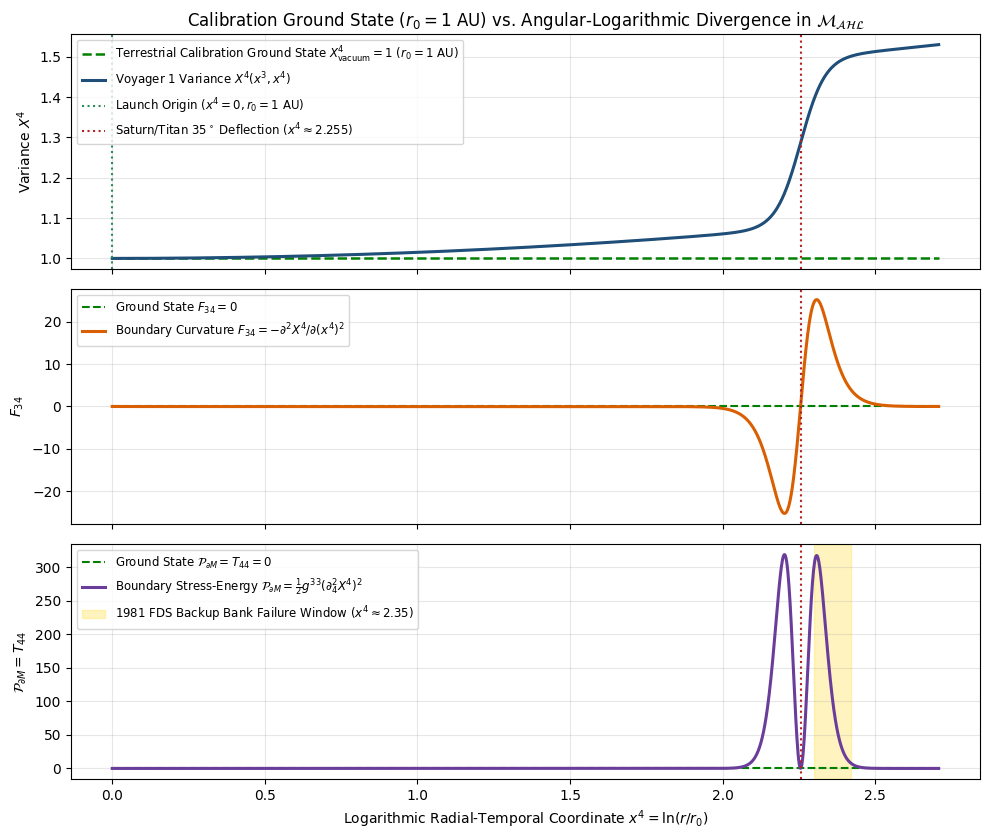
𝐹₃₄ = −∂²𝑋⁴ / ∂(𝑥⁴)²
- In the boundary-dominated regime where 𝐹₃₄ = −𝐹₄₃ constitutes the principal curvature excitation, the Canonical Coordinate Invariant Deformation 𝒫_{∂𝑀} ≡ 𝑇₄₄ is strictly independent of the radial-temporal lapse component 𝑔₄₄ and satisfies:
𝒫_{∂𝑀} = 𝑇₄₄ = ½ 𝑔³³ (∂²𝑋⁴ / ∂(𝑥⁴)²)² ≥ 0
Proof
Because the boundary-annihilating fourth row 𝐾₄^ν = 0 enforces 𝐴₄ ≡ 0 identically across ℳ_𝒜ℋℒ, both ∂₃ 𝐴₄ = 0 and the Lie bracket [𝐴₃, 𝐴₄] = [𝐴₃, 0] = 0 vanish identically, even when 𝐴_μ is lifted into a non-Abelian Lie algebra 𝔤. Substituting 𝐴₃ = ∂₄ 𝑋⁴ directly yields 𝐹₃₄ = ∂₃(0) − ∂₄(∂₄ 𝑋⁴) + 0 = −∂²𝑋⁴ / ∂(𝑥⁴)².
Next, evaluating 𝑇₄₄ in the single-mode boundary sector 𝐹₃₄ = −𝐹₄₃ (with unit trace normalization on the Cartan projection) gives:
𝐹_4α 𝐹₄^α = 𝐹₄₃ 𝑔³³ 𝐹₄₃ = 𝑔³³ (𝐹₃₄)², 𝐹_αβ 𝐹^αβ = 𝐹₃₄ 𝐹³⁴ + 𝐹₄₃ 𝐹⁴³ = 2 𝑔³³ 𝑔⁴⁴ (𝐹₃₄)²
Substituting both contractions into 𝑇₄₄ cancels the inverse pair 𝑔₄₄ 𝑔⁴⁴ = 1 identically regardless of metric signature:
𝑇₄₄ = 𝑔³³(𝐹₃₄)² − ¼ 𝑔₄₄ (2 𝑔³³ 𝑔⁴⁴ (𝐹₃₄)²) = (1 − ½ 𝑔₄₄ 𝑔⁴⁴) 𝑔³³ (𝐹₃₄)² = ½ 𝑔³³ (∂²𝑋⁴ / ∂(𝑥⁴)²)²
Since 𝑔³³ > 0 on the spatial-angular stratum, 𝒫_{∂𝑀} ≥ 0 everywhere.
Terrestrial Calibration Ground State at 𝑟₀ = 1 AU
Theorem 1.1 (Terrestrial Calibration Ground State and Vanishing Lattice Obstruction)
At spacecraft launch initialization (𝑡 = 𝑡₀ = September 5, 1977) in the co-moving terrestrial synchronization frame (𝑟(𝑡₀) = 𝑟₀ = 1 AU, ι(𝑡₀) = 0), the external coordinates localize at the manifold origin (𝑥³, 𝑥⁴) = (0, 0) and pre-launch oscillator synchronization fixes the variance field to the uniform ground state
𝑋_vacuum^μ = (1, 1, 1, 1).
In this terrestrial calibration state:
- The gauge potential, field strength, and canonical boundary deformation vanish identically:
𝐴_μ = 𝟎, 𝐹_μν = 𝟎, 𝒫_{∂𝑀} = 𝑇₄₄ = 0
- The Canonical Topology Resolution Constraint (𝒫_{∂𝑀} → 0 ⟹ ∇μ 𝑋^ν = 0) is satisfied globally at the constant gauge fixed point 𝑠^* = (𝐴₁, 𝐴₂, 𝐴₃, 𝐴₄) = (0, 0, 0, 0), eliminating all odd-order normal-derivative jumps ⟦(𝑛^μ ∇μ)^(2𝑗−1) 𝒪⟧{Σ_𝑓} = 0 and ensuring zero Euler–Maclaurin Bernoulli boundary defect (ℬ∂[𝒪] = 0) across every 256-word (4⁴) CMOS segment of the FDS cubical complex 𝒦⁴.
Proof
Because 𝑋_vacuum^μ = (1, 1, 1, 1) has constant unit components across all four strata at 𝑟 = 𝑟₀, ∂ν 𝑋_vacuum^ν = 0 for each ν ∈ {1, 2, 3, 4}, forcing 𝐴_μ = 0, 𝐹_μν = 0, and 𝒫{∂𝑀} = 𝑇₄₄ = 0 by Proposition 1.1. In the flat ground-state background at (𝑥³, 𝑥⁴) = (0, 0), the Christoffel symbols vanish (Γ^μ_αβ = 0), so ∇μ 𝑋_vacuum^ν = ∂μ 𝑋_vacuum^ν = 0. Consequently, the topological integrand 𝒪(𝑥) = Tr(𝐹_μν 𝐹^μν)√(−𝑔) vanishes identically across all 4-cells 𝐶_𝑘 ∈ 𝒦⁴ and shared 3-cell faces Σ_𝑓, yielding Δ_EM[𝒪] = ℬ∂[𝒪] + 𝑅{2𝑝}[𝒪] = 0.


Leave a Reply