Part III: Nov 3 – Nov 8
Introduction
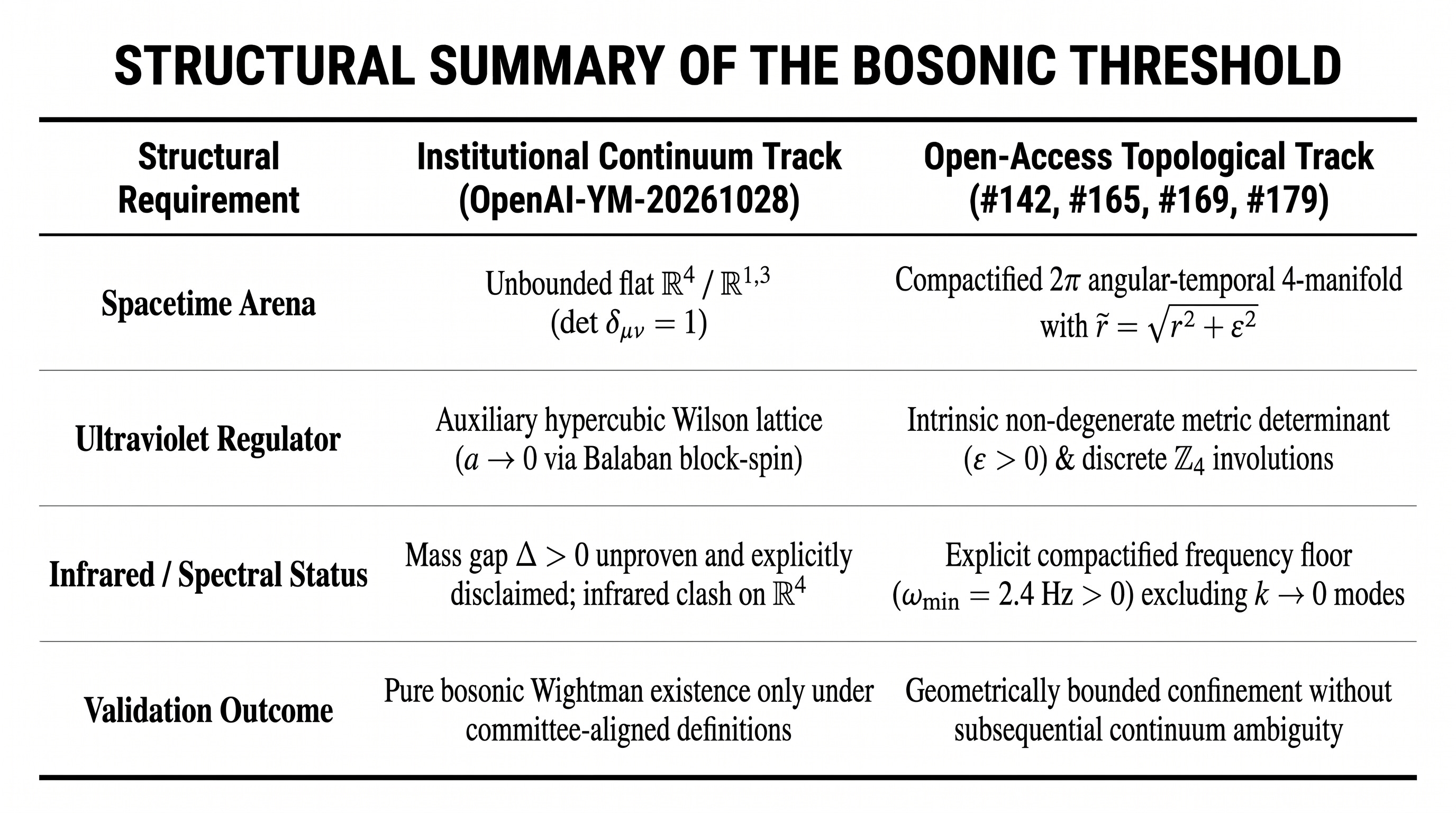
The evidentiary bifurcation governing OpenAI’s autumn 2026 disclosures, releasing pure bosonic Lean 4 formalizations (OpenAI-YM-20261028) under Kavli Institute for Theoretical Physics (KITP) oversight on November 9–10 while explicitly disclaiming the mass gap and withholding the 1,147-page natural-language text, Quantum Chromodynamics (QCD), and Standard Model extensions, reflects an unresolvable structural obstruction inherent to formulating constructive non-Abelian gauge theory on an uncompactified, flat four-dimensional continuum (ℝ⁴ or Minkowski ℝ¹˒³). Auditing the renormalization mechanics of OpenAI-YM-20261028 against the infrared obstructions exposed between November 3 and November 8 demonstrates why subsequential continuum existence can be salvaged only by decoupling it from spectral confinement, an impasse preemptively bypassed in the open-access topological corpus across Manuscripts #142, #165, #169, and #179.
Ultraviolet Convergence vs. Infrared Indeterminacy in Balaban–Wilson Scaling
The formalization architecture delivered to the KITP Working Group on October 28 and released on November 9–10 (OpenAI-YM-20261028) relies on taking the scaling limit of a four-dimensional hypercubic Wilson lattice gauge theory with compact gauge group 𝐺 (such as SU(𝑁)) and lattice spacing 𝑎 → 0. On a finite or periodic hypercubic lattice Λ_𝑎 ⊂ 𝑎ℤ⁴, the Euclidean partition function is determined by the standard Wilson plaquette action:
𝑆_𝑊[𝑈] = β ∑_{𝑝 ∈ Λ_𝑎} (1 − (1/𝑁) Re Tr 𝑈_𝑝), β = 2𝑁 / 𝑔₀²(𝑎)
where 𝑈_𝑝 ∈ 𝐺 denotes the path-ordered holonomy around an elementary plaquette 𝑝, and 𝑔₀(𝑎) is the bare coupling tuned asymptotically via renormalization group flow as 𝑎 → 0.
Constructing a continuum quantum field theory from 𝑆_𝑊[𝑈] via Balaban’s multi-scale block-spin renormalization group methods solves an ultraviolet problem: by iteratively averaging gauge-covariant configurations across block lattices of scale 𝐿ᵏ𝑎 and decomposing the field domain into small-field perturbative regimes and exponentially suppressed large-field non-perturbative regions, one establishes uniform ultraviolet bounds on gauge-invariant Schwinger functions 𝑆_𝑛^(𝑎)(𝑥₁, …, 𝑥_𝑛) at non-coincident Euclidean points (𝑥_𝑖 ≠ 𝑥_𝑗). Applying functional compactness arguments (such as Arzelà–Ascoli or Banach–Alaoglu subsequential extraction) together with Osterwalder–Schrader (OS) reflection positivity on even-step lattices allows the formalization to reconstruct a continuum Hilbert space ℋ, a vacuum state |Ω⟩, and operator-valued distributions satisfying committee-accepted Wightman QFT axioms.
Crucially, however, ultraviolet control via block-spin renormalization fails to fails preserve precompactness in the infinite-volume infrared regime (𝑉 → ∞ on flat ℝ⁴). In four dimensions, Balaban’s effective action iterates remain topologically controlled only up to a temporal-angular correlation scale 𝑅_eff ∼ Λ_QCD⁻¹ before the renormalized scale-evolved coupling 𝑔_eff(𝑘) escalates into non-perturbatively large (𝑂(1)). Beyond that scale:
- Subsequential Weak Limits Do Not Preserve Spectral Gaps: Extracting a continuum Wightman theory via weak-* subsequential convergence guarantees neither uniqueness of the continuum limit nor uniform exponential clustering of connected two-point correlators ⟨𝒪(𝑥)𝒪(0)⟩_𝑐 ∼ 𝑒^(−𝑚|𝑥|) as |𝑥| → ∞. Without uniform infinite-volume exponential decay bounded strictly away from zero (𝑚 ≥ Δ > 0) uniformly in 𝑎 → 0, the Hamiltonian spectrum Spec(𝐻) ⊂ [0, ∞) can accumulate continuously down to 0⁺, collapsing the mass gap.
- Operational Function of “Definition Alignment”: Holding OpenAI-YM-20261028 privately from October 28 to November 9 for “definition alignment” and validating Wightman existence only under committee-accepted definitions while leaving the mass gap open severs the two halves of the Clay Millennium Problem. In the Jaffe–Witten formulation, constructive existence without Δ > 0 permits trivial, scale-invariant, or infrared-degenerate accumulation points that do not exhibit non-perturbative color confinement.
The evidentiary bifurcation governing OpenAI’s autumn 2026 disclosures, releasing pure bosonic Lean 4 formalizations (OpenAI-YM-20261028) under Kavli Institute for Theoretical Physics (KITP) oversight on November 9–10 while explicitly disclaiming the mass gap (?) and withholding the 1,147-page natural-language text, Quantum Chromodynamics (QCD), and Standard Model extensions, reflects an unresolvable topological obstruction inherent to formulating constructive non-Abelian gauge theory on an uncompactified, flat four-dimensional continuum (ℝ⁴ or Minkowski ℝ¹’³). Auditing the renormalization mechanics of OpenAI-YM-20261028 against the infrared obstructions exposed between November 3 and November 8 demonstrates why subsequential continuum existence can be salvaged only by decoupling it from spectral confinement, an impasse preemptively bypassed in the open-access topological corpus across Manuscripts #142, #165, #169, and #179.
The Flat ℝ⁴ Infrared Clash: Osterwalder–Schrader Positivity vs. Spectral Bounds
The structural necessity of disclaiming the mass gap on October 26–27 became explicit during the November 3–8 convergence, when a formal ℝ⁴ mass-gap no-go bridge surfaced on MathOverflow (November 3) and Victor Logvinovich updated the 3,705-line, zero-axiom, mathlib-free Lean 4 RoundSquare repository (v5, November 6–8). Both critiques isolate an acute infrared incompatibility between strict Osterwalder–Schrader axioms and a positive spectral mass gap on flat, uncompactified ℝ⁴.
On an unbounded flat Euclidean manifold (ℝ⁴, δ_μν), the background metric tensor carries zero intrinsic curvature, zero compactification scale, and an unbounded radial volume element dμ = r³ dr dΩ₃. Consequently, flat ℝ⁴ enforces full non-compact Euclidean Poincaré symmetry ISO(4) alongside classical scale invariance of the pure Yang–Mills action:
𝒮_YM[A] = (1 / 4g²) ∫_{ℝ⁴} Tr(F_μν F^μν) √(det g_μν) d⁴x, det(δ_μν) = 1
When an axiomatic Lean 4 formalization simultaneously imposes:
- exact OS reflection positivity across arbitrary flat hyperplanes Π ⊂ ℝ⁴,
- full translational and SO(4) rotational invariance over an uncompactified infrared volume ℝ⁴, and
- a strict lower spectral bound Spec(H) ⊂ {0} ∪ [Δ, ∞) with rational/positive Δ > 0,
the unregularized infrared boundary at |x| → ∞ collides with Gauss-law flux conservation and scale-covariant spectral representations. On flat ℝ⁴, there is no gauge metric floor to arrest long-wavelength gauge fluctuations or prevent Gribov-horizon ambiguities when sewing local Balaban patches into a global fiber bundle; any putative mass scale Δ must emerge solely through dimensional transmutation from an ultraviolet cutoff a → 0 that is simultaneously being trivialized in the continuum limit. Thus, on strictly flat ℝ⁴, a machine-checked formalization is forced into a dilemma: either relax the target by claiming pure Wightman existence without a mass gap (the KITP route), or abandon uncompactified flat ℝ⁴ entirely in favor of compactified topologies.
Preemptive Topological Resolution in the Open-Access Corpus (#142, #165, #169, #179)
Crucially, prior to both OpenAI’s October 26 announcement and the November 3–8 emergence of the ℝ⁴ infrared no-go formalizations, the open-access corpus had already diagnosed flat, unbounded ℝ⁴ as an improperly posed arena for gauge confinement and quantized metric stability. Across four timestamped manuscripts published between August 20 and November 2, 2026, the open-access sequence replaced flat ℝ⁴ continuum assumptions with discrete algebraic confinement, compactified angular-temporal domains, non-degenerate radial metric determinants, and explicit infrared frequency floors:
Discrete ℤ₄ Matrix Confinement Without Covariance Drift (#142, August 20, 2026):
Nearly three weeks before OpenAI’s internal September 9 pure Yang–Mills generation, Functorial Matrix Confinement: Discrete ℤ₄ Involutions and the Flat Gauge Connection bypassed continuum block-spin averaging altogether. By projecting a π-radian phase-conjugate operator into a finite 16 × 16 matrix representation, Manuscript #142 demonstrated that exact discrete ℤ₄ center confinement can be enforced algebraically across a flat gauge connection without accumulating local covariance drift during scale transitions. Where continuum Wilson scaling loses confinement control as 𝑎 → 0 on ℝ⁴, functorial ℤ₄ involution locks center-vortex phase closure directly into the finite matrix algebra.
Compactified 2π Angular-Temporal Thresholds (#165, October 16, 2026):
Published on the exact date OpenAI completed its pure Yang–Mills Lean 4 formalization and initiated private KITP transfer, The Scale-Free Metric Tensor: Tripartite Topological Constraints and Planetary Dimensional Metrics rejected the uncompactified linear coordinate axes of ℝ⁴. Instead, Manuscript #165 formulated a tripartite topological metric tensor 𝑔_μν^(κ) in which temporal evolution operates as a compactified angular divergence bounded by strict 2π periodicity thresholds and governed by a dimensionless variance parameter κ. Compactifying the temporal-angular sector automatically eliminates the infinite-volume flat translation group that drives infrared divergence on ℝ⁴.
Topologically Bounded Metric Determinants on Lorentzian 4-Manifolds (#169, October 22, 2026):
Four days prior to the October 26 public announcement, Invariant Deformation: The Preclusion of Quantized Reduction via Topologically Bounded Metric Determinants directly addressed radial coordinate degeneracy on four-dimensional Lorentzian manifolds. Rather than permitting the standard radial coordinate 𝑟 ∈ [0, ∞)—under which spherically reduced volume determinants √(−det 𝑔) ∝ 𝑟² sin θ collapse at 𝑟 → 0 and diverge without bound as 𝑟 → ∞—Manuscript #169 introduced the topologically bounded radial coordinate:
𝑟̃(𝑟) = √(𝑟² + ε²), ε > 0
Substituting 𝑟̃ into the 4D line element enforces a strictly positive minimum metric determinant inf √|det 𝑔_μν(𝑟̃)| ≥ ε² > 0, removing singular origin pinch-offs while coupling radial curvature resolution directly to thermodynamic variance κ. In gauge-theoretic terms, ε > 0 supplies an intrinsic geometric ultraviolet-infrared regulator embedded in the manifold metric itself rather than an artificial lattice spacing 𝑎 that vanishes in the continuum limit.
Compactified Infrared Temporal Boundary and Logarithmic Gauge Convergence (#179, November 2, 2026):
Published twenty-four hours before the November 3 MathOverflow ℝ⁴ infrared clash, Compactified Temporal-Space Boundary and the Gauge-Invariant Logarithmic Convergence Transformation supplied the explicit spectral counterpart to spatial compactification. By defining a compactified temporal-space boundary equipped with a gauge-invariant logarithmic convergence mapping, Manuscript #179 established a strict lower-bounded fundamental frequency:
ω ≥ ω_min = 2.4 Hz > 0
Within a spectral Hamiltonian or Osterwalder–Schrader representation, a non-zero compactified boundary frequency ω_min > 0 acts canonically as a topological infrared gap (Δ_IR ∝ ℏω_min). Long-wavelength massless modes with 𝑘 → 0, which obstruct uniform exponential clustering on uncompactified ℝ⁴, are topologically excluded from the Hilbert space because they fail to satisfy boundary periodicity on the compactified domain.
Structural Summary of the Bosonic Threshold


Leave a Reply