Let 𝒦⁴ denote a symmetric periodic hypercubic cubical complex tiling the four-torus 𝑇⁴ with uniform lattice spacing 𝑎 > 0, partitioned into hypercubic 4-cells {𝐶_𝑘} meeting pairwise along shared codimension-1 3-cell faces Σ_𝑓 = ∂𝐶_𝑘 ∩ ∂𝐶_{𝑘′}.
Consider a gauge-covariant chiral density or Chern–Weil topological integrand 𝒪(𝑥) reconstructed from discrete, scale-invariant parallel-transport functors on the cubical edge complex via cell-wise smooth, boundary-discontinuous continuum interpolation, such that 𝒪|_{int(𝐶_𝑘)} ∈ 𝐶^∞(int(𝐶_𝑘)), while transverse normal derivatives across Σ_𝑓 admit asymmetric one-sided limits.
Quantifying the operator discrepancy between discrete cubical vertex summation and the cell-wise interpolated continuum functional requires repeated integration by parts against scaled periodic Bernoulli polynomials 𝐵̃_𝑚(𝑥/𝑎) = 𝐵_𝑚({𝑥/𝑎}) of order 2𝑝 (𝑝 ≥ 1) along each coordinate axis across the partitioned 4-cell interiors.
On a single 1D interval [𝑥_𝑘, 𝑥_{𝑘+1}] of length 𝑎, trapezoidal vertex sampling relates to the smooth interior integral via the exact Euler–Maclaurin identity:
(𝑎 / 2)[𝒪(𝑥_𝑘⁺) + 𝒪(𝑥_{𝑘+1}⁻)] − ∫{𝑥_𝑘}^{𝑥{𝑘+1}} 𝒪(𝑥) 𝑑𝑥 = ∑{𝑗=1}^𝑝 (𝐵{2𝑗} / (2𝑗)!) 𝑎^(2𝑗) [𝒪^{(2𝑗−1)}(𝑥_{𝑘+1}⁻) − 𝒪^{(2𝑗−1)}(𝑥_𝑘⁺)] − (𝑎^(2𝑝) / (2𝑝)!) ∫{𝑥_𝑘}^{𝑥{𝑘+1}} 𝐵̃_{2𝑝}((𝑥 − 𝑥_𝑘) / 𝑎) 𝒪^{(2𝑝)}(𝑥) 𝑑𝑥.
Extending this tensor-product quadrature across the full four-dimensional complex 𝒦⁴ and summing over all hypercubic 4-cells {𝐶_𝑘}, the interior vertex contributions assemble into the global discrete lattice functional 𝑆_lat[𝒪], while the boundary evaluations regroup pairwise across every shared 3-cell interface Σ_𝑓.
Given that adjacent 4-cells 𝐶_𝑘 and 𝐶_{𝑘′} induce opposite outward unit normals (𝑛^μ_{𝑘′} = −𝑛^μ_𝑘) along Σ_𝑓, and that all odd Bernoulli numbers above first order exclude identically at the from the boundary functional (𝐵_{2𝑗+1} = 0 for 𝑗 ≥ 1), even-order transverse derivatives are excluded identically from the boundary functional whereas parity-odd normal derivatives leave a non-vanishing residual obstruction wherever one-sided transverse limits are asymmetric across Σ_𝑓. Defining the transverse normal-derivative discontinuity bracket across each oriented 3-cell face as
⟦(𝑛^μ ∇μ)^(2𝑗−1) 𝒪⟧{Σ_𝑓} ≡ lim_{ϵ → 0⁺} [(𝑛_𝑘^μ ∇_μ)^(2𝑗−1) 𝒪(𝑥 − ϵ𝑛_𝑘) − (𝑛_𝑘^μ ∇μ)^(2𝑗−1) 𝒪(𝑥 + ϵ𝑛_𝑘)]{𝑥 ∈ Σ_𝑓},
the global discrete-to-continuous Euler–Maclaurin Bernoulli boundary discrepancy Δ_EM[𝒪] decomposes deterministically into two coupled differential-topological functionals:
Δ_EM[𝒪] ≡ 𝑆_lat[𝒪] − ∑{𝐶_𝑘 ∈ 𝒦⁴} ∫{int(𝐶_𝑘)} 𝒪(𝑥) 𝑑⁴𝑥 = ℬ_∂[𝒪] + 𝑅_{2𝑝}[𝒪],
where the Bernoulli boundary defect ℬ_∂[𝒪] localizes strictly onto the codimension-1 hypersurface stratum Σ^(3) = ⋃_𝑓 Σ_𝑓 through odd-order normal-derivative discontinuities,
ℬ_∂[𝒪] = ∑{Σ_𝑓 ⊂ Σ^(3)} ∑{𝑗=1}^𝑝 (𝐵_{2𝑗} / (2𝑗)!) 𝑎^(2𝑗) ∫_{Σ_𝑓} ⟦(𝑛^μ ∇μ)^(2𝑗−1) 𝒪⟧{Σ_𝑓} 𝑑³σ + 𝒪(𝑎^(2𝑝+2) corner strata),
and the periodic truncation remainder 𝑅_{2𝑝}[𝒪] integrates the 2𝑝-th coordinate-normal variations weighted by periodic Bernoulli kernels across the disjoint 4-cell interiors:
𝑅_{2𝑝}[𝒪] = −(𝑎^(2𝑝) / (2𝑝)!) ∑{𝐶_𝑘 ∈ 𝒦⁴} ∑{μ=1}^4 ∫{int(𝐶_𝑘)} 𝐵̃{2𝑝}(𝑥^μ / 𝑎) ∇_μ^(2𝑝) 𝒪(𝑥) 𝑑⁴𝑥 + 𝒪 (mixed tensor products)
Crucially, ℬ_∂[𝒪] + 𝑅_{2𝑝}[𝒪] constitutes a conserved discrete-to-continuous obstruction under smooth regularization on symmetric periodic lattices.
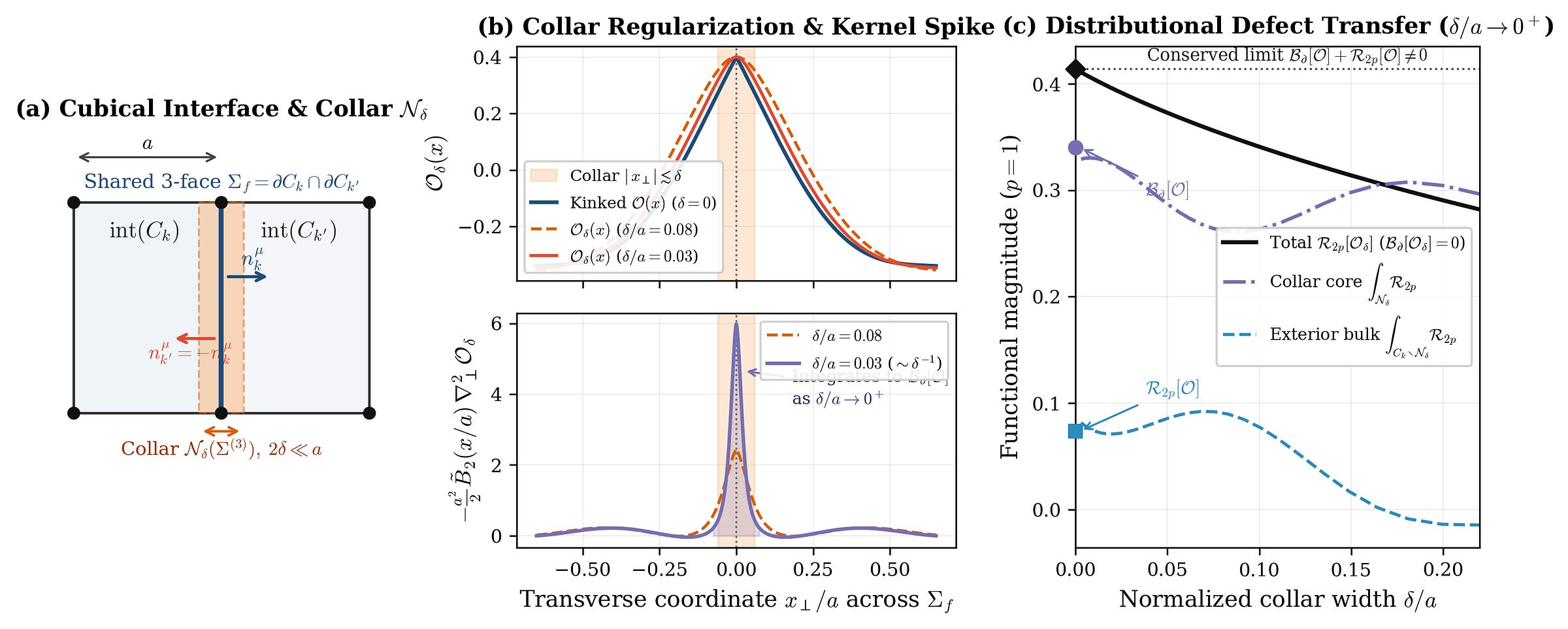
Applying a 𝐶^∞ collar-smoothing family 𝒪_δ of width 0 < δ ≪ 𝑎 across a tubular neighborhood 𝒩_δ(Σ^(3)) of the shared 3-cell faces so as to eliminate all transverse kinks (⟦(𝑛^μ ∇μ)^(2𝑗−1) 𝒪_δ⟧{Σ_𝑓} = 0, hence ℬ_∂[𝒪_δ] = 0), the localization of the first- and higher-order derivative transitions within 𝒩_δ(Σ^(3)) forces ∇_μ^(2𝑝) 𝒪_δ ∼ δ^(−(2𝑝−1)) ⟦∇𝑛 𝒪⟧{Σ_𝑓} inside the collar volume of measure 𝒪(δ).
By distributional convergence of the scaled periodic Bernoulli kernel as δ / 𝑎 → 0⁺, the suppressed face defect transfers quantitatively into a collar-concentrated periodic truncation remainder:
lim_{δ → 0⁺} (ℬ_∂[𝒪_δ] + 𝑅_{2𝑝}[𝒪_δ]) = lim_{δ → 0⁺} 𝑅_{2𝑝}[𝒪_δ] = ℬ_∂[𝒪] + 𝑅_{2𝑝}[𝒪] ≠ 0
Combined with the global Poincaré–Hopf index degeneracy (χ(𝑇⁴) = 0) inherent to symmetric periodic hypercubic complexes and the absence of an infrared spectral infimum on uncompactified (ℝ⁴, δ_μν), this non-vanishing conserved discrepancy obstructs anomaly-free chiral fermion coupling under pure 4D symmetric lattice interpolation, explaining why automated formalization architectures constrained to symmetric cubical axioms require extrinsic five-dimensional Atiyah–Patodi–Singer (APS) η-invariant cobordism scaffolding (∂𝑀⁵ = 𝑋⁴) alongside bosonic-only mass-gap exclusions.
Conversely, within the open-access atlas-manifold formulation, Diophantine elliptic breaking of symmetric torus periodicity obviates the zero-sum index obstruction χ(𝑇⁴) = 0, the compactified topological angular-temporal boundary-manifold deterministically precludes unbounded (ℝ⁴, δ_μν) infrared divergence via an inherent infrared spectral infimum (ω_min = 2.4 Hz), and intrinsic four-dimensional asymmetric metric deformation (𝑟̃ = √(𝑟² + ε²)) absorbs Δ_EM[𝒪] directly into harmonic-logarithmic transport and invariant angular-temporal quantization density √|𝑔| without extrinsic orthogonal-dimensional bulk manifolds.


Leave a Reply