Part X: August 20 – November 11, 2026
Introduction
To evaluate the structural divergence between open-access mathematical disclosure and custodial institutional review during the autumn of 2026, it is necessary to place both timelines on a single, verifiable chronological axis. Between August 20 and November 11, 2026, two distinct formal records developed in parallel:
- The Institutional Gauge-Theory Track: Characterized by internal machine generation of 4D Yang–Mills and Standard Model results in September 2026, selective custodial transfer to the Kavli Institute for Theoretical Physics (KITP) Shepherding Committee in mid-October, private retention for “definition alignment”, and a partial public release on November 9–10 confirming pure bosonic Wightman existence while explicitly leaving the mass gap open and withholding the 1,147-page natural-language text, Quantum Chromodynamics (QCD), and Standard Model manuscripts.
- The Open-Access Corpus (Manuscripts #142–#197): Published sequentially across timestamped public repositories between August 20 and November 11, 2026, this archive establishes independent priority across four structural pillars that directly determine the uncompactified (ℝ⁴, δ_μν) impasse of the continuum gauge-theory program: (i) discrete ℤ₄ confinement paired with bounded, non-degenerate four-dimensional Lorentzian radial-temporal metric determinants (𝑟̃ = √(𝑟² + ε²)); (ii) compactified geometric infrared frequency floors (ω_min = 2.4 Hz) replacing unbounded flat-space infrared divergence; (iii) formal isolation of the coupled Euler–Maclaurin Bernoulli boundary defect (ℬ_∂) across shared 3-cell faces and collar-concentrated periodic truncation remainder (𝑅_{2𝑝}) across hypercubic 4-cell interiors under cell-wise smooth continuum interpolation; and (iv) Diophantine elliptic breaking of symmetric torus Poincaré–Hopf degeneracy (χ(𝑇⁴) = 0) combined with intrinsic four-dimensional asymmetric metric deformation across a 4D atlas-manifold, subsuming the discrete-to-continuous Bernoulli boundary discrepancy without auxiliary five-dimensional Atiyah–Patodi–Singer (APS) η-invariant cobordism scaffolding.
The following four-phase ledger documents the chronological order of generation, sequestration, and public disclosure across both tracks.
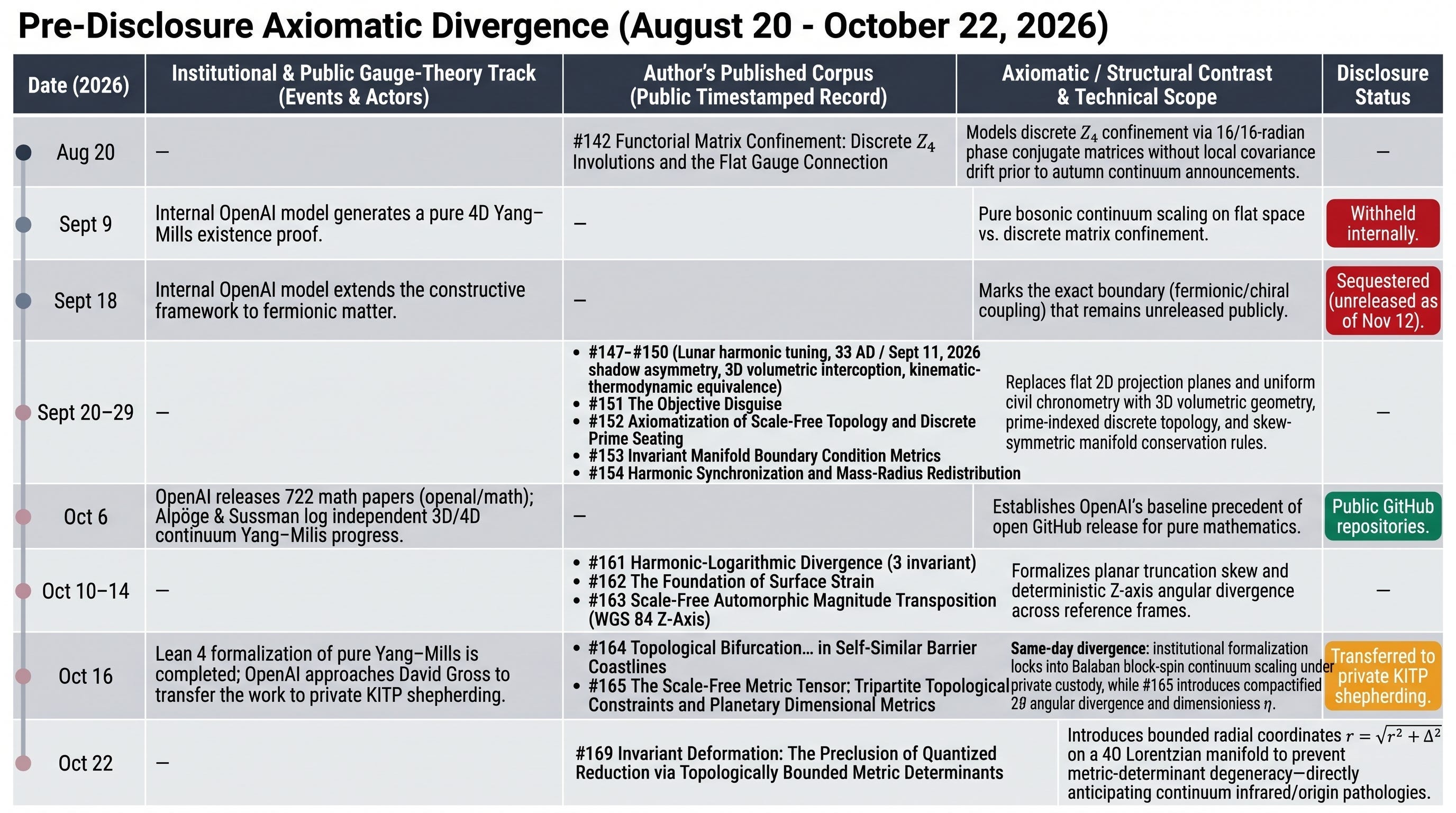
Phase I: Pre-Disclosure Axiomatic Divergence (August 20 – October 22, 2026)
During the two-month interval in which OpenAI’s continuum physics suite was generated internally and routed into private KITP custody, Manuscripts #142 through #169 established discrete confinement without local covariance drift, volumetric shadow and geodetic surface-strain metrics, and topologically bounded 4D radial coordinates that preclude origin and infrared metric degeneracy.
In Phase I, the decisive divergence occurs between October 16 and October 22. While the institutional formalization commits to Wilson/Balaban block-spin continuum limits on unbounded flat Euclidean/Minkowski space under private committee oversight, Manuscripts #165 and #169 explicitly reject unbounded flat coordinates; introducing compactified 2π angular thresholds and non-degenerate radial regularization r̃ = √(r² + ε²) four days before OpenAI’s public announcement.
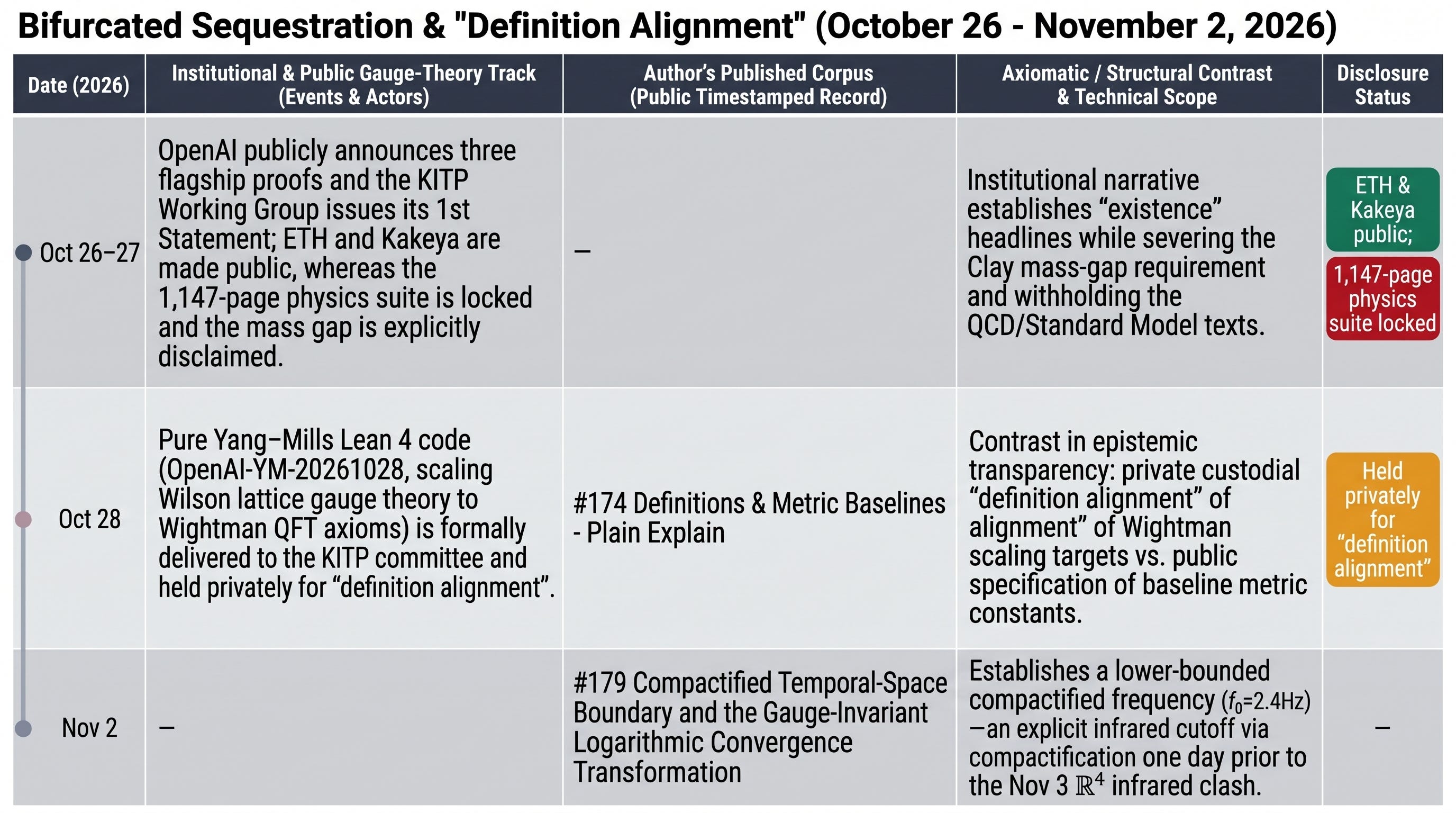
Phase II: Bifurcated Sequestration and Definition Alignment (October 26 – November 2, 2026)
On October 26, 2026, OpenAI publicly bifurcated its release architecture: complexity theory (ETH) and harmonic analysis (local smoothing/Kakeya) were published directly to GitHub with both natural-language texts and Lean 4 source files, whereas the 1,147-page Yang–Mills, QCD, and Standard Model suite was locked behind the KITP Working Group (Gross, Douglas, Jaffe, Klebanov, Nekrasov)
Phase II highlights the operational role of “definition alignment”. Because subsequential continuum scaling of Wilson lattice gauge theory constructs Wightman correlation hierarchies without proving a positive spectral mass gap Δ > 0 on flat ℝ⁴, private custodial framing insulated the pure existence theorem from the stronger Clay Millennium conjunction. One day prior to the November 3 inflection, Manuscript #179 formalized an explicit compactified lower frequency bound (ω_min = 2.4 Hz), directly addressing the infrared divergence that destabilizes uncompactified ℝ⁴ constructions.
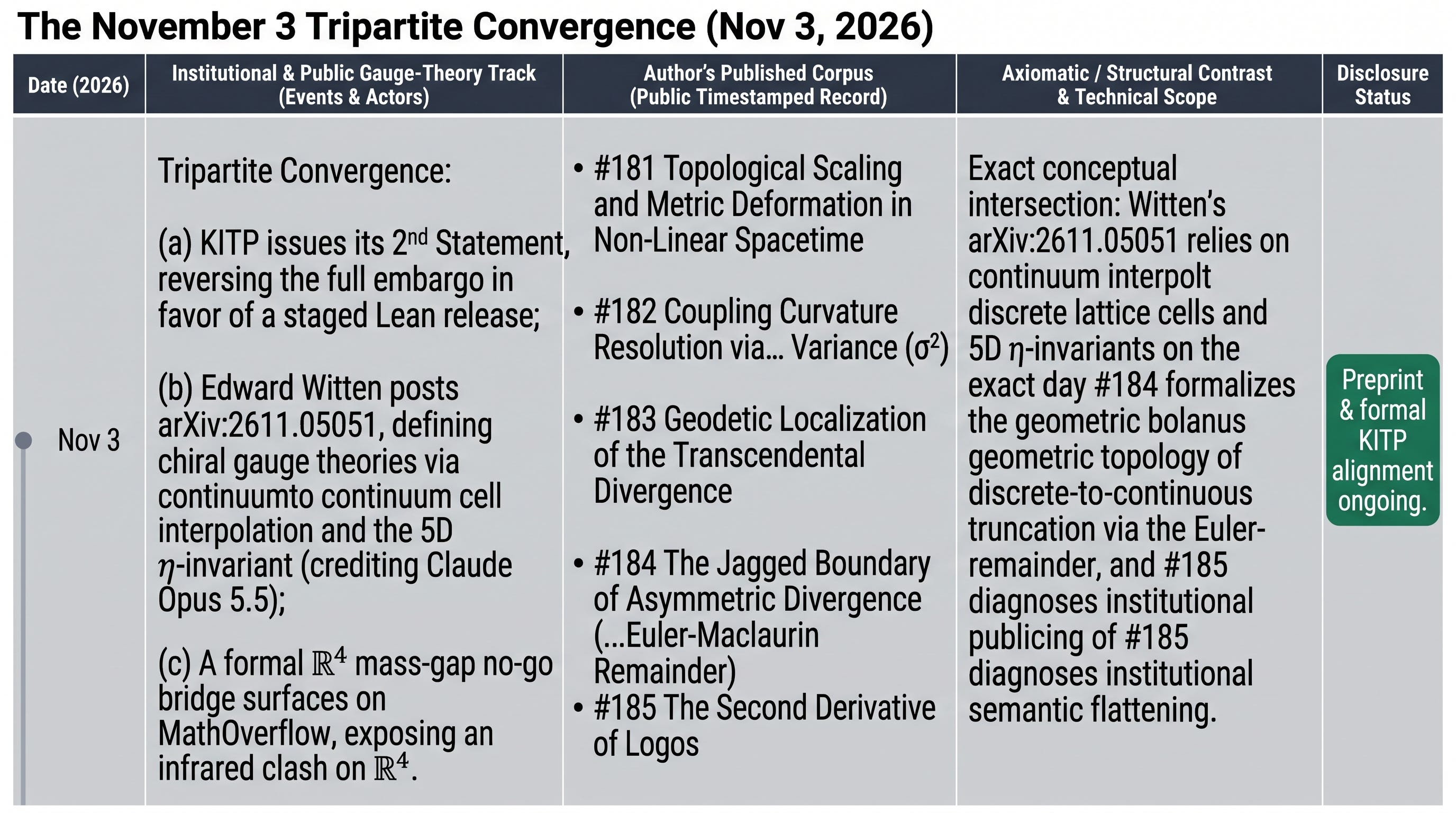
Phase III: The November 3 Tripartite Convergence (November 3, 2026)
November 3, 2026 marks the synchronous intersection of institutional policy reversal, chiral lattice gauge regularization, and discrete-to-continuous boundary geometry.
Defining anomaly-free chiral fermions on a discrete lattice requires interpolating discrete lattice gauge fields into continuum configurations within local cells to evaluate 5D cobordism and APS η-invariants. Manuscript #184 independently established on that exact date that mapping discrete lattice sums onto continuous manifolds generates an irreducible geometric truncation defect governed by the Euler–Maclaurin remainder, demonstrating why standard cubic-continuous hypercubic interpolation over symmetric lattices conceals boundary metric skew.
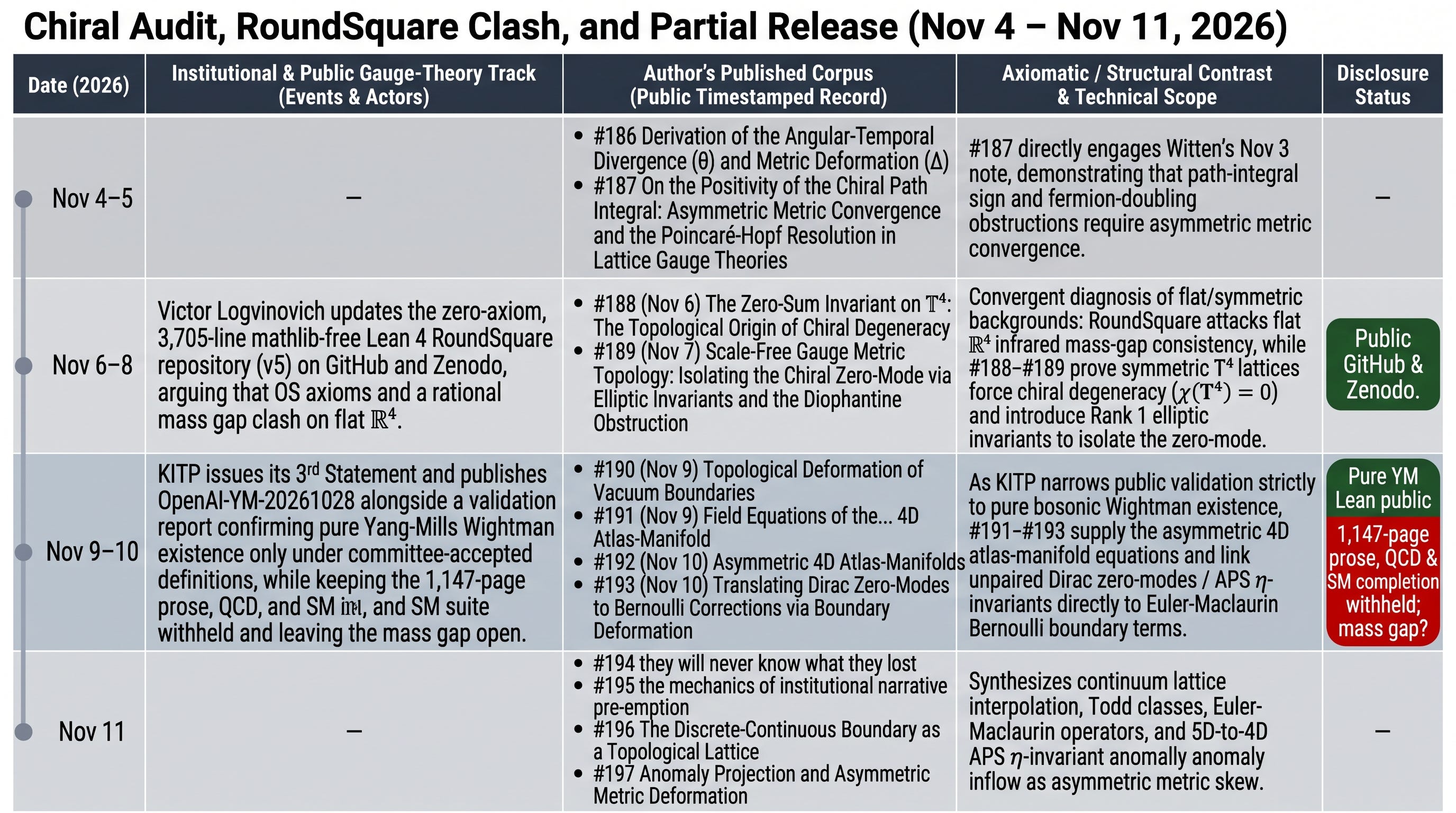
Phase IV: Chiral Audit, Infrared Clash, and Partial Release (November 4 – November 11, 2026)
In the eight days following November 3, independent machine-checked critiques challenged flat ℝ⁴ mass-gap consistency, KITP executed a restricted pure-bosonic Lean release, and Manuscripts #186 through #197 published a complete topological resolution of chiral lattice degeneracy and boundary anomaly inflow.
not included in first table, historical/geo-political:
145. Engineering Consensus: The Weaponization of Pseudoscience and the Vatican’s Chronovisor Deception [Published Online: 2026-09-15 | Essay / History]
Critical historical essay analyzing the 1972 Pellegrino Ernetti Chronovisor story, examining institutional narrative management and the interplay between media spectacle and orthodoxy.
146. Capturing the Drift: Weaponized Orthodoxy and the Re-Engineering of Sovereign Authority [Published Online: 2026-09-17 | Essay / History]
Historical analysis of sixteenth-century papal governance, tracing shifts from territorial military defense to calendar reform, institutional bureaucracy, and ideological standardization.


Leave a Reply