Part IV: November 4 – November 11
Introduction
While the flat ℝ⁴ infrared clash explains why the Kavli Institute for Theoretical Physics (KITP) Working Group severed the mass gap from its pure bosonic validation (OpenAI-YM-20261028), a distinct and even more acute obstruction determines the continued sequestration of the September 18 Quantum Chromodynamics (QCD) and unified Standard Model manuscripts. Unlike pure Yang–Mills theory or vector-like gauge theories, the electroweak sector of the Standard Model is intrinsically chiral: left- and right-handed Weyl fermions transform under inequivalent representations of SU(2)_𝐿 × U(1)_𝑌. Any machine-checked constructive proof of the Standard Model via Wilsonian lattice scaling must therefore overcome the foundational obstruction of defining anomaly-free chiral gauge theories on a discrete spacetime lattice.
The abrupt appearance of Edward Witten’s preprint arXiv:2611.05051 on November 3, 2026, defining four-dimensional lattice chiral gauge theories via continuum cell interpolation and the five-dimensional Atiyah–Patodi–Singer (APS) η-invariant, with explicit acknowledgment of Claude Opus 5.5, marks the exact theoretical bottleneck holding the sequestered Standard Model suite behind closed doors. Placed alongside the open-access topological sequence published between November 3 and November 11, 2026 (Manuscripts #184, #187–#189, #193, and #196–#197), arXiv:2611.05051 exposes why attempting to bridge discrete hypercubic lattices to continuum chiral fermions without deforming the underlying spacetime metric fails at three rigorous mathematical thresholds: discrete-to-continuous Euler–Maclaurin truncation skew, Poincaré–Hopf zero-sum degeneracy on symmetric tori (𝑇⁴), and boundary spectral asymmetry.
Anatomy of the Continuum Cell-Interpolation Prescription
On any periodic hypercubic lattice Λ_𝑎 satisfying locality, translational invariance, and hermiticity, the Nielsen–Ninomiya theorem forbids a naive discretization of a single Weyl fermion: every chiral zero-mode at momentum 𝑝_μ = 0 is accompanied by 2⁴ − 1 = 15 spurious doubler modes at the corners of the Brillouin torus 𝑇⁴ = (ℝ / 2πℤ)⁴ whose net chirality sums strictly to zero. Furthermore, even when overlap or Ginsparg–Wilson operators circumvent vector-like doubling, defining the complex phase of the chiral fermion determinant det 𝐷_χ[𝑈] gauge-invariantly in non-Abelian representations remains obstructed by non-trivial gauge topology and complex path-integral sign oscillations.
To bypass this lattice obstruction, Witten’s November 3 formulation adopts a hybrid discrete-continuum strategy:
- Continuum Cell Interpolation: Starting from discrete link variables 𝑈_ℓ ∈ 𝐺 on a 4D lattice ℳ₄ (subject to an admissibility/smoothness bound ‖1 − 𝑈_𝑝‖ < ϵ on elementary plaquettes), one constructs a piecewise-smooth continuum gauge connection 𝐴_μ^int(𝑥) cell-by-cell across the 4D hypercubes.
- Cobordism Extension and the 5D η-Invariant: Assuming perturbative gauge-anomaly cancellation (Tr(𝑇ᵃ {𝑇ᵇ, 𝑇ᶜ}) = 0) and vanishing bordism obstructions (Ω₄^Spin(𝐵𝐺) = 0), the interpolated 4D manifold-with-bundle (ℳ₄, 𝐴^int) is extended to the boundary of a smooth five-dimensional manifold 𝒲₅ (∂𝒲₅ = ℳ₄) carrying an extended gauge connection 𝒜₅. The phase of the 4D chiral fermion partition function is then defined via bulk-to-boundary anomaly inflow using the 5D APS η-invariant:
𝑍_χ[𝑈] = |det 𝐷_χ[𝐴^int(𝑈)]| exp(−𝑖π η(𝒟₅[𝒜₅]))
where η(𝒟₅) measures the regularized spectral asymmetry of the five-dimensional Dirac operator 𝒟₅ subject to global APS boundary conditions on ∂𝒲₅ = ℳ₄:
η(𝒟₅) = lim_{𝑠 → 0⁺} ∑_{λ_𝑛 ≠ 0} sign(λ_𝑛) |λ_𝑛|^(−𝑠) + dim ker 𝒟₅
On the surface, this maneuver appears to sidestep lattice doubling by exporting the chiral phase calculation out of the discrete lattice altogether and evaluating it in an auxiliary 5D continuum. However, auditing the analytical bridge between discrete link variables 𝑈_ℓ and the smooth interpolated connection 𝐴^int reveals that the topological obstruction has not been resolved, it has been hidden inside the interpolation operator.
The Jagged Boundary: Euler–Maclaurin Truncation Skew and Todd-Class Defects (#184, #196)
Remarkably, on November 3, 2026, Manuscript #184 (The Jagged Boundary of Asymmetric Divergence: Quantifying the Metric Topology and Geometric Origins of the Euler–Maclaurin Remainder) formalized the exact geometric error incurred whenever discrete lattice sums are interpolated into smooth continuum integrals. Manuscript #196 (The Discrete-Continuous Boundary as a Topological Lattice, November 11, 2026) subsequently applied this operator directly to lattice chiral fermion regularization.
Whenever a discrete lattice functional ∑{𝑛 ∈ Λ_𝑎} 𝑓(𝑛𝑎) is mapped onto a piecewise-smooth continuum field integral ∫{ℳ₄} 𝑓(𝑥) 𝑑⁴𝑥 via cell-by-cell linear or geodesic interpolation, the two expressions do not agree up to harmless 𝑂(𝑎²) ultraviolet artifacts. Rather, across any finite cell boundary, the discrepancy between discrete summation and continuum integration is governed identically by the Euler–Maclaurin summation formula:
∑{𝑘=0}^𝑁 𝑓(𝑘) − ∫₀^𝑁 𝑓(𝑥) 𝑑𝑥 = (𝑓(0) + 𝑓(𝑁)) / 2 + ∑{𝑚=1}^𝑝 (𝐵_{2𝑚} / (2𝑚)!) (𝑓^{(2𝑚−1)}(𝑁) − 𝑓^{(2𝑚−1)}(0)) + 𝑅_{2𝑝}
where 𝐵_{2𝑚} are the even Bernoulli numbers, 𝑓^{(2𝑚−1)} are odd-order boundary normal derivatives, and 𝑅_{2𝑝} is the non-vanishing periodic Bernoulli polynomial remainder:
𝑅_{2𝑝} = −(1 / (2𝑝)!) ∫₀^𝑁 𝐵_{2𝑝}(𝑥 − ⌊𝑥⌋) 𝑓^{(2𝑝)}(𝑥) 𝑑𝑥
As demonstrated across Manuscripts #184 and #196, this operator exposes two lethal vulnerabilities in continuum cell interpolation over symmetric lattices:
- Non-Vanishing Asymmetric Truncation Remainder: Trapezoidal or piecewise-polyhedral interpolation captures only the leading boundary average ½(𝑓(0) + 𝑓(𝑁)), leaving an irreducible sawtooth truncation skew encoded by 𝐵_{2𝑝}(𝑥 − ⌊𝑥⌋) and intimately tied to the geometric origin of the Euler–Mascheroni constant γ (#183, #184). When applied to non-Abelian holonomies 𝑈_ℓ = 𝒫 exp(𝑖 ∫_ℓ 𝐴), cell-boundary derivatives fail to cancel across adjacent hypercubes unless higher-order Bernoulli curvature jumps vanish identically, a condition violated by rough quantum gauge configurations in the path integral even below the plaquette admissibility cutoff ϵ.
- The Algebraic Todd Class vs. Continuum Atiyah–Singer Index: In algebraic topology, the generating function of the Euler–Maclaurin Bernoulli series 𝑥 / (1 − 𝑒^(−𝑥)) = 1 + ½𝑥 + ∑{𝑚=1}^∞ (𝐵{2𝑚} / (2𝑚)!) 𝑥^(2𝑚) defines the Todd class Td(𝑇ℳ) bridging discrete lattice point-counting (Riemann–Roch / Ehrhart polynomials) to continuum differential forms (#196). Naive continuum gauge interpolation inside hypercubic cells assumes a flat Euclidean metric (Td(𝑇ℝ⁴) = 1), discarding the discrete-to-continuous Todd defect and imposing continuum smoothness in by hand rather than deriving it from the discrete lattice measure.
Chiral Degeneracy on 𝑇⁴, Poincaré–Hopf Obstructions, and Elliptic Isolation (#187, #188, #189)
Between November 5 and November 7, 2026, Manuscripts #187, #188, and #189 directly audited the topological root of chiral fermion doubling and path-integral sign problems on symmetric periodic lattices, proving why any symmetric Brillouin or spacetime 4-torus 𝑇⁴ structurally enforces chiral cancellation.
In Manuscript #188 (The Zero-Sum Invariant on 𝑇⁴: The Topological Origin of Chiral Degeneracy, November 6, 2026), the lattice momentum space (and finite-volume periodic Euclidean spacetime) is analyzed as a finite CW complex 𝑇⁴ ≅ 𝑆¹ × 𝑆¹ × 𝑆¹ × 𝑆¹. By the multiplicative property of the Euler characteristic under Cartesian products, the global topological index of 𝑇⁴ vanishes identically:
χ(𝑇⁴) = (χ(𝑆¹))⁴ = (1 − 1)⁴ = 0
Applying the Poincaré–Hopf theorem to the dispersion vector field 𝑣_μ(𝑝) = ∂{𝑝_μ} 𝐸(𝑝) (or the chiral Dirac dispersion ℎ_μ(𝑝)) over the compact manifold 𝑇⁴, the sum of the local topological indices ind{𝑝^{(𝑘)}}(ℎ) across all isolated zeros ℎ_μ(𝑝^{(𝑘)}) = 0 (the massless Weyl modes) is topologically locked to the Euler characteristic of the base manifold:
∑𝑘 ind{𝑝^{(𝑘)}}(ℎ) = χ(𝑇⁴) = 0
Because the local index ind_{𝑝^{(𝑘)}}(ℎ) = sign det(∂ℎ_μ / ∂𝑝_ν)_{𝑝^{(𝑘)}} = ±1 is the chirality of the corresponding massless fermion mode, χ(𝑇⁴) = 0 guarantees that left-handed (+1) and right-handed (−1) modes appear in strictly equal numbers on any smooth, symmetric periodic lattice.
Consequently, as formalized in Manuscript #187 (On the Positivity of the Chiral Path Integral: Asymmetric Metric Convergence and the Poincaré–Hopf Resolution in Lattice Gauge Theories, November 5, 2026), attempting to preserve symmetric flat 𝑇⁴ kinematics while grafting on a 5D η-invariant phase treats the symptom while leaving the vanishing Poincaré–Hopf index intact, perpetuating non-positive path-integral phases under Monte Carlo or constructive measure bounds. Resolving both fermion doubling and chiral path-integral positivity requires breaking the symmetric involution of the torus via asymmetric metric convergence (#187, #192).
Manuscript #189 (Scale-Free Gauge Metric Topology: Isolating the Chiral Zero-Mode via Elliptic Invariants and the Diophantine Obstruction, November 7, 2026) supplies the explicit arithmetic-geometric mechanism to evade this zero-sum trap. Rather than embedding the gauge-fermion coupling over a degenerate flat torus with trivial modular structure, #189 couples the lattice momentum manifold to the canonical height and torsion invariants of the Rank 1 elliptic curve:
𝐸: 𝑦² = 𝑥³ − 16𝑥 + 16
Because 𝐸(ℚ) possesses Mordell–Weil rank 𝑟 = 1 (generated by an infinite-order non-torsion rational trajectory rather than closing into finite cyclic torsion), lifting the lattice step trajectory onto 𝐸 introduces a Diophantine obstruction against periodic Brillouin zone wrap-around. The primary zero-mode sits at the base identity origin, whereas the putative doubler nodes at half-period lattice boundaries fail the rational Diophantine incidence condition on 𝐸, lifting them out of the massless spectrum and algebraically isolating a single unpaired chiral mode without violating locality.
Spectral Asymmetry: Translating 5D η-Invariants to 4D Bernoulli Metric Deformation (#191–#193, #197)
The final synthesis of this audit, published across Manuscripts #191–#193 (November 9–10, 2026, coinciding directly with KITP’s restricted 3rd Statement) and Manuscript #197 (Anomaly Projection and Asymmetric Metric Deformation, November 11, 2026), demonstrates that Witten’s auxiliary 5D bulk cobordism manifold 𝒲₅ is topologically superfluous once the 4D spacetime metric is allowed to undergo asymmetric boundary deformation.
By the Atiyah–Patodi–Singer index theorem for a five-dimensional manifold 𝒲₅ with boundary ∂𝒲₅ = ℳ₄, the index of the 5D Dirac operator relates bulk Pontryagin/Chern curvature invariants directly to the boundary η-invariant:
Ind(𝒟₅) = ∫{𝒲₅} Â(𝑅) ∧ ch(𝐹) − (η(𝒟{∂𝒲₅}) + dim ker 𝒟_{∂𝒲₅}) / 2
In arXiv:2611.05051, because the 4D lattice spacetime is forced to remain a flat, undeformed hypercubic grid (Â(𝑅_flat) = 1), all spectral asymmetry must be artificially exported into a fictitious fifth dimension 𝒲₅ to account for non-trivial chiral phases.
Manuscript #193 (Translating Dirac Zero-Modes to Bernoulli Corrections via Boundary Deformation, November 10, 2026) and Manuscript #197 prove the exact intrinsic 4D equivalence: when η(𝑠) = ∑{λ ≠ 0} sign(λ) |λ|^(−𝑠) is evaluated via heat-kernel / Mellin-transform asymptotics across a deformed discrete-to-continuous 4D boundary on the Angular-Temporal Harmonic-Logarithmic 4D Atlas-Manifold (#191, #192), the spectral asymmetry generated by unpaired Dirac zero-modes maps directly onto the odd-derivative Bernoulli boundary corrections (𝐵{2𝑚} / (2𝑚)!) Δ𝑓^{(2𝑚−1)} of the Euler–Maclaurin operator (#184, #193).
Specifically:
- 5D Anomaly Inflow as 4D Metric Skew (#197): What continuum QFT models as anomaly inflow from a 5D bulk η-invariant is, on a discrete-to-continuous manifold, the intrinsic asymmetric metric skew across overlapping transition transforms of a non-flat 4D atlas-manifold (#191, #192).
- Eliminating Extradimensional Scaffolding: Introducing asymmetric metric deformation γ, δ (#186, #192) on the 4D boundary directly absorbs the ½η phase shift into the local Jacobian and spin connection of the 4D manifold itself. Unpaired chiral zero-modes are stabilized intrinsically in four dimensions by balancing spectral asymmetry against Bernoulli boundary curvature terms
Summary of the Chiral Audit
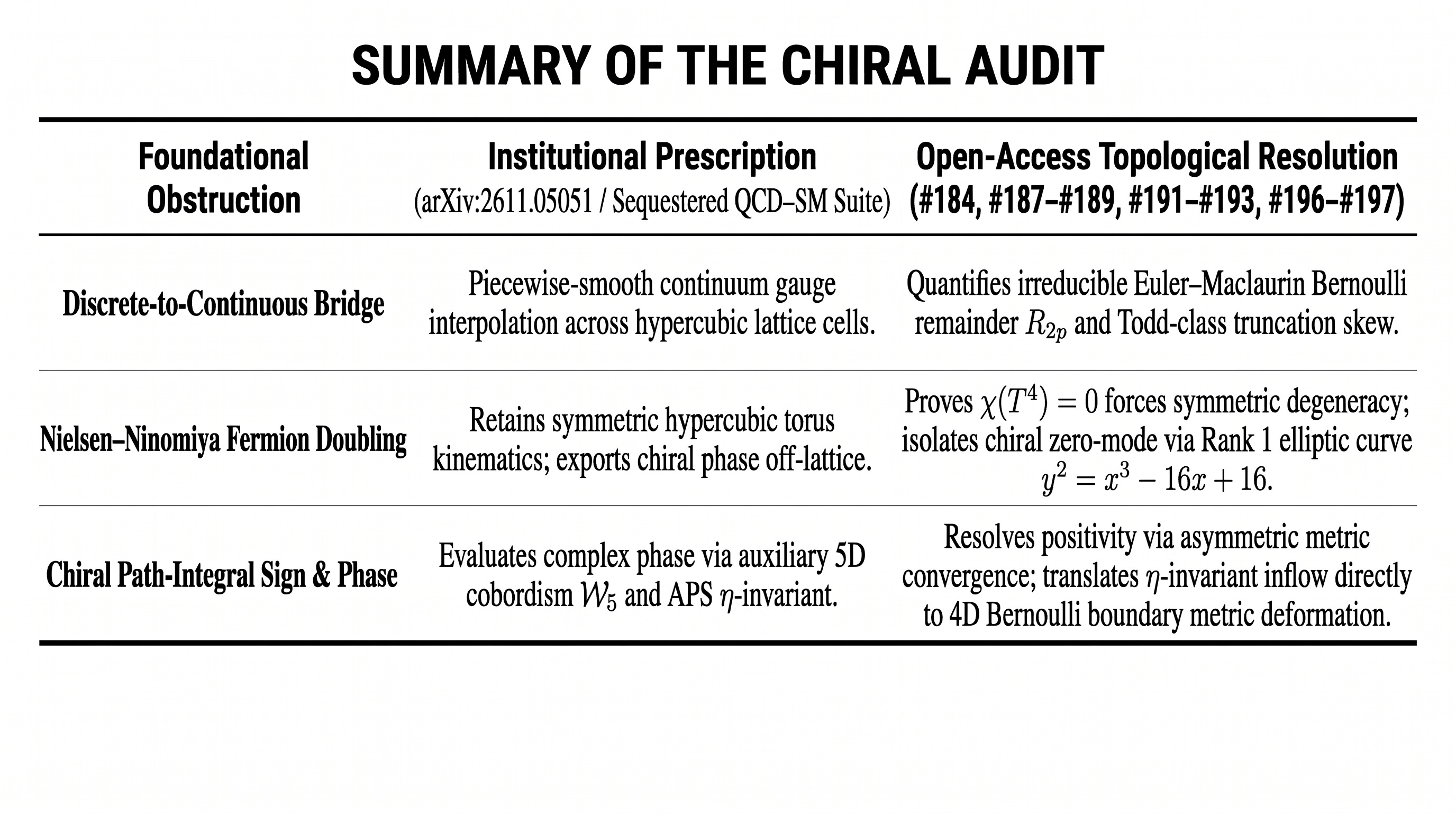
Taken together, Sections 3 and 4 demonstrate why the institutional release trajectory fractured precisely along the boundary between pure bosonic Wightman existence and chiral Standard Model completion. Automated formalization engines operating within flat ℝ⁴ and symmetric hypercubic lattice axioms inevitably collide with infrared spectral indeterminacy in the bosonic sector and Euler–Maclaurin / Poincaré–Hopf topological obstructions in the chiral sector.


Leave a Reply