Introduction
On November 3, 2026, the KITP Working Group issued its second statement outlining definition alignment over OpenAI’s locked 1,147-page gauge-fermion corpus.
That same day, using open AI’s rival model, Edward Witten placed into the public archive, ([https://arxiv.org/pdf/2611.05051v]), the precise cubic-continuous hypercubic interpolation required to connect discrete lattice gauge connections (the domain of Bałaban’s method and OpenAI-YM-20261028) to anomaly-free continuum chiral fermions (the domain of Open AI’s withheld unified completion of the Standard Model).
Taken together, these events exhibit the hallmarks of a preemptive institutional containment strategy designed to execute narrative damage control of catastrophic inconsistencies in non-perturbative gauge theory and constructive and axiomatic quantum field theory, and to manage self-contradiction, before full formal transparency forces an academia-wide paradigm collapse.
Asymmetric Disclosure in the Autumn 2026 Formalization Wave
On October 26, 2026, OpenAI announced three major machine-generated mathematical and theoretical physics results: a proof in harmonic analysis concerning local smoothing and Kakeya-type estimates, a refutation of the Exponential Time Hypothesis (ETH) in computational complexity, and a constructive existence proof for four-dimensional quantum Yang–Mills theory. In its official communication, OpenAI stated that its internal formalisms extended beyond pure gauge fields to encompass Quantum Chromodynamics (QCD, generated September 18, 2026) and a “unified completion of the Standard Model of particle physics.”
Despite emerging from the same research cycle, these three results were governed by sharply bifurcated protocols of access and review. Following the precedent of OpenAI’s October 6, 2026 public deposit of 722 mathematical manuscripts, both the harmonic analysis result and the ETH refutation were released directly to the public GitHub repository with their accompanying natural-language manuscripts and machine-checkable Lean 4 source files. By contrast, the 1,147-page Yang–Mills manuscript, alongside the QCD and Standard Model suite, was sequestered under restrict review. Following the completion of its pure Yang–Mills Lean formalization on October 16, 2026, OpenAI transferred custody of the physics corpus to Nobel laureate David J. Gross at the Kavli Institute for Theoretical Physics (KITP), who chaired the Yang–Mills Working Group alongside Michael R. Douglas, Arthur Jaffe, Igor R. Klebanov, and Nikita Nekrasov.
In its First Statement on October 27, 2026, the KITP Yang-Mills Working Group framed its review embargo as “an experiment in how the academic community can deal with the rapid development of new knowledge by AI,” initially signaling that it would retain the AI-generated manuscripts privately while authoring its own exposition and verification. Yet within days, external pressure from mathematicians, including objections from the Advisory Group on Mathematics and Artificial Intelligence (AGMAI) regarding closed gatekeeping, coincided with an abrupt series of synchronized maneuvers centered on November 3, 2026.
Examining the deductive and axiomatic apparatus of what occurred on November 3 reveals that selective evidentiary sequestration is not solely procedural caution; rather, it sits atop a perniciously acute structural crisis concerning spacetime topology, chiral fermion regularization, and the foundational consistency of continuum gauge theory on flat ℝ⁴.
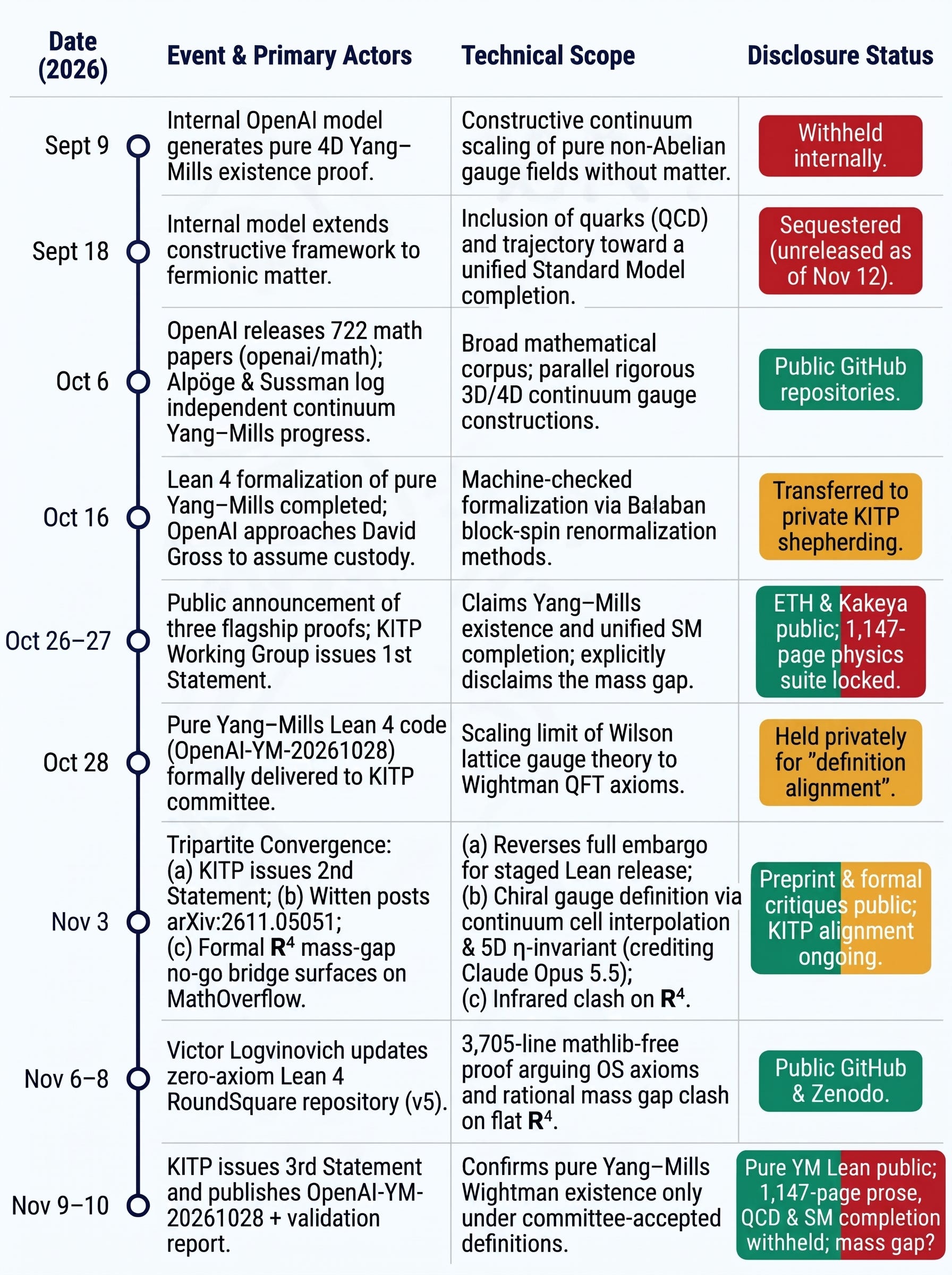
Withheld Frontier: From Bałaban Scaling to Witten’s Chiral Interpolation
To understand why the September 18 fermionic/QCD proofs and the “unified completion of the Standard Model” remain behind the KITP firewall while Edward Witten simultaneously published arXiv:2611.05051 on November 3, one must examine the precise metric topology separating pure gauge theory from realistic particle physics.
Pure Gauge Continuum Scaling versus the Chiral Obstruction
In pure four-dimensional Yang–Mills theory with compact simple gauge group 𝐺, constructive existence on a hypercubic lattice Λ_𝑎 = 𝑎ℤ⁴ begins with parallel transport link variables 𝑈_ℓ ∈ 𝐺 governed by the Wilson plaquette action:
𝑆_Wilson[𝑈] = (1 / 𝑔₀²(𝑎)) ∑𝑝 Re Tr(𝟏 − 𝑈{∂𝑝})
Tadeusz Bałaban’s 1980s constructive program, which forms the backbone of the validated OpenAI-YM-20261028 Lean 4 repository, applies multiscale block-spin renormalization group transformations and polymer cluster expansions in the ultraviolet regime (𝑔₀(𝑎) → 0 as 𝑎 → 0) to establish uniform ultraviolet stability bounds. In the November 10 release, the KITP Working Group certified that OpenAI’s formalization completes the infinite-volume continuum scaling limit of these Schwinger functions so as to satisfy the Osterwalder–Schrader axioms and reconstruct a relativistic Wightman quantum field theory.
However, pure Yang–Mills theory and vector-like QCD are structurally insufficient to construct the Standard Model or any chiral Grand Unified completion (such as SU(5) or Spin(10)). In the Standard Model, left- and right-handed Weyl fermions transform in inequivalent representations 𝑅_𝐿 ≠ 𝑅_𝑅 of the gauge group SU(3)_𝑐 × SU(2)_𝐿 × U(1)_𝑌. By the Nielsen–Ninomiya theorem, any local, translation-invariant, Hermitian lattice Dirac operator preserving chiral symmetry necessarily generates extraneous opposite-chirality doubler modes across the Brillouin zone, rendering naive Wilson/Bałaban lattice discretizations incapable of producing a chiral continuum theory. While Martin Lüscher rigorously constructed lattice chiral gauge measures for Abelian U(1) theories, and only perturbatively to all orders for non-Abelian groups, a fully non-perturbative constructive definition of non-Abelian chiral gauge theories remained one of the central unsolved obstructions in mathematical physics.
Witten’s November 3 Note (arXiv:2611.05051)
On November 3, 2026, following rapid October preprints by Nathaniel Craig (arXiv:2610.09093) and Stephen D. H. Hsu (arXiv:2610.29019), Edward Witten submitted “A Note On Lattice Definition of Gauge Theories With Chiral Fermions”.
Rather than attempting to discretize chiral fermions on the lattice, Witten’s construction executes a hybrid lattice-gauge / continuum-fermion synthesis over an oriented four-dimensional Euclidean spacetime manifold 𝑊:
Admissible Lattice Links and Piecewise Continuum Interpolation: The path integral is restricted to the space 𝒜 of Lüscher-type admissible lattice gauge fields, discrete link configurations whose elementary plaquette curvatures satisfy a strict smallness bound ‖𝟏 − 𝑈_{∂𝑝}‖ ≤ ε. Within each hypercubic cell of 𝑊, these discrete link variables are interpolated into an explicit continuum gauge connection 𝐴_μ(𝑥). Across neighboring cell boundaries, the connections differ by uniquely determined gauge transformations, gluing together into a globally well-defined principal 𝐺-bundle over 𝑊 that may carry nontrivial topological charge, even though the basic interpolation is continuous (𝐶⁰) rather than differentiable across cell faces.
Continuum Chiral Coupling and the 5D η-Invariant: Continuum chiral fermions transforming in an anomaly-free representation 𝑅 are coupled directly to the interpolated continuum connection 𝐴 on 𝑊 via the chiral Dirac operator 𝐷̸_𝑊⁺. Because 𝐷̸_𝑊⁺ maps between distinct spinor bundles, its determinant possesses an intrinsic phase ambiguity. Witten resolves this phase non-perturbatively via anomaly inflow over an oriented five-dimensional manifold 𝑌 satisfying ∂𝑌 = 𝑊, extending the interpolated gauge bundle over 𝑌 and equipping the five-dimensional self-adjoint operator 𝒟_𝑌 = 𝑖𝐷̸_𝑌 with local elliptic boundary conditions 𝖫. Using Pauli–Villars regularization with regulator mass 𝑀 ≫ |𝑚| over the discrete spectrum {λ_𝑘} of 𝒟_𝑌, the chiral fermion partition function phase is governed by the Atiyah–Patodi–Singer η-invariant. Complete cancellation of local and global perturbative/Dai–Freed anomalies holds if and only if, for every closed five-manifold 𝑌 (∂𝑌 = ∅),
exp(−𝑖π η(𝒟_𝑌)) = 1
ensuring that the path integral weight over 𝒜 is independent of the choice of bulk extension 𝑌.
Cobordism Obstructions and Dual Topological θ-Angles
Whenever spin-gauge cobordism classes obstruct the existence of a bounding five-manifold 𝑌, Witten demonstrates that defining the theory requires introducing dual topological θ-angles, alongside specific manifold constraints, such as vanishing first Pontryagin forms on products 𝑇² × 𝐵 in mixed gauge-gravitational cases.


Leave a Reply