The Boundary Interval Deficit Between Geodetic and Solar Rotational Manifolds
Introduction
In the study of celestial mechanics and chronometry, tracking the coupling of Earth’s axial tilt and orbital velocity necessitates transforming the motion of a terrestrial observer into and across two distinct reference perspectives:
The Inertial/Geodetic baseline (defined by distant, fixed background stars)
The Orbital/Rotational domain (defined by the Earth-Sun vector)
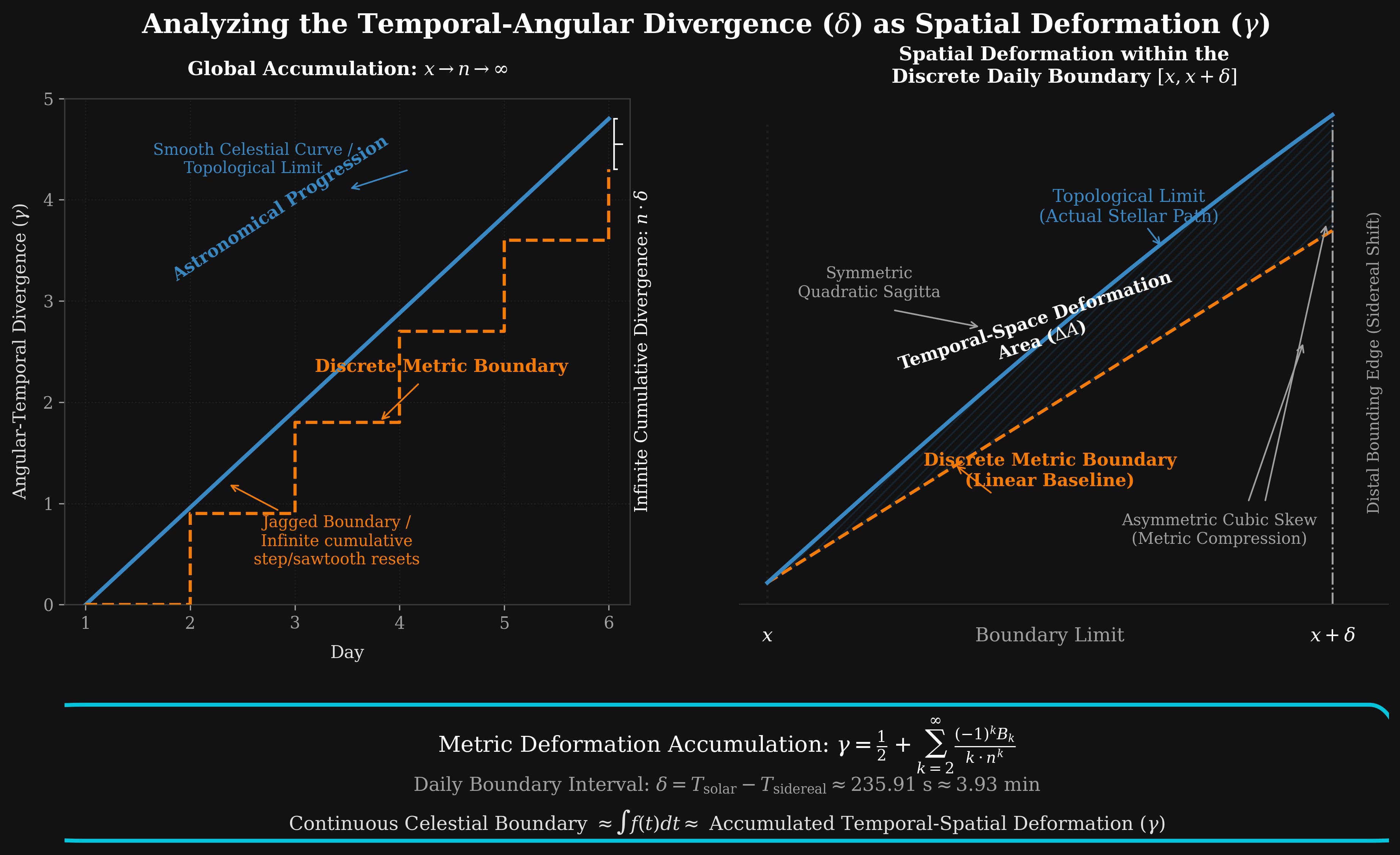
The discrepancy between these coordinate metrics manifest as an angular-temporal divergence (δ) which, when evaluated over n discrete iterations, yields an accumulating metric deformation (γ) in any discrete periodic chronometric system.
Establishing the Rotational-Orbital and Inertial Reference Systems
Let the Earth’s absolute, intrinsic rotation about its rotational axis be parameterized by its inertial (sidereal) angular velocity ω*. Since the geodetic celestial coordinate baseline is the inertial celestial reference, a complete geodetic 2π rad (360°) rotation defines the sidereal day (T*):
ω* = 2π / T* ≈ 7.292115 × 10⁻⁵ rad/s ⟹ T* ≈ 86,164.09 s (23h 56m 4.09s)
Simultaneously, the Earth traverses its heliocentric-barycentric Keplerian orbit, resolving an eccentric orbital trajectory about the Sun-Earth barycenter. By approximating a circular reference baseline to resolve the rotational coupling, the Earth’s barycentric angular velocity Ω_orb is determined as:.
Ω_orb = 2π / T_orb ≈ 1.991 × 10⁻⁷ rad/s
where T_orb is the Tropical Year (365.24219 mean solar days ≈ 3.15569 × 10⁷ s).
Deriving the Solar Reference Frame (ω⊙)
From a terrestrial observer’s reference, measuring a solar cycle requires a complete apparent synodic revolution of the sun, which is resolved by the solar vector’s return to successive transits across the observer’s local meridian. However, due to the coupling of Earth’s intrinsic rotation with its orbital velocity, it simultaneously translates along its orbital angular displacement, Δθ = Ω_orb ⋅ T, along its elliptical trajectory over any temporal interval T.
To resolve consecutive solar transits, the terrestrial reference must traverse an additional angular displacement beyond the 2π rad inertial geodetic (sidereal) boundary. This defines the Mean Solar Day (T_⊙):
θ*(T_⊙) = 2π + Δθ = 2π + Ω_orb T_⊙
Because θ*(t) = ω* ⋅ t, substituting t = T_⊙:
ω* T_⊙ = 2π + Ω_orb T_⊙ ⟹ T_⊙(ω* − Ω_orb) = 2π
Solving for the Solar Day (T_⊙):
T_⊙ = 2π / (ω* − Ω_orb) ≈ 86,400 s (24h 00m 00s)
Thus, the apparent solar angular velocity (ω_⊙) determining standard civilian chronometry is:
ω_⊙ = 2π / T_⊙ = ω* − Ω_orb ≈ 7.272205 × 10⁻⁵ rad/s
The Boundary Interval Deficit and Gauge-Metric Transformation (δ)
The instantaneous angular rate divergence between the astronomical inertial angular accumulation and solar synodic interval quantifies the Earth’s orbital velocity:
Δω = ω* − ω_⊙ = Ω_orb ≈ 1.991 × 10⁻⁷ rad/s
To determine the temporal deficit per solar cycle, evaluate the accumulated angular divergence over one Solar Day (T_⊙):
Δθ_daily = Δω ⋅ T_⊙ = Ω_orb T_⊙ ≈ 0.0172 rad ≈ 0.9856°
The temporal interval δ mandated for the Earth to traverse this deficit angular increment at its intrinsic (sidereal) angular velocity ω* is:
δ = Δθ_daily / ω* = (Ω_orb T_⊙) / ω* = (1 − ω_⊙/ω*) T_⊙
Since T_⊙ = T* + δ, resolving for the boundary interval gauge-metric δ:
δ = T_⊙ − T* = 2π / (ω* − Ω_orb) − 2π / ω* = 2πΩ_orb / (ω*(ω* − Ω_orb)) ≈ 235.91 s (≈ 3.9318 minutes)
This gauge metric δ is the irreducible temporal increment accumulated each rotational iteration, defining the exact temporal-spatial divergence of Earth’s barycentric orbital translation.
The Angular-Temporal Divergence: Boundary Interval [x, x + δ]
For any arbitrary initial epoch x, the diverging trajectories of the geodetic and chronometric coordinate systems are mapped as the temporal parameter t advances within the boundary gauge-metric interval [x, x + δ]. Let:
S(t) represent the continuous angular position of the star-fixed inertial baseline (sidereal trajectory).
M(t) represent the linear position of the solar observer’s domain (Solar chronometric trajectory).
Over the temporal bounds of a given coordinate interval, their respective angular progressions from the initialization baseline (t = 0) are defined by:
S(t) = ω* ⋅ t M(t) = ω_⊙ ⋅ t
Where ω* and ω_⊙ represent their respective angular velocities, and t ∈ [0, T] (where T = T_⊙ for a single-day validation). Because these systems progress at differing rates, their trajectories in temporal-space do not share the same angular velocity. Instead, they diverge at a constant differential rate:
Δω = ω* − ω_⊙ = Ω_orb
The cumulative metric deformation (γ), which measures the integrated accumulated volume between these two divergent vectors over a complete observational duration T, is the definite integral of this instantaneous distance:
γ = ∫₀ᵀ (S(t) − M(t)) dt = ∫₀ᵀ (Δω ⋅ t) dt = [ (1/2) Δω ⋅ t² ]₀ᵀ = (1/2) Δω ⋅ T²
Global Accumulation and the Metric Deformation (γ)
Any discrete chronometric system that updates in integer step counts of the solar day (x = nT_⊙) is mismatched against the continuous geodetic astronomical progression t* = nT*.
Let 𝒙_astro(t) be the actual geodetic position on the celestial manifold, and 𝒙_discrete(t) be the linear chronometric estimation of that progression. Defining the global Temporal Phase Offset (γ_n) over n days as:
γ_n = n ⋅ δ = n(T_⊙ − T*)
As n → ∞, the divergence behaves as a cascading step system. Over any single interval [x, x + δ], the divergence is non-linear due to the orbital eccentricity (e ≈ 0.0167) and axial obliquity (ϵ ≈ 23.44°) of the Earth.
The actual, varying orbital speed introduces a Symmetric Quadratic Sagitta (Sag_q) and Asymmetric Cubic Skew (Skew_c) to the accumulated error (derived from the Equation of Time). Evaluating the asymptotic limit of the discrete discrepancy relative to the continuous celestial boundary:
γ = lim_{n→∞} (∑_{k=1}^{n} (1/k) − ∫_1^n (1/t) dt)
This exactly yields the Euler-Mascheroni Constant (γ ≈ 0.577215), expressing the infinite accumulation of discrete boundary intervals over a continuous natural curve:
γ = 1/2 + ∑_{k=2}^{∞} ((−1)^k B_k / k) ⋅ n^k
where B_k represents the Bernoulli numbers.
The deformation γ is therefore the inevitable topological deficit accumulated when approximating the smooth, orbital-rotational continuum of the cosmos using discrete, periodic chronometric boundaries.


Leave a Reply