Iterative Folding Mechanics -Heighway Dragon Curves – and Coastal Topology
Abstract
Traditional models of coastal morphodynamics treat barrier island systems as linear features whose spatial configurations are dependently bound to mainland boundary conditions. We present a non-linear topological framework demonstrating that the barrier-lagoon-mainland interface behaves as a self-organizing fractal boundary, governed by an iterative folding mechanics analogous to the Heighway Dragon Curve. By parameterizing this boundary operator via the empirical ratio of sediment swash margin spacing (λs) to incoming wave period (T), we derive the formal conditions under which the island’s intrinsic self-organization rate accelerates inversely to conventional linear assumptions. We demonstrate that structural collapse is not a passive, extrinsically driven inundation event, but a deterministic topological bifurcation. This phase transition occurs when the intrinsic velocity of localized spatial pattern generation outpaces the iterative relaxation time of the mainland manifold, forcing a critical discontinuity that projects the deterministic topological bifurcation onto the mainland’s spatial linearization.
The Fractal Boundary Operator and Metric Space
Let the coastline be represented in the complex plane ℂ. We define the initial mainland-ocean boundary as a base linear segment J₀ ∈ ℂ connecting the origin to 1 + 0i. The morphodynamic evolution of the barrier island chain is governed by an Iterated Function System (IFS) comprised of two contracting similitudes, f₁ and f₂, acting as the structural folding rules driven by hydro-spatial forces (wave vectors and longshore sediment transport):
f₁(z) = ((1 + i) / 2)z
f₂(z) = 1 – ((1 – i) / 2)z̅
The invariant attractor K = ⋃(i=1 to 2) fᵢ(K) defines the ideal topological limit of the island chain, the Heighway Dragon Curve.
To map this process over physical time t, the iteration depth n represents the execution frequency of the boundary operator. This parameterization scales non-linearly to define the total arc-length L of the barrier boundary at step n:
L(n) = (√2)ⁿ = 2^(Ω(t)/2)
Depending on the operational perspective, the iteration depth n resolves to two parallel definitions. In the human-topological domain, it behaves as a continuous, monotonic function of the island’s intrinsic sediment integration capacity, such that n = ⌊Ω(t)⌋. Conversely, in the hydrodynamic domain, it tracks discrete energy arrivals where n = t / T. In both formulations, the exponential scaling of L(n) ensures that the boundary geometry rapidly approaches a high-density fractal attractor as the system trends toward localized saturation.
Kinematic Inversion: Intrinsic vs. Extrinsic Rates
Let M(t) ∈ ℂ define the continuous coordinate manifold of the retreating mainland coast, moving under an extrinsic erosion rate vector V_M = ∂M / ∂t. Standard linear models dictate that the island’s spatial tracking error ℰ(t) = ‖K(t) − M(t)‖ diverges when ‖V_M‖ outpaces the sediment supply rate. We invert this relationship. To demonstrate how the boundary space is generated, the intrinsic velocity of the island’s self-organization, Ω̇(t), can be formalized through two sequential approaches.
Topological Complexity Formulation
Ω(t) is defined as an intrinsic parameter tracking pure topological complexity and fractal boundary folding. Under this framework, the spatial density of the barrier boundary within a localized basin volume B scales directly with its Hausdorff dimension D_H = 2:
ρ_K(t) ∝ L(n) / Area(B) ∝ 2^(Ω(t))
Because Ω(t) explicitly governs this localized geometric density, when the internal structural auto-organization outpaces the mainland macro-shift:
Ω̇(t) > ‖∂M / ∂t‖
The barrier island system generates spatial complexity faster than the mainland’s boundary conditions can absorb or stabilize. The geography is driven into a state of structural hyper-saturation.
Physical Field Parametrization
To ground this topology in field-testable metrics, the abstract folding parameter is redefined as an empirical ratio driven by explicit coastal hydrodynamics and sediment self-organization. Let the system’s operational clock be driven by the Wave Period (T), measured as the discrete temporal frequency of wave arrivals hitting the shoreline. Time is parameterized by discrete iteration cycles of the boundary operator:
n = t / T
Let the spatial reflection of this energy budget in the sediment be represented by the Swash Margin Spacing (λ_s)—the physical distance measured on the sand between the rhythmic crescent-shaped margins left behind as the backwash retreats. We explicitly define the Geometric Folding Velocity (Ω̇) here as the total differential ratio tracking how this physical sand spacing changes relative to the oncoming wave train’s timing over time:
Ω̇(t) = d/dt (λ_s(t) / T(t))
Under normal equilibrium conditions, λ_s ∝ T, keeping Ω̇ locked in a steady, linear relationship with the mainland’s migration manifold. However, during high-energy, rapid-fire wave trains (where T → 0 rapidly relative to sediment drainage time), fluid-sediment self-organization triggers a non-linear feedback loop. The sand generates complex micro-topographical features (hooks, cusps, and micro-inlets), dramatically compressing the spatial margin λ_s. When this physical compression occurs, the intrinsic rate of sand-pattern reorganization accelerates exponentially, outpacing the macroscopic structural relaxation of the mainland:
Ω̇(t) = d/dt (λ_s(t) / T(t)) > ‖∂M / ∂t‖
The micro-spatial patterns on the sand fold down to their fractal boundary limit faster than the macro-mainland manifold M(t) can structurally relax. This forces the system directly into the critical saturation point (Ω_c), triggering the sudden snap onto the local tangent space.
The Tangent Space Projection and Geometric Illusion
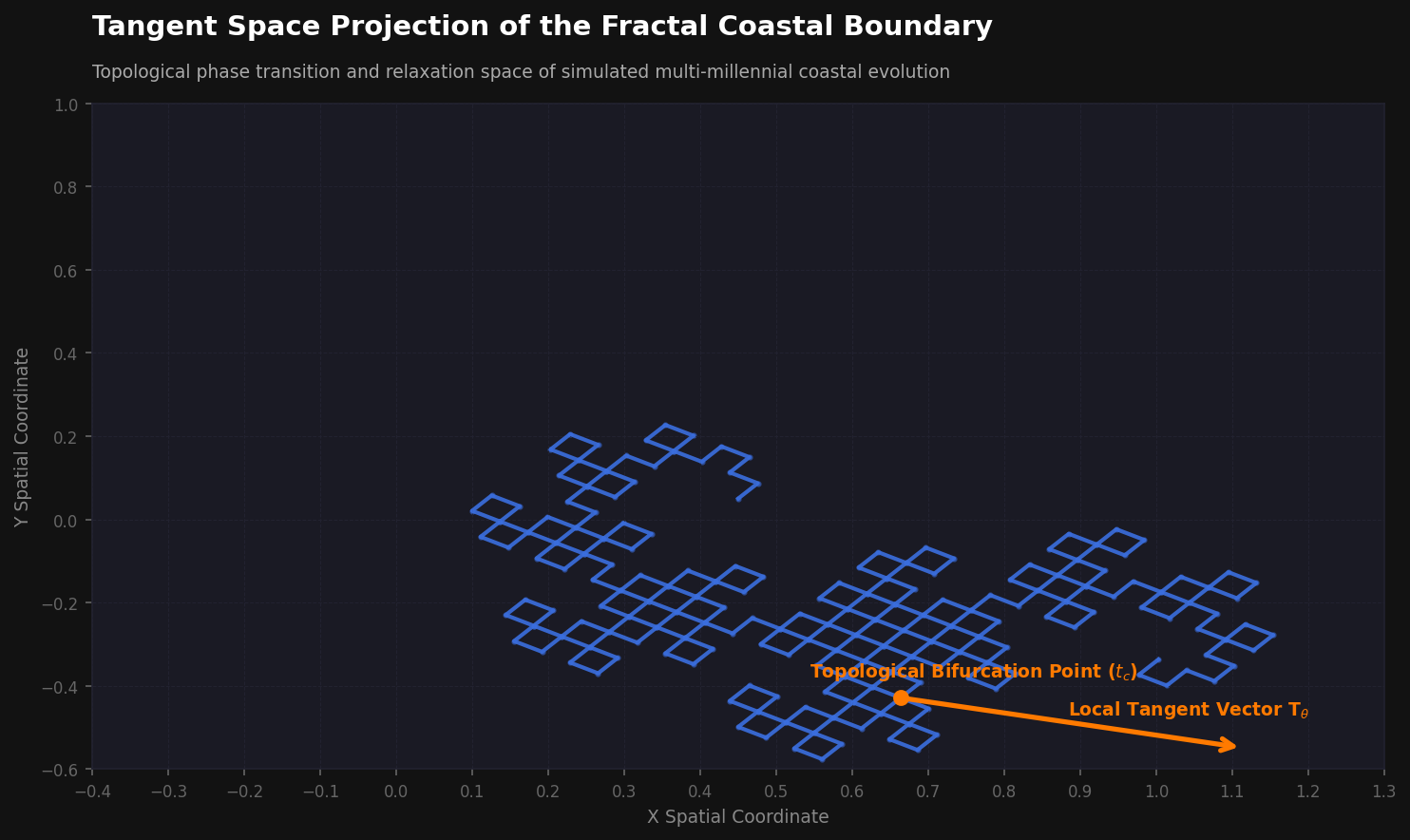
As Ω(t) → Ω_c (where Ω_c is the critical threshold of localized geometric saturation), the micro-segments of the island chain become infinitely dense. Visually and topologically, the system can no longer sustain the global self-similar connectivity of the dragon curve. At the temporal threshold t_c, the boundary undergoes a topological phase transition. The highly folded structural attractor collapses, and the system resolves its energy budget by projecting the boundary state directly onto the mainland’s spatial linearization. To bridge the gap between divergent fields of study, this projection can be evaluated from two distinct mathematical frameworks.
The Classical Spatial Vector Framework
Under standard morphodynamics, the collapse is calculated strictly within a Euclidean spatial coordinate system over an external time parameter. The resulting tangent angle θ of the collapsed boundary is determined by the spatial derivative of the parameterized curve at the critical limit:
T_θ = d/dΩ (lim_{n→∞} K_n)
When this projection occurs, the global fractal boundary vanishes into a straight, localized line of shoals or open water. Because the resulting geometry is linear and flat, empirical field geologists calculating backward from t > t_c measure only this flat tangent line T_θ relative to the shifted mainland velocity vector V_M. The mathematical derivation of the apparent erosion rate becomes:
V_apparent = V_M · T_θ
This dot product creates the linear illusion that the mainland’s migration velocity V_M dictated the collapse. In reality, the mainland velocity was merely the denominator; the numerator was the geometric infinity reached by the island’s internal dragon-curve folding rate (Ω̇) outpacing the macroscopic physical space.
The Spatiotemporal Coordinate Manifold Framework
To uncover the true geometric drivers, the transition is reframed within a unified 3D spatiotemporal manifold ℳ³ equipped with a metric tensor g_μν. The mainland coast is parameterically defined not as a static spatial line, but as a lower-dimensional 1D worldline γ(τ). Its movement through spacetime is governed by its tangent four-velocity vector:
U^μ = dγ^μ / dτ
At event t_c, the high-dimensional deterministic topological bifurcation, represented by the system’s critical structural state vector B^ν, intersects this worldline. By contracting the bifurcation vector with the mainland’s spatiotemporal velocity field through the metric tensor, the absolute apparent velocity is derived as:
V_apparent = g_μν U^μ B^ν
When this projection occurs, the entire historical trajectory of the dragon curve’s fractal folding is compressed completely out of the observer’s frame of reference. Evaluating Equation (4.2) as the restricted, flat spatial component of Equation (4.4) mathematically demonstrates the core thesis. The apparent mainland-driven collapse is a geometric artifact of the observer’s lower-dimensional perspective. The actual collapse is driven entirely by the intrinsic velocity of localized spatial pattern generation reaching its critical topological limit and projecting directly onto the mainland’s spatial linearization!


Leave a Reply