Topological Incommensurability and Geodetic Gauge Invariance in Differential State-Space
Abstract
We present a novel, integrated scaling model demonstrating how a localized spatial apparatus can be constructed to function as a differential state-space configuration for global-scale geodetic and celestial mechanics. By evaluating the truncation error of a planar projection against a discrete harmonic iteration, we distinguish an explicit, non-vanishing cubic skew. We demonstrate that when this localized manifold embedding is parameterized to a 2:1 integer harmonic angular divergence, the ratio between the relative entropy constant, γ and the spatial-temporal boundary discrepancy, Δ yields a scale invariant factor of 3,953.53. This evaluates to the spatial-dimensional volumetric radius of Earth, establishing a direct, invariant topological link between localized spatial-temporal dimensions and global scaling.
Introduction: Topological Incommensurability and Geodetic Gauge Invariance in Differential State-Space
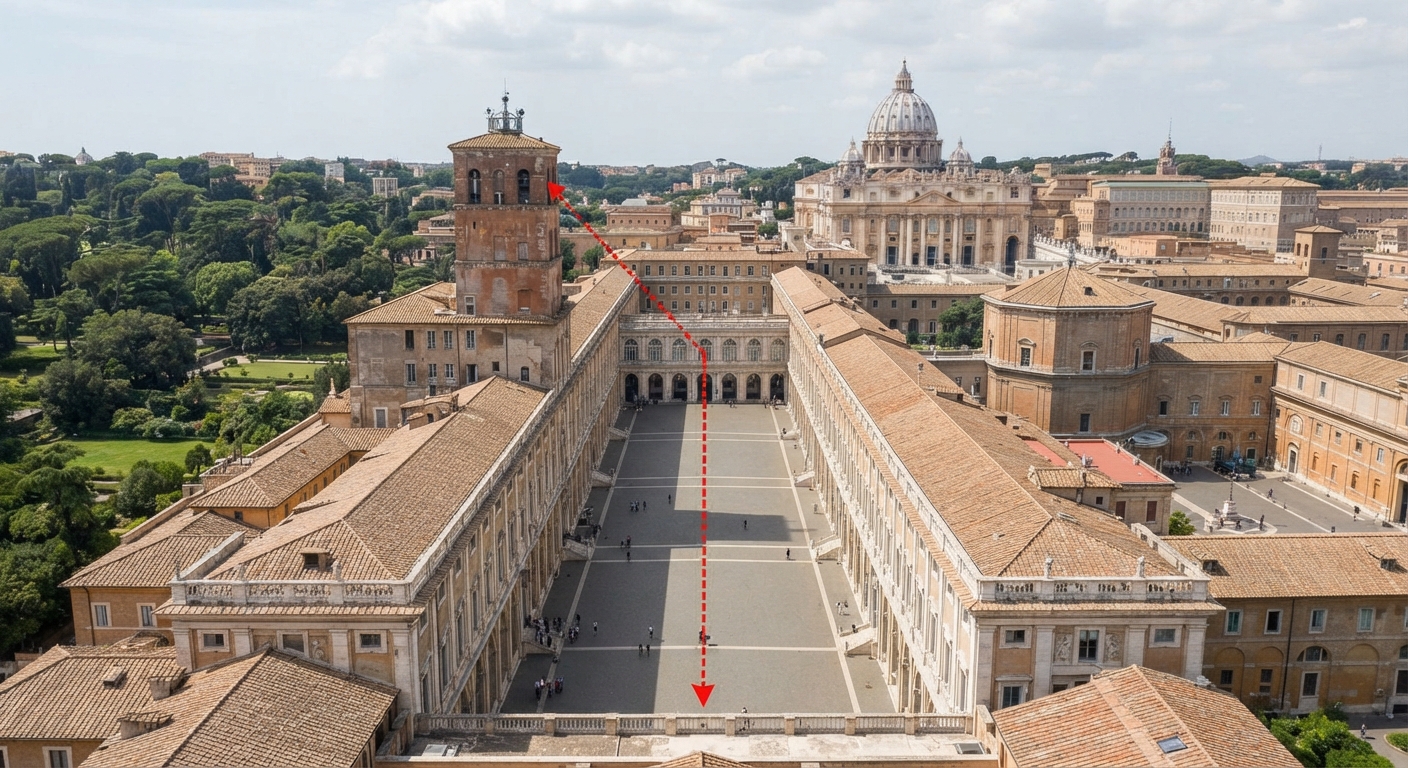
When projecting a continuous celestial arc onto a fixed horizontal plane, a fundamental topological incommensurability occurs between the discrete harmonic iterations of terrestrial timekeeping and the continuous logarithmic manifold of the projection baseline. Rather than treating the Torre dei Venti as a passive observational device, this paper models its localized architecture as an active differential state-space configuration, acting as a topological manifold embedding designed to equilibrate this global angular-temporal divergence. When the system is constrained by a strict 2:1 integer harmonic parameterization, this boundary divergence resolves into a bounded residual limit, ∆, from which the canonical constant harmonic divergence constant, γ, inherently emerges.
By analyzing these spatial-temporal translation discrepancies, we demonstrate that the structural features of the architecture are strictly deterministic. The foundational √3 (60°) baseline acts as a physical scaling invariant that gauges the local isolated residual discrepancy directly to the global scale factor of the Earth-Solar system. The invariant ratio between the canonical constant γ and the local boundary discrepancy ∆ evaluates precisely to the Earth’s volumetric bulk, establishing a direct, invariant geodetic link between localized spatial-temporal dimensions and global planetary scaling. The Vatican’s Torre dei Venti functions as a 1-to-1 fractional map of the Earth itself.
The Analytical Taylor Expansion and the √3 Invariant
Generalized Symbolic Derivation of the Projection Manifold
To establish a canonical structural baseline of the planar projection, we evaluate the horizontal intercept distance y as an unconstrained symbolic function of the apparent solar declination δ for a fixed vertical aperture height H at an arbitrary geodetic latitude ϕ:
y(δ) = H tan(ϕ – δ) = H ((tan ϕ – tan δ) / (1 + tan ϕ tan δ))
Setting the baseline terrestrial tangent parameter to μ = tan ϕ, a higher-order Taylor series expansion about the equinoctial node (δ = 0) decomposes the continuous transcendental projection into its constituent structural derivatives:
y(δ) = Hμ – H(1 + μ²)δ + Hμ(1 + μ²)δ² – H(1 + μ²)(μ² + ⅓)δ³ + 𝒪(δ⁴)
This unconstrained expansion isolates the invariant differential kernels governing the geometric landscape:
The Linear Dispersion Field (c₁): −H sec²ϕ, constraining continuous optical ray velocity across the baseline.
The Parabolic Conic Splay (c₂): +H tan ϕ sec²ϕ, dictating the intrinsic quadratic curvature of the projection plane.
The Cubic Skew Kernel (c₃): −H sec²ϕ (tan²ϕ + ⅓), representing the lowest-order non-vanishing divergence between linear spatial increments and the continuous transcendental manifold.
The deductive necessity of the ⅓ factor within the cubic kernel determines the prime geometric requirement of the system. Because cot²(60°) = ⅓, a strictly deterministic structure truncated at exactly a 60° bevel couples the physical masonry to the invariant third-order derivative of the tangent function:
⅓ ≡ cot²(60°) = 1 / tan²(60°)
The √3 baseline is therefore not an aesthetic choice; it is a deterministic constraint required to equilibrate the cubic curvature of the infrastructure.
Local Parametric Instantiation and State-Space Calibration
To map this generalized constraint manifold into the topological manifold embedding of the Torre dei Venti, we substitute the fixed, empirical parameters of the localized physical apparatus. We define the horizontal intercept distance y as a localized state-space configuration, utilizing an effective vertical aperture elevation H = 5.180 m at the precise geodetic latitude of the Vatican observatory (ϕ = 41.903°N):
y(δ) = H tan(α(δ)) = H tan(90° – ϕ + δ) = H tan(ϕ – δ)
Applying the tangent subtraction matrix parameters to this specific local manifold embedding how the canonical coefficients materialize within the physical chamber track:
y(δ) = 5.180 ((tan(41.903°) – tan δ) / (1 + tan(41.903°) tan δ))
Evaluating the expanded series with the localized geodetic tangent constraint (μ = tan(41.903°) ≈ 0.89726) isolates the explicit, empirical numerical parameters of the physical apparatus:
The Equinoctial Base Intercept (c₀): y₀ = Hμ = 5.180 × tan(41.903°) ≈ 4.6478 m
This value establishes the nominal canonical projection plane for the zero-point state configuration.
The Linear Dispersion Coefficient (c₁): c₁ = −5.180 × (1 + 0.89726²) ≈ −9.3503 m/rad
Fixing the local translation velocity of the optical transit ray.
The Parabolic Curvature (c₂): c₂ = 4.6478 × 1.80508 ≈ +8.3897 m/rad²
Inducing the localized quadratic conic splay across the horizontal projection manifold. Because c₂ > 0 holds strictly for all non-equatorial latitudes, this positive term invariantly determines an identical northward displacement for both positive and negative solar declinations (±δ).
This cascade highlights a critical vulnerability in the quantitative stability of localized differential models: the non-linear divergence that occurs when a truncated proxy value is projected across and propagated through higher-order derivative multipliers. If an intermediate, rounded baseline tangent is substituted as a localized coordinate shortcut, the resulting numerical truncation errors compound exponentially across successive derivatives, intrinsically distorting the continuously differentiable curve of the system’s manifold embedding. The original geodetic calibration parameters must therefore remain un-discretized. By preserving strict continuity from the primary geodetic coordinate through to the higher-order parameters, the infrastructure prevents this quantitative drift, ensuring that the local state-space configuration is inherently embedded within the actual, un-truncated geometric curvature of the global Earth-Solar system.
The Invariant Cubic Skew and Truncation Limits
When a localized tracking architecture attempts to map a true transcendental conic curve through a simplified symmetric second-order or parabolic interpolation (P₂(δ) = A₀ + A₁δ + A₂δ²), the omission of higher-order dynamics isolates an explicit, non-vanishing truncation error:
Δy(δ) = y(δ) – P₂(δ) ≈ c₃δ³ + 𝒪(δ⁴)
where the third-order cubic skew coefficient is derived as:
c₃ = -H sec²ϕ (tan²ϕ + ⅓)
The inevitability of the ⅓ factor within the cubic truncation kernel dictates the infrastructural masonry architecture of the chamber. Because cot²(60°) = ⅓, constructing the baseline window sill with a fixed, unalterable structural bevel of exactly α_cutoff = 60.0000° directly anchors the physical masonry to the invariant third-order derivative of the tangent function:
⅓ ≡ (1 / √3)² = cot²(60°) = 1 / tan²(60°)
The √3 geometry is therefore an explicit, functional requirement of the manifold embedding. It provides the exact architectural baseline curvature against which the non-linear divergence of terrestrial geography and celestial time was balanced, ensuring the structural stability of the local truncation.
Dimensional Analysis and Unit Invariance
To verify that the state-space configuration of the localized spatial infrastructure represents an inherent, structural property of the manifold embedding rather than an artifact of modern measurement systems, we submit the matrix parameters to a dimensional analysis. An analog differential topological system is verified by the presence of absolutely dimensionless ratios, quantities where the dimensions of length (L) exactly cancel out, leaving unit-free mixtilinear ratios.
We define the transformation matrix factor κ as the direct ratio between the primary tracking trajectory slope and the infrastructure curvature calibration. Let H represent the vertical aperture elevation and y₁ represent the local horizontal intercept coordinate. Under any arbitrary transformation of the fundamental length unit, where λ serves as the scaling tensor shifting modern meters to 1581 Roman architectural palms (palmi architettonici romani, where λ ≈ 4.4763 palms/m), the linear state-space coordinates transform as:
H_local = λH, y_{1,local} = λy₁
Substituting these scaled coordinates into the primary tracking tangent function yields:
tan(α) = (λH) / (λy₁) = H / y₁
Because the length scaling tensor λ cancels identically in the numerator and denominator, the primary ray elevation slope is revealed as a pure dimensionless invariant. Consequently, the matrix transformation factor κ remains absolutely invariant under coordinate transposition:
κ = tan(α) / √3 = (λH / λy₁) / √3 ≡ 1.437824… [L⁰]
Similarly, the ⅓ kernel isolated in the third-order truncation error coefficient c₃ represents a cannonical, dimensionless derivative of planar gnomonic space. When mapped to the physical architecture via the baseline masonry cutoff angle, it registers as a pure, unit-free trigonometric identity:
cot²(60.0000°) ≡ ⅓ … [L⁰]
This dimensional analysis proves that the state-space configuration of the infastructure possesses absolute analytic invariance. The 2:1 integer harmonic parameterization and the √3 logorithmic calibration realizes as an invariant topological constraint manifold. The structural ratios are parameterized as a constant into the spatial apparatus itself, remaining entirely true for a 16th-century Vatican astronomer working in Roman palms or a modern physicist operating in meters.
The Harmonic-Logarithmic Divergence
The operational focus of the localized spatial infrastructure relies on resolving a fundamental topological incommensurability: the translation of an iterative, discrete chronological metric into a continuous, spatial-geodetic projection field. This interface functions as a harmonic-logarithmic divergence engine, parameterizing the exact truncation error that naturally manifests when a discrete temporal iteration sequence is embedded into a continuous planar manifold.
Discrete Iterations vs. Continuous Manifold Projections
The tracking of sequential temporal steps, such as seasonal partitions or discrete zodiacal tracking sectors, relies on a discrete harmonic iteration of fractional inverse steps approximating the meridian partitions:
Sₙ = ∑ₖ₌₁ⁿ (1 / k)
Conversely, the continuous spatial field generated by the optical ray trajectory across the horizontal projection manifold is determined by the logarithmic field of the secant-squared projection integral:
I(u) = ∫₀ᵘ sec²(ϕ – θ) dθ = ln |cos(ϕ – u) / cos ϕ| + chord terms
The limiting asymptotic difference between this discrete harmonic iteration and the continuous natural logarithm defines the canonical constant harmonic divergence constant, γ:
γ = limₙ→∞ (∑ₖ₌₁ⁿ (1 / k) – ln(n)) ≈ 0.57721566…
Within the framework of pure number theory, γ represents the fundamental, non-vanishing remainder left behind when an arithmetic progression is mapped against an underlying continuous logarithmic space. When this global mathematical divergence is localized within the infrastructure’s state-space configuration, it can no longer be evaluated as an infinite limit. Instead, the physical boundary conditions of the architecture compress this transcendental divergence into a finite, measurable spatial-temporal translation discrepancy, Δ.
still editing.


Leave a Reply