The Semantic and Contractual Re-classification of Usury
Abstract
We trace the institutional conversion of legal authority, examining how sovereign power transitioned from the coercive, land-based physical administration of the early Roman Empire to the pervasive, jurisdictional, and financial governance of the medieval and Renaissance Catholic Church. We assert that the structural foundation of modern commercial finance, characterized by the separation of ownership from management, the legal fiction of the corporate entity, and the securitization of risk, constructs bureaucratically mapped from classical Roman actions to high scholastic decretals, is not the product of secular, post-Enlightenment capitalism. Rather, it represents a continuous lineage of imperial administrative governance designed to capture, contain, and extract wealth from decentralized human systems. Central to this evolution is the semantic and contractual re-classification of usury. By analyzing the trajectory from the ancient Greek Lex Rhodia to the Byzantine kerdokoinonia and the scholastic Contractus Trinius, this historical deconstruction demonstrates how institutional authorities consistently manufacture legal systems to override natural human agency through a bypass of manipulated legal nomenclature, thus embedding exploitative financial constructs into the foundational bedrock of all institutional architecture claiming for itself sovereign status.
The Roman Enclosure: Capturing the Sovereignty of the Sea
The pre-Roman Mediterranean shipping economy operated within a highly decentralized, custom-driven ecosystem. Chief among these systems was the Lex Rhodia (Rhodian Sea Law), a compilation of seafaring protocols developed by independent Greek maritime coalitions between the 9th and 3rd centuries BCE. This framework was inherently horizontal, designed by active merchants and sailors to distribute risk and manage shared perils, such as the equitable sharing of economic losses during cargo jettison (General Average), without relying on a centralized, territorial sovereign.
When the Roman Republic and early Empire expanded into the Mediterranean basin, they encountered an advanced mercantile commerce that they lacked the indigenous civil infrastructure to manage. The Roman response was a multi-century project of bureaucratic enclosure. Roman praetors initially absorbed Rhodian maritime custom under the flexible rubric of jus gentium (the law of nations), but as the Empire grew dependent on the continuous flow of the provincial grain supply (annona) to sustain its urban centers, informal adoption gave way to strict statutory containment.
By forcing horizontal maritime customs into centralized, land-based bureaucratic courts, the Roman state fundamentally altered the purpose of the law. The fluid, adaptive protocols of the seafaring merchant were constrained into strict property laws engineered to protect imperial shipping lanes and elite patrician property holdings. The state asserted that disputes occurring on the high seas could only be legitimized when filtered through the territorial courts of the Roman magistrate. This marked the initial pivot from community-regulated custom to an institutional apparatus where law served as an instrument of state-backed capital preservation.
The Byzantine Pivot: Justinian and the Codification of Absolute Command
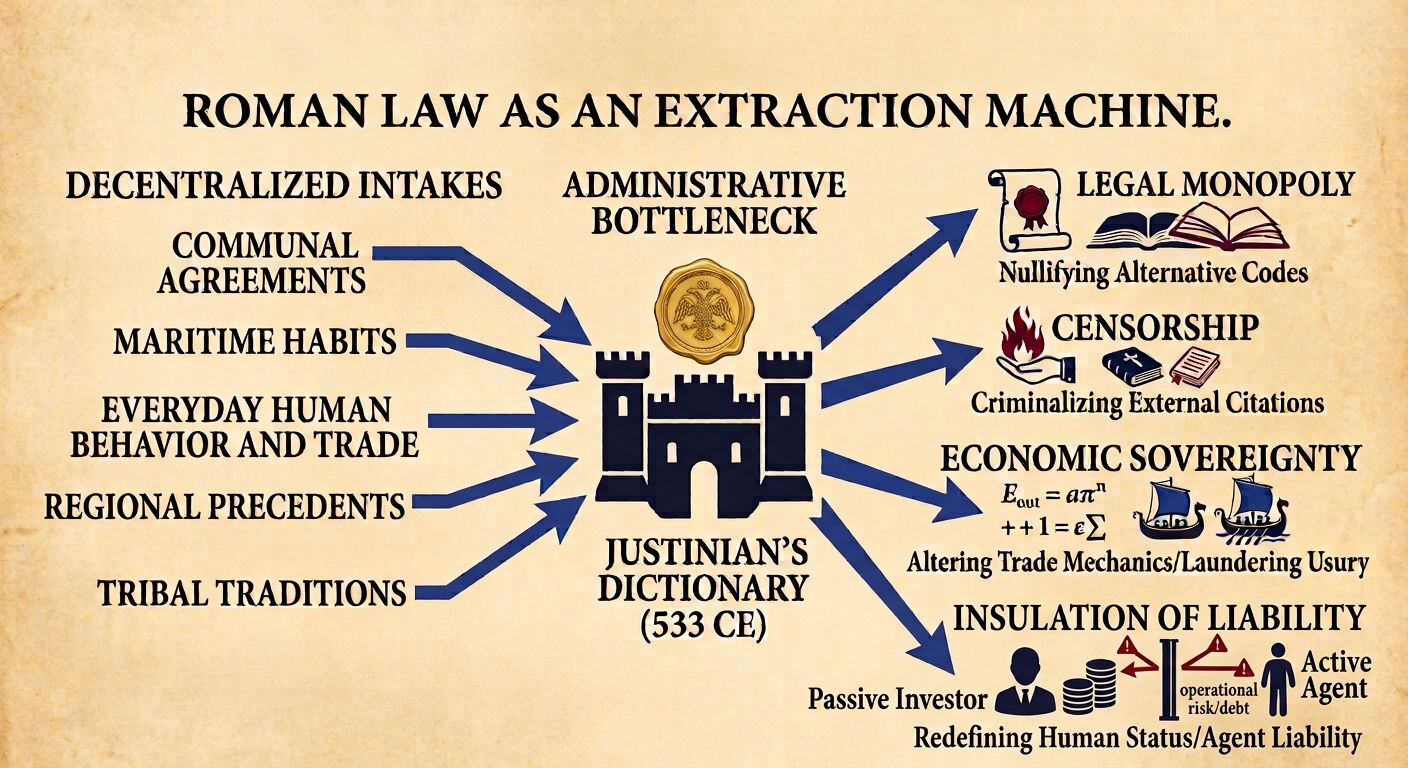
The structural transformation from pragmatic judicial administrative capture to absolute state command was finalized during the 6th-century Byzantine Empire under Emperor Justinian I. In 533 CE, the publication of the Digest (Digesta) formally weaponized Roman legal jurisprudence as a totalizing monopoly on truth. Within Book 14, Title 2 (De Lege Rhodia de Jactu), Justinian’s legal commission did not only preserve ancient Rhodian principles; they re-authored them into a closed, state-sanctioned corpus.
Justinian’s Digest established an ideological precedent: the state possesses the ultimate sovereign authority to define, alter, and regulate the internal mechanics of commerce and human status. To enforce this monopoly, Justinian issued imperial decrees that criminalized the citation or teaching of any historical legal text outside his official codification. This was a deliberate erasure of competing legal traditions.
Furthermore, this era formalized the legal mechanics of altered status to facilitate imperial extraction. To shield wealthy patrician investors from the physical and financial fallout of hazardous voyages, Roman law leveraged the constructs of patria potestas (the absolute power of the patriarch) by placing dependent sons or household slaves as shipmasters (magistri navis).
When this structure threatened trade stability due to the legal non-personhood of slaves, the state intervened with Praetorian Actions, specifically the Actio Exercitoria (Shipowner Liability). This mechanism legally decoupled the investor from everyday operational exposure while preserving their absolute claim to the financial upside, establishing the earliest historical baseline for the separation of ownership from management.
The Usury Intersect: Laundering Credit via Kerdokoinonia
The primary geopolitical and economic crisis of the Byzantine era emerged from the structural contradiction between the state’s official theological posture and its material realities. As a self-proclaimed Christian empire, Byzantium was bound by ecclesiastical prohibitions against usury, the practice of charging an interest premium on a loan (fenus nauticum or tokos). Church fathers universally condemned usury as a predatory violation of fundamental human rights, framing it as the unnatural generation of wealth from the passage of time, which exploited the vulnerability of the borrower.
The Byzantine state; The ruling class, the imperial aristocracy, and monastic foundations possessed immense stores of liquid capital that required continuous, profitable deployment. The survival of the empire’s maritime trade networks relied heavily on credit injection. To resolve this existential tension, the state’s legal architects engineered the kerdokoinonia (maritime joint venture), explicitly codified in the 8th-century Nomos Rhodion Nautikos (Rhodian Sea Law).
The kerdokoinonia was a legal fiction designed to mask the structural reality of an interest-bearing loan:
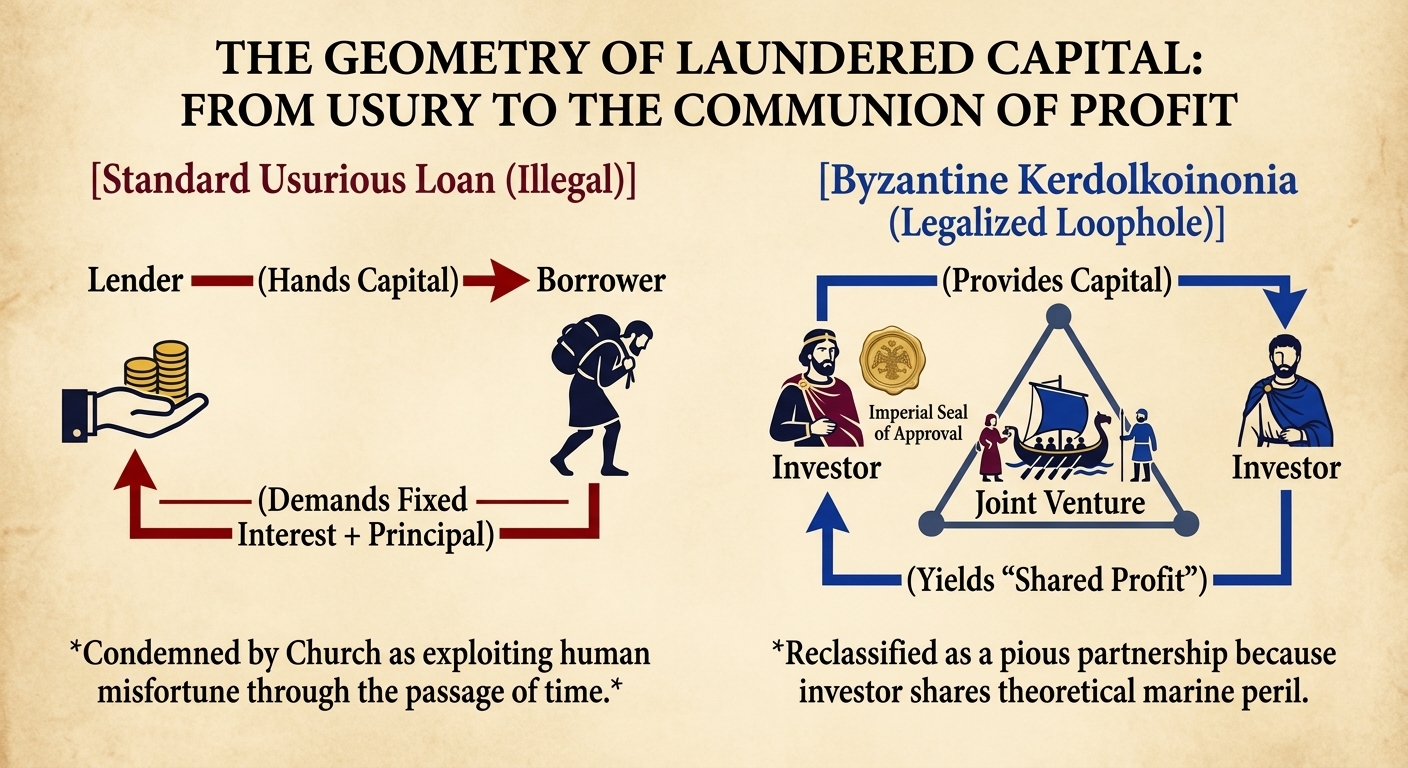
By reclassifying the capitalist not as an extractive lender but as a co-equal partner sharing in the communion of profit, the state bypassed anti-usury statutes. The moral loophole hinged on the concept of periculum maris (maritime peril): because the investor stood to lose their capital if the vessel sank, the double-digit financial returns yielded upon a successful voyage were legally redefined as a legitimate reward for risk, rather than sinful interest.
While the investor remained securely in Constantinople, the crew bore the physical labours of seafaring, slavery, and death. If the voyage failed due to any subjective assessment of crew negligence, the state’s criminal codes authorized the investor to strip the seafarers of their personal property and wages to make the initial capital whole. The kerdokoinonia industrialized usury by wrapping it in the vocabulary of communal partnership, further deepening and masking the exploitive nature of power dynamics.
The Canonist Counter-Offensive: The Church as the Matrix of Modern Capital
When the physical sovereignty of the Western Roman Empire collapsed and transitioned into the fragmented landscapes of feudal Europe, the Roman Catholic Church inherited, preserved, and upgraded this Roman legal technology. By the 15th and 16th centuries, the Vatican faced an institutional crisis. The rise of centralized nation-states and the fractures of the Protestant Reformation demonstrated that sovereign authority could no longer depend on physical coercion, territorial armies, or feudal land claims.
In response, the Church initiated a counter-offensive, shifting its governance model from physical dominance to invisible, jurisdictional, and financial capture. Rather than attempting to suppress the financial architecture of the expanding global market, the medieval and Renaissance Church canonized, formalized, and transformed it into the legal bedrock of all commercial finance.
The apex of this institutional legal engineering was the formulation of the Contractus Trinius (Triple Contract), pioneered by late-scholastic Jesuit and Dominican jurists:
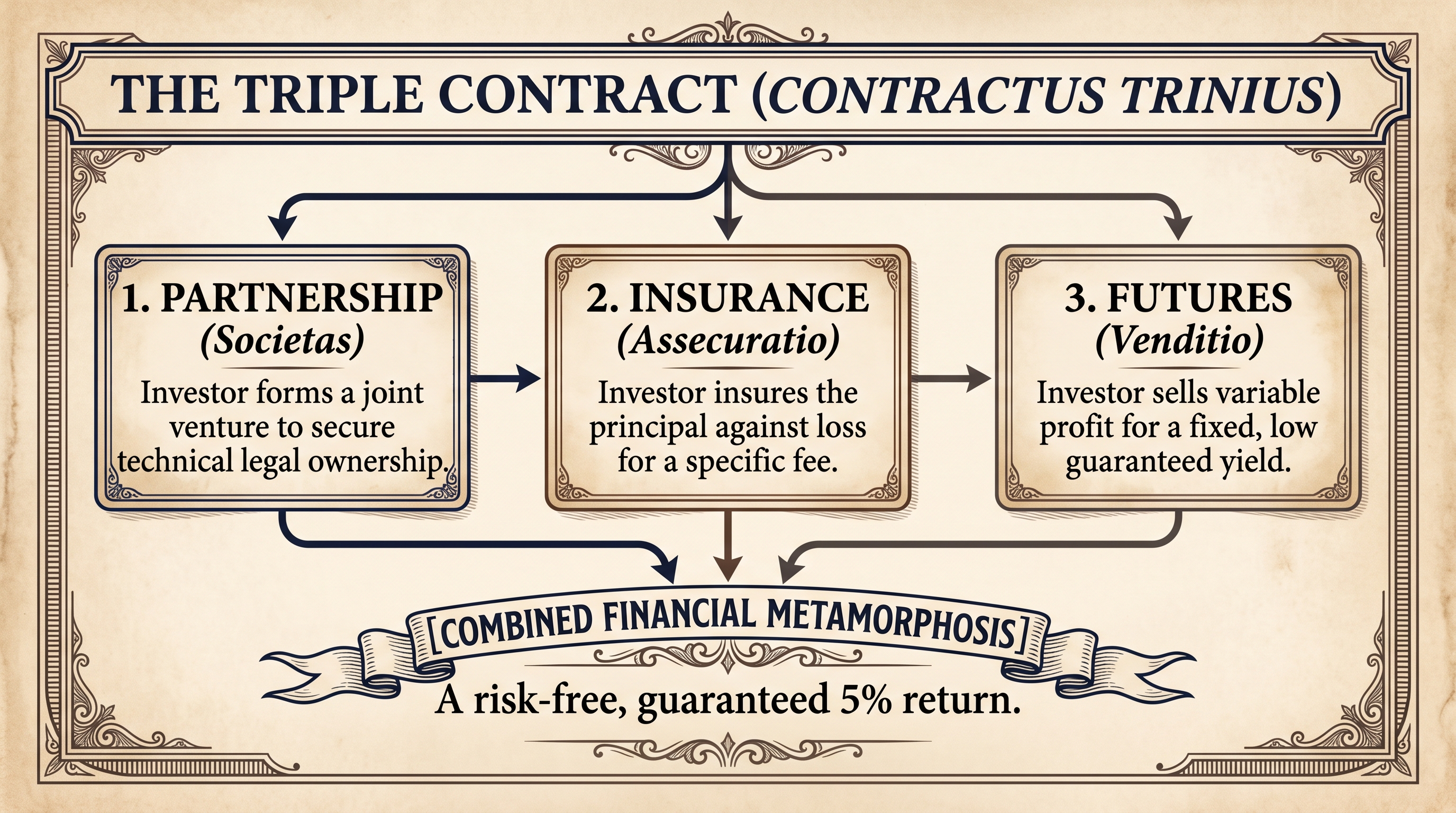
By stacking these three individually compliant legal abstractions into a single commercial transaction, the Church achieved a total financial metamorphosis. The investor assumed zero risk and secured a guaranteed interest return, replicating the exact economic mechanics of a usurious loan. Yet, because each layer was isolated and justified by canonist definitions of property and risk assignment, the transaction was free from spiritual or civil penalty.
Conclusion
The long arc of Western legal history reveals that the foundational structures of modern finance are the direct consequence of imperial and ecclesiastical mechanisms of control. The early Roman Empire captured decentralized maritime customs to fortify elite property holdings; the Byzantine state crystallized this power by asserting its absolute right to dictate the terms of human commerce; and the Catholic Church finalized the process by embedding these sanitized, usurious structures into Canon Law.
By building a transnational financial framework grounded in the legal fictions of corporate insulation, risk securitization, and semantic laundering, these institutions created a form of invisible governance. Long after empires fell and armies disbanded, the code written by these medieval jurists remains the unchallenged, operational infrastructure governing global wealth and human labor.


Leave a Reply