Deep Time and the Disruption of Human Chronology
Abstract
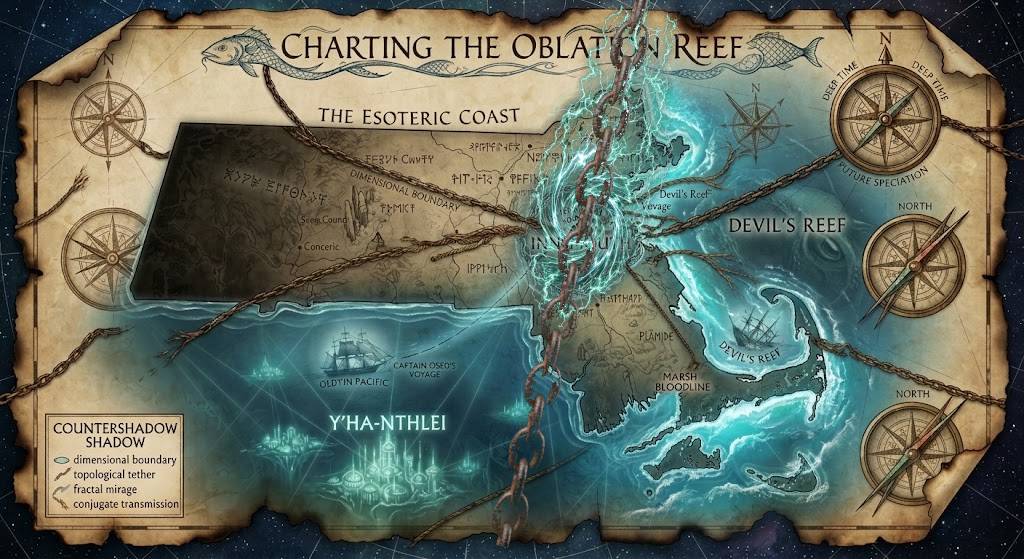
This paper presents a unique re-evaluation of H.P. Lovecraft’s The Shadow over Innsmouth (1931), by analyzing how its epistolary structure operates beyond the critical reductionism that relegates Lovecraft’s prose to a localized symptom of psycho-social alienation and biographical pathology, this analysis formalizes the text as an instance of historiographic metafiction. The novella serves as an intentionally encrypted, hyper-localized embedded narrative, whose closure is dependent on tethering to precise coastal topography and dimensional geographic boundaries. By utilizing spatial and temporal scales as a narrative mirage, Lovecraft constructs a perceptual threshold that crosses boundaries and conceals the very real, cosmic shift in human speciation. The supposed xenophobia narrative functions not as a focal thematic engine, but as a gauged psychological externalization, a countershowding construct designed to exploit human cognitive bias, deflecting a latent evolutionary transition from naive readers, while the subtext is tightly kerned and justified into the margins, leaving an empty shell behind for mainstream literary and historical analysis. Fundamentally, this evaluation demonstrates that by utilizing pseudonymity, Lovecraft constructs a hermetic narrative apparatus; the text deliberately misdirects the unfamiliar through a surface-level spectacle of alterity, while reserving its epochgraphic closure exclusively for those bound within the spatial-socio-temporal-topographical subtexts of the lived New England coastal landscape.
Introduction: Coded Historiography
For decades, literary scholarship surrounding H.P. Lovecraft has heavily favored a biographical approach, frequently identifying his thematic obsession with alterity as the unmediated byproduct of early 20th-century xenophobia. While these psychological frameworks capture the author’s surface anxieties, they flatten the structural and technical sophistication of his prose. When evaluated through the lens of historiographic metafiction, The Shadow over Innsmouth ceases to function as mere weird fiction; instead, it operates as a meticulously constructed counter-history.
Lovecraft’s narrative methodology relies on the deliberate synthesis of real-world historical subtexts, empirical geography, and fabricated nomenclature. By embedding a highly volatile cosmic truth within the mundane, bureaucratic, and historical textures of New England coastal lore, Lovecraft builds a closed semiotic loop. The narrative presents an unresolved, gothic mystery to the casual or external reader, while simultaneously providing a mathematically and geographically coherent record to the initiate. The structural core of this metafictional architecture depends on a profound manipulation of scale, perception, and spatial camouflage.
Temporal Horizon: Deep Time and the Disruption of Human Chronology
Within The Shadow over Innsmouth, Lovecraft disrupts the traditional, linear paradigm of human chronology by forcing it into a direct structural collision with the destabilizing horizon of cosmic deep time. To the naive observer, the town of Innsmouth is bound to a standard historical trajectory, a chronological continuum marked by nineteenth-century maritime prosperity followed by a sudden, linear descent into socioeconomic collapse. This localized human framework, however, operates as a profound perceptual illusion.
By compressing epochgraphic data into the syntactical margins of the narrative, Lovecraft reveals that the apparent ruin of the seaport is not a historical regression, but a profound synchronization with an ancient, pre-human temporal continuum. The text deliberately destabilizes the reader’s reliance on historical milestones by anchoring the true evolutionary transition of the populace to a scale that renders human history entirely irrelevant:
“For ocean is more ancient than the mountains, and freighted with the memories and the dreams of Time.”
In this formulation, the physical parameters of the coastal landscape, specifically the abyssal, aquatic depths, are repositioned as the literal archive of deep time. Human history is exposed as a shallow, fleeting layer of temporal paint dried over an immutable, primordial bedrock. When Zadok Allen notes that the town has “all gone to pieces in the last hundred years or so,” the narrative mirage becomes apparent. The century of human decay is a localized distortion; on a human-temporal scale, this exact block of time represents the latent incubation period required for the hybrid populace to shed their terrestrial, linear lifespans.
This temporal manipulation completely reframes the biological metamorphosis occurring within the population. The development of the Innsmouth look and the subsequent migration of the mature hybrids into the ocean are systematically stripped of their status as a contemporary disease or a sudden mutation. Instead, the narrative establishes this transition as a return to a permanent, unyielding species baseline, an awakening into a realm where the citizenry “would live with those who had lived since before man ever walked the earth.”
By using typographic compression to bury this temporal transition within casual observations of municipal decline, Lovecraft constructs a double-layered historical record. The superficial text satisfies the mainstream literary expectation of a regional ghost story, leaving a hollow historical shell for standard analysis to dissect. Meanwhile, the subtext quietly executes an epochal shift. The narrator’s ultimate realization at the conclusion of his journal is not an descent into madness, but a structural correction of his own temporal orientation. He stops measuring his existence by the fleeting, linear scale of his human ancestry and accepts his place within an immortal temporal continuum, proving that the apparent disappearance of the town’s lineage was merely a transition out of human time altogether.
…………………
……………..


Leave a Reply