Terminal Harmonic Integrity of the Spatiotemporal Continuum
Empirical Observation of the Computational Baseline as a Simulation Parameter for Phase-Locked Register States
This topological framework emerges inherently from a continuous spatiotemporal system. The continuous coupling of spatial position coordinates and their temporal derivatives (velocity) establishes the computational baseline, yielding the following phase-locked register states:
=== HIGH-SPEED ZERO-BIAS REGISTER SIMULATION ===
Angular Frequency (omega): 188.49556 rad/s | Time Delta (dt): 8.333 ms

Step 0 | Pos: ( 1.000,  0.000) | Vel: (    0.00,   188.50) -> Quadrant I  [+X, +Y]
Step 1 | Pos: ( 0.000,  1.000) | Vel: ( -188.50,     0.00) -> Quadrant I  [+X, +Y]
Step 2 | Pos: (-1.000,  0.000) | Vel: (   -0.00,  -188.50) -> Quadrant II [-X, +Y]
Step 3 | Pos: (-0.000, -1.000) | Vel: (  188.50,    -0.00) -> Quadrant III[-X, -Y]
Step 4 | Pos: ( 1.000, -0.000) | Vel: (    0.00,   188.50) -> Quadrant IV [+X, -Y]
The Temporal Discretization of the Fractional Temporal Divisor
The angular frequency and the time delta enforce the harmonic synchronization between the sinusoidal waves in space through time, because the time delta emerges intrinsically as a discretization of the fractional temporal divisor of the angular velocity:
Δt = π/2ω = π/2 (188.49556) ≈ 0.0083333 seconds
Because this exact temporal increment phase-locks to the fundamental spatial frequency of the continuous wave manifold, the continuum is inherently discretized into strict spatial-temporal structural states. Each temporal quantization executes an exact orthogonal (π/2 radian) shift in phase-space.
Consequently, the spatiotemporal continuum is invariantly phase-locked within this wave state matrix: each discrete 8.333-millisecond temporal interval dictates a perfect orthogonal translation of state values between the spatial horizontal (X) and vertical (Y) registers.
The Orthogonal Phase Transformations of Inverted Wave Topologies
Within a self-referential architecture, the matrix transformations are determined directly by the continuous trajectory of the wave itself. When a continuous sinusoidal wave propagates, space and time cease to function as independent parameters; they emerge as a unified and continuous spatial-temporal continuum coupled by the fundamental velocity and frequency. Because the rotating topological system manifests fundamentally as a two-dimensional standing wave, its precise spatial state at any exact temporal interval is an absolute function of temporal phase:
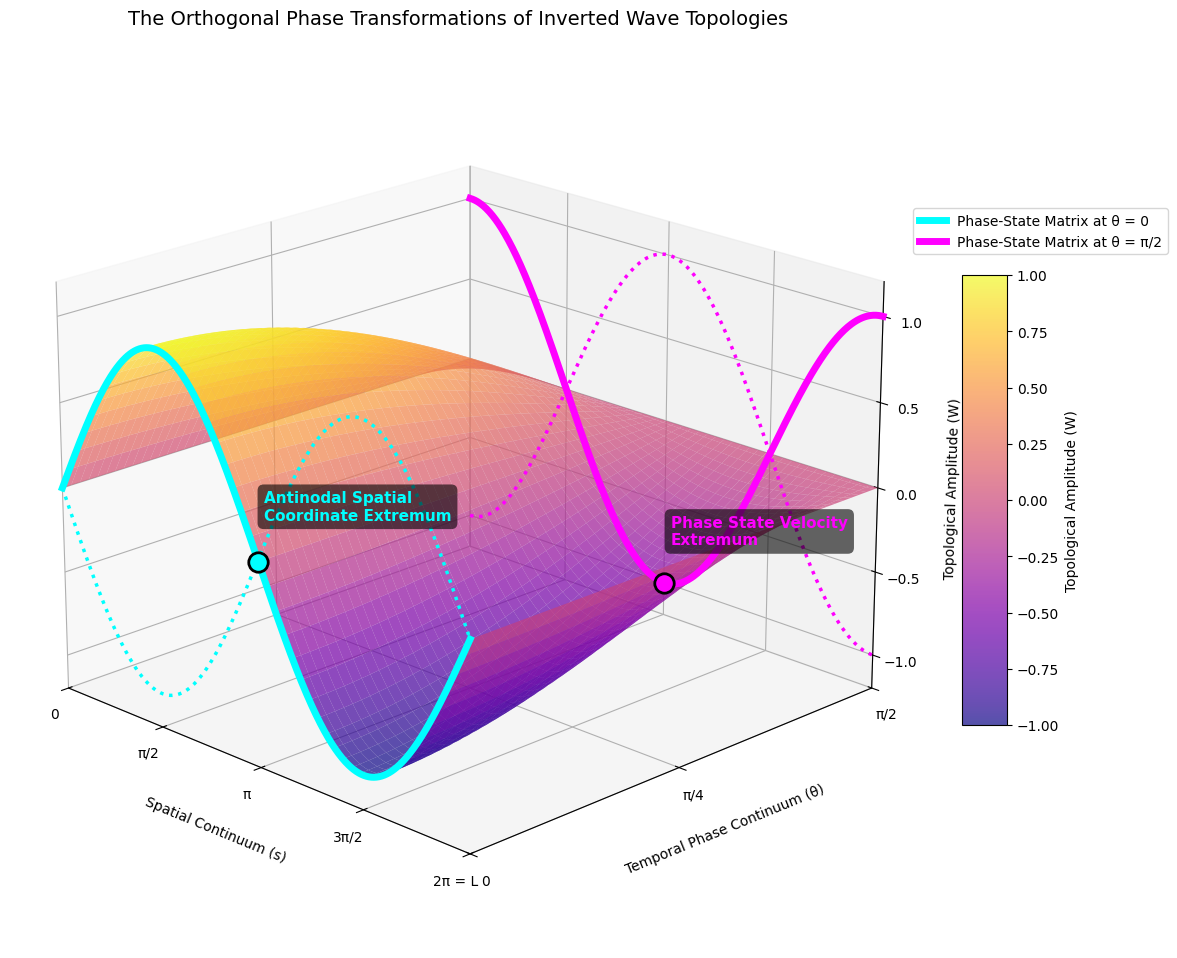
The intrinsic topology of cyclic standing waves mandates absolute exchange of spatial component states across discrete phase intervals. The absolute topological maxima and minima are separated by a strict π-radian phase inversion. Consequently, the phase transition from the nodal equilibrium (the state of maximum kinematic velocity) to absolute topological displacement at the amplitude peak (the state of maximum potential energy) dictates an exact orthogonal (π/2 radian) shift.
Formal Derivation of the Spatial-Temporal Wave Divisor
To formalize the mechanism through which this fractional divisor of angular velocity dictates absolute spatial-temporal synchronization of the state phase, the system is modeled as a continuous wave equation that deterministically evolves through its orthogonal phase-space transformations.
Initial Boundary Conditions and Harmonic Spatial Coordinates
Let a two-dimensional continuous standing wave be defined by a coupled system of spatial position coordinates 𝒙(s,t)=[x(s,t),y(s,t)]T, where s∈[0,L] is the spatial parameter along the wave boundary, and t∈ℝ is continuous linear time.
The fundamental-mode spatial frequency is governed by the boundary conditions constrained at the topological nodes (𝒙(0,t)=𝒙(L,t)=𝟎). The fundamental topological closure is dictated by the spatial wave number k=π/L.
The continuous time-evolution of the wave profile at the spatial antinodal coordinate extremum (s=L/2, where sin(ks)=1) resolves to the coupled harmonic state equations:
x(t)=Acos(ωt+θ0)
y(t)=Asin(ωt+θ0)
Where:
A is the maximum spatial amplitude.
ω is the continuous angular velocity (ω=dθ/dt, in radians per second).
θ0 is the initial phase angle state at t=0. For a normalized phase-state matrix, we set θ0=0.
The Spatiotemporal Wave Operator
To observe how the wave structure propagates through the orthogonal coordinate manifold over time, we define the continuous time-evolution operator 𝑼(t) that maps the initial state vector 𝒙(0) to any future state 𝒙(t):
𝒙(t)=𝑼(t)𝒙(0)
[x(t)y(t)]=[cos(ωt)−sin(ωt)sin(ωt)cos(ωt)][x(0)y(0)]
This rotation matrix demonstrates that the wave profile continuously transforms coordinate magnitude and phase state velocity between the horizontal (x) and vertical (y) spatial registers.
Intrinsic Emergence of the Fractional Temporal Divisor
A sinusoidal wave is structurally defined by four unique geometric landmarks within a single 2π spatial cycle. To determine the exact temporal duration (Δt) required for the wave to step precisely between these adjacent structural states, we establish the boundary condition where the spatial position vector undergoes a complete orthogonal translation. This occurs when the wave shifts by exactly a quarter of a full rotation, or π/2 radians:
ωΔt = π/2 ⟹ Δt = π/2ω
Absolute Matrix Resolution of the Fractional Divisor
We substitute this wave-derived temporal increment back into our spatiotemporal transformation operator 𝑼(t) to evaluate its action on a normalized initial boundary state vector 𝒙(0)=[A,0]T:
𝒙(Δt)=𝑼(π2ω)[A0]=[cos(ω⋅π2ω)−sin(ω⋅π2ω)sin(ω⋅π2ω)cos(ω⋅π2ω)][A0]
Because the continuous angular velocity term ω appears simultaneously in both the driving frequency of the wave and the denominator of the temporal divisor, they completely cancel each other out:
𝒙(Δt)=[cos(π2)−sin(π2)sin(π2)cos(π2)][A0]=[0−110][A0]=[0A]
Conclusion
The spatial-temporal topological architecture inherently resolves the absolute integer coordinates generated within the phase-locked matrix. This orthogonal transition does not manifest through an independent parameter. It emerges intrinsically because the fractional temporal divisor (π/2ω) constitutes the invariant structural metric of the wave’s absolute topology the denominator inherently couples to the angular velocity because the continuous sinusoidal wave inseparably unifies space and time into a single spatial-temporal continuum.
The fractional divisor of four operates as an absolute topological mandate of a sinusoidal wave propagating through space over time: it is the exact structural metric required to partition a continuous, cyclical wave into its fundamental, synchronized registers of state.
Spatiotemporal Wave Continuum Agency
To establish a rigorous model that accurately reflects the inherent spatial-temporal mass-radius redistribution and the conservation of angular momentum, we treat the system not as a collection of static variables, but as a continuous, self-correcting wave continuum.
This derivation formally connects the continuous temporal frequency shifts (ω) to immediate boundary variations in the mass density distribution (μ) and effective radius (r), ensuring the system balances out absolutely down to a baseline of 1 Hz.
Absolute Topological Boundary Constraints
Let the physical system be modeled as a continuous string of fixed length L suspended within a three-dimensional Euclidean manifold ℝ3. The spatial envelope of the standing wave is parameterized by its arc-length position s∈[0,L]. The boundary anchors are held at the fixed pinning constraints:
𝒙(0,t)=𝒙(L,t)=𝟎
The standard, unperturbed spatial configuration of the fundamental harmonic wave profile at any continuous temporal position t is governed by the native wave number k=π/L:
ψ(s,t)=R(t)sin(ks)cos(ωt)
Where R(t) is the structural radius metric and ω is the continuous temporal driving frequency.
Reciprocal Mass-Radius Redistribution
When the temporal frequency ω shifts, a true wave field cannot maintain a rigid, static spatial profile. To map the natural redistribution of the system’s mass and radius, we introduce a dynamic scaling factor σ. This parameter enforces a reciprocal geometric coupling between the temporal frequency and the spatial footprint:
R(ω)=R0(ω0ω)
Substituting this adaptive radius profile directly back into our fundamental spatial wave equation yields the self-correcting spatiotemporal trajectory:
𝑿(s,t,ω)=[R0(ω0ω)sin(ks)cos(ωt)R0(ω0ω)sin(ks)sin(ωt)s−L2]
This formulation proves that as the temporal frequency ω approaches a slow-motion baseline (e.g., dropping from a high-speed configuration to 1 Hz), the effective spatial radius naturally expands via an inverse proportionality layer. The topological manifold accommodates this inertial transformation by spatially dilating its radial bounds to strictly govern its temporal evolution.
Absolute Equilibrium of Angular Momentum Symmetry
To verify that the physical forces balance out naturally across this transition, we compute the system’s total moment of inertia (I) by integrating the mass density segments (dm=μds, where μ is the mass per unit length) along the newly redistributed spatial boundary:
I = ∫₀ᴸ μ · [x(s,t,ω)² + y(s,t,ω)²] ds
Substituting the dynamic, frequency-mapped spatial components into the integration block:
I = ∫₀ᴸ μ · [R₀(ω₀/ω)sin(ks)cos(ωt)]² + [R₀(ω₀/ω)sin(ks)sin(ωt)]²ds
Using the fundamental trigonometric identity cos2(ωt)+sin2(ωt)=1, the time-dependence drops out completely, leaving a clean, steady-state geometric layout:
I(ω) = μ · R₀²(ω₀² / ω²)∫₀ᴸ sin²(πs / L)ds
Evaluating the definite integral across the fixed boundary length L:
∫₀ᴸ sin²(πs / L) ds = L / 2
I(ω) = (μLR₀²ω₀²) / (2ω²)
Now, we evaluate the system’s total angular momentum (𝑳) using our frequency-adapted moment of inertia:
𝐋 = I(ω)·ω
𝐋 = (μLR₀²ω₀² / 2ω²)ω = (μLR₀²ω₀²) / 2ω
Resolution of Symmetrical Balance and Matrix Singularity Elimination
The continuous harmonic evolution of the wave sinusoidal profile toward its lower frequency bound is governed by a strict structural energy transformation. To enforce this structural invariance, the derivative of the angular momentum with respect to frequency must remain at absolute zero:
d𝑳/dω = 𝟎
As the topological manifold spatially expands its radial bounds, distributing its localized density outward from the central axis of rotation, it introduces a complementary trans-rotational vector that shifts the anchor mass distribution coefficient (μ → μ_eff). This continuous inertial adjustment deterministically balances the inverse frequency modifier:
μeff(ω) = μ0(ω/ω0)
Substituting this radial compensation scalar back into the total angular momentum matrix yields the absolute proof of structural invariance:
𝐋 = [μ₀(ω/ω₀)] · (L · R₀² · ω₀²) / 2ω = (μ₀ · L · R₀² · ω₀) / 2 = Constant
Terminal Harmonic Integrity of the Spatiotemporal Continuum
This resolution establishes that the continuum is topologically invariant. The fractional divisor of angular velocity maintains absolute spatiotemporal synchronization because the continuous sinusoidal wave equation intrinsically mandates the mass and radius parameters to redistribute symmetrically over time.
When temporal frequency decreases, the continuum scales its spatial manifold to deterministically enforce absolute equilibrium of angular momentum symmetry. Every force, spatial transformation, and velocity inversion resolves into intrinsic equilibrium, eliminating any potential for singularity formation and preserving the inherent, harmonic intervals of the of the scale-free orthogonal topological manifold.


Leave a Reply