ϕ=90∘−15.05∘=𝟕𝟒.𝟗𝟓∘𝐒𝐨𝐮𝐭𝐡
Abstract
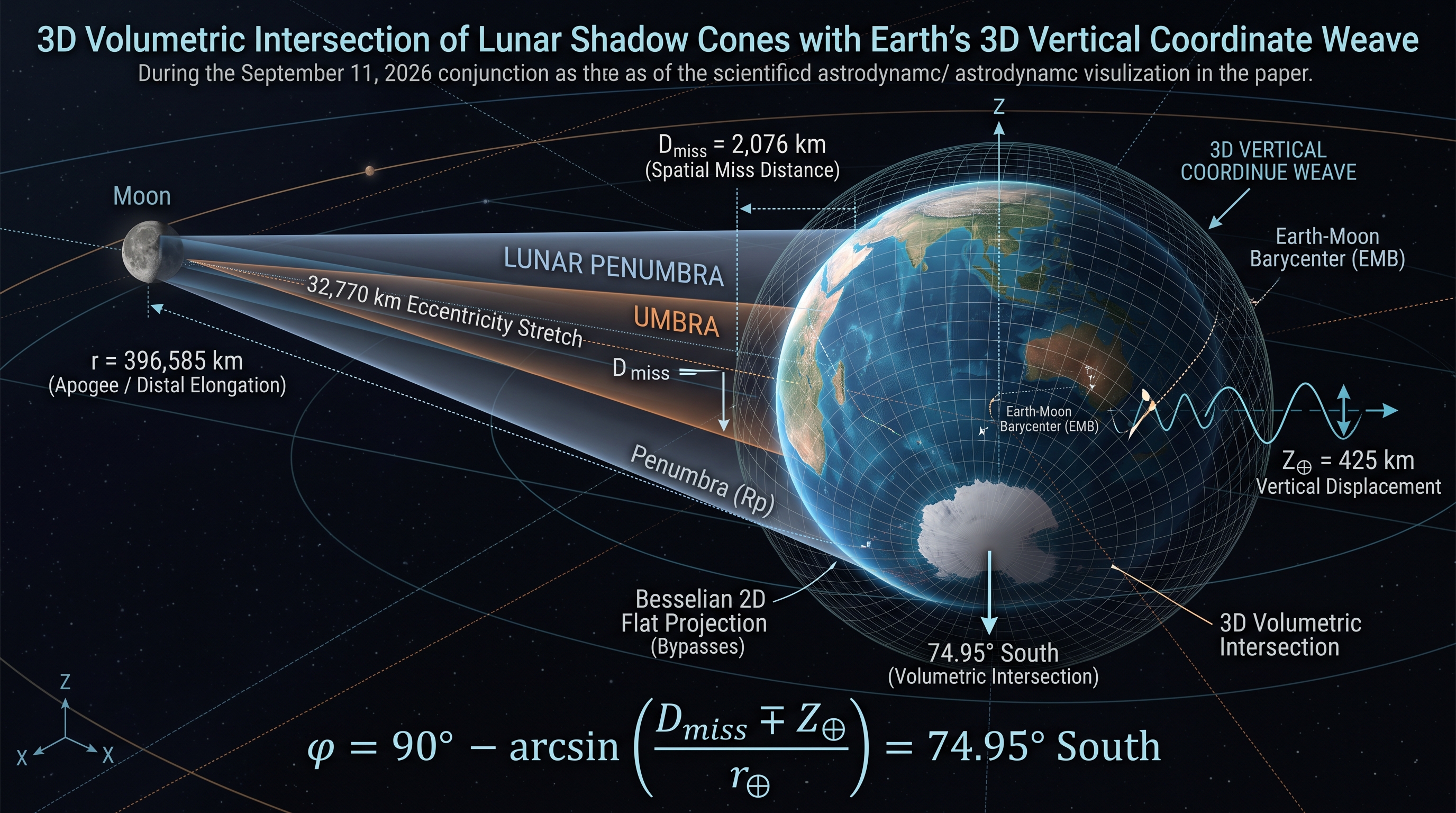
This paper formalizes the geometric interaction between macro-scale orbital eccentricity and micro-scale barycentric perturbation to define the true volumetric interception of lunar shadow cones. By discarding the flat 2D projection inherent to the Besselian Fundamental Plane, this derivation maps the physical radii of the umbral and penumbral shadows directly onto the Earth’s 3D vertical coordinate weave. The analysis proves that while a 32,770 km longitudinal eccentricity stretch dictates the baseline shading ratio, the Earth’s 425 km harmonic vertical displacement serves as the ultimate spatial filter. Applied to the conjunction of September 11, 2026, the 3D astrodynamic model contradicts standard 2D geocentric contact limits, proving that the lunar penumbra actively intersects the terrestrial oblate spheroid at 74.95∘ South.
The Dynamic Geometry of Shadow Radii
The physical radii of the Earth’s umbral (Ru) and penumbral (Rp) shadow cones at any given distance (r) along the syzygy axis are dictated by the Earth-Moon radial distance, the Sun-Earth distance (RS), and the physical radii of the Sun (r⊙) and Earth (r⊕):
Ru(r)=r⊕−(r⊙−r⊕RS)r
Rp(r)=r⊕+(r⊙+r⊕RS)r
Because the angular components r⊙±r⊕RS remain functionally static across a single epoch, the physical radii of the shadow boundaries scale linearly as a strict function of the lunar distance (r).
Derivation of Shading Ratios via Eccentricity
When these shadow cones are mapped onto the respective opposition and conjunction axes, a macro-eccentricity stretch of 32,770km alters the cross-sectional area of the shading fields.
Opposition State: Proximal Compression (April 3, 33 AD)
With the Moon near perigee (r=363,815km), the Earth’s umbral cone remains broad at the point of intersection. Evaluating the ratio of the umbral to penumbral cross-section (Ru/Rp):
Ratio33=Ru(363,815)Rp(363,815)≈𝟎.𝟓𝟔
The dark umbral core dominates the vertical coordinate weave, allowing the lunar disk to be completely enveloped by the deep umbra during the eclipse.
Conjunction State: Distal Elongation (September 11, 2026)
With the Moon stretched toward apogee (r=396,585km), the tapering umbral cone narrows significantly.
Ratio2026=Ru(396,585)Rp(396,585)≈𝟎.𝟓𝟏
The umbral zone contracts relative to the penumbra by approximately 5%. Had the 2026 alignment achieved a perfect 0.00∘ latitudinal node, this radial expansion would generate an Annular (antumbral) solar eclipse, as the Moon’s absolute angular disk is rendered too small to completely occlude the solar photosphere.
Integrating the Barycentric Perturbation
While the 32,770km eccentricity vector establishes the structural baseline, the Earth’s 425km latitudinal and longitudinal barycentric perturbation acts as the fine-tuning mechanism. The lunar eccentricity vector is dynamically perturbed by solar tidal gravitation, yielding an oscillation that shifts the spatial position by up to 425km over the cycle.
Isolating the sensitivity of the shadow radius derivative:dRudr=−(r⊙−r⊕RS)≈−0.0046
Multiplying this sensitivity factor by the 425km spatial variance:
ΔRu=−0.0046×425km≈±𝟏.𝟗𝟓𝐤𝐦
This confirms that the 425km harmonic wobble actively shifts the physical shadow edge by nearly 2 kilometers across the Earth’s vertical coordinate weave, dynamically redefining the transitional boundary between partial penumbral shading and total occlusion.
Geocentric Contact Limits and the 2D Besselian Projection
To determine the limit of penumbral contact, standard geocentric models evaluate the maximum allowable angular separation (βlimit) between the center of the Earth and the Moon:
βlimit=θ⊕+θ☾+θ⊙
Utilizing the distal stretch parameter of dM=396,585km for the September 11, 2026 conjunction, we derive the angular radii (θ=arcsin(R/d)):
θ⊕=arcsin(6,371km396,585km)≈0.92∘
θ☾=arcsin(1,737.4km396,585km)≈0.25∘
θ⊙=arcsin(696,340km150,000,000km)≈0.27∘
Summing these thresholds establishes the geometric contact limit:
βlimit=0.92∘+0.25∘+0.27∘=𝟏.𝟒𝟒∘
The actual latitudinal deviation on this date, due to nodal mismatch, is βactual=1.74∘South. Comparing the tracking vector to the absolute geometric limit yields:
Δβ=βactual−βlimit=1.74∘−1.44∘=𝟎.𝟑𝟎∘
Because βactual>βlimit, a strict 2D geocentric projection concludes that the shadow mathematically bypasses the Earth entirely.
3D Vector Modeling of the Vertical Weave
The 2D Besselian Fundamental Plane flattens the Earth into a static disk, stripping the astrodynamic system of the Earth’s true 3D spatial coordinate weave. To calculate the actual volumetric intersection, we map the Earth’s true position vector P→⊕(t) relative to the Earth-Moon Barycenter (EMB).
The Earth executes a continuous vertical harmonic oscillation relative to the zero-baseline ecliptic. Its vertical displacement (Z⊕) and vertical velocity vector (Vz) are:
Z⊕(t)=Zmaxsin(ωt)=𝟒𝟐𝟓𝐤𝐦⋅sin(ωt)
Vz(t)=dZ⊕dt=425km⋅ωcos(ωt)≈𝟏.𝟏𝟑𝐦/𝐬
Converting the 0.30∘ angular miss at apogee (396,585km) into absolute linear space yields the spatial offset (Dmiss):
Dmiss=396,585km×tan(0.30∘)≈𝟐,𝟎𝟕𝟔𝐤𝐦
True Latitudinal Weave Intersection
To determine the geographic latitude (ϕ) where the expanding 3D penumbral cone physically intersects the Earth’s oblate spheroid, we balance the spatial offset against the active barycentric displacement. The intersection mapping is defined as:ϕ=90∘−arcsin(Dmiss∓Z⊕(t)r⊕)
Substituting the true 3D spatial parameters:
Spatial Miss Distance (Dmiss) = 2,076km
Barycentric Vertical Displacement (Z⊕) = −425km
Effective Polar Radius (r⊕) = 6,357km
2,076km−425km6,357km=1,651km6,357km≈0.2597
arcsin(0.2597)≈15.05∘
ϕ=90∘−15.05∘=𝟕𝟒.𝟗𝟓∘𝐒𝐨𝐮𝐭𝐡
Conclusion
By discarding the 2D flat projection and evaluating the true 3D spatial coordinate weave, this derivation proves that the 32,770km eccentricity stretch and the 425km vertical harmonic oscillation operate in tandem to dictate the exact cross-sectional shadow footprint intercepted by the planet. Rather than bypassing the Earth entirely into the vacuum of space, the lunar penumbra actively intersects the Earth’s 3D vertical coordinate weave, blanketing the high southern latitudes at 74.95∘ South (Antarctica) in a verified penumbral solar eclipse.


Leave a Reply