The Trinity of Absolute Control: Space, Mind, Time
Introduction: From Geographic Insulation to Universal Calibration
This paper traces the restructuring of papal sovereignty across the sixteenth century as the Vatican transitioned from a localized territorial power to a universal regime of ideological and spatial-temporal control. In the early 1500s, the papacy defended its sovereign authority primarily through physical means, engaging in regional land campaigns and relying on conventional military forces to secure its borders. This traditional reliance on territorial defense proved inadequate when confronted by the ideological fracture of the Protestant Reformation in 1517 and the destruction of Rome during the mutinous sack of 1527. These dual crises exposed the limits of relying on physical borders to protect an increasingly fragile ideological consensus, forcing a reassessment of how the Holy See guaranteed its survival.
Following the Council of Trent, the papacy pivoted away from traditional border defense, weaponizing Renaissance splendor and embracing a system of centralized governance rooted in defensive spiritual warfare. The Vatican deployed systemic instruments of governance and institutional control, such as the Roman Inquisition and the Index of Forbidden Books, to enforce ideological compliance. Simultaneously, the papacy constructed instrumental architecture, with advanced cartography, astronomy, and physics to regulate the geopolitical and temporal landscape.
During this period, the physical footprint of the Vatican was reshaped, and its religious authority was fiercely challenged and redefined. As the century progressed, the Vatican shifted from a worldly Renaissance court to a centralized bureaucratic court and organized counter-offensive state.
The Kinetic Breach: Systemic Failure and the Limits of Terrestrial Hegemony
In 1517, the Vatican’s predatory and coercive financial maneuvers, specifically, the widespread authorization of indulgences to fund its sweeping and prodigious architectural endeavors, caused a theological dispute and ideological fracture. This practice prompted Martin Luther to publish his 95 Theses, sparking the Protestant Reformation. This was a catastrophic fragmentation of the Vatican’s centuries-old monopoly on spiritual consensus.
At the beginning of the sixteenth century, the Holy See operated under the assumption and active pursuit of a sovereign terrestrial hegemony, anchoring its divine authority to physical borders. Under the martial command of Pope Julius II, the Vatican relied on traditional kinetic force. The Warrior Pope personally led papal armies into battle to expand Vatican territory and secure its geopolitical perimeter against foreign invaders and rival Italian states.
Pope Julius II needed an independent corps who could not be bought or blackmailed by rival Roman noble families. Funded by the German merchant Jacob Fugger, Julius recruited a contingent of 150 Swiss soldiers. Under the command of Kaspar von Silenen, they marched into Rome through the Porta del Popolo and officially entered the Vatican on January 22, 1506, establishing the Pontifical Swiss Guard.
Taking the head of the Church onto a Renaissance battlefield was an enormous political risk; capture or death would cause an immediate institutional crisis. The elite Swiss pike-and-halberd square functioned as a mobile, impenetrable wall surrounding the Pope’s person, giving him the tactical safety needed to command from the front line.
On May 6, 1527, any illusion of the Vatican’s invulnerability was ruined during the Sack of Rome, transforming the capital of the High Renaissance into a landscape of rubble, and permanently fracturing the Holy See’s claim to absolute terrestrial hegemony. The bottom-up mutiny was a cascading systemic failure of fiscal exhaustion, geopolitical friction, and theological fury.
The broader imperial apparatus in northern Italy had fractured, a force originally totaling some 34,000 men comprised of Spanish infantry, Italian mercenaries, and German Landsknechts. Left unpaid by a bankrupt Emperor Charles V, and deprived of provisions from having spent months campaigning in logistical isolation, this restless collective revolted against their superiors.
To salvage a modicum of command, their general, the renegade French aristocrat Charles de Bourbon, redirected this mutinous force southward toward Rome, implicitly offering the immense, accumulated treasury of Europe’s spiritual capital as their overdue remuneration. This escalating tactical emergency collided directly with acute political resentment against the papacy itself.
Pope Clement VII, who had initially operated as an imperial ally, had grown increasingly anxious over Charles V’s suffocating monopoly on the Italian peninsula. In a bid to rebalance the regional architecture of power, Clement VII orchestrated the League of Cognac, aligning the Vatican with France and various Italian city-states to militarily challenge the Holy Roman Empire. Consequently, to the approaching imperial troops, the Pope was viewed as actively hostile, as he had aggressively capitalized and weaponized a war against them.
Further fanning the flames, a large cohort of the invading force consisted of German Landsknechts who had recently converted to Lutheranism. These soldiers conceptualized Catholic Rome not as a sanctuary of faith, but as a western Babylon, a corrupt nexus of idolatry, systemic avarice, and spiritual decay. They marched with a righteous, explicit desire to humiliate the papacy and dismantle its opulent High Renaissance monuments.
When the rampaging imperial troops arrived outside Rome’s neglected fortifications on May 6, 1527, their commander, Charles de Bourbon, was fatally shot during the opening skirmish. The localized mob of roughly twenty thousand battle-hardened mutineers, breached the fragile fortifications of the Borgo neighborhood near the Vatican. As the defenses collapsed, a wave of pikemen and musketeers flooded toward St. Peter’s Basilica.
The Swiss Guard, numbering 189 men under the command of Captain Kaspar Röist, knew they could not hold the city. Their sole objective shifted from defending territory to buying time. The sovereign authority of the Church was reduced to a panicked retreat. Captain Röist deployed his men at the High Altar of St. Peter’s Basilica and outside on the steps of the basilica’s burial grounds. Surrounded by overwhelming numbers, the Guard formed a tight, defensive ring. Because they were fighting battle-hardened mercenaries, the combat was savage and hand-to-hand, fought with halberds, swords, and pikes. Out of the 189 guards, 147 were killed. They held the line long enough to create a bottleneck, freezing the vanguard of the imperial army in place for critical moments.
The remaining Swiss Guards grabbed Pope Clement VII and rushed him out of the palace, using Passetto di Borgo, a raised stone corridor that runs for about 800 meters along the top of the fortification wall connecting the Vatican to the fortress of Castel Sant’Angelo, where he remained for months while the terrorizing continued. The plundering served as the definitive curtain call to Rome’s absolute sovereignty, reducing the papacy to an institution whose survival had to be bought in blood on the steps of St. Peter’s.
The unraveling of the Vatican’s seeming invincibility and ancient glory during the 1527 siege proved that static fortifications, traditional standing armies, and purely physical strategies of containment were no longer sufficient to safeguard the survival and supremacy of the Holy See. To withstand the fracturing of the European geopolitical landscape, the Vatican’s apparatus recognized that their control paradigms had to radically evolve. They could no longer rely on defending a geographic border; they had to begin engineering the structural and existential parameters of the space contained within it.
The Inquisition Grid: Weaponized Orthodoxy and Temporal Vulnerability
In 1542, Pope Paul III established the Congregation of the Holy Office (the Inquisition) inside the Vatican to combat heresy, censorship, and doctrinal errors throughout Catholic territories. The Roman Inquisition was a formidable intelligence and enforcement apparatus designed to mandate localized doctrinal compliance.
In 1559 this control grid was further expanded by the first Index Librorum Prohibitorum (Index of Forbidden Books), a list of publications deemed heretical or immoral by the Vatican that Catholics were forbidden to read. Banned titles were organized into a three class structure, targeting the complete works of Protestant reformers and humanists like Desiderius Erasmus and Niccolò Machiavelli. The Index Librorum Prohibitorum also prohibited foundational scientific, medical, and geographical texts alongside various anonymous books and vernacular Bibles.
Convened to aggressively condemn Protestant theology and codify Counter-Reformation doctrine, the Council of Trent (1545–1563) centralized the Vatican’s authority, doubling down on traditional Catholic views, salvation requires both faith and good works. Ultimate authority belongs to both the Bible and Church tradition. Furthermore, only the Catholic Church has the authority to interpret scripture.
During the council, the Church rigidly reaffirmed the necessity of dating Easter based on the exact parameters established by the First Council of Nicaea in 325 AD: the celebration must fall on the first Sunday after the first full moon following the spring equinox (anchored to March 21). This strict enforcement, backed by the explicit threat of excommunication, was geopolitically weaponized to further isolate the Orthodox Church, which utilized a different process for determining the date.
This spatio-temporal mandate positioned the Vatican into a paradox. Because the Julian calendar had accumulated centuries of continuous fractional drag, the actual physical equinox had drifted from the March 21 parameter. The Vatican’s intelligence apparatus permitted advanced astronomy and mathematics only if they functioned exclusively as theoretical tools for the Church’s use, such as astronomer Christopher Clavius’s calculations for Easter.
The moment a scientist claimed their empirical data redefined physical reality without papal authorization, they were neutralized by the Index. This control mechanism ensured no external data could overwrite the Church’s consensus reality. This friction from the monopoly on reality is precisely what later targeted the revolutionary frameworks of Copernicus and Galileo.
Time had become an existential vulnerability threatening the structural integrity of the Holy See.
The Crucible of Architectural Reform: Reimagining Roman Space
The Great Architectural Rebuild was simultaneously, the economic catalyst that triggered the Protestant Reformation, and the propaganda weapon used during the Counter-Reformation. Before the Reformation, the Vatican’s architecture was about Renaissance beauty, and classical antiquity. After the Council of Trent , the purpose of the architecture shifted, as Trent decreed that art and architecture must be used to teach Catholic doctrine, inspire emotional awe, and visually defeat Protestantism.
When in 1506, Pope Julius II authorized the demolition of the 1,200-year-old Old St. Peter’s Basilica, he realized the Vatican lacked the money to fund Donato Bramante’s colossal new design. To raise cash, his successor, Pope Leo X, aggressively expanded the sale of plenary indulgences across Europe. Dominican friar Johann Tetzel was hired to hawk these indulgences in Germany, using high-pressure sales tactics to convince poor peasants that buying a piece of paper would release their relatives from purgatory.
Furious that money meant for local salvation was being funneled to Rome to build a luxurious Italian basilica, Martin Luther drafted his 95 Theses in 1517. Luther explicitly wrote that if the Pope had so much money, he should build the basilica with his own cash rather than the skin and bones of the poor. While Protestants were stripping their churches bare and destroying statues, the Vatican built an overwhelmingly opulent, golden, giant monument.
Over the ensuing decades, the Vatican commissioned architects and artists like Michelangelo and Raphael to structurally and visually reimagine the seat of papal authority. Raphael was commissioned to redecorate a suite of four reception rooms on the second floor of the Apostolic Palace. Julius II famously refused to live in the apartments of his predecessor and bitter rival, Alexander VI, which prompted the renovation. Raphael mathematically mapped perspective grids of the walls of the Stanze di Raffaello before painting, creating definitive High Renaissance frescoes such as The School of Athens. Michelangelo painted the Sistine Chapel ceiling, later painted The Last Judgment on the altar wall as the Reformation raged, and spent his final years engineering the immense cupola and dome of the new basilica.
By the time Pope Gregory XIII assumed control later in the century, this architectural instrumentation had evolved. Between 1578 and 1580, Bolognese architect Ottaviano Mascherino was commissioned to construct the Gallery of Maps. This 395 foot long corridor connecting the papal palace to the Sistine Chapel, was a statement of geopolitical and spiritual dominion.
The visionary behind the project was Ignazio Danti, a Dominican friar, brilliant mathematician, cosmographer, and astronomer. Gregory XIII had originally brought Danti to Rome to help fix the inaccurate Julian calendar. Between 1580 and 1583, Danti utilized cutting-edge Renaissance cartography to map the Italian peninsula across 40 fresco panels, measuring roughly 15 by 11 feet each. The Gallery Of Maps was a cartographic projection of geographic authority, binding the known topography of the Italian peninsula into the Vatican’s internal matrix.
Directly linked to this gallery, rising at its northern terminus as one of the highest vertical points in Vatican City, Mascherino simultaneously erected the Torre dei Venti (The Tower of the Winds). Supervised by Ignazio Danti, the Torre dei Venti was ostensibly commissioned as an observatory to quantify the inaccuracy of the Julian Calendar. In reality, the room was being constructed as a temporal grounding device. On the ceiling of the room of the Meridian was a 16-point anemoscope. This mechanical wind rose was physically tethered to an exterior weather vane on the roof, allowing an internal pointer to sweep across the ceiling’s painted directional matrix and allegorical personifications of the seasons.
The surrounding late Counter-Reformation frescoes were painted by Paul and Matthijs Bril, brothers from Antwerp, and Nicolò Circignani, also known as Pomarancio and Matteino da Siena. The frescos articulate a powerful narrative: the absolute sovereignty of divine will over temporal forces. The walls feature Christ calming the tempest on the Sea of Galilee (south wall), The Shipwreck of St Paul on Malta (west wall), all within an apocalyptic allegory of the Angels holding back the four winds.
Between 1578 and 1582, the construction of the Tower of the Winds and the Gallery of Maps transformed the northern corridor of the Apostolic Palace into a chaotic epicenter. Under the command of Captain Jost Segesser von Brunegg, the Pontifical Swiss Guard was tasked with securing active construction zones occupied by secular artisans, masons, and foreign scholars. Stationed at pivotal choke points along the upper west gallery, the elite sentries functioned as a high-security cordon. They restricted access to the confidential chambers of the Papal Calendar Commission, protecting astronomers like Christopher Clavius and Egnazio Danti as they calculated the foundations of the Gregorian calendar.
Danti’s maps in the Gallery were the most (known) geographically precise visual data ever compiled of the Italian peninsula, detailing ports, mountain passes, and fortification positions. At a time when foreign powers like Spain and France were vying for control of Italy, these maps were state secrets. The Swiss Guard was tasked with searching laborers specifically for hidden rolls of parchment, sketches, or unauthorized measurements to prevent foreign spies from leaking the defensive vulnerabilities of the Papal States to rival kingdoms.
Inside the Tower of the Winds, the Papal Calendar Commission was calculating how to drop the temporal drift from the year to create the Gregorian calendar. In the 1580s, calendar data was highly volatile. If a Protestant state intercepted the exact equations or the premature announcement, they could weaponize it as propaganda, framing the Pope as a tyrant attempting to alter time. The Swiss Guard enforced a strict information quarantine around the Sala del Meridiano, allowing only vetted Jesuit astronomers and the Pope’s inner circle past the thresholds.
Historical accounts from Roman chroniclers indicate that the brawls and riots erupting on the scaffolding of the Belvedere gallery were frequently stoked by theological and geopolitical espionage rather than wages. Because the Vatican required hundreds of highly specialized artisans, masons, and stone-cutters, they had to hire labor from across northern Italy and Europe. Vetting every single worker’s religious background was impossible. Records show that Protestant sympathizers and anti-papal agitators infiltrated the work crews. They purposefully initiated brawls or damaged infrastructure to slow down the completion of Counter-Reformation architecture.
This footprint established a human barrier around Pope Gregory XIII during a volatile era marked by rural banditry and lingering geopolitical threats outside the Roman walls. Simultaneously, the Swiss Guard operated as a vital diplomatic nexus between the Holy See and the fragmented territories of the Swiss Confederacy. When riots occurred, the Swiss Guard did not treat them as simple labor strikes. They deployed with full armor and weapons, isolating the instigators. Workers caught starting fights were heavily interrogated under the suspicion that they were paid saboteurs trying to disrupt the Vatican’s academic and political progress.
As the Protestant Reformation drove a wedge through the Swiss cantons, the leadership of the Guard became an international geopolitical asset for the papacy. Captain Segesser von Brunegg served as Gregory XIII’s direct liaison to the Swiss cantons, executing strict recruitment networks to source soldiers exclusively from devoutly Catholic regions such as Lucerne and Uri. This screening process ensured that the forces patrolling the construction possessed absolute ideological loyalty to Rome.
By securing the perimeter of the palace with ideologically vetted troops, the Vatican successfully projected a unified front of Catholic sovereignty to visiting foreign dignitaries, balancing internal religious warfare with physical defense. While the guards held their halberds at the thresholds, the interior spaces they protected were being fine-tuned to assert the Church’s global authority over time and space. The 40 maps drafted by Egnazio Danti served as a terrestrial manifestation of papal dominion over the Italian peninsula, while the solar observatories in the Tower of the Winds provided the celestial data needed to issue the calendar reform in February 1582. The Swiss Guard provided the structural stability and secure physical peace required for these intellectual and artistic programs to materialize.
The Trinity of Absolute Control: Space, Mind, Time
By the final decades of the sixteenth century, the Vatican’s intelligence and institutional apparatus had upgraded and obfuscated their multi-layered control grid. The boundaries were enforced through the Roman Inquisition and the Index Librorum Prohibitorum, standardizing Catholic life and stamping out dissenting ideas. Still, this localized hegemony remained vulnerable to the fractional drag of the Earth’s orbital velocity. The Council of Trent forced a theological boundary (Easter), but the physical reality of the Julian drift was breaking that theological boundary. Therefore, the Vatican couldn’t just measure time; they had to utilize an apparatus to manipulate time back into compliance with their theological mandate.
The continuous, accumulating drift of the calendar was a critical asymmetric vulnerability. The reality of the cycles of the metric drift was actively shearing away from the ecclesiastical parameters established by the Council of Trent. If the Vatican could not dictate the exact timing of the equinox, their arbitration of reality would be compromised.
The only remaining frontier of unmitigated control was time itself. To close this existential loophole, Egnazio Danti, required a mechanism that transcended traditional papal edicts. He did not set out to construct a passive astronomical observatory in order to witness temporal drift, he engineered an apparatus capable of capturing the temporal shift.
By immersing the observer within the artwork, in a totalizing visual and kinetic environment, the Vatican weaponized awe, transforming spectacle into theology. The architectural rebuilding became the locus where the Inquisition’s demand for spiritual and temporal consensus merged with mathematical physics. The architecture, instrumentations, and spatial overlays, operated as a coordinated project of persuasion.
While Pope Julius II had weaponized stone and mortar to project sheer spatial mass through the construction of the new St. Peter’s Basilica, Pope Gregory XIII deployed the architecture to dominate temporal scales. By building the architecture and instrumentation of a temporal calibration instrument, the temporal tuning moved beyond the observational anchoring of the Gregorian calendar reform, and cemented the Church’s absolute arbitration over time, space, and the mind.
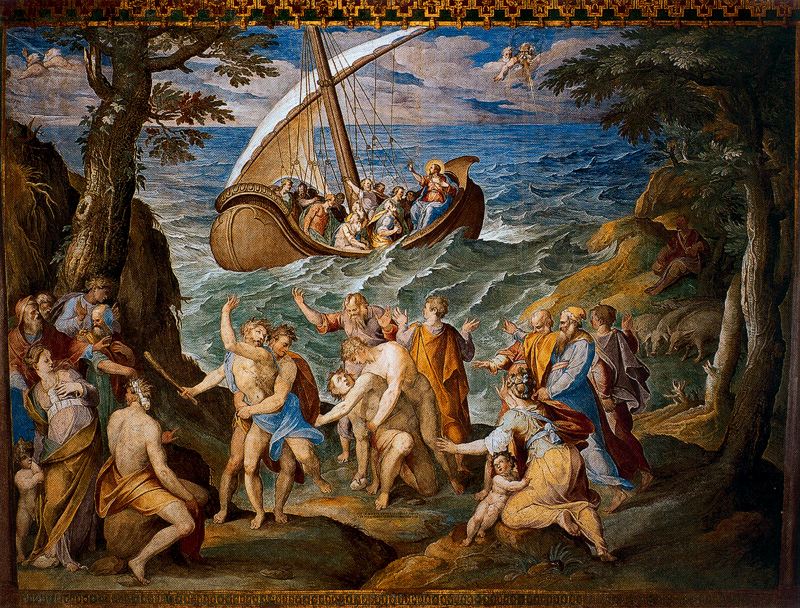
Niccolò Circignani – La Tempesta Sedata (1579-1580)


Leave a Reply