Birth into a Corpse
The history of the word corpse maps a profound shift in how human culture categorizes the physical body and the boundaries of mortality. Arriving in England during the Norman Conquest of 1066, Anglo-Norman French became the language of law, literature, and the ruling class. Thousands of French words flooded the language, carrying a higher social register and legal authority. Among these was cors, a term refashioned over time to mirror its Latin ancestor corpus, meaning body. As this elite vocabulary took root to describe the physical form, it pushed native Germanic words to the margins, narrowing their meanings until they became obsolete or were relegated strictly to the mortuary sphere.
Before corpse dominated the language of mortality, the Anglo-Saxons understood the human form and its boundaries through a literal lens. The primary word for a living human body was līchama, a compound built from līc (form, shape, or appearance) and hama (covering, garment, or home). To early Germanic speakers, the physical frame was a flesh-garment or a temporary body-home. This concept is anchored deeply in the standalone root līc, which traces back to the Proto-Indo-European root *lik-, fundamentally meaning likeness, image, or similar, originally describing any body, living or dead. This etymology reveals an interesting ontological distinction: the physical frame was not viewed as the true, enduring self, but rather as a likeness of it, an outward projection or a proxy. It was understood purely as a physical carrier, a temporary vessel tasked with housing the actual life force.
Proto-Germanic speakers understood the physical frame through continuity: not as a container for a soul, but as the physical boundary that keeps living mass bound. Human speech identified the vital, animating force not as a spirit, but as the concrete reality of *liba, a term meaning life, to remain, or the living remnant. The bodig or hama (flesh-garment or skin-shroud) thus functioned as the rigid outer barrier engineered to consolidate this internal *liba, sealing it from the external world. The word for a structural barrier and the word for a body blend because the primary function of both is not simply to enclose, but to consolidate and protect the boundary of that which must remain.
When Anglo-Norman French displaced līchama, English did not adopt a Latin equivalent for the living frame. Instead, the language pulled forward an isolated Old English word: bodig. The modern word body traces back to the Old English bodig, an isolated term that originally referred strictly to the trunk, torso, or stature of an individual rather than the complete physical organism. Unlike līċ, bodig constitutes an etymological black box with no clear cognates across the Germanic tree save for the vanished Old High German botah. At its foundation lies the ancient Indo-European root *bhu-, meaning to swell or to grow. Through this root, the primary seat of identity was defined not by its external silhouette, but by its physical capacity for volumetric expansion, a thick, swelling centered mass.
This understanding of the bodig as a structural enclosure exposes a critical mechanical divergence between two kinds of barriers: the fence and the pen. A fence (short for defense, from Latin dēfendere, to ward off) is an outward-facing perimeter engineered to repel external intrusion; it marks a boundary to keep the outside world out. In contrast, the agricultural pen (Old English penn) and the municipal pound (from Proto-Germanic *pennijō-) face entirely inward. A pen is not defined by external defense, but by active mechanical confinement, exerting continuous inward resistance against an expanding, kinetic mass to prevent it from escaping . To impound or pawn (from this same root) is to physically seize a living body and lock it down as a pledge or hostage. A fence is the defensive boundary, but the pen is the active confinement. The bodig operates not as a fence, but as an anatomical pen: a pressurized frame holding the swelling volume of *liba in custody until the fastener, the pin securing the wicket hatch, finally yields.
This concept of the swelling mass as a central pillar mirrors the botanical architecture embedded within English morphology. In the late fifteenth century, English adopted the word trunk from the Old French tronc (itself derived from the Latin truncus), applying the term simultaneously to the woody main stem of an arbor and the human torso. Both definitions share an identical structural logic: an anchoring lower boundary rooted in darkness, from which a substantial, voluminous mass swells upward into the light to support life. Just as a tree trunk pushes past the horizontal gate of the soil, the human bodig functions as a vertical expansion emerging above its horizontal lower frame.
That swelling mass is defined entirely by the compressive forces acting upon it, a relationship preserved in the generative network of the Proto-Germanic root *burþiz, rooted in the ancient verb *bher-, to carry or to bear. Descending from this single action of physical endurance are three sibling terms mapping the spatial physics of the torso:
Burden: The direct nominalization of the load being carried; the expanding volume of the bodig during gestation becomes the biological burden.
Berth: Originally the nautical space required for a vessel to rest or the structural carrying capacity of a hull, evolving into the designated frame built to support a static weight.
Birth: The kinetic resolution of the cycle, where the burden carried within the swelling vessel is pushed through the narrow constraint.
The abstract expansions of language, such as a body of work or a body of water, rely directly on this ancestral geometry. A lifetime of creative labor is conceptualized as a singular, thick trunk of production, treating an artist’s cumulative output as an interconnected mass . A body of water operates through a dual mechanical logic: first, it requires the sheer volumetric bulk of *bhu-, demanding a dense, accumulated presence rather than a scattered, transient trickle. Second, it demands a physical containment frame, an earthen basin, trench, or bed that functions as an architectural hull or berth to mechanically support that fluid load and prevent it from dissipating. In every case, bodig demands an accumulated mass, while the derivatives of *burþiz govern the physical laws of supporting, carrying, and releasing that weight.
As this swelling mass forces its way downward toward the aperture of life, the mechanics of passage depend on an encounter between two distinct geometries: the summit and the ring. The apex of this vertical structure belongs to the Proto-Indo-European root *káput- (head), which traveled into Proto-Germanic as *haubudą (modern English head) and into Latin as caput. In the evolution of English, this single Latin root branched into two distinct functional pathways:
The Anatomical and Positional Summit (caput): Retaining the direct meaning of the primary head, leading point, or governing peak. This branch produced capital (the head city), cape (the geographic headland jutting into the sea), and, via the Old French sound shift from ca- to ch-, chief and chef (the literal head of an organization or kitchen).
The Structural Enclosure (cappa): Branching through Late Latin cappa, which shifted from an actual head-covering or hood down to the draped fabric below it. This track generated cap (the fitted headpiece), cape (the garment hanging from the shoulders), the ecclesiastical cope (a long liturgical mantle), and chapel, named after the sanctuary housing the preserved half-cloak (cappella) of Saint Martin.
Whether describing a coastal promontory or a priest’s liturgical vestment, the language remains anchored to the head. Geometrically opposite this linear projection is the linguistic family born from the Proto-Indo-European root *ker- (extended as *sker-), meaning to turn, bend, or curve. Rather than naming an apex, this root governs circular, twisted, and arched forms:
Circle: Entering through Latin circus and circulus, representing the symmetrical, unyielding boundary of a loop.
Crown: Tracing through Latin corona, designating the circular wreath, garland, or ring that encircles a summit.
Crest: Deriving through Latin crista (from *sker-), describing the curving ridge or arched tuft that reaches the peak of a form before sloping downward.
In the physical threshold of birth, these independent linguistic lineages collide with mechanical precision. The maternal hatch stretches into a dilated aperture, the circular constraint of the muscular ring. Through this circular boundary (circle / *ker-), the swelling bodig forces its upward projection: the curved ridge of the skull (crest) and its anatomical summit. In obstetrics, this leading edge is designated as the vertex, a term descending from the Proto-Indo-European *wer- (to turn), signifying an anatomical eddy or turning point where the hair whorls and the directional vectors of birth converge. Beneath this crest lies the anatomical caput itself. The physical stress of passage makes the mechanical reality of this apex undeniable: when severe pressure from the rigid aperture causes localized edema on the presenting scalp, medicine terms the lesion a caput succedaneum. Rooted in the Latin succedere (to follow under or take the place of), this physiological swelling is literally a substitute head, an artificial, fluid-filled dome forged by the compressive force of the gate. When the widest diameter of that arched peak clears the dilated ring, the event is defined anatomically as crowning. The circular band (crown) and the physical apex (caput) merge at the boundary: the head crowns through the ring to release the swelling mass into the open.
This emergence through an aperture immediately demands an external shelter, mirroring the structural mechanics of dress. Derived from Late Latin cappa (from caput), the garment known as a cape originally designated a head covering before shifting downward to describe a cloak hanging from the shoulders. In tandem with Proto-Germanic *hōdaz (modern hood, rooted in Proto-Indo-European *kadʰ-, “to cover”), the earliest cloaks were constructed by cutting a single horizontal slit into a piece of fabric. To wear the garment, the head (caput) must physically push up and crown through that structural slit, allowing the cloth to drape downward and shelter the swelling trunk (bodig). Though etymologically independent from the Proto-Indo-European root *ḱem- that produced the Old English hama (flesh-garment), both roots converge on the exact same anatomical requirement: the body is an entity that must be enclosed. Pushing the head through the slit of a woven hood replicates the mechanical passage of birth, clothing the innate flesh-garment (līchama) in an external shroud.
The concept of an enclosed interior relies on the Proto-Indo-European root *kam- (”to bend, curve, or arch”), which gave Ancient Greek kamára (vaulted room or covered carriage) and Latin camera. In English, this root divided into a functional doublet: Old French transformed it into chamber, the private vaulted room, the uterine cavity, or the enclosed architectural space, while Latin preserved camera, later designated in optics as the camera obscura, the sealed dark room engineered to capture light. This curved interior mirrors the Germanic hama (flesh-garment or bodily covering from Proto-Indo-European *kem-): whether examining the pelvic cavity, the vaulted chapel (cappella), or the dark lens box, the structure remains an arched vault engineered to contain an internal mass or hidden illumination in complete darkness.
Both the biological threshold and the architectural gate converge on two words: aperture and hatch. Modern anatomical description relies on aperture, borrowed from the Latin apertura, which stems from the verb aperīre (to uncover, open, or unclose). Built from the prefix ab- (away) and the Proto-Indo-European base *wer- (to shut, cover, or protect), an aperture is literally an “un-covering”, the mechanical withdrawal of a protective barrier to expose a passage.
In early optics, the aperture of a camera obscura functioned as a mechanical opening that regulated the diameter through which light rays breached the dark chamber (camera), projecting an inverted image onto its interior surface. During a solar eclipse, this geometry scales mechanically: the opaque body of the Moon acts as a shutter blocking the solar disk. As the Sun is blocked, small gaps, such as spaces between leaves or perforations in a barrier, act as pinhole apertures, projecting inverted crescents of the eclipsed sunlight onto the ground. At the edge of totality, the obscured solar rim forms the corona (crown), while topographical valleys along the edge of the Moon act as natural apertures, allowing the last direct rays of sunlight to pass through as distinct points of light.
Everyday speech preserves this exact dynamic through the Germanic word hatch, a term whose historical homophones share a singular physical reality. In architectural and maritime design, hatch descends from Old English hæcc (from Proto-Indo-European *keg-, peg, hook, or catch), naming a wooden half-door, wicket gate, or grated barrier held shut by a latch. In biology, to hatch names the emergence of life through the fracture of a shell, originating from Proto-Germanic *hakjan-. While lexicographers categorize these as separate historical roots, their mechanical logic is identical: both describe a rigid enclosure forced open to permit passage. The structural hatch of a fence or ship and the biological hatching of an egg both demand the breach of an enclosing wall.
At the threshold of birth, the maternal aperture behaves simultaneously as both forms of the hatch. The muscular ring withdraws its protective cover (aperture), unfastening the anatomical wicket gate (hæcc) so that the swelling mass can break into existence (hatch). The Latin and Germanic terms unite around a common engineering requirement: life cannot enter the light until the barrier is unfastened and the vessel is breached.
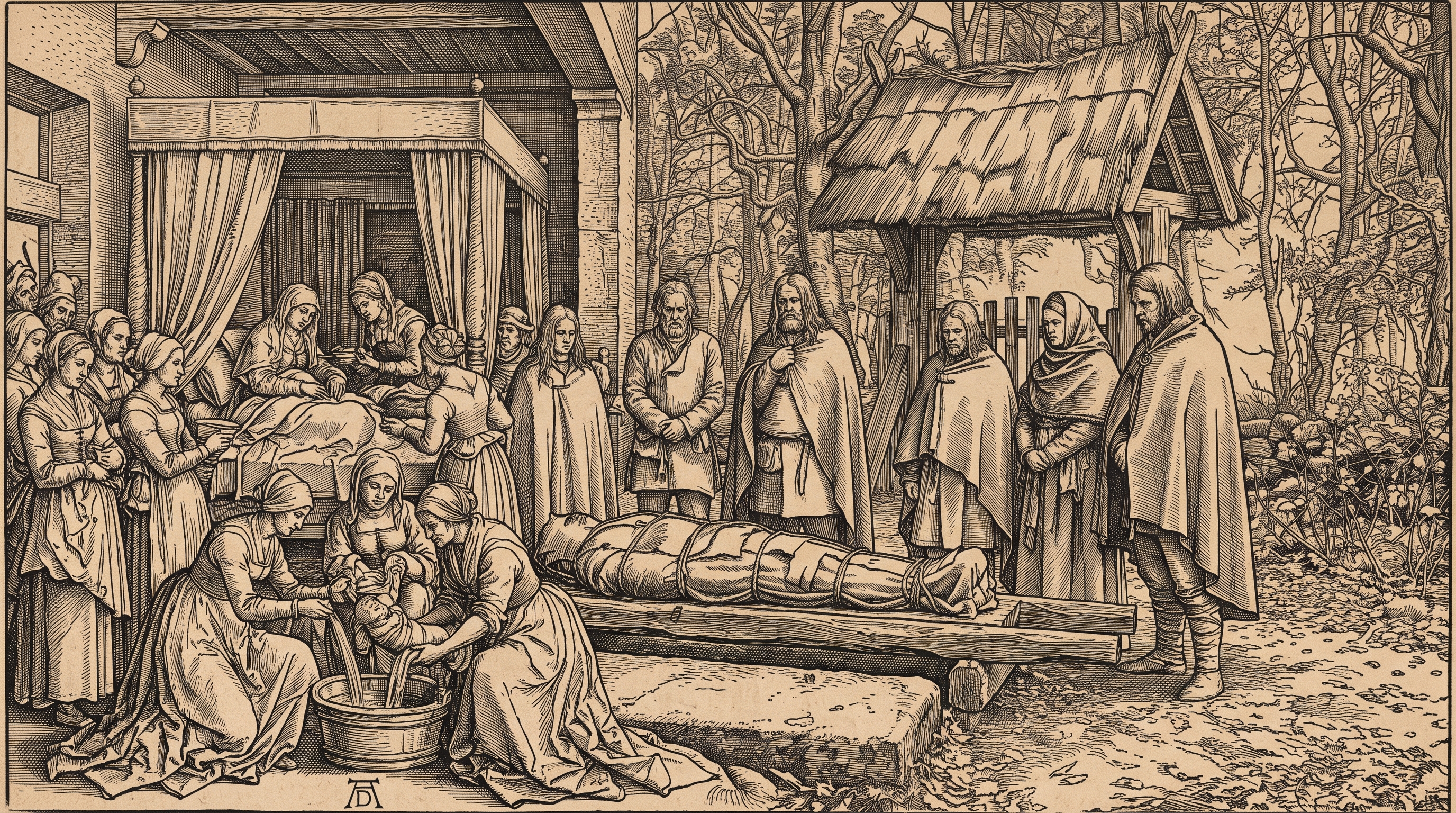
Once life departs, that swelling mass collapses, reversing the cycle and returning the frame to the architectural boundary. Over centuries, the standalone word līċ underwent a rigorous process of semantic specialization; its meaning narrowed exclusively to a dead body, surviving primarily in architectural terms like lychgate, the roofed churchyard gate, the principal gateway of the churchyard, or shelter point where a coffin was set down to await the clergyman’s arrival. This architectural staging ground took other forms as well: in Scotland, stone slabs known as lykerstanes (literally “corpse stones”) held the bier. Here, the linguistic design comes full circle. The word bier traces directly back to Proto-Germanic *bērō, derived from the exact same Proto-Indo-European verbal root *bher- (to carry or to bear) that generated the birth-cycle lineage of *burþiz, burden, berth, and birth. The language assigns the identical mechanics of physical carriage to both horizons of existence. At the entrance of life, the maternal frame acts as the living bearer, supporting the downward load (burden) until the body is delivered into movement (birth). At the exit, when that movement stops, the constructed wooden frame built to carry the dead weight to the grave becomes the literal bier, the mechanical bearer. Both are physical instruments designed to carry a heavy mass to a threshold.
This mechanical base mirrors an ancient botanical counterpart found at the very origins of Celtic epigraphy. In the Irish Ogham script, where letters were carved as branches along the vertical wooden edge or stone spine (druim) of a monument, the entire linguistic tree is anchored at its base by beith, the birch tree (Betula). As a pioneer species rising from barren soil, beith served as the foundational root from which the written language climbed vertically into the light. in ancient northern and Celtic mortuary rites, that same botanical foundation seemingly operated in reverse. Sheets of water-resistant birch bark were wrapped around the deceased to form a protective outer shroud, a vegetative second skin encasing the līchama, while woven boughs of birch were laid beneath the body to line the grave cut and cushion the fallen frame. The convergence between the two traditions is striking: beith marks the living base where the symbolic tree begins its ascent out of the soil, while the bier marks the mechanical base where the collapsed body (līċ) is supported as it is carried back down into the ground. In regional variants like the Cornish and Devonian “trim-tram,” this threshold makes the structural connection explicit: to “trim” a funeral train into proper order draws directly on the ancient Germanic root for building and firm structural arrangement, treating the reorganization of the living procession as an architectural staging ground before crossing the gate.
This intersection of architecture and anatomy deepens when examining corresponding terms across the Germanic language family. In Swedish, a lychgate is a stiglucka, combining the concepts of stepping (stiga) and a wicket opening or hatch (lucka), a stiglucka is a stile-gate built directly into the churchyard enclosure. The perimeter wall operated as a defensive fence, shielding consecrated ground from external intrusion, while simultaneously functioning as the perimeter of an agricultural pen, preventing penned livestock from breaching holy soil. Because a standard opening would compromise that containment, the stiglucka forced human passage vertically: mourners had to physically step up and over (stiga) a raised horizontal threshold to breach the barrier. Etymologists isolate these words as coincidental look-alikes, but in practice, physical context overrides strict lineage. When two roots occupy the same threshold, everyday speech forces them together. Linguists often dismiss this as folk etymology, yet it represents an active driver of semantic convergence: words shift their shape over time simply because they inhabit the same practical domain. That shared ground is why the architectural hatch and the physical body became synonymous. To carry the collapsed līc through a stiglucka was to lift the dead mass over the boundary line between the active pens of the living world and the final enclosure. To a culture processing the boundaries of mortality, the word for a gate and the word for a body blend because a physical hatch is inherently understood as a site of transition.
This blending becomes a literal, biological reality at the absolute threshold of life. Etymologically, the event of birth requires the swelling burden of the bodig to emerge directly through an aperture. The anatomical doorway is a gate. Nature relies on a physical hatch to bring a living form into existence, just as structures relied on a physical gate to carry that form out. The journey begins when the vertical mass of the bodig, defined by its capacity to swell, forces its crowning apex through the circular ring of the birth aperture. It is an emergence through a structural slit, immediately wrapped in the secondary shroud of the hood and the cape to shield the underlying līchama. Yet that entire swelling frame was never understood conceptually as the permanent self; it was merely a *lik-, an approximation, a physical carrier forged to transport a living burden across the earth. When that carrier finally ceases its movement, the rhythmic tension between the mass and the aperture resolves. The swelling recedes, the living frame collapses back into stasis, and the cors is brought to rest at the threshold of the lychgate.
When looking past rigid definitions, the traditional separation between the beginning of life and its end collapses entirely. The biological aperture of birth and the mechanical hatch of the lychgate become the exact same door, viewed from different sides. Ultimately, coming through that maternal hatch is a literal birth into a corpse. The physical material constructed and delivered through that opening, the flesh-garment, is the identical material destined to become static. The living body is simply a corpse that has not yet stopped moving, an anchor to mortality forged at the moment of entry. This symmetry echoes the existential philosophy of Martin Heidegger, who wrote that human beings are defined by “Being-towards-death.” He argued that from the very moment one is born, they are already old enough to die. The writer Samuel Beckett captured this exact sentiment beautifully and brutally in his play Waiting for Godot, writing: “They give birth astride of a grave, the light gleams an instant, then it’s night once more.”
The architectural passage from origin to grave treats the human form not as a static object, but as a mechanical passage through a sequence of barriers from aperture to gate; the physical frame is delivered through an opening, held temporarily within an expanding flesh-garment, and carried finally through a gate, revealing that birth and the corpse are bound within the very same cycle. At the lychgate, the procession is trimmed into proper structural order one last time to negotiate the transition of the final boundary. The maternal hatch and the cemetery gate remain the exact same aperture: the narrow portal through which a transient likeness enters the world as an expanding mass, only to be set down, unburdened, and laid into the earth at the close of the cycle.


Leave a Reply