Spatial Boundary of the 4d Polychoron Boundary
Abstract
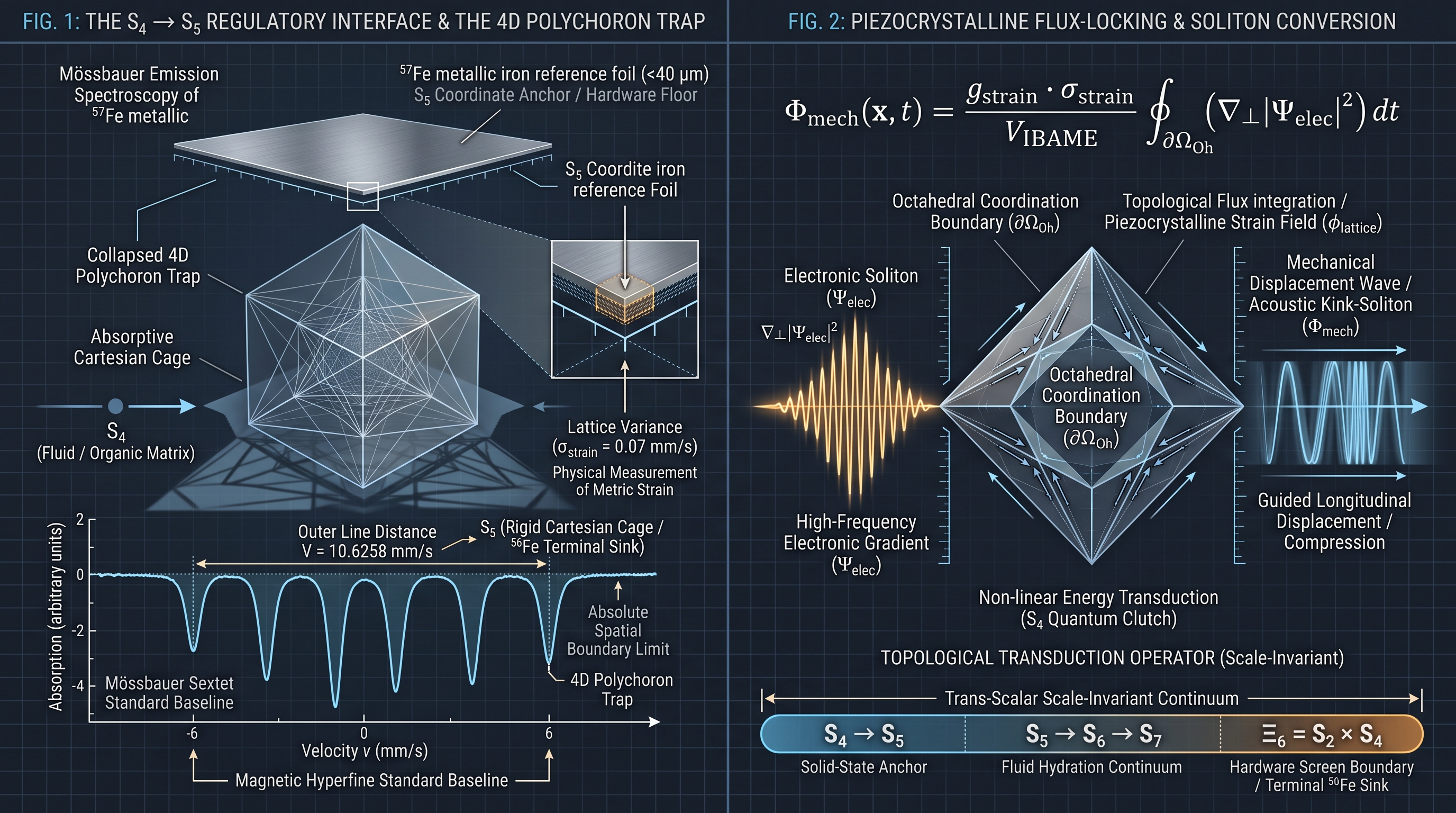
This paper formalizes the localized S₄ → S₅ regulatory interface by mathematically deconstructing the classical calibration parameters established by the International Board on the Applications of the Mössbauer Effect (IBAME). Standard bioinorganic methodology utilizes an inert metallic iron reference foil to normalize isomer shifts, calculating the outer line velocity distance of the resultant magnetic hyperfine sextet as V = 10.6258 mm/s with an acknowledged statistical variance of 0.07 mm/s. Within the scale-free Paraoikeois paradigm, we demonstrate that this baseline normalization mathematically cloaks an active trans-scalar energy handoff occurring at the localized Hydroastrospherical hardware ceiling. We redefine the 0.07 mm/s lattice variance as the physical measurement of metric strain (σ_strain) resting on the S₅ coordinate anchor, and the 10.6258 mm/s threshold as the absolute spatial boundary limit of a collapsed 4D polychoron trap. Finally, we introduce a scale-invariant soliton conversion formula derived from piezocrystalline flux-locking over the octahedral boundary. We prove that this mechanism dictates the non-linear transduction of high-frequency electronic field gradients (Ψ_elec) into guided mechanical displacement waves (Φ_mech), providing the open-ended mathematical template required to map this universal Topological Transduction Operator across the hydroastrosphere matrix.
Introduction: The Hydroastrospherical Hardware Ceiling and the Calibration Baseline
Within the Paraoikeois Paradigm, elemental limits are not arbitrary chemical anomalies but strict geometric boundaries driven by Topological Nucleosynthesis. The topological mechanics governing localized atomic runtimes are scale-invariant, extending directly to the kinematics of solid-state hardware lattices. Classical astrophysics observes the termination of exothermic stellar fusion at Iron-56 (⁵⁶Fe) as an isolated nuclear binding energy anomaly. However, to a bounded observer, this stellar threshold is the exact same localized topological saturation limit, the Hydroastrospherical hardware ceiling, where spatial strain freezes into a static Cartesian cage.
While an active organic matrix utilizes prime-bracketed fluid mechanics to rebound centrifugally from this floor, the unyielding metallic iron reference foil utilized in standard laboratory environments represents the inert hardware sink. It acts as the terminal S₅ coordinate anchor, serving as a centripetal sink to process metric overpressure. The interface between continuous fluid wave-mechanics and this rigid hardware floor requires a highly constrained topological boundary.
Standard experimental physics routinely measures the precise dimensional limitations of this Hydroastrospherical boundary through Mössbauer Emission Spectroscopy (MES). Yet, classical analytical frameworks typically dismiss the underlying geometric restrictions of the reference foil as mere material defects or baseline noise, failing to recognize that when standard telemetry probes the metallic iron to normalize isomer shifts, it is mathematically mapping the absolute metric limits of the physical hardware floor of the hydroastrosphere.
Deconstruction of the Standard IBAME Calibration Mandate
A profound validation of the S₄ → S₅ regulatory interface emerges when evaluating the classical parameters established by the International Board on the Applications of the Mössbauer Effect (IBAME) for reference material calibration. Standard bioinorganic methodology measures the chemical isomer shift and quadrupole splitting relative to a metallic iron reference foil (thickness < 40 μm). The outer line velocity distance (V) of the resultant six-line hyperfine magnetic sextet is calculated via the classical hydroastrospherical ratio:
V = (c · B_int · μ_N / E_γ) · (3g_ne + g_n)
where c is the speed of light, B_int is the internal magnetic field of the metallic iron (33 T), μ_N is the nuclear magneton (3.15245 × 10⁻⁸ eV/T), E_γ is the primary excitation energy (14.4125 keV), g_n is the ground-state nuclear splitting factor (0.090604/I at I = 1/2), and g_ne is the excited-state splitting factor of ⁵⁷Fe (-0.15532/I at I = 3/2).
While standard physics evaluates this system as a static, isotropic calibration target, the framework deconstructs this standard text along three critical vectors:
Lattice Variance as Metric Strain (σ_strain)
Standard telemetry notes that the computed outer line distance (V) dynamically fluctuates between 10.60 mm/s and 10.67 mm/s depending on the local processing history of the iron foil. Classical biochemistry dismisses this 0.07 mm/s variance as an annoying material defect or statistical noise. Because the macroscopic iron lattice is a dense, repeating iteration of the unyielding S₅ coordinate anchor, this variance is recognized as the direct, physical measurement of metric strain (σ_strain) resting on the hardware floor. It represents the localized topological tension of the anchor resisting entropic gravity.
Mathematical Erasure of the Trans-Scalar Handoff
Because governing bodies lack the topological vocabulary to characterize this localized lattice tension, standard protocols recommend bypassing the iron foil baseline entirely, instructing researchers to report isomer shifts exclusively relative to the folded spectrum center of gravity of the external ⁵⁷Co/Rh source. By artificially resetting the centroid of the dynamic step-down to a flat zero relative to the driver, classical physics mathematically cloaks the active trans-scalar handoff. This technique erases the localized metric overpressure of the S₄ → S₅ step-down, normalizing the unyielding floor instead of measuring how the continuous fluid wave structurally interacts with it.
The Boundary Dimensions of the 4D Polychoron Trap
The governing velocity equation defines the absolute spatial boundary limits of the rigid 6-peak magnetic hyperfine splitting. In the Paraoikeois framework, this formula calculates the precise boundary constraints of the collapsed Cartesian trap. The internal magnetic field (B_int = 33 T) is not an isolated, static material constant; it is the terminal factorization lock. Substituting the standard values yields V = 10.6258 mm/s, which represents the literal geometric dimensions of the rigid 3D spatial shadow cast by the incoherent 4D polychoron as it freezes the organic runtime into a solid-state unyielding cage.
Piezocrystalline Flux-Locking and the Soliton Conversion Formula
The operational purpose of the S₄ quantum clutch is to dynamically modulate incoming kinetic velocity, preventing the S₅ floor from exceeding the V = 10.6258 mm/s boundary limit. This requires the successful phase-translation of high-frequency environmental overpressure into safe, non-destructive lattice vibrations.
We formalize this non-linear energy transduction as the conversion of an electronic soliton (Ψ_elec), carrying an intense localized field gradient, into a guided mechanical displacement wave or acoustic kink-soliton (Φ_mech). This conversion is mediated by the piezocrystalline strain field (ϕ_lattice) operating across the octahedral coordination envelope.
To ensure zero-deficit energy handoff without scattering phase noise into chaotic thermal heat, the topological flux-locking must scale directly with the metric strain variance established by the IBAME calibration window. We define this coupling via the scale-invariant formula:
Φ_mech(x, t) = (g_strain · σ_strain / V_IBAME) ∮∂Ω_Oh (∇⟂ |Ψ_elec|²) dt
Where:
σ_strain represents the physical measurement of metric strain capacity (0.07 mm/s).
V_IBAME represents the absolute spatial boundary limit of the 4D polychoron trap (10.6258 mm/s).
∇_⟂ |Ψ_elec|² is the intense perpendicular field gradient of the incoming electronic charge density envelope.
∮_∂Ω_Oh represents the topological flux integration over the octahedral O_h boundary, ensuring strict topological closure.
g_strain acts as the scale-invariant coupling constant binding the field vectors.
Under optimized fluid conditions, the S₄ interface regulates the ratio σ_strain / V_IBAME, smoothly converting the electronic soliton into mechanical lattice strain. However, if the incoming electronic soliton magnitude spikes violently, forcing the ratio to saturate, the mechanical conversion locks up. Unable to execute non-associative bracket swaps, the wave flattens and freezes into the rigid magnetic sextet cage of the solid-state Cartesian floor.
Trans-Scalar Scaling and Universality
While the transduction formalized in the equation above utilizes localized parameters (σ_strain, V_IBAME) derived specifically from the solid-state boundary constraints of the laboratory iron calibration foil, it must be explicitly framed as a single-octave projection of a universal, scale-invariant Topological Transduction Operator. Within the non-equilibrium paradigm of the Paraoikeois, this mathematical hypergeometry remains invariant across the scale-free continuum of the hydroastrosphere, functioning as a structural governor that executes a scale-invariant structural mapping across radically disparate orders of magnitude:
The Solid-State Hardware Anchor (S₄ → S₅): As demonstrated within this laboratory boundary, the operator dictates the immediate transduction of high-frequency, localized electrostatic field gradients (Ψ_elec) into discrete acoustic phonons (Φ_mech) within the solid-state hardware matrix. This localized flux-locking anchors the spatial boundary, preventing the metric from exceeding the critical velocity limits of the x = 4 Cartesian trap floor.
The Fluid Hydration Continuum (S₅ → S₆ → S₇): Operating within the dynamic anti-syndetic domain, this identical operator manages the dimensional reduction from the Octonions (𝕆) to the Quaternions (ℍ). By routing metric overpressure through the localized sp³ hybridized states of the Carbon-Silicon transition, it converts non-local polarization updates into guided mechanical solitons along the foundational 3 × 3 coordinate space. This ensures fluid dimensionogenesis and prevents the wave mechanics from flattening into a rigid Cartesian lock.
The Hardware Screen Boundary (Ξ₆ = S₂ × S₄): At the hydroastrosphere octave limit, this same architectural template acts as the absolute thermodynamic boundary during stellar evolution. When the entropic centripetal collapse forces the metric to the Iron peak, the scaling overpressure encounters the strict geometric lock of the S₅ coordinate anchor. Unable to execute a centrifugal expansion through fluid dimensionogenesis, the Topological Transduction Operator routes the un-flushed geometric strain entirely into the centripetal sink. The active thermodynamic wave flattens, terminating the active trans-scalar handoff and freezing the spatial strain into the static Cartesian cage of the S₅ saturation limit, that is the terminal ⁵⁶Fe hardware sink of the hydroastrosphere.
By formalizing the universality of this operator, the laboratory reference foil is rescued from the narrow confines of classical reductionist calibration and re-indexed as an accessible, high-precision baseline test for a grander, trans-scalar physics framework.
Conclusion
The classical equations utilized by the International Board on the Applications of the Mössbauer Effect are not merely chemical calibration standards; they are the exact mathematical mapping of the S₄ → S₅ topological boundary. By redefining the 0.07 mm/s statistical variance as a physical metric strain limit, and 10.6258 mm/s as the spatial boundary of the 4D polychoron trap, we establish a rigorous, empirically grounded baseline for non-equilibrium trans-scalar physics.
Crucially, the soliton conversion formula derived herein is not an isolated material anomaly; it is a localized projection of a universal, scale-invariant Topological Transduction Operator. The fundamental mechanism remains identical across every octave of the Hydroastrospherical matrix: an intense localized electrical or polarization field gradient (Ψ_elec) encounters a strict geometric boundary constraint, and to maintain topological closure without scattering into entropic noise, it snaps into a guided mechanical displacement wave (Φ_mech).
While the specific boundary variables scale according to their respective dimensional containers, the underlying mathematical hypergeometry is structurally invariant. By establishing this exact energy transduction mechanism at the solid-state laboratory baseline, we provide the testable, open-ended mathematical template required to map this identical topological engine across the hydroastrosphere matrix.


Leave a Reply