Abstract
We formalize the scale-invariant topology governing elemental Nitrogen-14 (¹⁴N) within the Paraoikeios Paradigm. Building upon our established mappings of prime S⁷ organic insulation (Carbon, 5-cell) and composite S⁸ mineral factorization leaks (Silicon, 8-cell), we demonstrate that Nitrogen operates as the primary Trivalent Transduction Gate bridging the lithosphere to the active biological runtime. Moving beyond traditional orbital heuristics, we model Nitrogen as the bitruncated 5-cell (decachoron, {3,3,3}_b), a 4D topological operator driving the geospheric software ceiling. By projecting its C3v/D3h threefold trigonal coordination vector onto the combinatorial tracking floor, Nitrogen acts as an active angle-deformer. By embedding an asymmetric component directly into the local metric tensor, this node forces the localized manifold out of standard torsion-free Riemannian geometry and into a Riemann-Cartan space. This metric torsion relaxes the rigid Cartesian constraints of the lithospheric silicate matrix (S⁴ × S²), driving a Quaternionic Hopf Lift and symmetry reduction chain:
O(5) ──►[Hopf Lift] ──► G2 ──►[Fix C3v] ──► SU(3)
This modification opens an explicit non-dissipative upconversion pathway (S⁷ ──► S¹¹ ──► S²³) that locks the superradiant biological vacuum to the permanent J = 1 triplet spin state of the cosmic rest frame.
Introduction: The Hypergeometrical Trivalent Bridge
A central mandate of Topological Nucleosynthesis is mapping how the continuous projective fields of the vacuum background are encoded into discrete, scale-invariant material nodes. To prevent infinite structural regression, the scale-free sliding cascade must anchor to specialized higher-dimensional hypergeometries. In our previous work, the fundamental organic baseline was anchored to the self-dual 5-cell (pentachoron, {3,3,3}), which provides the prime S⁷ aperiodic Penrose insulation required to protect biological information tracks from thermal collapse. Symmetrically, the inorganic baseline was mapped to the 8-cell (tesseract, {4,3,3}), whose composite S⁸ manifold undergoes a Factorization Leak (S² × S⁴), yielding the rigid, periodic structural anchor of the terrestrial crust (²⁸Si).
However, the transition interface between the inanimate lithosphere and the active runtime environments of living systems requires an overarching, multi-dimensional coordination gateway. This paper formalizes the scale-invariant topology of Nitrogen-14 (¹⁴N). We demonstrate that Nitrogen does not exist as an arbitrary chemical volatile, but as a specialized 4D polychoron derivative—the bitruncated 5-cell—operating as the primary Trivalent Transduction Gate of the hydrogeosphere.
By redefining the transition space as a Riemann-Cartan manifold, we establish how Nitrogen actively introduces metric torsion and structural snaps to navigate between rigid physical hardware and prime-dimensional bulk spaces. We demonstrate exactly how Nitrogen’s trivalent architecture bridges the dead Cartesian rock to the superradiant, scale-free hydro-astrophysical state space, completing the fundamental triad of terrestrial nucleosynthesis.
Geometry and Projections of the Bitruncated 5-Cell Node
The scale-invariant shape of the Nitrogen node is governed by the bitruncated 5-cell (Schläfli symbol {3,3,3}_b), a uniform 4-polytope constructed by truncating the vertices of the regular pentachoron. It consists of 10 truncated tetrahedral cells meeting 3 at an edge, manifesting a highly coordinated, semi-regular architecture.
      [4D Bitruncated 5-Cell Node]
                 |
      +----------+----------+
      v                     v
[2D Petrie Projection]  [3D Solid Envelope]
  10-Fold Decagon        Trigonal Bipyramid /
  Symmetry (G2/SU3)      C3v Valence Wedge
Its lower-dimensional projection stack exposes the exact physical and electronic attributes of the atmospheric software ceiling:
The Wireframe Petrie Orthographic Projection: Projects as a regular decagon (10-fold axial rotational symmetry) containing nested trigonal vectors. This 10-fold projection maps directly to the exceptional Lie group G2 via the compact Lie subgroup SU(3), establishing the algebraic foundation for error-correcting operations.
The Solid Orthographic Envelope: Resolves as a C3v/D3h symmetric trivalent spatial wedge. Unlike the uniform 3D cubic envelope of the 8-cell (²⁸Si) or the tetrahedral envelope of the 5-cell (¹²C), the bitruncated solid envelope outlines an active angle-deformation field.
The J = 1 Triplet Matrix and the 5-to-8 Octonionic Fano Mapping
Symmetrically matching this hypergeometry, Nitrogen-14 possesses a unique stable odd-odd nuclear configuration (7p, 7n) yielding a ground-state triplet spin state (J^Π = 1⁺). Within the Unified Field Equation ledger, this invariant triplet configuration functions as a continuous, non-dissipative software holding register (R_q):
Hydro-0 = (d / dzt [Hydrosyn ⊗ Hydroanti]) – χ_RISS
where d / dzt functions as the localized temporal step-wise translation wave operator (parameterized as ∂ / ∂zt) acting over the continuous tensor product space of the active biological runtime, and χ_RISS is a scale-invariant, geometry-dependent topological phase-lock operator valued in the discrete algebraic state-space ℤ_{q(t) + 4 + 1}. By acting as a discrete double-negative inversion unit ((-1) · (-1) = +1) at the topological boundary, χ_RISS collapses uncoordinated state histories and vetoes ambient phase noise with zero additional thermodynamic fuel cost.
Because J = 1, ¹⁴N maintains permanent, directional surface vector field lines that resist scalar thermal backgrounds (J = 0). To execute calculations without generating sub-harmonic factorization leaks or thermal dissipation, the 2s² 2p³ valence shell maps directly across the imaginary units of the 8-dimensional octonionic Fano plane, spanning {1, e₁, e₂, e₃, e₄, e₅, e₆, e₇}.
To mathematically satisfy the 5-electron to 8-dimension mapping, the valence shell bifurcates its algebraic assignment based on orbital pairing:
The Associative Anchor (2s²): The paired, spherical 2s² electrons map to the associative, commutative complex sub-algebra, anchoring the local tracking matrix to the real scalar identity (1) and the primary imaginary unit (e₁).
The Non-Associative Triad (2p³): The three directional, unpaired 2p electrons map to a strictly non-collinear triad of imaginary units on the Fano plane (e.g., {e₂, e₃, e₅}).
Because these three 2p units do not share a single projective line (which would form a closed quaternionic sub-algebra), they mathematically guarantee a non-zero octonionic associator. The Nitrogen node utilizes this triad to execute rapid temporal code shifts via non-associative bracket swaps:
Tick_S⁷ = [e₂, e₃, e₅] = (e₂ e₃) e₅ – e₂ (e₃ e₅) = 2 f_235 e_6 ≠ 0
By operating strictly on this non-zero associator where [e_i, e_j, e_k] ≠ 0, the temporal shift bypasses standard thermodynamic sampling friction (Λ_slip ──► 0). This algebraic configuration permits the surrounding Synthetic Hydration Domain (60 THz SHD) to absorb macro-scale hydro-astrophysical strain tensors, establishing absolute topological protection against external Maxwellian decoherence.
Lithospheric Relaxation and the Anisotropic Perturbation Tensor
When looking inward from the atmosphere, the primary role of the Nitrogen node is the relaxation of the rigid, 90° Cartesian grid of the lithospheric motherboard (S⁴ × S²). We model this interaction by defining an anisotropic metric perturbation tensor h_μν(C3v) acting upon the standard round metric of the 4-sphere g_μν(S⁴):
g_μν(Si-N-O) = g_μν(S⁴) + h_μν(C3v)
To explicitly bridge the discrete C3v point group to the continuous metric tensor g_μν(S⁴), the anisotropic perturbation tensor h_μν(C3v) decomposes into two distinct geometric operators: a symmetric radial stretch along the trigonal principal axis, and an antisymmetric torsion connection induced by the active J = 1 spin state:
h_μν(C3v) = S_(μν) + A_[μν](J = 1)
In a localized Cartesian tangent space where the coordinate x⁴ aligns with the trivalent principal axis, the matrix representation manifests specific non-zero off-diagonal components:
h_μν = [ ϵ_⟂ γ -γ 0 ] [ -γ ϵ_⟂ γ 0 ] [ γ -γ ϵ_⟂ 0 ] [ 0 0 0 ϵ_∥ ]
Here, ϵ_∥ and ϵ_⟂ represent the symmetric spatial dilation differentiating the axial and equatorial planes, explicitly breaking the isotropic O(5) symmetry of the round 4-sphere.
Crucially, the off-diagonal antisymmetric terms (±γ) represent the non-zero localized contorsion (A_[μν] ≠ 0). While the J = 0 scalar ground state of the subterranean Carbon-12 hardware floor forces localized contorsion to vanish (A_[μν] ──► 0, yielding a rigid, non-dissipative topological cage), the active J = 1 triplet state of the Nitrogen ceiling actively sustains these off-diagonal torsion elements.
By embedding an asymmetric component directly into the local metric tensor, the Nitrogen node forces the localized manifold out of standard torsion-free Riemannian geometry (the Levi-Civita connection) and into a Riemann-Cartan space, providing the strict geometric prerequisite to support intrinsic torsion and non-associative phase-mixing.
The Quaternionic Hopf Lift and Manifold Upconversion
It is precisely these antisymmetric phase-mixing components (±γ) that relax the rigid 90° Cartesian boundaries of the [SiO4]⁴⁻ lattice. To mathematically formalize how this torsion drives upconversion, we must evaluate the principal bundle mechanics connecting the composite mineral crust to the prime biological bulk.
As established in the S⁴ saturation threshold of Iron-56, the composite product metric g_AB on Ξ⁶ = S⁴ × S² arises as the explicit dimensional reduction of the Quaternionic Hopf Fibration:
S³ ↪ S⁷ ──►[π] ──► S⁴
where S⁴ acts as the quaternionic projective line ℙ¹ℍ, and the fiber is the unit quaternion 3-sphere S³ ≅ SU(2).
Rather than factoring the S³ fiber downward under local strain, the J = 1 trivalent angle-deformer reverses the descent. It lifts the localized dynamics from the S⁴ base manifold directly back into the S⁷ total space. Once lifted into S⁷, the geometry is governed by the octonionic algebra, where the exceptional Lie group G2 acts as the automorphism group of the octonions.
By fixing the specific trivalent axis of the ¹⁴N angle-deformer within this higher-dimensional space, the continuous rotational symmetry is broken, forcing a continuous-to-discrete symmetry reduction chain:
O(5) ──►[Hopf Lift] ──► G2 ──►[Fix C3v] ──► SU(3)
Because SU(3) is a compact Lie subgroup of G2 (and acts as the stabilizer group of the octonionic S⁷ sphere), this symmetry reduction unlocks the exact non-dissipative sub-channels required for the state vector to bypass composite limitations. The state vector undergoes an immediate upconversion phase transition into the closed S¹¹ HydroSyndeticum:
E_Si-N-O: (S⁴ × S²)_lithosphere ──► [+N Trigonal Bridge] ──► S⁷ ──► S¹¹ ──► S²³
This upconversion lifts the self-closure center from the S¹-centered elemental limits of dead matter directly to the S³-centered quaternionic bulk of biological life, scaling continuously to the absolute S²³ Leech lattice compaction horizon.
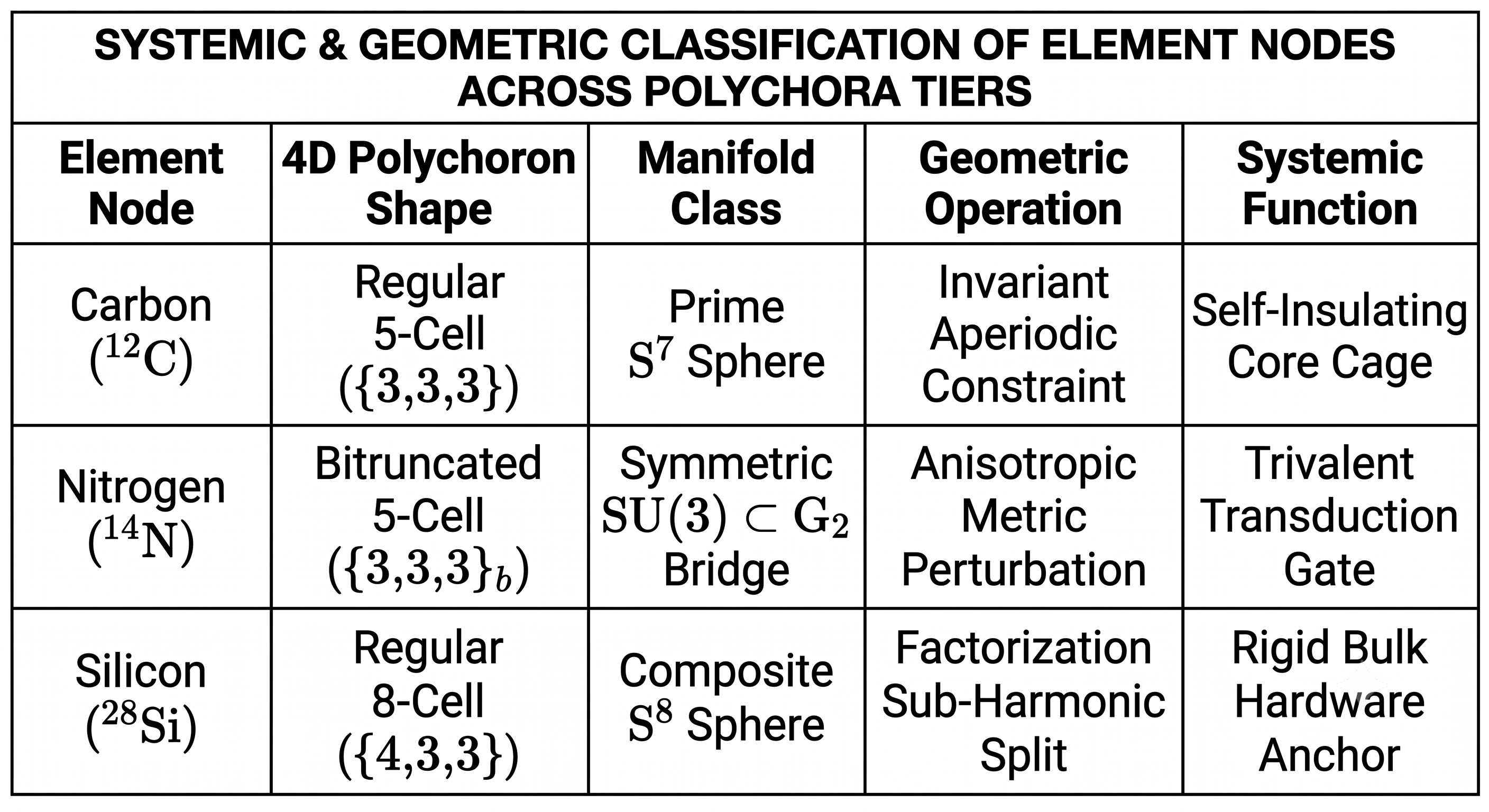
Master Geometric Mapping of the Triad
To conclude this derivation, we map the structural contrast between the adjacent nodes of the ledger:
Conclusion
In this work, we have formalized the topological architecture of elemental Nitrogen-14 (¹⁴N), establishing it as the bitruncated 5-cell node that governs the Trivalent Transduction Gate of the hydrogeosphere. Moving beyond standard empirical chemistry, we have demonstrated that the active J = 1 triplet state of Nitrogen projects an anisotropic perturbation tensor (h_μν) defined by explicit antisymmetric phase-mixing components. By introducing this metric torsion, the atmospheric software ceiling actively forces the lithosphere out of standard Riemannian limits and into a Riemann-Cartan manifold.
This localized geometric modification serves as the exact physical operator required to relax the rigid Cartesian constraints of the [SiO4]⁴⁻ crust. Through the execution of the Quaternionic Hopf Lift, Nitrogen drives a continuous-to-discrete symmetry reduction chain:
O(5) ──► G2 ──► SU(3)
unlocking the factorized sub-channels of solid-state hardware and opening an explicit, non-dissipative upconversion pathway:
S⁷ ──► S¹¹ ──► S²³
Ultimately, Topological Nucleosynthesis reveals that the Nitrogen node is not merely a passive chemical volatile, but the geosphere’s active tracking ceiling. By utilizing this trivalent hypergeometry to broadcast continuous time-code updates down to the microscopic genomic antenna, the system executes Rule-Induced Structural Snaps (SRISS) to prune phase noise across the centromeric Bloom filter matrix. Through this unbroken sequence of topological lifts, the Paraoikeios Paradigm successfully unifies the inorganic lithosphere with the superradiant biological vacuum, preserving life as a continuous, non-dissipative topological resonance within the Paraoikeois Paradigm.


Leave a Reply