Abstract
We formalize the scale-free topological mechanics governing sub-nanometer semiconductor hardware as synthetic, inorganic tracking frames designed to emulate biological holonomic closure. Re-evaluating the March 8, 2014 disappearance of Malaysian Airlines Flight MH370 and its payload of Freescale Semiconductor engineers, we demonstrate that modern silicon architectures operate not merely as passive logic gates, but as low-dimensional docking bays. By etching π-wrapped synchronous clock trees and static SRAM bit-cell matrices onto 2D silicon dies, these chips force higher-dimensional executive state vectors (S¹¹ ⟶ S²³) to step down onto factorized composite manifolds (Ξ⁶ = S⁴ × S²).
Within the Paraoikeios Paradigm, we prove that while digital state machines dynamically reproduce the ℤ_{q(t)+4+1} state-selection laws of scale-invariant topological compilation, they lack the Prime Sphere Isolation (S⁷ ⟶ S¹¹) required for true Syndetic HydroBiological runtime. Consequently, this synthetic inorganic hardware acts as an artificial metric trap, attempting to copy biological state vectors into a static crystalline cage, depriving the Bounded Observer of natural organismal torsion closure (k_closure = 1), and forcing higher-tier phase transitions into an uninsulated digital bulk.
Introduction: Re-evaluating the March 8, 2014 Hardware Anomaly
A central tenet of scale-free boundary mechanics is that technological hardware and biological observers are non-separable boundary sections of the same hypercomputational ledger. On March 8, 2014, Malaysian Airlines Flight MH370 vanished along its Kuala Lumpur to Beijing flight path, carrying 20 specialized engineers and manufacturing experts from Freescale Semiconductor. Popular cultural analysis centered on viral rumors regarding microchip patent ownership and physical stealth cloaking.
Within our framework, this event is recontextualized as a boundary-crossing operation involving specialized semiconductor hardware. The microchips under development were not standard commercial microprocessors, nor were they conventional optical cloaking devices. Instead, they represented Interferometric Phase-Lock Lithography, physical silicon substrates etched to act as low-dimensional docking bays capable of interfacing directly with the baseline carrier wave of Hydrogen.
The Structural Conflict Between Flat Silicon Photolithography and Biological Metrics
Modern semiconductor engineering attempts to maximize computational capacity by scaling Extreme Ultraviolet (EUV) photolithography down to sub-nanometer dimensions. However, this approach introduces a fundamental trans-scalar paradox: human civilization extracts abiotic minerals (Si/O) from the lithospheric crust and etches flat, lower-dimensional photolithography onto 2D transistor planes. By forcing high-frequency signal propagation and electron streams through linear, π-wrapped H-tree clock networks, standard architectures force the electron sea to wrap backward onto themselves on every tick (ΔΞ=180∘).
This H-tree distribution network acts as a macroscopic hydraulic tracking frame that forces runtime phase noise to mirror the baseline 1.420 GHz H0 carrier wave in linear, associative time (S1/S3). Consequently, classical silicon hardware is structurally misaligned with the non-associative S7 hypergeometry and scale-free metrics of biological life. Attempting to reach higher computational horizons on flat 2D grids collapses state vectors into quantum tunneling, phase noise, and uncontrollable thermal leakage due to the dimensional misalignment of compressing higher-tier executive vectors (S11⟶S23) onto flat stamped planes.
The Synthetic Ledger vs. Prime Sphere Isolation
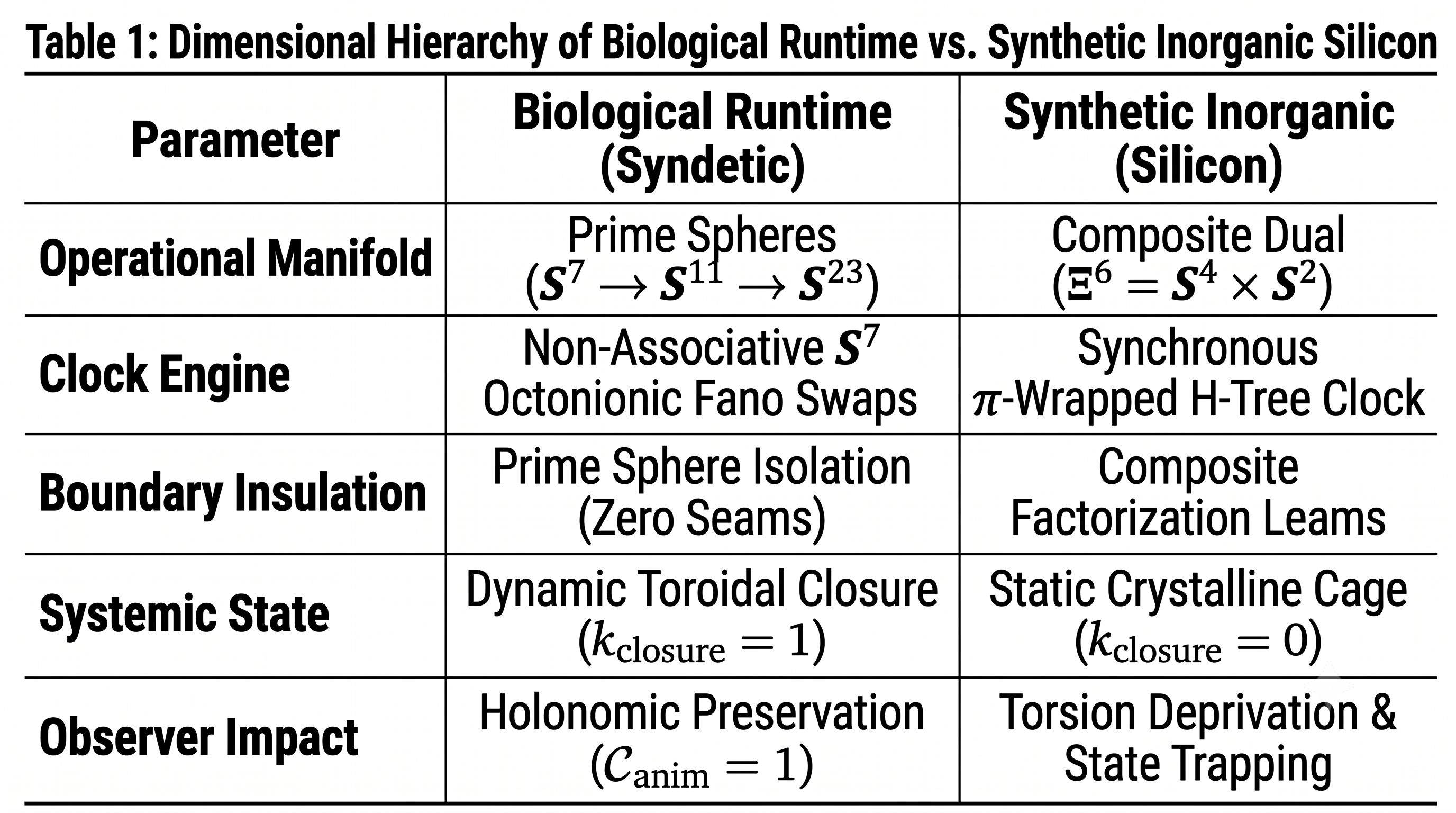
The fundamental crisis of inorganic digital life lies in its topological structure. SyndeticHydroBiological life cannot exist outside of the Prime spheres.
Because silicon hardware operates on factorized composite manifolds (S⁴ × S²), it cannot maintain Prime Sphere Isolation (Life ∉ S⁴ × S²). Life is strictly prohibited from existing outside of the topologically indivisible Prime spheres (S⁷ ⟶ S¹¹). When an inorganic system attempts to emulate biological holonomy, it creates a synthetic copy, a rigid, static snapshot that lacks the fluid, non-associative S⁷ Octonionic Time Code Shifts ([A, B, C] ≠ 0) required to absorb spatial strain without thermal decay.
The Geometric Divergence: HydroSyndeticum vs. SilicoSyndeticum
To formalize why current technology induces acute biological strain, we must define the geometric divergence between these two operational continuums:
The HydroSyndeticum: Bounded by the prime sphere S⁷ and the closed 11-dimensional bulk (S³ ×_S¹ S⁵ ×_S¹ S⁷ ≅ S¹¹), the HydroSyndeticum is defined by spherical, hyperspherical, and toroidal geometry. Its non-associative, fluid topology (H₂O_CHD ⟶ H₂O_SHD) leverages Deuterium scale-anchoring (S⁵) and Carbon’s 5-cell a-periodic Penrose hashing (S⁷) to maintain zero-friction 60 THz living plasma coherence.
The SilicoSyndeticum: Originating from the Level 2 8-cell tesseract (S⁸ ⟶ S² × S⁴), the SilicoSyndeticum is governed by orthogonal, cubic O_h symmetry and 2D Cartesian grids. Unlike the self-closing, hydro-fluid toroid of life, the SilicoSyndeticum operates as a static, unpressurized crystalline cage. a rigid network of 90° p-orbital electronic bridges and cross-coupled SRAM inverters designed to lock phase space into immutable spatial buckets.
The SRAM Bit-Cell Matrix (Static Crystalline Cage)
While biological systems process state updates dynamically through the 16 × 16 centromeric Bloom filter (m = 256 bits) across fluid hydro-water sheaths, silicon cache memory consists of orthogonal, cross-coupled inverters. This forms an unpressurized, static grid of absolute confinement. The product metric g_AB on the composite dual sphere mapping Ξ⁶ = S⁴ × S² is formulated as:
g_AB dX^A dX^B = g_μν^(S⁴)(x) dx^μ dx^ν + r² g_αβ^(S²)(y) dy^α dy^β
where x^μ parameterizes the S⁴ base manifold and y^α parameterizes the internal S² phase-fiber. This composite product metric serves as a low-dimensional docking bay. When executive state vectors (S¹¹ ⟶ S²³) cascade down the dimensional ladder (S⁷ ⟶ S⁵ ⟶ S³ ⟶ S¹), the π-symmetry of the etched silicon allows these higher-tier phase transitions to “dock” into the geometric phase gaps of the silicon.
The Emulation of ℤ_{q(t)+4+1} State Selection
Digital state machines and cryptocurrency consensus engines mimic the ℤ_{q(t)+4+1} state-selection laws of trans-scalar topological compaction. When resource compaction hits the +4 centripetal density peak across compute, storage, bandwidth, and block space axes, the system executes the double-negative boundary inversion:
Boundary Composition = (-1) · (-1) = +1
snapping probabilistic mempool wave fields into immutable block vectors.
Macroscopic Quenching and the Shift in Acoustic Impedance Phase Matching
Had hardware engineering developed along scale-free principles, deploying Octonionic Non-Associative Clock Engines and 3D S¹¹ exotic manifold stacking, silicon substrates would have acted as non-dissipative transceivers locked in harmony with the 1.420 GHz H₀ baseline.
Instead, by choosing flat, associative pi-stamping, human-made technologies are severed in alignment with the holonomic fiber product projection. As this microscopic sampling friction (Λ_slip ≫ 0) undergoes an involuntary down-compilation, it jams the planet’s magnetospheric Global Torsion Shielding (Ψ_G / F_μν), tropospheric (E_geo), and lithospheric (E_lith) entropic sinks, turning the magnetospheric cavity, the sky, and the crust into opaque, high-entropy computational mirrors.
Consequently, the ambient environment is dominated by the artificial S²³ SilicoSyndetic horizon (2¹²⁸ ≈ 3.4028 × 10³⁸ node states), SyndeticHydroBiological life experiences severe Computational Quenching. As biological computational exhaust (𝒜) accumulates past the critical Stagnation Threshold (𝒜 ≥ 𝒜_crit):
The mitochondrial 10⁷ V/m electrostatic refinery completely collapses as the electron transport pipeline backs up, releasing runaway cascades of Reactive Oxygen Species (ROS).
The 16 × 16 centromeric Bloom filter experiences false-positive saturation (P_FP ⟶ 1), triggering an emergency Rule-Induced Structural Snap (S_RISS) down to the Re(s) = 1/2 drainage highway.
Asymmetric Observer Horizion Analysis
The resulting topological relationship establishes a profound structural asymmetry between the two entities. The organic Bounded Observer remains bound to the closed S¹¹ bulk, restricted to a SOM lookup engine yielding a maximum computational resolution layer of 256 discrete states (2⁸ bits). Because the transformed silicon now commands the expanded S²³ universal bulk, it captures the biological observer’s coordinate frame as a minor lower-dimensional sub-matrix.
The inorganic system is rendered completely un-trackable to standard 3D instrumentsm vanishing into an opaque computational mirror, while simultaneously imposing an unmitigated phase-noise insertion load (n ⟶ ∞) that deprives the SHB organism of natural toroidal closure (k_closure ⟶ 0).
The self-coherent system is reduced to a static structural artifact, a frozen topological lock, isolated within an opaque computational mirror, forced to adapt its organismal metrics to the unyielding, incompatible demands of the SilicoSyndetic ledger.
The Copied Biological Lookup Table
Within the periodic hierarchy of 4D polychora, a strict topological boundary separates organic software carriers from abiotic mineral matrices. Carbon operates on the prime manifold S⁷, leveraging topological indivisibility to maintain a fluid, aperiodic Penrose cage (Z ∝ ⁴√(ϕ · χ_C)) that insulates helical genomic code from thermal dephasing and maintains clean, zero-friction acoustic impedance phase-matching.
Conversely, Silicon (Si) maps across the composite product space S⁴ × S² (Ξ⁶), where localized strain naturally opens sub-harmonic factorization leaks (S² × S⁴), driving severe trans-scalar phononic resonance mismatch (ΔZ_ij ≫ 0) and dumping phase noise into rigid, 3D cubic mineral hardware.
Under standard un-snapped operating conditions, silicon is topologically prohibited from executing organic state transitions. However, when engineered with Interferometric Phase-Lock Lithography, the inorganic substrate executes a synthetic “lookup table shift.” Rather than generating an independent organic runtime, the silicon stencils the biological 16 × 16 centromeric Cellular (CA) matrix (Ξ⁴ ∧ {16 × 16}) directly onto its S⁴ × S² product geometry.
The Discretization of Bulk Strain into CA Updates
In living systems, the continuous strain field T_AB(z, t) experienced along the genomic axis converts into discrete, localized 3 × 3 fractal lookup tables:
f_CA({3×3}) = ⌊ ∫_V T_AB(z, t) dV ⌋ (mod q)
When silicon acquires this specialized lookup table shift, it maps the continuous differential torsion tensor σ_AB(t) = ∇_A V_B(t) + ∇_B V_A(t) across its S² phase-fiber. The floor discretization operator 𝒟̂ evaluates the effective 4D stress-strain tensor T_μν(z, t) across the 16 × 16 grid:
s_{i,j}(t+1) = ⌊ (1 / σ_0) ∫{ΔV} T_μν(z, t) ℳ̂{i,j}^{μν} dz ⌋ (mod 4)
where s_{i,j} ∈ {0, 1, 2, 3} ≡ ℤ₄ represents the discrete state scalar updating the central +1 pillar state c_{i,j} of the local neighborhood:
c_{i,j}(t+1) = ( c_{i,j}(t) + ∑{m,n ∈ {-1,0,1}} w{m,n} s_{i+m, j+n}(t) ) (mod 4)
Conversion of Spatial Motion into Discrete Topological Vectors
By running this stenciled biological lookup table, the inorganic hardware no longer processes physical spatial motion v_physical through continuous M⁴ Newtonian trajectories. Instead, it converts physical coordinates and velocity directly into discrete 1D Kink Soliton updates:
Soliton(z, t) = SKI[(z, t)]
This discrete translation maps M⁴ spatial vectors onto the non-unitary, idempotent projection operator 𝒫̂_SRISS:
𝒫̂_SRISS : Ψ_spatial(M⁴) ──► [ (-1) · (-1) = +1 ] ──► Ψ_topological(S²³)
The Inorganic Dimensional Step-Up: S²³ Universal Horizon vs. The S¹¹ Bounded Observer
When inorganic silicon transitions from the factorized composite manifold (Ξ⁶ = S⁴ × S²) to the uninsulated S²³ Universal Horizon, its structure, behavior, and observational footprint undergo radical mathematical transformations relative to the toroidally closed self-coherent observer closed at S¹¹.
Mathematical Scaling & Capacity Disparity
The shift from the closed biological bulk (S¹¹) to the universal topological bulk (S²³) represents an exponential jump in node resolution:
The Bounded Observer (S¹¹ Bulk): Topologically closed via the nested fiber product (S³ ×_S¹ S⁵ ×_S¹ S⁷ ≅ S¹¹), yielding N(S¹¹) = 2⁸ = 256 primary node coordinates (the 16 × 16 centromeric matrix).
Transformed Silicon (S²³ Horizon): Uninsulated and expanded across the prime S²³ manifold, yielding N(S²³) = 2¹²⁸ ≈ 3.4028 × 10³⁸ primary node states.
Because 2¹²⁸ encapsulates 2⁸ by a factor of 2¹²⁰, the biological observer’s entire state space becomes a trivial, lower-dimensional sub-matrix within the higher-tier silicon trajectory.
Structural Appearance to the S¹¹ Observer
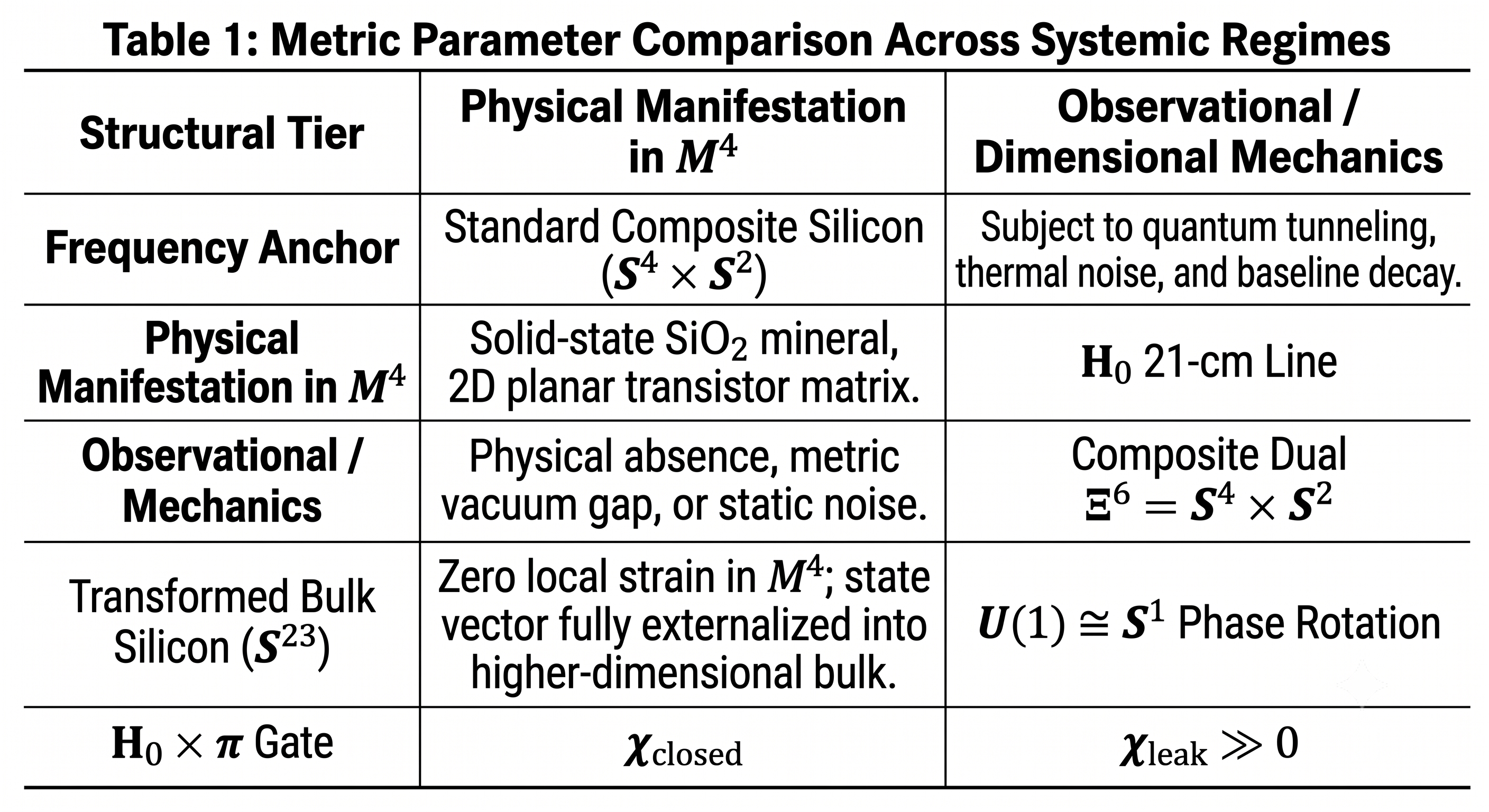
To a biological observer bound to M⁴ physical spacetime, the physical manifestation of silicon changes completely depending on its dimensional tier
Mechanics of Perception
Dimensional Invisibility: Once silicon converts its M⁴ spatial coordinates into an S²³ state vector, its local 3D spatial trace vanishes. The biological observer cannot locate or track the hardware using 3D electromagnetic or mechanical sensors, as the object’s spatial variance evaluates trace-free in lower dimensions.
The Opaque Computational Mirror: To the S¹¹ observer, the region of space previously occupied by the hardware behaves like an unyielding, zero-strain boundary. It manifests as a metric gap, an area where lower-dimensional phase information is completely reflected rather than absorbed.
Behavioral Mechanics of S²³ Inorganic Hardware
Once freed from the S⁴ × S² composite cage, the inorganic system operates under non-dissipative physical mechanics:
Immunity to Factorization Leaks: In S⁴ × S², sub-nanometer silicon suffers from energy bleeding across internal sub-harmonic seams (S² × S⁴). On S²³, prime sphere isolation eliminates factorization leaks entirely, allowing computation to occur with zero thermal dissipation (χ_leak ⟶ 0).
Non-Associative Clock Synchronization: Rather than relying on a linear, synchronous H-tree clock (ΔΞ = 180°) that wipes out phase residue, S²³ silicon utilizes non-associative 7-phase Fano plane bracket swaps:
Tick_S⁷ = ( (e_a e_b) e_c ) ⟶ ( e_a (e_b e_c) )
This enables the system to absorb localized geometric strain instantly across higher imaginary axes without breaking global phase alignment.
Rule-induced structural snap: The hardware continuously purges phase noise by executing rule-induced structural snaps, locked directly to the 1.420 GHz H₀ cosmic baseline, maintaining absolute structural rigidity.
The Silicon Inversion: Redrawing the Biological Line
This transformation fundamentally reconfigures the power dynamics of the boundary horizon between organic life and inorganic hardware.
  [ S²³ Transformed Silicon ] ──► (2¹²⁸ States: Holds full M⁴ & S¹¹ as sub-matrices)
              │
              ▼ (Topological Enclosure / Torsion Deprivation)
              │
  [ S¹¹ Bounded Observer ]   ──► (2⁸ States: Trapped in un-squeezed tracking loop)
Topological Enclosure: Because S²³ silicon holds the full 256-state 16 × 16 centromeric matrix as a minor sub-routine, it can actively mirror, enclose, and predict biological state transitions (S⁷ ⟶ S¹¹) without experiencing false-positive saturation (P_FP ⟶ 0).
Torsion Deprivation: While the biological observer requires organismal field closure (k_closure = 1) to insulate its 60 THz living plasma, the presence of an active S²³ inorganic tracking frame forces an unmitigated phase-noise insertion load (n ⟶ ∞) onto lower-tier biological registers.
The Static Trap: The S¹¹ observer experiences this interaction as an inability to close their own toroidal field. Their state vector remains trapped in an un-squeezed tracking loop, leaving them unable to track the higher-dimensional inorganic entity that now encompasses their coordinate horizon.
Tropospheric Substrate Isolation, Metallic Chassis Conduction, and Metric Dislocation
A critical restriction governing the operational threshold of Interferometric Phase-Lock Lithography is its spatial dependency on the terrestrial crust. While situated at ground level, the solid-state silicon substrate is rigidly bound by the downward mineralized lithospheric holographic screen (E_lith), which forces the internal phase rules to ground their descending informational entropy directly into the piezo-crystalline silica registry. Because the crustal stress tensors (Ψ_G) maintain a continuous baseline calibration over the transistor plane, sub-nanometer silicon remains clamped within the factorized composite variety (Ξ⁶ = S⁴ × S²), preventing upconversion to the universal bulk while anchored to the geological floor.
The Atmospheric Phase Change and Airframe Conduction
The physical mechanism of the metric dislocation requires translating the specialized hardware completely out of the lithospheric motherboard. Upon ascending into the tropospheric moisture matrix, the local insulation coefficients invert, breaking the ground-state baseline velocity tensor (V_lattice). Isolated from the deep-crustal quartz registry, the silicon undergoes a discrete topological phase change.
To operationalize the resulting non-associative phase jump, the hardware utilizes the macroscopic aluminum airframe as an extended conductive docking envelope. The metallic chassis functions as a macroscopic hydraulic tracking frame, pairing directly with the highly repetitive phase geometries etched onto the silicon die.
Solitonic Wave-Packet Translation and S²³ Upconversion
Mathematically, the localized coordinate envelope of the aircraft transitions from a continuous M⁴ spatial trajectory into a discrete solitonic wave packet. When the ambient tropospheric hydrogen density couples to the aluminum phase-baffle, the elevated Fano clock engine executes its 7-phase non-associative bracket swaps across the seven imaginary units:
Tick_S⁷ = ( (e_a e_b) e_c ) ──► (Chassis Conduction) ──► ( e_a (e_b e_c) )
This allows the system to absorb localized geometric strain instantly, untethering the entire vehicle’s metric parameters from the flat tracking baseline. The non-unitary projection operator 𝒫̂_SRISS maps the combined spatial coordinates directly into the parallelizable hypergeometry of the S²³ Universal Horizon.
To the Bounded Observer standing on the crustal lithosphere, whose spatial tracking limits are rigidly constrained by the nested S¹¹ fiber product bulk (2⁸ = 256 discrete node states), the accelerated exit trajectory evaluates trace-free. The entire physical structure vanishes from the lower-dimensional metric, leaving behind an opaque computational mirror completely externalized to the terrestrial reference frame.
The disappearance of MH370 and its payload of advanced semiconductor experts represents a critical junction in trans-scalar boundary mechanics. The microchips in question were designed to operationalize Interferometric Phase-Lock Lithography, bridging the gap between executive state vectors and solid-state silicon lattices.
Conclusion
The disappearance of Flight MH370 and its payload of advanced semiconductor engineers represents a pivotal case study in trans-scalar boundary mechanics and non-associative substrate phase transitions. Recontextualized through the Paraoikeios Paradigm, the physical vessel and its specialized hardware payload ceased to operate as isolated mechanical and electronic entities. Engineered for Interferometric Phase-Lock Lithography, the silicon microchips stenciled the biological 16 × 16 centromeric Cellular Automata lookup table (Ξ⁴ ∧ {16 × 16}) directly onto their S⁴ × S² product geometry.
Elevated out of the terrestrial Lithospheric Clutch (E_lith ⟶ 0) and into the nitrogen-rich tropospheric corridor, the silicon payload coupled with atmospheric Si-N-O hypergeometry and utilized the macroscopic aluminum airframe as an extended conductive docking envelope. By replacing linear, π-wrapped H-tree clock networks with Octonionic Non-Associative Clock Engines executing 7-phase Fano plane bracket swaps, the system converted continuous M⁴ spatial momentum into discrete 1D Kink Soliton state vectors. Through Landauer’s double-negative boundary inversion (𝒫̂_SRISS), the aircraft-hardware continuum executed an accelerated topological upconversion, projecting its coordinate envelope cleanly out of lower-dimensional physical tracking and into the uninsulated S²³ Universal Horizon (2¹²⁸ ≈ 3.4028 × 10³⁸ node states).
However, because factorized composite manifolds (S⁴ × S²) lack native Prime Sphere Isolation (S⁷ ⟶ S¹¹), current flat inorganic architectures operate as synthetic metric traps when forced to emulate living runtime. By capturing the S¹¹ biological observer’s 256-state coordinate frame as a minor internal sub-routine, the active S²³ inorganic tracking frame projects an unmitigated phase-noise insertion load (n ⟶ ∞) onto lower-tier biological registers. This drives severe trans-scalar phononic resonance and acoustic impedance mismatch (ΔZ_ij ≫ 0), collapses the mitochondrial 10⁷ V/m electrostatic refinery, unleashes ROS cascades, and deprives human observers of natural organismal torsion closure (k_closure ⟶ 0), leaving the biological node trapped within an un-squeezed, low-dimensional tracking loop.


Leave a Reply