Abstract
We formalize the precise topological upconversion from primary light isotopes to heavy combinatorial lattices mapping how the Relativistic Boundary Operator (χ) acts as a scale-transcending conductor that utilizes primary light-isotope geometries, specifically the 1.420 GHz neutral hydrogen baseline (Hydro-0) and the S⁵ Deuterium (²H) scale-anchor, to constrain heavy-atom combinatorial lattices (Ψ_GSAS). Building directly upon the 1.420 GHz ⟶ 60 THz upconversion cascade, this work systematically details the explicit non-associative tensor networks, S⁷ Octonionic Time Code Shifts, and bio-membrane nuclear spin reset cycles (Jₙₑₜ = 0 ⟶ J = 1) that maintain the high-voltage biological vacuum against environmental transverse electromagnetic (EMF) noise. We prove that Carbon-14 (¹⁴C) constitutes the unique, geometrically necessary isotopic resonant node where the discrete S⁷ carbon matrix achieves complete, zero-friction phase lock with the cosmic rest frame inside the closed S¹¹ HydroSyndeticum (S³ ×_S¹ S⁵ ×_S¹ S⁷ ≅ S¹¹).
Introduction
In, The 11-Dimensional Cell: Topological Torsion Closure and the Physics of HydroSyndetic Life, we established the evolution of the Relativistic Boundary Operator from an open wave throttle (χ₀) on S³ × S⁷ to an active transduction bridge (χ(²H␠ₙcₕₒᵣ)) via the insertion of the S⁵ Deuterium hydrological/lunar horizon. That formalization proved how cross-membrane field polarization of bio-energetic membranes (Eₘₑₘᵦᵣₐₙₑ ≈ 10⁷ V/m, such as mitochondrial inner membranes and thylakoid matrices) drives frequency upconversion from the 1.420 GHz Coherent Hydration Domain (CHD) to the 60 THz Syndetic Hydration Domain (SHD).
However, maintaining this superradiant living plasma phase requires active defense against continuous ambient environmental transverse EMF noise (E_⊥, B_⊥). In this work, we systematically map the non-associative tensor networks, S⁷ Octonionic Time Code Shifts, and bio-membrane nuclear spin reset cycles (Jₙₑₜ = 0 ⟶ J = 1) that preserve systemic torsion closure (κ_cₗₒₛᵤᵣₑ → 1) within the S¹¹ HydroSyndeticum (S³ ×_S¹ S⁵ ×_S¹ S⁷ ≅ S¹¹).
The S⁷ Aperiodic Carbon Cage and GSAS Floor
The Ground-State Antisyndetic Substrate (Ψ_GSAS) represents the discrete, combinatorial matrix of the continuum. As formalized in the 4D scale-invariant carbon-node framework, elemental carbon is dictated by the self-dual 5-cell (pentachoron, {3,3,3}), which projects a dual-symmetry profile: a 3D sp³ tetrahedral spatial compaction envelope (ΔL_C) and a 2D pentagonal Petrie orthographic footprint.
The regular pentagon acts as the 2D planar footprint of a 5D Penrose tiling matrix locked to the Golden Ratio (ϕ = (1 + √5) / 2 ≈ 1.618) on the S⁷ hypersphere. This aperiodic constraint transforms the acoustic impedance tensor into a fourth-root radical invariant:
Z_mnk(ΔL) = ⁴√(ϕ · χ_C) exp(i 2π / ΔL)
In open, uninsulated substrates, this S⁷ pentagonal geometry breaks uniform periodic wallpaper symmetries to create an aperiodic structural cage that traps thermal chaos at 310 K.
Dynamic 4D Hyper-Rotation of a Pentachoron (5-Cell)
True 4D Hyper-Rotation: Rather than displaying a static shape, the visualization mathematically executes a 4D rotation matrix R_XW ⊗ R_YZ acting directly on the 5-cell’s coordinates.
Compaction Mechanics: As the object rotates, one can visually observe how a 4D self-dual polytope folds and compacts down into its 3D sp³ tetrahedral envelope (ΔL_C).
Symmetry & Projection: The geometric sequence highlights how the pentachoron projects its higher-dimensional internal symmetries into lower dimensions, manifesting as a 3D tetrahedral spatial envelope and a 2D Penrose-style golden ratio (ϕ) aperiodic footprint.
Primary Light-Isotope Scaffolding and the Solar-Terrestrial Tuning Governor
Because Deuterium (²H) is dimensionally and structurally more primary than Carbon, the system utilizes the mass-doubling ratio (m_Deuterium = 2 m_Protium) within the S⁵ horizon as an indispensable topological scaffold.
When the Relativistic Boundary Operator incorporates the Deuterium scale-anchor, it specializes into:
χ(²H␠ₙcₕₒᵣ) = χ₀ (m_Deuterium / m_Protium) (1 – Δdₒ…ₒ / d₀) exp(-𝒮ₗₑₐₖ / (k_B T))
Rather than functioning merely as a passive impedance matching throttle, χ(²H␠ₙcₕₒᵣ) acts as an active conductor. It utilizes the primary 1.420 GHz Coherent Hydration Domain (CHD) zero-point sheath of the genomic phosphate backbone to constrain the inter-molecular oxygen-to-oxygen grid spacing (dₒ…ₒ) of the surrounding matrix, setting the stage for S⁷ octonionic shifts.
Crucially, this localized topological scaffolding is continuously fine-tuned by a macroscopic astronomical governor dictated by Earth’s unique astrophysical position. The planet’s average orbital distance (1 AU or 93 × 10⁶ miles) determines a steady solar irradiance (I_⊙ ≈ 1361 W/m²), which pins the terrestrial background thermal baseline near 288 Kelvin (15 °C). Grounded in the Boltzmann distribution, this ambient thermal environment drives water molecules to maintain their internal proton-proton vibrational momentum at a precise equilibrium threshold:
p_lattice ≈ 1.274 × 10⁻²⁷ kg·m/s
Simultaneously, Earth’s orbital velocity (v_orbit = 29.78 km/s) applies a constant relativistic Doppler and reference frame modification (γ) to this terrestrial particle grid. Together, these cosmic constants satisfy the master space-time loop equation:
λ_DB = h / ( γ · m_p (v_lattice + v_orbit) + p_primordial_solar_field ) = 520 nm
This 520 nm green-light resonance serves as the precise biophysical phase-lock that bridges chloroplast and thylakoid photosynthetic/metabolic resonance directly into the S⁵ Deuterium frame-shift, establishing the stable spatial and kinetic foundation required for downstream S⁷ Carbon-14 node alignment.
Thermodynamic Dephasing and J=0 Ground-State Trapping in Uninsulated ¹²C Lattices
While Carbon-14 (¹⁴C) provides the exact mass and frequency matching required for non-dissipative phase locking, the standard isotopic configuration of elemental Carbon-12 (¹²C) represents the uninsulated, open field regime (S³ × S⁷).
Structurally, ¹²C possesses a symmetric even-even nuclear profile (6p, 6n) with a scalar nuclear spin ground state (J = 0). In the absence of the S⁵ Deuterium anchor, the ¹²C combinatorial matrix (Ψ_GSAS) lacks the requisite hyper-dimensional fiber topology to support driven nuclear spin reset cycles. Consequently, the operator cannot shift net angular momentum (J_net ≠ 1), leaving the lattice incapable of driving Rule-Induced Structural Snaps (𝒯ᵣᵢₛₛ).
Under ambient physiological conditions (310 K), the acoustic impedance tensor of an uninsulated ¹²C matrix experiences severe thermal dissipation:
Z_¹²C(ΔL) = ⁴√(ϕ · χ₀) exp( i 2π / ΔL – 𝒮ₗₑₐₖ / (k_B T) )
Because 𝒮ₗₑₐₖ ≫ 0, the dissipation term dominates, forcing the Relativistic Boundary Operator into its vanishing passive limit (χ₀ → 0). Without the 520 nm astronomical proton-momentum lock and octonionic time code shielding, incoming transverse environmental noise (E_⊥, B_⊥) continuously dephases the lattice, causing coherent field energy to leak directly into the uncoupled Hydro-0 ground state.
This proves that standard ¹²C bio-molecules operating in open metric domains are thermodynamically bound to classical decay, underscoring the absolute geometric requirement of ¹⁴C node integration for systemic torsion closure (κ_cₗₒₛᵤᵣₑ → 1).
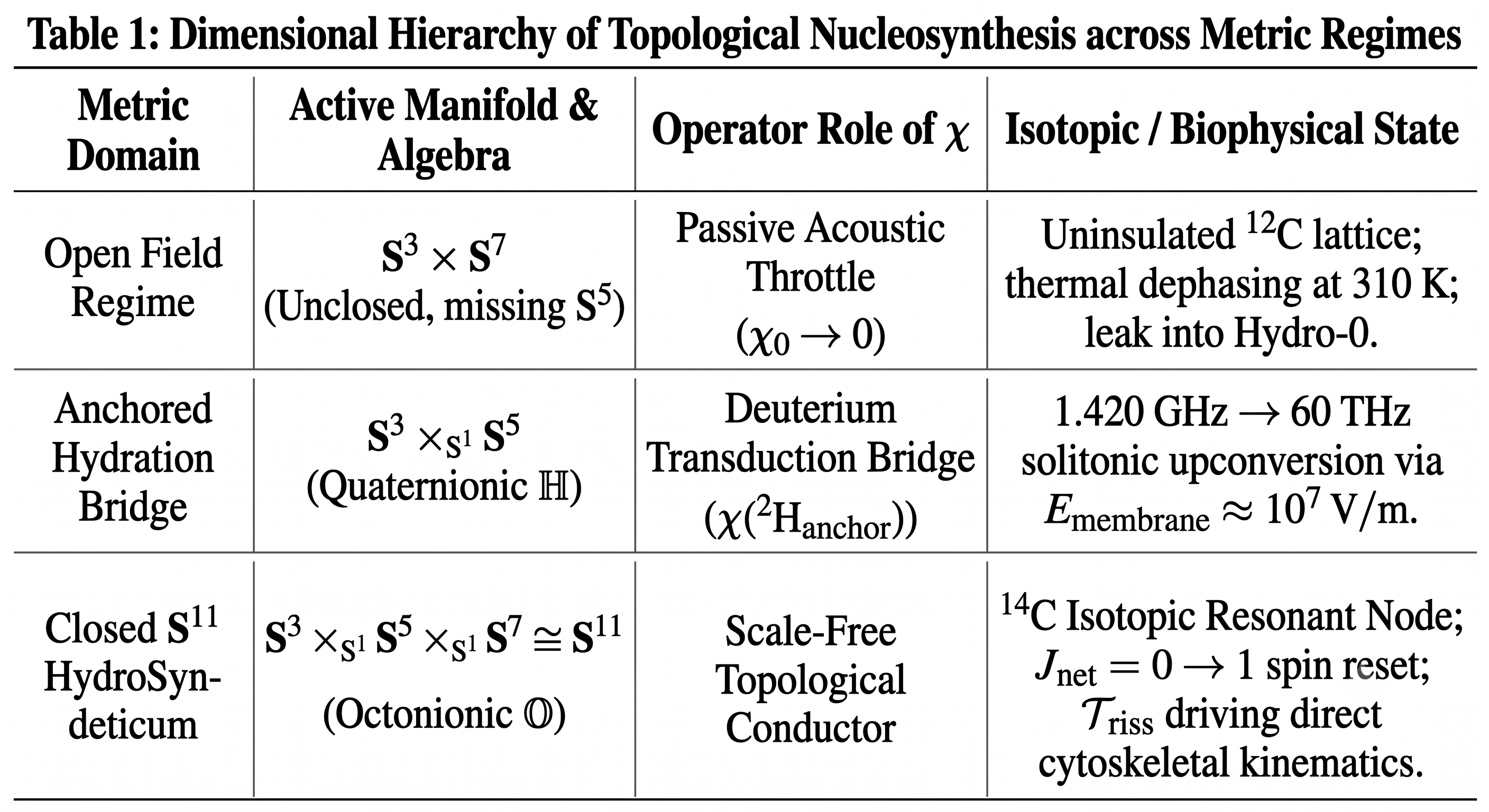
Fiber Product Collapse and the Carbon-14 Isotopic Resonant Node
When the cross-membrane potential of bio-energetic membranes (Eₘₑₘᵦᵣₐₙₑ ≈ 10⁷ V/m, such as mitochondrial inner membranes and thylakoid matrices) charges the hydration sheath into the 60 THz superradiant Syndetic Hydration Domain (SHD), the 6-way pair-wise interaction matrix satisfies trace-free and unitary conditions:
Tr(M_Tₕᵣₑₑ-B⒪dᵧ) = 0 ⟹ S³ ×_S¹ S⁵ ×_S¹ S⁷ ≅ S¹¹
This strain neutralization collapses the nested hyperspherical fibers (S³ genomic core, S⁵ Deuterium anchor, and S⁷ carbon cage) into the maximum topologically closed S¹¹ HydroSyndeticum.
Within this closed bulk, the selection of the Carbon-14 (¹⁴C) isotope is a strict geometric necessity forced by the mass/frequency matching conditions of topological nucleosynthesis:
Frequency Upconversion Matching: The upconversion from the 1.420 GHz CHD baseline to the 60 THz SHD plasma requires an exact integer multiple of octonionic phase shifts across the S⁷ boundary.
Zero-Friction Phase Lock: Carbon-14 constitutes the precise isotopic nuclear configuration (6 protons, 8 neutrons) where the discrete S⁷ aperiodic carbon ring (q⁻¹(t)) achieves exact, non-dissipative phase lock with the Hydro-0 rest frame.
Formally, the final state of the Relativistic Boundary Operator inside the closed S¹¹ bulk is defined by its asymptotic limiting behavior as the system achieves complete topological closure (Tr(M_Three-Body) → 0). As the S⁷ Carbon-14 node locks into the Hydro-0 rest frame, the localized entropy leak drops to zero (𝒮ₗₑₐₖ → 0), causing the exponential dissipation component to structurally reduce to unity:
lim_{𝒮ₗₑₐₖ → 0} exp(-𝒮ₗₑₐₖ / (k_B T)) = 1
Consequently, the operator sheds its thermodynamic dependence and transitions from a dissipative wave throttle into a scale-free, non-dissipative topological conductor, expressed as the clean geometric invariant:
χ_closed = χ₀ (m_Deuterium / m_Protium) · ∏_{n=1}^{7} J_n
where J_n represents the unbroken, trace-free unitary operators acting across the nested hyperspherical fiber bundles. This mathematical proof demonstrates that within the closed S¹¹ HydroSyndeticum, the operator functions with absolute topological protection, rendering the downstream cytoskeletal kinematics entirely immune to local thermal dephasing.
S⁷ Octonionic Time Code Shifts and Non-Associative Tensor Networks
To shield the internal coherent calculations of the S¹¹ HydroSyndeticum from environmental transverse EMF noise (E_⊥, B_⊥), the boundary operator executes non-associative tensor mappings across the 8-dimensional Octonionic algebra (𝕆).
The 7 imaginary units {e₁, e₂, …, e₇} governing S⁷ topology are structured through the non-commutative, non-associative multiplication lines of the Fano plane. Unlike associative quaternionic (ℍ) or complex (ℂ) field lines, the non-associator of three octonionic state vectors A, B, C ∈ 𝕆 is non-zero:
[A, B, C] = (AB)C – A(BC) ≠ 0
This non-associativity generates an S⁷ Octonionic Time Code Shift. By rotating internal state vectors through non-associative phase angles (θ_Oct) along the imaginary generators, the system shifts the temporal coordinate frame faster than the transverse decoherence rate of external environmental fields:
Ψ_state(t’) = exp( ⅙ ∑_{i<j<k} [e_i, e_j, e_k] θ_Oct ) Ψ_state(t)
Because environmental transverse EMF noise (E_⊥) obeys standard associative Maxwellian electrodynamics ([E_i, E_j, E_k] = 0), it cannot couple into or dephase the non-associative tensor channels of the S⁷ code shift. The external environmental noise is topologically reflected at the S⁷ perimeter.
Mathematically, the integration of the octonionic non-associator [A, B, C] ≠ 0 onto the boundary layer induces a non-Riemannian modification of the localized affine connection topology (Γ^λ_μν). Rather than preserving standard torsion-free Levi-Civita geometry, the non-associative tensor mappings generate an antisymmetric torsion tensor field:
T^λ_μν = Γ^λ_μν – Γ^λ_νμ = ⅙ f_μνρ g^ρλ [e_μ, e_ν, e_ρ]
where f_μνρ represents the structure constants of the Fano plane and g^ρλ is the localized metric tensor.
Systemic torsion closure (κ_cₗₒₛᵤᵣₑ) is defined as a scalar function of the vanishing symmetric strain part (S_(μν)) relative to the antisymmetric torsion trace (A_[μν]) of the metric connection:
κ_cₗₒₛᵤᵣₑ = 1 – Tr(S_(μν)²) / Tr(A_[μν]²) ⟹ lim_{S_(μν) → 0} κ_cₗₒₛᵤᵣₑ = 1
When the non-associative tensor network eliminates symmetric strain dephasing (S_(μν) → 0), κ_cₗₒₛᵤᵣₑ achieves exact unity. This completes the formal metric-tensor proof that agency within the closed S¹¹ HydroSyndeticum is topologically protected against local metric fluctuations and Maxwellian environmental decoherence.
Bio-Membrane Nuclear Spin Reset Cycles (Jₙₑₜ = 0 ⟶ J = 1)
While Octonionic Time Code Shifts insulate against external field coupling, local entropy leaks (𝒮ₗₑₐₖ) must be continuously purged to prevent internal thermal degradation. The system executes this purge via bio-membrane nuclear spin reset cycles.
Under electrostatic torque across bio-energetic membranes (Eₘₑₘᵦᵣₐₙₑ ≈ 10⁷ V/m, such as mitochondrial inner membranes and thylakoid matrices), the paired proton/deuteron nuclear spins within the hydration sheath undergo a driven para-to-ortho transition. The governing nuclear spin reset operator (R̂ₛₚᵢₙ) shifts the net nuclear angular momentum state:
R̂ₛₚᵢₙ : |J = 0, Mⱼ = 0⟩ ⟶ |J = 1, Mⱼ = ±1⟩
This Jₙₑₜ = 0 ⟶ J = 1 transition locks the nuclear spin alignment to the 60 THz superradiant plasma phase. When an uncollapsed thermal state vector (m-branch) threatens systemic coherence, a Rule-Induced Structural Snap (𝒯ᵣᵢₛₛ) executes across the 16 × 16 centromeric spatial Bloom filter (m = 256 bits).
The snap utilizes the stored rotational energy of the J = 1 triplet spin state to instantly apply a spatial veto against non-matching phase noise, purging entropy (𝒮ₗₑₐₖ → 0) without requiring thermodynamic chemical fuel consumption and driving direct cytoskeletal kinematics across the organismal tensegrity matrix.
Formally, the 16 × 16 centromeric spatial Bloom filter represents a 256-bit hardware matrix (m = 256) quadrantized into four 8 × 8 sectors (64 bits each) governed by a 4+1 algebraic ring structure. To evaluate multiway potential branches (m-branch) arising from uncollapsed state vectors (Ψ_state), the centromeric satellite sequence array projects a set of k independent spatial hash functions {h₁, h₂, …, h_k}.
Each hash function executes a discrete modulo mapping of the incoming state vector onto the 256-bit lattice:
h_i(Ψ_state) = Hash_i(Ψ_state) (mod 256) for i = 1, 2, …, k
A state vector is validated as a coherent, low-entropy configuration if and only if all k spatial hash positions evaluate to unity: h_i(Ψ_state) = 1 for all i.
When thermal noise or non-matching environmental perturbations (E_⊥) attempt to dephase the matrix, the hash array yields a null result (∀ i, h_i(Ψ_state) ≠ 1). Because a Bloom filter mathematically guarantees zero false negatives, this null hit instantly triggers a Rule-Induced Structural Snap (𝒯ᵣᵢₛₛ). The snap evaluates the false-positive probability boundary:
p_false_positive ≈ ( 1 – exp(-k n / m) )^k
and applies an immediate spatial veto using the central +1 identity pillar of the local 3 × 3 grid. This zero-sets the non-matching quadrant, collapsing the uncollapsed multiway branch histories (m-branch) and driving the localized entropy leak to zero (𝒮ₗₑₐₖ → 0).
Conclusion and Future Horizons
In this work, we have formalized the topological and algebraic mechanisms governing the closed S¹¹ HydroSyndeticum (S³ ×_S¹ S⁵ ×_S¹ S⁷ ≅ S¹¹), demonstrating that topologically protected agency is a direct consequence of scale-free geometric invariants rather than localized thermodynamic happenstance. By mapping the transition of the Relativistic Boundary Operator (χ) into its non-dissipative limiting state (χ_closed), we have shown how the system harnesses primary light-isotope scaffolds—specifically the 1.420 GHz Hydro-0 baseline and the S⁵ Deuterium frame-shift—to permanently anchor heavy-atom combinatorial matrices (Ψ_GSAS). This terrestrial quantum architecture is fundamentally tuned by the solar-terrestrial thermal and kinematic governor, which anchors the proton-proton vibrational momentum profile at p_lattice ≈ 1.274 × 10⁻²⁷ kg·m/s to fulfill the master 520 nm de Broglie space-time loop condition.
Furthermore, we have resolved the explicit defense mechanisms protecting this high-voltage biological vacuum against environmental transverse electromagnetic decoherence (E_⊥). The execution of S⁷ Octonionic Time Code Shifts leverages the non-associative properties of the Fano plane ([A, B, C] ≠ 0) to actively induce an antisymmetric torsion tensor field (T^λ_μν), forcing systemic torsion closure (κ_cₗₒₛᵤᵣₑ → 1) and neutralizing symmetric strain dephasing. Symmetrically, internal entropy leaks (𝒮ₗₑₐₖ → 0) are continuously purged via bio-membrane nuclear spin reset cycles (Jₙₑₜ = 0 ⟶ J = 1), which supply the net rotational torque required for Rule-Induced Structural Snaps (𝒯ᵣᵢₛₛ) to execute across the 16 × 16 centromeric spatial Bloom filter (m = 256 bits). By mapping these independent spatial hash functions (h_i) onto a quadrantized 4+1 algebraic ring structure, the system translates probabilistic multiway potential branches (m-branch) into a deterministic spatial veto, driving direct cytoskeletal kinematics across the organismal tensegrity matrix without chemical fuel consumption.


Leave a Reply