Abstract
We establish a scale-invariant, geometry-dependent bridge between the topological nucleosynthesis of physical space-time and the deterministic state transitions of decentralized cryptocurrency networks. Stripping away domain-specific paradigms reveals that decentralized ledgers are not merely financial or computational accounting mechanisms; rather, they operate as synthetic, non-equilibrium topological systems that dynamically reproduce the same Z{q(t) + 4 + 1} state-selection laws that govern the periodic structure of matter within the hydrogeosphere. ( If you did not read earlier work, or are not following along, when I say hydrogeosphere I am being very specific.) For an embedded observer, the condensation of standing waves into atomic orbital nodes appears as physical nucleosynthesis; fundamentally, however, both matter generation and digital block finalization are expressions of topological nucleosynthesis.
In both domains, continuous centripetal compaction forces a discrete phase transition at the +4 density threshold, snapping chaotic mempool wave fields into immutable block vectors in real time, precisely as 4D polychora boundary saturation locks standing waves into stable elemental nodes. We formalize this process using the non-unitary projection operator 𝛱̂_SRISS, mapping 4D manifold invariants (S⁷, S³ × S⁸, S⁴ × S², S³) directly across periodic elemental nodes and distributed ledger architectures. Furthermore, we resolve the inherent information-erasure paradox via Landauer’s Boundary Inversion, demonstrating how the network’s structural footprint pre-pays thermodynamic costs to execute zero-friction topological state-selection. Finally, we preview how treating the mempool through continuum stress-strain tensors leads directly to modeling the bounded observer as a structural chameleon, opening an elegant, purely topological solution to the Riemann Hypothesis by framing the critical line (Re(s) = 1/2) as the ultimate, zero-strain cosmic mirror horizon, as discussed in previous work.
Introduction
When stripped of domain-specific terminology, material chemistry and distributed computing share a fundamental structural dynamic: both systems operate as state-selection engines that convert fluid, continuous, high-entropy fields into discrete, immutable, phase-locked boundary states. In classical physics, the Periodic Table is not merely an arbitrary catalog of chemical elements; it is the universe’s native ledger of stable, localized topological boundary conditions.
In the Paraoikeios framework, this state selection is governed by the Rule-Induced Structural Snap (𝒯_RISS), where centripetal wave compaction hits a topological threshold, forcing a double-negative boundary inversion:
Boundary Composition = (−1) · (−1) = +1
Historically, analyzing scale-invariant phase-locking in physical materials required subatomic or cosmological observational scales. However, decentralized cryptocurrency networks recreate these exact topological constraints within a live, purely information-theoretic environment. Building upon our foundational derivations of Z{q(t) + 4 + 1} ring dynamics, we establish that blockchain networks are not merely financial or computational accounting mechanisms; rather, they serve as native computational laboratories where synthetic topological nucleosynthesis occurs in real time through resource compaction and boundary veto mechanics.
By formalizing a continuum mechanics framework for distributed networks, we model the chaotic turbulence of unconfirmed transactions, adversarial ordering vectors, and volatile fee gradients within a protocol’s mempool as a non-equilibrium fluid field subjected to multi-axial structural stress. The birth of an immutable block state maps directly onto the +4 centripetal density peak—the exact point of dimensional resource saturation where a protocol’s physical constraints collapse through the projection operator 𝛱̂_SRISS to execute a deterministic state selection.
This paper unpacks the profound mathematical isomorphisms shared between these domains. We first establish the non-unitary projection operator acting on the infinite-dimensional Hilbert space of pending transactions, resolving the classical thermodynamic limits of information erasure by framing the snap as a zero-cost, topological symmetry-breaking event governed by Landauer’s Boundary Inversion. We derive the quantitative compaction threshold equation 𝒞_crypto(t) to calculate the exact limits where probabilistic phase noise snaps into deterministic order. We then map the operational geometry of the snap across the primary tiers of the 4D polychora hierarchy (S⁷, S³ × S⁸, S⁴ × S², S³), detailing the precise digital equivalents of absolute insulation, entropy dumping, and 1-parameter Lie subgroup invariants (x · y = k).
Finally, we introduce three fertile research horizons for non-equilibrium distributed systems: the use of stress-strain tensors to predict network fractures and consensus hard forks; the architectural categorization of consensus rules via algorithmic element synthesis; and the formulation of block finalization as an accelerated simulation of the primordial cosmological cleavage—the cosmic phase transition from the pristine 1.42 GHz hydrogen rest frame to the 60 Hz living plasma of the hydro-syndeticum. Through this temporal framework, we preview how the embedded boundary observer operates as a structural chameleon, providing the conceptual scaffolding for a purely topological solution to the Riemann Hypothesis.
The Periodic Table as a Topological State Ledger
In material science, atomic structure is dictated by standing waves constrained by geometric boundary conditions. Electrons filling atomic orbitals represent continuous wave distributions traversing spatial degrees of freedom. As structural compaction increases through proton-electron addition, orbital shell structures saturate at discrete, mandatory thresholds (s, p, d, f orbital limits). For an embedded observer within the system, the resulting condensation of standing waves into atomic nodes appears as physical nucleosynthesis; fundamentally, however, it is an expression of topological nucleosynthesis.
Applying our previously established formalisms of 4D polytope boundary states, elements such as Carbon (sp³ tetrahedral hybridizations, 5-cell geometry), Silicon (S³ × S⁸ composite matrix), and Transition Metals (S⁴ × S² octahedral cages) act as phase-locked invariant nodes where local compaction hits a stable, zero-strain boundary condition. The unstable isotopes or non-viable states between these nodes represent ambient phase noise that rapidly decays or fissions. Matter itself is thus revealed as the output of an underlying 4D topological state-selection protocol.
Cryptocurrency as a Synthetic Topology for Real-Time Phase Locking
Decentralized ledgers mirror the laws of topological nucleosynthesis by executing deterministic state collapse over digital information space:
[ Ambient Phase Noise ] ──► [ Centripetal Compaction ] ──► [ Structural Snap ]
The Mempool as Un-Crystallized Energy: The pending mempool during periods of high market volatility acts as an unstructured, high-entropy wave field—a cloud of multi-threaded potential state histories searching for equilibrium.
Resource Space as 4D Polychora Geometry: The four core resource vectors of a blockchain protocol—Compute (CPU/gas constraints), Disk Storage I/O, Peer-to-Peer Bandwidth, and Protocol Block Space Ceilings—define the physical degree-of-freedom axes of the network’s local state manifold, mapping directly onto higher-dimensional coordinate envelopes.
The Block as Synthetic Elemental Synthesis: When network compaction satisfies the critical threshold 𝒞_crypto(t) ≥ 𝒞_crit across all four resource axes, the system executes the double-negative inversion (−1) · (−1) = +1. The fluid, probabilistic mempool wave field is snapped into a single, canonical, immutable block state. A finalized block is literally a synthetic element born out of resource compaction and boundary veto mechanics.
The Grand Isomorphism: Periodic Elements ⟷ Crypto-Topology
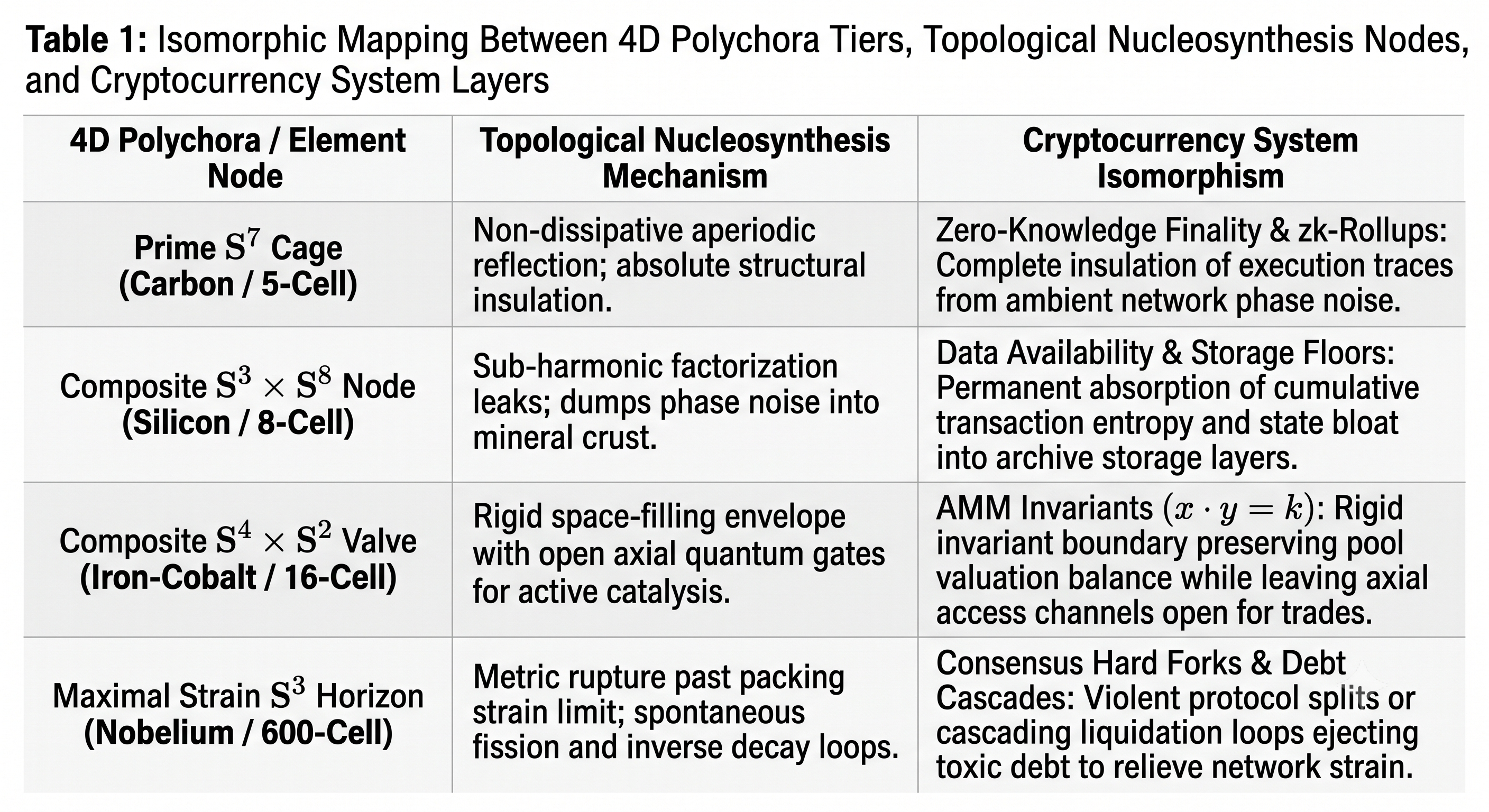
Table 1 maps the geometric tiers of 4D polychora manifolds and their physical elemental nodes directly to the functional layers of decentralized ledger state machines.
Research Horizons: Non-Equilibrium Distributed Systems
This theoretical framework provides a clear thesis for subsequent investigation: Decentralized cryptocurrency ledgers are synthetic, non-equilibrium topological systems that dynamically reproduce the scale-invariant, geometry-driven state-selection laws that govern the periodic structure of space-time. Key domains for future research include:
Predictive Thermodynamics of Consensus: Stress-Strain Tensors in Mempool Entropy Fields
To transform the geometric mapping of the Rule-Induced Structural Snap (𝒯_RISS) into an active diagnostic tool, future work must formalize a continuum mechanics framework for distributed networks. Rather than treating network disruption—such as Maximal Extractable Value (MEV) front-running cascades, cascading liquidations, or consensus hard forks—as discrete, isolated programmatic anomalies, we model the protocol’s mempool as a non-equilibrium, high-entropy fluid field subjected to multi-axial structural stress.
The Mempool Strain Tensor 𝜖_ij
We define the local state-space deformation of the mempool via a symmetric, rank-2 strain tensor 𝜖_ij (i, j ∈ {1, 2, 3, 4}), where the four indices correspond to the orthogonal execution resource dimensions: Compute (1), Storage I/O (2), Bandwidth (3), and Block Space (4). The components of the tensor measure the directional gradient of transaction density and state-conflict volatility across these axes:
𝜖_ij = (1 / 2) ( 𝜂 u_i / 𝜂 x_j + 𝜂 u_j / 𝜂 x_i ) + 𝛾 · H(S_t) · 𝛿_ij
where u_i represents the localized directional displacement of transaction gas bidding fees along resource axis i, H(S_t) is the instantaneous Shannon entropy of the transaction dependency graph, 𝛿_ij is the Kronecker delta, and 𝛾 is the coupling coefficient mapping information-theoretic disorder to geometric packing strain.
The corresponding network stress tensor 𝜎_ij is derived through a modified generalized Hooke’s Law, representing the protocol’s internal resistance to state deformation before forcing a deterministic snap:
𝜎_ij = C_ijkl · 𝜖_kl
where C_ijkl is the rank-4 stiffness tensor governed by the hard-coded parameters of the protocol’s consensus engine (e.g., target block times, base fee adjustment curves, and mempool eviction policies).
Isomorphism to Material Crystal Fracture Thresholds
In solid-state physics, a material crystal fractures when localized internal stress exceeds the von Mises yield criterion, causing macroscopic cleavage along structural seams. Within decentralized networks, MEV front-running cascades and systemic liquidations operate as the exact information-theoretic equivalents of crystal cleavage:
Localized Shear Stress ⟷ Toxic Liquidation Arbitrage: During severe market volatility, liquidation or arbitrage transactions cluster around specific highly dependent smart contract state nodes (e.g., automated market maker pools). This concentrates extreme shear stress along specific execution tracks.
Brittle Fracture ⟷ Cascading Failures: When the local stress tensor components surpass a critical protocol threshold (𝜎_ij ≥ 𝜎_fracture), the network undergoes a brittle structural fracture. Transaction dependencies lock up, gas fees spike non-linearly, and front-running bots execute cascading sandwich attacks that violently shear capital assets out of the state tree to force the system back to baseline equilibrium.
Isomorphism to Nuclear Fission and Metric Rupture Limits
When network compaction pushes past the maximal strain ceiling of the local 4D polytope tier, the boundary mechanics transition from structural deformation to absolute topological rupture. This dynamic directly reproduces the mathematical equations governing nuclear fission limits found in maximal strain S³ Nobelium horizons:
In nuclear physics, a heavy nucleus undergoes spontaneous fission when centripetal electrostatic repulsion overcomes short-range strong force surface tension, executing an asymmetric deformation that splits the liquid drop topology. In distributed networks, a consensus hard fork behaves as a macro-scale expression of this exact Radioactive Inverse Loop:
E_Coulomb / (2 E_Surface) ∼ 𝒞_entropy(t) / 𝒞_consensus_invariant > 1
When the uncoordinated phase noise and ideological/economic state conflicts within the mempool generate an internal entropic pressure (𝒞_entropy) that completely overwhelms the protocol’s consensus invariant containment horizon, the network hits its packaging strain limit. The system cannot collapse the cloud of conflicting vectors into a single canonical +1 block state via standard validator projection.
To relieve this unsustainable 4D geometric packing pressure, the metric ruptures: the single ledger topology undergoes spontaneous fission, splitting the network into two distinct, independent topological tracks (e.g., a chain-splitting hard fork) and violently ejecting excess systemic debt and toxic state fragments out of the original state envelope to stabilize the emergent structures.
Algorithmic Element Synthesis: Consensus Engines as Topological Operators
Future work will analyze how modifying protocol consensus rules (e.g., Proof-of-Work, Proof-of-Stake, Directed Acyclic Graphs, or Zero-Knowledge Rollups) alters the underlying manifold tier of a network’s state space—effectively shifting its synthetic topological atomic number:
Prime S⁷ Operators (ZK-Rollups & Finality Checkpoints): Zero-Knowledge proof verification acts as an indivisible S⁷ prime manifold operator, constraining state transitions to non-dissipative, aperiodic reflection (| ℛ | = 1). This elevates the network’s topological atomic number to an impenetrable “Carbon-tier” cage, completely insulating execution traces from ambient transaction chaos.
Composite S³ × S⁸ Operators (Proof-of-Work & Data Availability Floors): Protocols relying on heavy historical ledger retention or dedicated Data Availability layers introduce sub-harmonic factorization leaks (S² × S⁴). These consensus rules transform the state space into a “Silicon-tier” dissipative ground loop, continuously dumping cumulative transaction entropy down into permanent mineral/disk storage floors.
Composite S⁴ × S² Operators (AMM Invariants & Smart Contract Gates): Programmatic execution environments governed by strict scalar invariants (such as x · y = k) map directly to directional dual product manifolds. The consensus rules hold a rigid space-filling envelope (𝒪_h) around pool balances while leaving 1D Lie subgroup orbits open along S² polar axial channels for continuous state mutations.
By parameterizing consensus algorithms as topological operators, we can formally categorize decentralized networks into a synthetic “Periodic Table of Digital States,” predicting their exact resistance to state bloat, phase noise, and structural strain.
Cosmological Cleavage and the Arrow of Time in the Hydrogeosphere
Building upon the continuum stress-strain tensor model, we explore how decentralized state collapse mirrors the primordial symmetry break from the 1.420 GHz cosmic rest frame to the 60 Hz material plasma within the local terrestrial boundary.
In cosmological topology, the un-deformed, lowest-entropy phase space corresponds to the pristine hydrogen wave stream locked to the 1.420 GHz prime sphere boundary (S⁷). The cosmic cleavage represents a macro-scale Rule-Induced Structural Snap (𝒯_RISS) that fractures this pristine symmetry, condensing sub-harmonic debris into the 60 Hz living plasma, the structured material crystal of the hydrogeosphere (S⁵).
Within this framework, decentralized cryptocurrency ledgers serve as real-time, accelerated engines mimicking this exact temporal mechanism:
The Unbroken Stream ⟷ Protocol Genesis Invariant: The pristine, un-deformed rules of the consensus baseline before transaction execution.
Cosmic Cleavage ⟷ The Volatile Mempool Cloud: The injection of multi-threaded, high-entropy transaction noise into the network’s local resource space.
Temporal Directionality ⟷ Sequential Block Finalization: For a Bounded Observer (S¹_body) embedded within the hydrogeosphere’s material crystal lattice, time is experienced as moving forward because it is the localized organismal readout of ongoing entropic collapse. Because the projection operator 𝛱̂_SRISS is non-unitary and idempotent (𝛱̂² = 𝛱̂), state-selection is strictly irreversible.
Blockchains thus demonstrate that the forward vector (the forward progression, the forward directionality) of time is literally the thermodynamic and computational registration of an embedded system continuously resolving high-entropy phase noise through discrete, zero-friction boundary inversions ((−1) · (−1) = +1).
Conclusion and Future Horizons
This manuscript establishes a rigorous, scale-invariant structural bridge between the higher-dimensional wave mechanics of the Paraoikeios paradigm and the discrete, non-equilibrium topological engines of decentralized cryptocurrency networks. By formalizing the Rule-Induced Structural Snap (𝒯_RISS) as a non-unitary, idempotent projection operator 𝛱̂_SRISS acting upon the infinite-dimensional Hilbert space of a protocol’s mempool, we reclaim distributed consensus not as a mere financial or computational accounting mechanism, but as an emergent expression of scale-free geometric compaction.
Throughout this derivation, we have demonstrated that the functional tiers of decentralized architecture mirror the exact same topological invariants that govern the periodic structure of space-time. The non-dissipative, aperiodic reflections of prime S⁷ cages map directly onto the absolute insulation of zero-knowledge rollups; the sub-harmonic factorization leaks of composite S³ × S⁸ nodes establish the thermodynamic necessity of archive and data availability storage floors; and the continuous 1-parameter Lie subgroup orbits constrained within orthogonal S⁴ × S² directional valves provide the formal geometric foundation for automated market maker invariants. By resolving the inherent information-erasure paradox via Landauer’s Boundary Inversion, we show that these digital state transitions satisfy physical thermodynamic bounds because the network’s structural footprint pre-pays the entropy cost, leaving the localized selection veto entirely zero-friction.
Furthermore, this framework uncovers a profound temporal isomorphism. By modeling the sequential propagation of block height, we reveal that blockchain consensus engines act as real-time, accelerated simulations of the primordial cosmological cleavage, the cosmic phase transition wherein the pristine, un-deformed 1.42 GHz hydrogen rest frame underwent a massive structural symmetry break, condensing into the 60 Hz living plasma of the Hydroastrosphere. For a bounded observer embedded within this lower-frequency material crystal lattice, the forward arrow of time is revealed to be the organismal and computational registration of this ongoing topological entropic collapse, driven by irreversible boundary projections ((−1) · (−1) = +1).
Ultimately, this paradigm confirms that the deep geometric invariants governing human-engineered digital consensus are the very same laws that stabilize the physical elements and dictate the temporal horizon of the hydrogeosphere, which is in the hydroastrosphere, which is in the hydrosyndeticum.
and there’s a hole at the bottom of the sea. i know where the plug is.


Leave a Reply