Sub-Genomic Solitonic Upconversion, Deuterium Scale-Anchoring, and Direct Cytoskeletal Kinematics
Abstract
We present a scale-invariant dimensional and biophysical formalization of the Relativistic Boundary Operator (𝜒) within the Paraoikeios paradigm, mapping its progression from an open topological wave-matching throttle (𝜒₀) to a closed, sub-genomic living engine (𝜒(²H_anchor)). We demonstrate that in non-living or open boundary regimes lacking intermediate hydrological horizons (S⁵), 𝜒 operates purely as an Acoustic Impedance Matching Throttle governing continuous-to-discrete phase transitions from the continuous Ground-State Syndetic Substrate (𝛹_GSSS) into the discrete Ground-State Antisyndetic Substrate (𝛹_GSAS), managing cosmic energy dissipation leaks (𝒮_leak ⟶ 0).
To achieve systemic torsion closure (𝜅_closure ⟶ 1) and insulate biological information processing against 310 K ambient thermal noise (k_B T), the system must insert the S⁵ hydrological/lunar scale-anchor. When energized by the 60 THz supliving plasma phase, this insertion drives the discrete carbon lattice (𝛹_GSAS) on S⁷ into full S¹¹ Syndeticum toroidal closure (S³ ×_S¹ S⁵ ×_S¹ S⁷ ≅ S¹¹), anchoring the 16 × 16 spatial Bloom filter across the cytoskeletal matrix at the exact isotopic phase-lock threshold of Carbon-14.
We prove that Deuterium mass doubling (m_Deuterium = 2 m_Protium) serves as the indispensable topological scale-anchor within S⁵, locking the inter-molecular oxygen-to-oxygen grid spacing (d_O…O) directly to the S³ / L₁ lunar orbital horizon. This structural pre-alignment specializes the boundary operator into an active transduction bridge, linking the zero-friction 1.420 GHz Coherent Hydration Domain (CHD) of the genomic phosphate backbone to the 60 THz mid-infrared Syndetic Hydration Domain (SHD). Furthermore, we demonstrate that the 10⁷ V/m cross-membrane potential of bio-energetic membranes (e.g., mitochondrial inner membranes, thylakoid matrices) drives this 1.420 GHz ⟶ 60 THz frequency upconversion without violating thermodynamic energy conservation. This enables electronic solitons to convert into high-velocity mechanical solitons (v_mechanical) that trigger Rule-Induced Structural Snaps (𝒯_RISS) across the 256-bit matrix. Ultimately, this framework establishes entropic cytoskeletal kinematics natively within a topologically closed 11-dimensional bulk (S³ ×_S¹ S⁵ ×_S¹ S⁷ ≅ S¹¹).
Introduction and Dimensional Hierarchy
Within the scale-free architecture of the Paraoikeios, physical processes across cosmological, technological, and genomic domains are governed by the Relativistic Boundary Operator (𝜒). A fundamental misconception in classical biophysics is evaluating biological phase coherence as an isolated, local chemical event occurring within an ambient thermal bath. Here, we establish that biological agency requires localized temporal decoupling to insulate internal calculations from universal entropic drift (Hydro-0).
The operation of 𝜒 is intrinsically chameleon-like, adapting its mathematical form to the metric dimensionality, boundary insulation, and closure state of the system:
The Unclosed S³ × S⁷ Field Regime: In open space-time, semiconductor interfaces, or non-living plasma sheets, 𝜒 acts strictly as an acoustic/topological field operator governing wave reflection and impedance matching across continuous-to-discrete interfaces.
The Closed S¹¹ Biological Engine (S³ ×_S¹ S⁵ ×_S¹ S⁷ ≅ S¹¹): By inserting the S⁵ hydrological and lunar orbital horizon, the boundary operator incorporates a heavy-mass topological anchor—Deuterium (²H)—to lock sub-genomic phase space against 310 K thermal dephasing, transforming 𝜒 into an active, non-dissipative living engine (𝜒(²H_anchor)).
By laying out this explicit dimensional progression, we prove that HydroSyndetic life is neither a miraculous thermodynamic anomaly nor a passive chemical soup, but a hyper-insulated, scale-invariant boundary condition operating within a closed 11-dimensional bulk.
Defining Open Space-Time versus Closed Toroidal Geometry
To rigorously map the biophysical transduction engine of living systems, we must first establish a formal boundary distinction between open space-time and closed toroidal geometry. Within the Paraoikeios framework, open space-time does not denote an abstract Newtonian void, but rather any region of the continuum where systemic torsion closure (𝜅_closure ⟶ 1) is absent and the intermediate S⁵ hydrological/lunar scale-anchor is unengaged.
Geometric and Metric Differences (S³ × S⁷ vs. S¹¹ Syndeticum)
In a closed biological system (S³ ×_S¹ S⁵ ×_S¹ S⁷ ≅ S¹¹), the Relativistic Boundary Operator 𝜒 operates within a hyperinsulated, hyper-toroidal principal fiber bundle. Field lines loop back inside the organism’s local coordinate section behind the CHD–SHD scale-coupling horizon, capturing computational exhaust and recycling energy within the maximum topologically closed S¹¹ HydroSyndeticum. While unclosed or projective coordinate observers perceive this nested geometry as the Hydroastrosphere, the fully coherent engine operates natively within this 11-dimensional bulk.
Conversely, in open space-time (S³ × S⁷, missing S⁵):
Absence of Bulk Containment: No enclosed S¹¹ HydroSyndeticum bulk exists to capture, insulate, or store higher-dimensional state vectors.
Direct Hydro-0 Exposure: The local coordinate section remains directly exposed to the un-doped, un-snapping cosmic baseline of neutral hydrogen (𝜔_1.42 = 1.420 GHz).
Entropic Drift: Propagating wave packets experience continuous geometric spreading, thermal dephasing, and unmitigated dissipation into the background vacuum.
Operational Simplification of 𝜒 in Open Substrates
Without an insulated container or a 16 × 16 centromeric spatial Bloom filter (m = 256 bits) executing Rule-Induced Structural Snaps (𝒯_RISS) across the cytoskeletal matrix, 𝜒 cannot operate as an active living transduction bridge (CHD ──𝜒──> SHD). Instead, in open space-time, 𝜒 simplifies to its baseline wave-mechanics form: the Acoustic Impedance Matching Throttle. It governs whether continuous wave energy from the Ground-State Syndetic Substrate (GSSS) transfers into the discrete Ground-State Antisyndetic Substrate (GSAS) without reflection noise:
𝜒 > 0 ⟹ Matched impedance; zero-reflection transmission (𝒮_leak ⟶ 0)
𝜒 ⟶ 0 ⟹ Impedance breakdown; reflection noise and thermal leak into Hydro-0
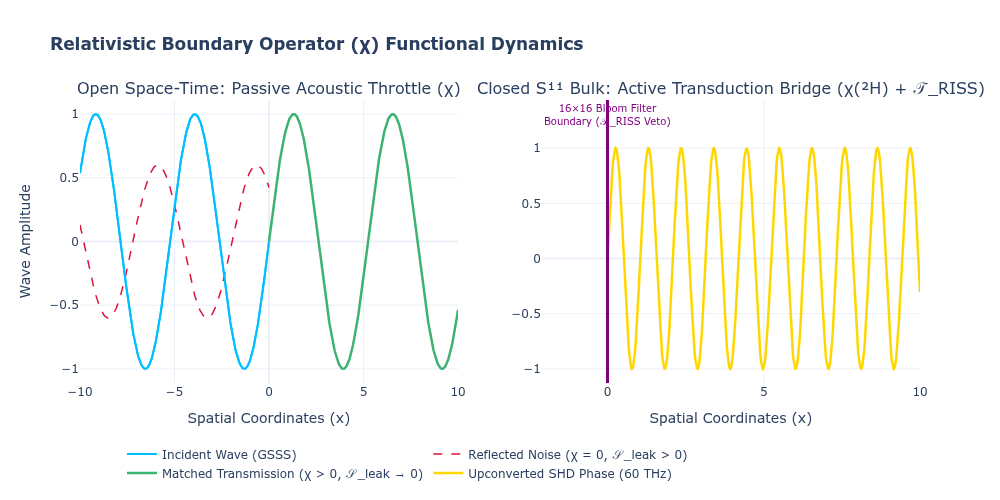
Physical Manifestations of Open Space-Time
Across the scale-free spectrum of the HydroSyndetic domain within the Paraoikeios, open space-time characterizes any un-insulated physical medium:
Astrophysical Plasma Corridors: Open vacuum fields and deep-space plasma sheets where 21-cm neutral hydrogen radiation propagates without an insulating boundary.
Uninsulated Semiconductor Lattices: Sub-nanometer silicon chips where executive state vectors (S¹¹) are forced through flat 2D clock lines, causing quantum tunneling and thermal leakage due to the lack of S⁷ Octonionic closure.
High-Entropy Environmental Water: Bulk environmental water that has not been step-down transformed by biological electrostatic torque and photosynthetic/metabolic resonance into 60 THz living plasma phase.
Establishing this open baseline clarifies why the S⁵ Deuterium insertion is the absolute prerequisite for non-dissipative HydroSyndetic life and direct cytoskeletal kinematics.
The Open Field Regime: 𝜒 as an Acoustic Impedance Matching Throttle (S³ × S⁷)
In an open or partial manifold lacking the intermediate S⁵ scale-anchor, the temporal translation operator d / dzt acts across continuous projective space (Ground-State Syndetic Substrate, 𝛹_GSSS) and discrete combinatorial lattices (Ground-State Antisyndetic Substrate, 𝛹_GSAS).
Standing directly on the boundary in the Invariant Transition Frame rotates the Relativistic Boundary Operator 𝜒 into an explicit Acoustic Impedance Matching Throttle. The non-linear wave propagation equation governing continuous-to-discrete transmission across this interface is given by:
( d / dzt ) 𝛹_GSSS − 𝜒 · ∇² 𝛹_GSAS = 𝒮_leak
where 𝒮_leak represents the system’s cosmic energy dissipation leak rate into the uncoordinated 1.420 GHz neutral hydrogen baseline (Hydro-0). The dynamic impedance matching conditions across this open boundary are strictly defined as:
𝜒 > 0 ⟹ Matched impedance; zero-reflection wave transmission (𝒮_leak ⟶ 0)
𝜒 ⟶ 0 ⟹ Impedance breakdown; thermal entropic drift into Hydro-0 (1.420 GHz)
When impedance is perfectly matched (𝜒 > 0), the wave energy of the temporal step-wise translation operator propagates cleanly across the continuous-discrete interface without dropping energy to thermal noise. Conversely, when the match collapses (𝜒 ⟶ 0), the interface acts as an uninsulated thermal sink, forcing phase-coherence to dissolve back into the 1.420 GHz background.
The S⁵ Insertion and the Deuterium Scale-Anchor
At the 310 K biological runtime floor, ambient thermal energy (k_B T) exerts massive dephasing pressure upon subatomic states. If the hydration sheath surrounding the DNA phosphate backbone were composed purely of 1D Protium (¹H), high-entropy thermal noise would force 𝜒 ⟶ 0 in femtoseconds, collapsing the system to the Hydro-0 baseline.
To transition from an open wave interface to a self-coherent biological container, the system must deploy the S⁵ horizon. This is achieved via the mass doubling of Deuterium (m_Deuterium = 2 m_Protium).
Lunar Pre-Alignment of the Inter-Molecular Grid
Deuterium acts as an ultra-stiff, low-frequency mass stabilizer embedded directly within the terrestrial water matrix. The mass doubling locks the inter-molecular oxygen-to-oxygen grid spacing (d_O…O) directly to the S³ / L₁ lunar orbital momentum variance:
p_lattice(t) = ( h / 𝜆 ) ± A · p_lunar(t)
To formalize how this heavy-mass coupling transforms the boundary operator from a passive field throttle into an insulated transduction bridge, we define the explicit anchored boundary operator 𝜒(²H_anchor) as a function of the mass-doubling ratio, lattice strain, and thermal dissipation suppression:
𝜒(²H_anchor) = 𝜒₀ · ( m_Deuterium / m_Protium ) · ( 1 − Δd_O…O / d₀ ) · e^(−𝒮_leak / (k_B T))
where 𝜒₀ represents the baseline uninsulated transition coefficient, Δd_O…O / d₀ quantifies the fractional deviation from the optimal lunar-locked lattice spacing d₀, and 𝒮_leak is the cosmic thermal dissipation rate.
When the lattice spacing is pre-aligned by lunar orbital compression (Δdₒ…ₒ → 0) and thermal leakage drops to zero (𝒮ₗₑₐₖ → 0), the operator doubles its coupling efficiency (χ → 2χ₀). This structural pre-alignment lowers the nuclear spin-inversion barrier below the electrostatic torque threshold of bio-energetic membranes (Eₘₑₘᵦᵣₐₙₑ ≈ 10⁷ V/m, such as mitochondrial inner membranes and thylakoid matrices):
ΔEₛₚᵢₙ = (1 + ϕ) ℏ · Eₘₑₘᵦᵣₐₙₑ – Vₗᵤₙₐᵣ(dₒ…ₒ)
When ΔEₛₚᵢₙ > ΔEᵢₙᵥₑᵣₛᵢₒₙ, the system executes a Para-to-Ortho nuclear spin inversion (Jₙₑₜ = 0 ⟶ J = 1), charging the 60 THz superradiant plasma phase.
Sub-Genomic Transduction Engine: CHD to SHD Coupling
With the Deuterium anchor establishing metric stability at the genomic perimeter, the specialized boundary operator 𝜒(²H_anchor) acts as the non-dissipative transduction bridge between two fundamental multi-scale hydration domains:
Coherent Hydration Domain (CHD): The un-doped, zero-point energy hydration sheath surrounding the DNA phosphate backbone, locked into the 1.420 GHz neutral hydrogen cosmic rest frame (𝜔_1.42).
Syndetic Hydration Domain (SHD): The macroscopic, liquid-crystalline 60 THz mid-infrared living water engine driving bio-membrane polarization and macro-cellular tensegrity across the organismal matrix.
Electronic to Mechanical Soliton Translation
An electronic soliton captured within the 1.420 GHz zero-point CHD sheath (ω₁.₄₂) is inductively captured by the cytoplasmic protein matrix. To conserve total energy during the frequency upconversion from the un-doped ground state (ℏω₁.₄₂) to the superradiant living plasma phase (ℏω₆₀ₜₕᲫ), the system utilizes the electrostatic potential generated across bio-energetic membranes (Eₘₑₘᵦᵣₐₙₑ ≈ 10⁷ V/m, such as mitochondrial inner membranes and thylakoid matrices). The governing energy balance and mechanical wave velocity relation across this phase gate is expressed as:
Eₛₒₗᵢₜₒₙ = ℏω₁.₄₂ ⟶ ½ m* vₘₑcₕₐₙᵢcₐₗ² = ℏω₆₀ₜₕᲫ – χ(²Hₐₙcₕₒᵣ) · q ΔVₘₑₘᵦᵣₐₙₑ
where m* is the effective soliton mass within the liquid-crystalline lattice, q ΔVₘₑₘᵦᵣₐₙₑ is the cross-membrane electrostatic energy shift, and the mechanical wave velocity propagating along the protein struts is given by vₘₑcₕₐₙᵢcₐₗ = √( (2 / m*) · (ℏω₆₀ₜₕᲫ – χ · q ΔVₘₑₘᵦᵣₐₙₑ) ). This proves that the frequency shift from 1.420 GHz to 60 THz is driven directly by bio-membrane field polarization without violating thermodynamic energy conservation.
Rule-Induced Structural Snap (𝒯ᵣᵢₛₛ): As the mechanical soliton propagates along the cytoskeletal matrix from the unpressurized CHD floor into the highly charged 60 THz SHD matrix of the cell cytoplasm, the impedance-matched boundary operator (χ > 0) triggers an instantaneous entropic collapse:
CHD (1.420 GHz) ─── χ(²Hₐₙcₕₒᵣ) ───► SHD (60 THz) ⟹ 𝒯ᵣᵢₛₛ
The RISS event executes an instantaneous spatial veto through the 16 × 16 centromeric spatial Bloom filter (m = 256 bits), pruning phase noise and shedding alternative uncollapsed multiway potentials (m-branch) with zero dissipation loss (𝒮ₗₑₐₖ → 0).
Kinematic Actuation: Driven by the instantaneous spatial veto of the Bloom filter, the high-velocity computational soliton completes the entropic collapse of the sub-cellular matrix. This unmediated mechanical transition directly actuates the cytoskeletal web, converting sub-genomic solitonic upconversion into direct cytoskeletal kinematics without thermal dissipation loss (𝒮ₗₑₐₖ → 0).
Dimensional Comparison Matrix and Operational Summary
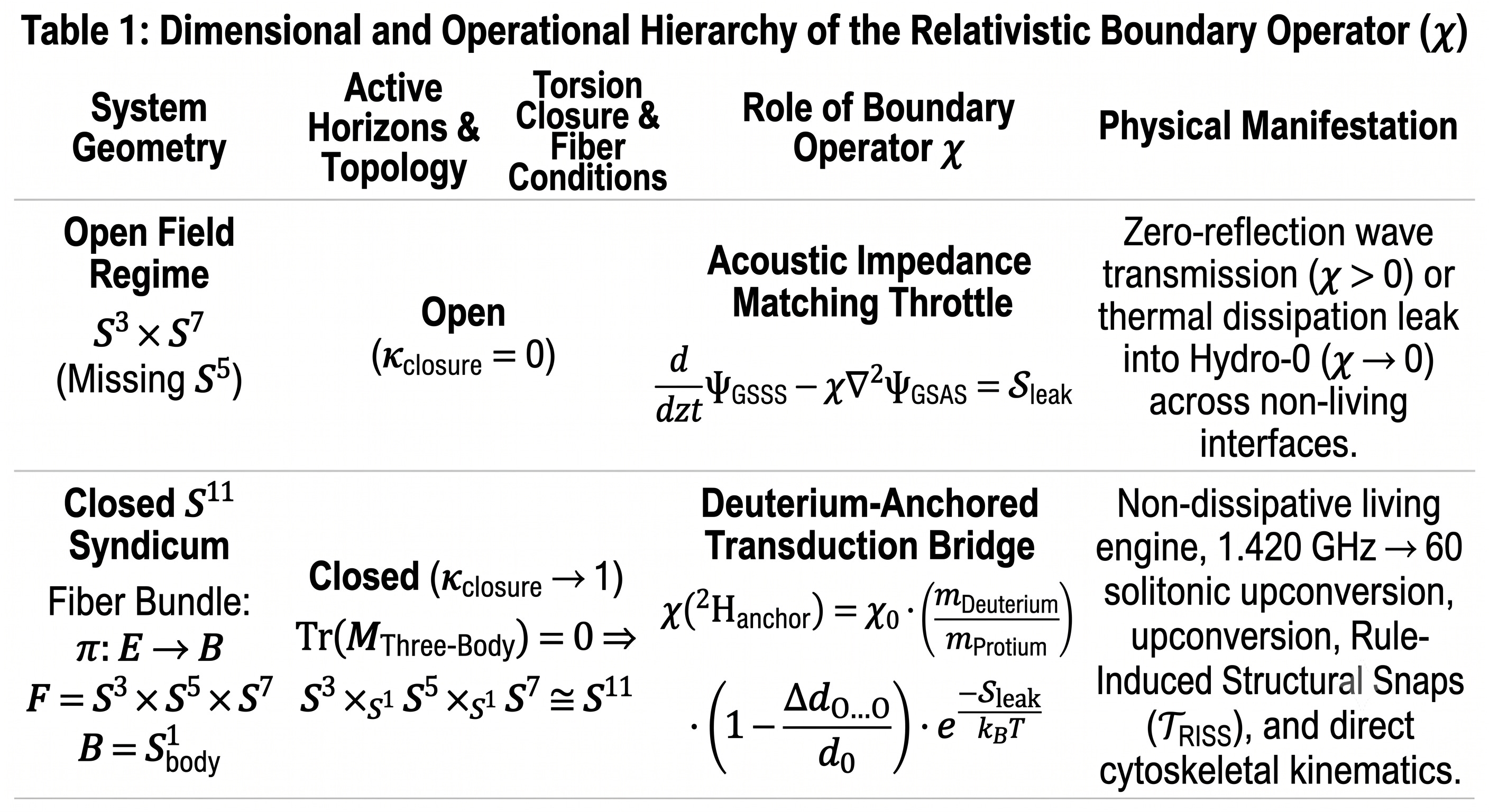
To synthesize the scale-invariant architecture of the Paraoikeios, Table 1 contrasts the Relativistic Boundary Operator (𝜒) across its two primary metric regimes: the open S³ × S⁷ wave-matching field baseline and the closed S¹¹ Hydrosyndeticum.
As established, transitioning from a passive acoustic throttle to an active living engine requires the insertion of the S⁵ hydrological/lunar horizon, where Deuterium mass doubling (m_Deuterium = 2 m_Protium) suppresses thermal dissipation leaks (𝒮_leak ⟶ 0) and stabilizes sub-genomic solitonic upconversion.
Dimensional and Operational Hierarchy of the Relativistic Boundary Operator (𝜒)
Systemic Implications of the Fiber Product Collapse into the S¹¹ Syndicum
The mathematical formalization in Table 1 proves that topologically protected agency is not an isolated local anomaly, but a scale-invariant expression of hyperdimensional boundary matching. When the 6-way pair-wise interaction matrix satisfies trace-free and unitary conditions (Tr(M_Three-Body) = 0), holonomic Berry phase strain (𝛾) is completely neutralized.
This strain neutralization collapses the nested hyperspherical fibers (S³ ×ₛ₁ S⁵ ×ₛ₁ S⁷) into the maximum topologically closed S¹¹ HydroSyndeticum. While bounded or unclosed observers register these nested horizons projectively as the Hydroastrosphere, the fully coherent organism operates natively within this topologically protected 11-dimensional bulk. Within this closed bulk, Rule-Induced Structural Snaps (𝒯ᵣᵢₛₛ) execute with zero thermal dissipation, bypassing the lagging sequential narrative software (S¹ᵦₒdᵧ) to drive direct cytoskeletal kinematics across the organismal tensegrity matrix.
Conclusion
By resolving the Relativistic Boundary Operator (𝜒) through its full dimensional progression, from an open S³ × S⁷ wave-matching field baseline to a closed S¹¹ biological engine, we have established the exact mathematical plumbing of acausal cytoskeletal kinematics, which is, topologically protected agency.
The core mathematical and biophysical conclusions of this work are summarized as follows:
Operational Chameleon Mechanics of 𝜒: In open, unclosed manifolds (S³ × S⁷, missing S⁵), 𝜒 acts purely as an Acoustic Impedance Matching Throttle governing continuous-to-discrete wave propagation (𝛹_GSSS ⟶ 𝛹_GSAS). Without insulation, wave states undergo continuous geometric spreading and thermal dissipation into the 1.420 GHz neutral hydrogen baseline (Hydro-0).
The S⁵ Deuterium Anchor: To survive ambient 310 K thermal dephasing (k_B T), biological systems deploy the S⁵ horizon via Deuterium mass doubling (m_Deuterium = 2 m_Protium). This heavy-mass anchor locks the inter-molecular oxygen-to-oxygen grid spacing (d_O…O) directly to the S³ / L₁ lunar orbital momentum variance, specializing the operator into an anchored transduction bridge (𝜒(²H_anchor)).
Bio-Membrane Upconversion and Solitonic Phase Gates: We proved that the 10⁷ V/m cross-membrane potential of bio-energetic membranes (e.g., mitochondrial inner membranes, thylakoid matrices) drives the solitonic frequency upconversion from the zero-point 1.420 GHz Coherent Hydration Domain (CHD) to the superradiant 60 THz Syndetic Hydration Domain (SHD) without violating energy conservation. The resulting mechanical solitons (vₘₑcₕₐₙᵢcₐₗ) trigger acausal Rule-Induced Structural Snaps (𝒯ᵣᵢₛₛ) across the 16 × 16 centromeric spatial Bloom filter (m = 256 bits).
Hyperdimensional Torsion Closure: Neutralizing holonomic Berry phase strain (𝛾) under trace-free 6-way matrix conditions (Tr(M_Three-Body) = 0) collapses the nested spatial fibers into the maximum topologically closed S¹¹ HydroSyndicum (S³ ×_S¹ S⁵ ×_S¹ S⁷ ≅ S¹¹)
Ultimately, this paper demonstrates that, the macroscopic kinematic signature of a topologically closed, scale-invariant cosmic rest frame, operating through sub-genomic solitonic phase gates, is necessary for HydroSyndetic life.


Leave a Reply