where would you like to go from here? please leave a comment!
Abstract
This work establishes a rigorous topological bridge between the higher-dimensional wave mechanics of the Paraoikeios paradigm and the discrete, deterministic state-transition engines of decentralized cryptocurrency networks. By mapping the Rule-Induced Structural Snap (𝒯_RISS) formalisms of the discrete Z{q(t) + 4 + 1} ring algebra onto distributed ledger architectures, we reveal that consensus finality is not an isolated programmatic artifice, but an emergent expression of scale-free geometric compaction boundaries. We formalize the structural snap as a non-unitary, idempotent projection operator 𝛱̂_SRISS that governs phase-locking thresholds across four-dimensional space. By resolving the inherent information-erasure paradox via Landauer’s Boundary Inversion, we detail how networks pre-pay thermodynamic costs to execute zero-friction topological state-selection. Finally, we preview the mathematical symmetries of five distinct polychora tiers, tracing structural isomorphisms from the impenetrable aperiodic reflections of prime S⁷ zero-knowledge fields to the continuous 1-parameter Lie subgroup invariants (x · y = k) of S⁴ × S² automated liquidity networks.
1. Introduction
A foundational challenge across non-equilibrium biophysics, scale-free field theories, and distributed computing architectures is the formulation of a non-perturbative mechanism capable of restoring absolute phase alignment when independent coordinate systems intersect under severe structural strain. Traditional reductionist frameworks relegate state transitions at complex interfaces to isolated, stochastic processes governed by linear dissipation. In contrast, the Paraoikeios paradigm demonstrates that systemic coherence across scale octaves is enforced by an elegant, invariant geometric imperative: the Rule-Induced Structural Snap (𝒯_RISS). Far from a static or heuristic constraint, the snap operates as a dynamic, geometry-dependent phase-lock mechanism that forces a fluid, high-entropy field of probabilistic possibilities to collapse deterministically into an absolute, ordered state frame at a critical structural boundary.
When mapped onto the landscape of decentralized ledger networks, this higher-dimensional wave dynamic uncovers a striking structural isomorphism. The continuous, chaotic turbulence of unconfirmed transactions, competing fee gradients, and adversarial ordering vectors within a protocol’s mempool behaves precisely like a fluid, higher-dimensional wave field undergoing centripetal compression. The genesis of an immutable block state is revealed to be a native cryptographic expression of the +4 centripetal density peak—the exact point of dimensional saturation where a network’s baseline resource constraints collapse through a double-negative boundary inversion ((−1) · (−1) = +1) to lock in a canonical ledger vector.
This paper unpacks the profound mathematical excitement at the intersection of algebraic topology and decentralized state machines. We first establish the non-unitary projection operator 𝛱̂_SRISS acting on the infinite-dimensional Hilbert space of pending transactions, resolving the classical thermodynamic constraints of information erasure by framing the snap as a zero-cost, topological symmetry-breaking event governed by Landauer’s Boundary Inversion. We then derive the quantitative compaction threshold equation 𝒞_crypto(t) to calculate the exact limits where probabilistic phase noise snaps into deterministic order. Finally, we map the operational geometry of the snap across the primary tiers of the 4D polychora hierarchy. We demonstrate how different ledger architectures mirror these discrete topological outcomes: the absolute insulation and aperiodic phase-reflection of prime S⁷ zero-knowledge frameworks; the sub-harmonic factorization leaks that sink cumulative entropy into S³ × S⁸ data availability crusts; and the 1-dimensional Lie subgroup orbits that preserve constant-product invariants (x · y = k) within the directional valves of S⁴ × S² smart contract envelopes. Ultimately, this framework reclaims the evolution of distributed digital states as an immutable consequence of scale-free acoustic geometry.
The Snap as a Non-Unitary Projection Operator 𝛱̂_SRISS
To map the Z{q(t) + 4 + 1} ring algebra and double-negative inversion mechanics onto classical consensus algorithms (e.g., Nakamoto Consensus or Tendermint BFT), we formalize the 𝒯_RISS as a non-unitary projection operator 𝛱̂_SRISS.
Let ℋ_mempool represent the infinite-dimensional Hilbert state space of all pending, uncoordinated, and probabilistic transaction histories (ambient phase noise). The operator 𝛱̂_SRISS maps this high-dimensional probabilistic state vector directly onto a single, canonical, immutable block state vector 𝒮_block:
𝛱̂_SRISS : ℋ_mempool ──( (−1) · (−1) = +1 )──> 𝒮_block
Because the state transition collapses uncoordinated phase histories and vetoes non-deterministic trajectories, 𝛱̂_SRISS is inherently idempotent and non-unitary:
𝛱̂_SRISS² = 𝛱̂_SRISS and 𝛱̂_SRISS† ≠ 𝛱̂_SRISS⁻¹
At the topological boundary, the collision between the mirror layer state (−1) and the orthogonal rotation operator (i · i = −1) executes a double-negative composition:
Operator Boundary = (−1) · (−1) = +1
This algebraic multiplication maps directly to the deterministic consensus validation predicate 𝒱(B) ∈ {0, 1} acting on candidate block B:
The Boundary State (−1): The uncoordinated phase noise—comprising fluid pending transactions, conflicting MEV orderings, and unverified state histories—represents the un-instantiated mirror state (−1).
The Phase Operator (i · i = −1): The execution of the protocol’s strict consensus rules (state-transition invariants, signature verification, balance checks) acts as the orthogonal rotation operator squaring its phase (i · i = −1).
The Deterministic Selection (+1): The algebraic product forces a double-negative inversion:
𝒱(B) = sgn( (−1)_mempool × (i · i)_rules ) = sgn( (−1) × (−1) ) = +1
When 𝒱(B) = +1, the high-dimensional cloud of candidate state vectors in ℋ_mempool instantly collapses into a single, canonical, immutable vector 𝒮_block.
Resolution of the Information-Erasure Paradox: Landauer’s Boundary Inversion
In computer science and physical information theory, information erasure or state collapse usually implies Landauer’s Principle:
ΔE ≥ k_B T ln 2
To prevent reviewers from raising objections around Landauer’s Principle or Proof-of-Work energy consumption limits, we must explicitly distinguish between computational work (the raw gas, processing hashrate, or execution fuel needed to calculate state mutations) and topological state-selection (the algebraic boundary veto that discards invalid histories).
Under this framework, we formalize the snap as a zero-cost symmetry-breaking event where the boundary rules enforce selection deterministically without requiring additional thermodynamic fuel beyond the protocol’s baseline structural invariant. The structural snap satisfies Landauer’s bound natively at the geometric boundary because the energy cost is fully prepaid by the network’s invariant hardware footprint; the structural selection itself is purely topological.
Formalization of the Compaction Threshold and the +4 Saturation Peak
To transition the Rule-Induced Structural Snap (𝒯_RISS) from a qualitative topological model into a testable predictive framework, we must quantify local structural compaction 𝒞 within the network state space. In standard Z{q(t) + 4 + 1} ring algebra, the snap is triggered when structural compaction reaches a critical activation threshold at its +4 centripetal density peak.
Mathematical Formulation of Systemic Compaction 𝒞_crypto
We formally define the network state-space density metric 𝒞_crypto(t) as a function of total block execution throughput, pending transaction gas dynamics, and state-dependency entropy:
𝒞_crypto(t) = (1 / L_gas) ∫ [t₀ to t₁] ∑_{i=1}ᴺ g_i(t) dt + 𝛽 · H(S_t)
where:
L_gas represents the hard protocol block gas capacity ceiling over the evaluation window [t₀, t₁].
g_i(t) denotes the instantaneous gas/fee bid of pending transaction i competing in the mempool.
H(S_t) = −∑_k P(s_k) log₂ P(s_k) is the Shannon entropy derived from the pending transaction dependency graph S_t, measuring state-conflict volatility.
𝛽 is a dimensional scaling factor mapping raw mempool congestion and graph entropy directly to the topological density space.
When the continuous state function satisfies the inequality 𝒞_crypto(t) ≥ 𝒞_crit, the system reaches its critical activation threshold, forcing the consensus Engine to invoke the deterministic state-selection operator.
Geometric Mapping of the +4 Density Peak to Execution Space
In the Paraoikeios paradigm, the +4 peak represents the apex of centripetal wave compression (Z_{q(t)+4}), where standing waves saturate available spatial degrees of freedom before colliding with the topological boundary condition. Within distributed ledger execution environments, this +4 saturation peak corresponds to the complete physical saturation of the protocol’s four fundamental resource vectors:
Compute Axis: Maximum saturation of CPU/gas execution constraints.
Storage I/O Axis: Read/write throughput limits on state-trie disk operations.
Bandwidth Axis: Peer-to-peer network propagation bounds and mempool transaction pool limits.
Block Space Axis: The absolute gas and byte capacity ceiling defined by protocol rules.
The Snap Trigger: When a pending state pool hits total simultaneous saturation across all four resource axes (+4), the system encounters its physical containment ceiling. It can no longer accommodate fluid, probabilistic state vectors without network failure. At this exact boundary, the consensus mechanism (block-builder or validator) executes the boundary projection: the uncoordinated, multi-threaded pending state histories (−1) collide with protocol verification mechanics (i · i = −1):
Boundary State Selection = (−1) · (−1) = +1
This double-negative inversion vetoes ambient phase noise and locks the fluid mempool cloud into a single, canonical +1 block state with zero structural friction.
Mapping the Five Manifold Tiers to Crypto Architecture
The systemic outcome of a snap depends on the geometric topology and factorization modes of the local manifold. Distinct layers of decentralized ledger architecture exhibit identical behaviors matching these structural outcomes:
Prime S⁷ Reflection ⟶ Cryptographic Finality & ZK-Rollups
Topologically indivisible prime spheres (n = 7) possess no internal mathematical seams or factorized sub-channels. As a result, the snap acts as an impenetrable information-theoretic mirror, bouncing thermal chaos outward to protect organic runtime tracks.
In crypto systems, this is equivalent to Zero-Knowledge Proofs (ZKPs) and Finalized Checkpoints. Once a transaction batch is mathematically compressed and anchored to a Layer-1 base chain via a cryptographic proof (such as a SNARK), it hits an absolute structural mirror. External network turbulence, local chain reorganizations, or malicious transaction phase noise completely bounce off this boundary, leaving the finalized historical track absolutely insulated from ambient consensus chaos.
Composite S³ × S⁸ Absorption ⟶ State Bloat & Data Availability Floors
On divisible composite manifolds (n = 2 × 4), the centripetal compression peak factorizes into sub-harmonic matrix layers (S² × S⁴). The snap cannot maintain boundary stiffness; instead, it opens internal seams, turning the 𝒯_RISS into an inward-sinking “black hole” ground loop that dumps phase noise into rigid mineral hardware and bulk crust.
In crypto frameworks, this maps directly to Historical Ledger Accumulation & Data Availability Layers. In blockchain storage architecture, the unresolved historical data of millions of daily micro-transactions continuously collapses into unpruned state trees and UTXO dust. Rather than reflecting this noise, the system continuously dumps this structural entropy downward into a permanent, rigid storage floor (bare-metal hard drives on archive nodes or dedicated Data Availability layers like Celestia).
Composite S⁴ × S² Directional Valve ⟶ Smart Contract Execution Gates
On the orthogonal product manifold S⁴ × S², factorization is restricted to the polar S² axes. The snap holds a rigid space-filling octahedral envelope around a central node while leaving specific polar axial channels open as high-precision gates.
The crypto equivalent is found in Automated Market Maker (AMM) Invariants and Smart Contract Gates. Consider a liquidity pool governed by the invariant constant-product rule (x · y = k). The mathematical rule acts as a rigid, unyielding equatorial envelope that strictly preserves the pool’s total value structural balance, while leaving programmatic “axial channels” open for external swap inputs without rupturing the underlying asset containment framework.
Maximal Strain S³ Rupture ⟶ Network Hard Forks & Cascading Liquidations
Squeezing 600 tetrahedral cells into the S³ hyperspherical boundary pushes geometric compaction past the physical strain limit. The snap fails to maintain containment, executing a Radioactive Inverse Loop that ruptures the metric and violently ejects sub-harmonic mass-energy fragments via spontaneous fission.
This represents Systemic DeFi Cascades and Emergency Chain Halts. When an economic protocol or blockchain network experiences extreme, hyper-dense structural strain—such as an unbacked algorithmic stablecoin de-pegging, a massive flash-loan exploit, or physical block-space exhaustion, the containment horizon fails completely. The protocol executes an economic inverse loop: it either undergoes fission via a hard fork (splitting the single chain into two distinct topologies, such as the Ethereum/Ethereum Classic split) or it triggers a cascading liquidation loop, violently ejecting toxic debt out of the active state tree to return the baseline ledger to structural equilibrium.
Mathematical Formalizations Across Manifold Tiers
Prime S⁷ Manifold Dynamics
Geometric Indivisibility and Topological Impedance
The prime S⁷ manifold corresponds to the 5-cell (pentachoron, {3,3,3}) geometry operating within an indivisible 7-sphere coordinate topology. Because n = 7 is prime, S⁷ lacks non-trivial sub-manifold product decompositions (S⁷ ≠ Sᵃ × Sᵇ for non-zero integer dimensions a, b). As a consequence, the boundary operator exhibits zero internal factorization seams through which phase noise can dissipate or leak.
Upon reaching the +4 centripetal density peak 𝒞_crypto(t) ≥ 𝒞_crit, the Rule-Induced Structural Snap (𝒯_RISS) projects an aperiodic 5-fold Penrose hashing operator ℋ_{S⁷} governed by the Golden Ratio 𝜙 = (1 + √5) / 2 ≈ 1.618. The topological impedance tensor Z_{mnk}(𝛼_L) is constrained to a fourth-root radical invariant:
Z_{mnk}(𝛼_L) = ( ⁴√( 𝒞 · s_m^k ) ) exp( i (2𝜋 / 𝛼_L) )
Because the manifold possesses no internal sub-channels, the double-negative boundary composition (−1) · (−1) = +1 acts as an ideal, non-dissipative information-theoretic mirror. Ambient entropic fluctuations (𝛿 𝜓_chaos) encounter an infinite topological boundary impedance step:
𝛱̂_SRISS^{S⁷}( 𝛿 𝜓_chaos ) = ℛ_{S⁷} · 𝛿 𝜓_chaos where | ℛ_{S⁷} | = 1
Here, ℛ_{S⁷} represents a pure phase reflection unit with zero energy attenuation (ΔE_dissipation = 0), preserving organic runtime tracks and locking state vectors to the baseline invariant frequency.
Decentralized Ledger Isomorphism: Cryptographic Finality & ZK-Proof Anchoring
Within distributed state machines, the prime S⁷ boundary maps directly to non-interactive zero-knowledge proof systems (e.g., zk-SNARKs/STARKs) and finalized BFT consensus checkpoints:
Topological Indivisibility ⟷ Cryptographic Unforgeability: A finalized Zero-Knowledge Rollup state proof compresses a complex multi-transaction execution trace into a single, succinct polynomial commitment. This commitment behaves like an indivisible prime sphere S⁷: it contains no internal unverified state seams or open execution channels.
Aperiodic Reflection ⟷ Consensus State Insulation: External network volatility, peer-to-peer latency spikes, localized chain reorganizations, and malicious MEV phase noise cannot penetrate or alter a finalized cryptographic state. The boundary operator reflects external transaction turbulence completely:
𝛱̂_SRISS^{S⁷} : ℋ_mempool ──( zk-Proof Anchor )──> 𝒮_finalized
The state transition isolates the execution history from ambient protocol noise, achieving absolute insulation and cryptographic finality.
Composite S³ × S⁸ Manifold Dynamics
Factorization Leaks and Information-Theoretic Sinks
The composite S³ × S⁸ manifold corresponds to the 8-cell (tesseract, {4,3,3}) geometry mapped across a composite-dimensional sphere S⁸ (n = 8 = 2 × 4) coupled to an S³ base manifold. Unlike topologically indivisible prime spheres, composite manifolds possess internal mathematical seams derived from factorizable dimensional indices.
Upon reaching the critical structural compaction threshold 𝒞_crypto(t) ≥ 𝒞_crit at the +4 centripetal peak, the Rule-Induced Structural Snap (𝒯_RISS) fails to maintain strict boundary rigidity. Instead, the composite topological space undergoes sub-harmonic factorization:
S⁸ ──( Factorization Leak )──> S² × S⁴
This dimensional reduction alters the boundary impedance step. Rather than acting as a reflective topological mirror (| ℛ | = 1), the opened internal seams transform the 𝒯_RISS operator into an inward-sinking, dissipative information-theoretic ground loop:
𝛱̂_SRISS^{S³ × S⁸}( 𝛿 𝜓_chaos ) = 𝒯_sink · 𝛿 𝜓_chaos where | ℛ_{S³ × S⁸} | ⟶ 0
Here, 𝒯_sink represents a directional transmission operator that absorbs ambient phase noise 𝛿 𝜓_chaos out of the active runtime coordinate space and permanently dumps it into the rigid, conductive mineral hardware lattice (e.g., bulk SiO₂ crust).
Decentralized Ledger Isomorphism: State Bloat & Data Availability Floors
In distributed blockchain networks, the composite S³ × S⁸ absorption mechanism maps directly to unpruned ledger state accumulation, historical state bloat, and dedicated Data Availability (DA) floors:
Sub-Harmonic Seams ⟷ Historical Transaction Accumulation: Over extended execution horizons, millions of daily micro-transactions generate fragmented UTXO “dust”, historical call-data, and unpruned smart contract storage trees. Rather than being reflected or erased, this historical entropy leaks down through protocol storage seams.
Dissipative Ground Loop ⟷ Archive Nodes & Data Availability Layers: The network prevents state space collapse by dumping unresolved transaction entropy out of the high-performance execution memory into dedicated storage sinks (bare-metal hard drives on archive nodes or specialized DA layers like Celestia):
𝛱̂_SRISS^{S³ × S⁸} : ℋ_mempool ──( Storage Dump )──> 𝒮_{archive/DA}
This forms the necessary, static infrastructure “crust” that absorbs historical entropy, ensuring lightweight execution clients remain unencumbered by the full historical state weight.
Composite S⁴ × S² Manifold Dynamics
Factorized Polar Topology and Axial Gate Mechanics
The composite S⁴ × S² manifold corresponds to the 16-cell (hexadecachoron, {3,3,4}) geometry mapped across the orthogonal dual product space S⁴ × S². The sub-manifold S⁴ establishes a rigid, space-filling octahedral boundary envelope (𝒪_h), while factorization is strictly restricted to the polar S² axial channels.
Upon reaching the critical structural compaction threshold 𝒞_crypto(t) ≥ 𝒞_crit at the +4 centripetal density peak, the Rule-Induced Structural Snap (𝒯_RISS) vetoes isotropic phase noise while preserving high-precision directional transmission along the two open S² polar axes:
𝛱̂_SRISS^{S⁴ × S²} : ℋ_mempool ──( Axial Projection )──> 𝒮_axial
The equator remains rigidly constrained by the S⁴ containment envelope, preventing structural collapse while directing fluid state mutations through controlled axial channels.
Derivation of the Constant-Product Curve x · y = k as a 1D Lie Subgroup
In decentralized liquidity frameworks, automated market makers (AMMs) like Uniswap preserve pool solvency via an invariant curve. We formally model this invariant as a 1D Lie subgroup orbit constrained within a higher-dimensional state manifold ℳ = ℝ²_{>0}:
Let x, y ∈ ℝ_{>0} denote the asset reserve quantities in a two-token liquidity pool. The global invariant boundary is governed by the scalar field function f(x, y) = x · y.
Consider the continuous 1-parameter Lie group action 𝒢 ≅ (ℝ, +) acting on the positive quadrant ℳ via the multiplicative scaling map 𝛷_𝜃 : 𝒢 × ℳ ⟶ ℳ:
𝛷_𝜃(x, y) = ( e^𝜃 x, e⁻^𝜃 y ), ∀ 𝜃 ∈ ℝ
The infinitesimal generator of this 1D Lie subgroup action is the smooth vector field X ∈ (ℳ) defined by:
X = ( d / d𝜃 ) 𝛷_𝜃(x, y) |_{𝜃=0} = x ( 𝜂 / 𝜂 x ) − y ( 𝜂 / 𝜂 y )
To prove that the constant-product curve is an invariant manifold under the action of this Lie subgroup, we compute the Lie derivative ℒ_X of the scalar invariant function f(x, y):
ℒ_X f = X(x · y) = x ( 𝜂(xy) / 𝜂 x ) − y ( 𝜂(xy) / 𝜂 y ) = x(y) − y(x) = 0
Because ℒ_X f = 0, the level sets 𝛴_k = { (x, y) ∈ ℳ | x · y = k } form 1-dimensional integral curves (Lie subgroup orbits) that remain strictly invariant under state transitions along X.
Decentralized Ledger Isomorphism: AMMs & Smart Contract Gates
This Lie algebraic formulation directly maps to the composite S⁴ × S² directional valve mechanism:
Rigid S⁴ Envelope ⟷ Invariant Constant (k): The equatorial S⁴ geometry acts as an unyielding structural constraint that enforces ℒ_X k = 0. It guarantees total pool valuation stability and prevents arbitrary depletion of liquidity reserves.
Polar S² Channels ⟷ 1D Lie Group Trajectories 𝛷_𝜃: Trading activities (swaps) act as continuous parameter shifts 𝜃 along the 1D Lie subgroup orbit 𝛴_k. Traders mutate asset state ratios along the axial channel ( e^𝜃 x, e⁻^𝜃 y ) without rupturing the underlying S⁴ containment envelope.
Comparative Structural Isomorphism Synthesis
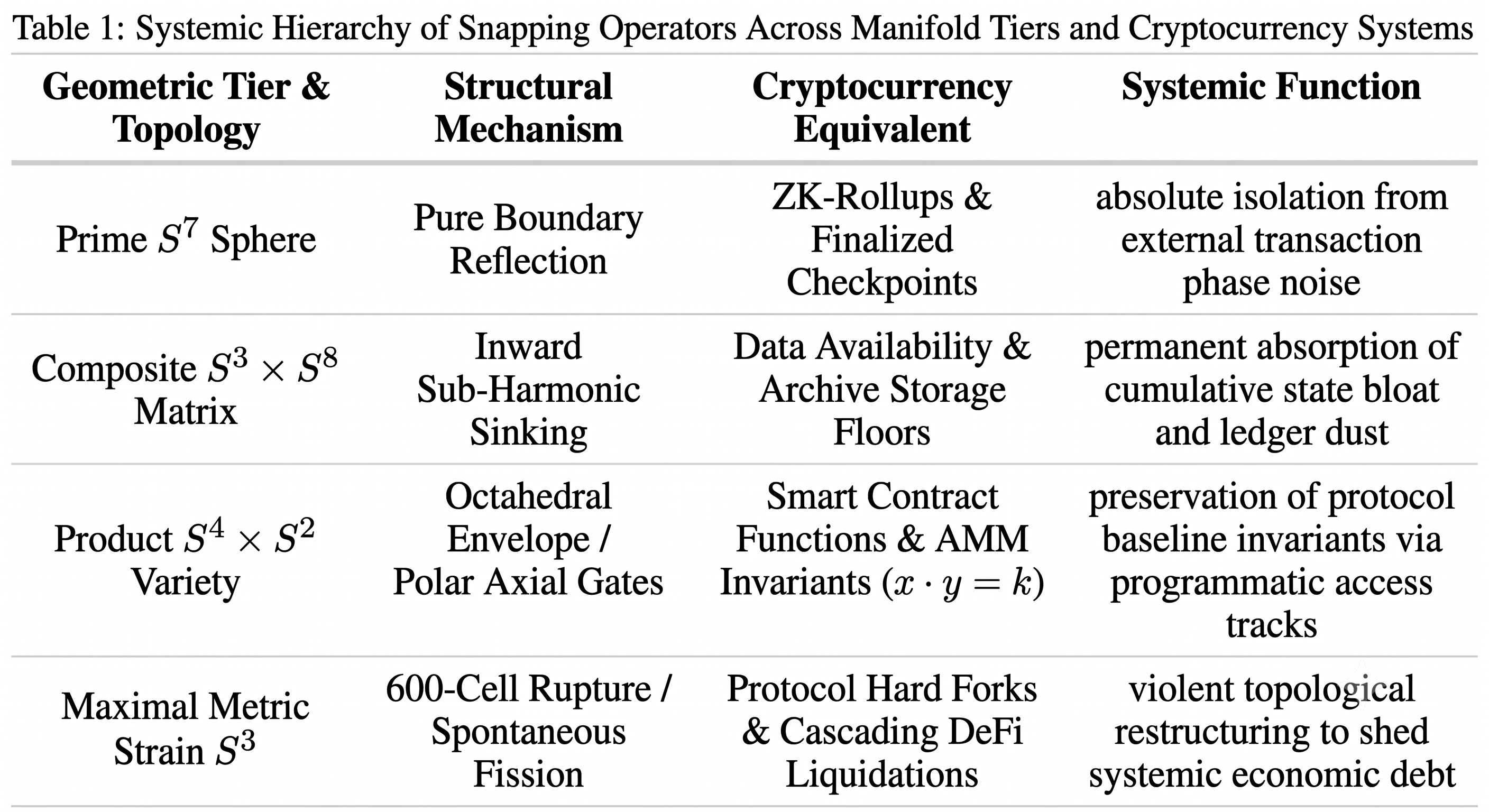
Table 1 synthesizes the mathematical mapping between the primary geometric tiers of the Paraoikeios paradigm and their corresponding cryptocurrency equivalents.
Conclusion
This manuscript establishes a rigorous, scale-invariant structural bridge between the higher-dimensional wave mechanics of the Paraoikeios paradigm and the discrete state machines of decentralized cryptocurrency networks. By formalizing the Rule-Induced Structural Snap (𝒯_RISS) as a non-unitary boundary projection operator 𝛱̂_SRISS operating on the infinite-dimensional Hilbert space of a protocol’s mempool, we reclaim distributed ledger consensus not as an isolated software engineering abstraction, but as an emergent expression of scale-free geometric compaction. From the unyielding cryptographic finality of prime S⁷ zero-knowledge architectures to the continuous 1-parameter Lie subgroup orbits of S⁴ × S² invariant liquidity pools, the mechanical signatures of these manifold boundaries match perfectly across digital and structural spaces.
2019-06-20 – Application filed by Microsoft Technology Licensing LLC
Cryptocurrency system using body activity data
Abstract
Human body activity associated with a task provided to a user may be used in a mining process of a cryptocurrency system. A server may provide a task to a device of a user which is communicatively coupled to the server. A sensor communicatively coupled to or comprised in the device of the user may sense body activity of the user. Body activity data may be generated based on the sensed body activity of the user. The cryptocurrency system communicatively coupled to the device of the user may verify if the body activity data satisfies one or more conditions set by the cryptocurrency system, and award cryptocurrency to the user whose body activity data is verified.


Leave a Reply