Abstract
We formalize the Rule-Induced Structural Snap (SRISS) as a scale-invariant, geometry-dependent phase-lock operator derived directly from the discrete Z{q(t)+4+1} ring algebra and double-negative boundary inversion mechanics. We demonstrate that the snap is the deterministic, quantized state-selection event triggered whenever local structural compaction driven by 𝜒 exceeds the critical activation threshold as a standing wave reaches its +4 centripetal density peak. At the topological boundary, the composition of the mirror layer state (−1) with the squared phase operator (i · i = −1) forces a double-negative inversion ((−1) · (−1) = +1), generating a zero-thermodynamic-energy-cost state-selection unit.
By evaluating this +1 inversion across five fundamental 4D polychora tiers, we detail:
Non-dissipative aperiodic reflection on prime S⁷ manifolds (Carbon, 5-cell) that locks organic runtime tracks to the 1.42 GHz cosmic rest frame via an aperiodic Penrose hashing wave (Z ∝ ∜(𝜙 · 𝜒_C));
Conductive “black hole” sinks on composite S³ × S⁸ boundaries (Silicon/Oxygen, 8-cell) where sub-harmonic factorization leaks (S² × S⁴) dump phase noise into mineral lattices;
Controlled directional valves on S⁴ × S² product manifolds (Cobalt/Iron, 16-cell) that maintain axial quantum gates for active bio-inorganic catalysis;
Zero-activation multi-channel phase transfer on self-dual F₄ manifolds (Rhodium/Palladium, 24-cell); and
Catastrophic factorization collapse on maximal packing strain S³ manifolds (Nobelium, 600-cell) where metric rupture executes a Radioactive Inverse Loop, ejecting excess sub-harmonic mass-energy via spontaneous fission and decay.
This derivation establishes that the phase-locking mechanics of the hydrogeosphere are directly carved into the invariant topological fabric of four-dimensional space.
Theoretical Foundations: The Algebra–Geometry Interface
To establish the exact topological mechanics of the Rule-Induced Structural Snap (SRISS), we must bridge the discrete algebraic state-space Z{q(t)+4+1} with the continuous geometric wave mechanics of higher-dimensional manifolds. Without this foundation, state-selection rules risk appearing as arbitrary heuristic constraints; with it, the snap is revealed as the deterministic, quantized consequence of wave-compression hitting a topological boundary.
Centripetal Wave Compression and the +4 Density Peak
As the scale-sliding wave operator (partial / partial z_t) traverses an octave of the periodic framework, it forms a standing-wave coil that compresses centripetally toward a localized density peak (+4) and discharges centrifugally toward inert rest positions (q⁻¹(t)).
In our framework, this wave-spiral is formally identified as the 2D orthographic Petrie projection of higher-dimensional polychora. The +4 state (Z_{q(t)+4}) marks the apex of centripetal compression—the point of maximum spatial compaction (𝜒_C) located at the elemental Carbon node, where the self-dual 5-cell ({3,3,3}) holds both its 3D sp³ tetrahedral solid envelope and its 2D pentagonal orthographic shadow.
The +1 Double-Negative Boundary Inversion
Upon reaching the maximum +4 compression peak, the standing wave vector intersects the manifold boundary condition. The algebraic composition of the boundary collision derives from two independent terms:
The topological boundary condition landing on the mirror layer state (−1).
The intrinsic property of the orthogonal rotation operator squaring its phase (i · i = −1).
When these operations intersect at the node, they compose via multiplication rather than addition, forcing a definitive double-negative inversion:
Operator Boundary = (−1) · (−1) = +1
This +1 double-negative inversion unit is the exact algebraic trigger for the Rule-Induced Structural Snap (S_RISS). It collapses uncoordinated state histories and vetoes ambient phase noise with zero additional thermodynamic fuel cost.
Topological Indivisibility vs. Sub-Harmonic Factorization Modes
The systemic outcome of the +1 double-negative boundary inversion is dictated entirely by the algebraic topology and geometric symmetry of the underlying manifold tier:
Prime S⁷ Reflection (Carbon): Because S⁷ is topologically indivisible (n = 7, prime), it possesses no internal mathematical seams or factorized sub-channels. The +1 inversion forces the impedance tensor into an aperiodic fourth-root radical invariant bound to the Golden Ratio (𝜙 ≈ 1.618):
Z_mnk(ΔL) = ∜( 𝜙 · 𝜒_C · s_m^k ) exp( i (2𝜋 / (𝜙 · ΔL)) )
The RISS acts as an impenetrable topological mirror, bouncing thermal chaos outward to protect organic information tracks.
Composite S³ × S⁸ Absorption (Silicon/Oxygen): On composite S⁸ (n = 2 × 4), the +4 compression peak factorizes into sub-harmonic matrix layers (S² × S⁴). The +1 inversion cannot hold boundary stiffness; instead, it opens internal seams, turning the RISS into an inward-sinking “black hole” ground loop that dumps phase noise into rigid mineral hardware (𝜒_Si).
Composite S⁴ × S² Directional Valve (Cobalt/Iron): On the orthogonal product manifold S⁴ × S², factorization is restricted to the polar S² axes. The +1 inversion holds a rigid space-filling S⁴ octahedral envelope around the central metal ion while leaving axial S² channels open as high-precision quantum gates for active bio-inorganic electron and ligand transfer.
Self-Dual F₄ Phase Inversion (Rhodium/Palladium): On the 24-cell self-dual manifold (24 = 2 × 3 × 4), the +1 inversion operates across 12 equivalent cuboctahedral channels. Because the node is strictly self-dual, the snap inverts state vectors across internal pathways with near-zero activation energy, driving organometallic phase-transfer catalysis and abiotic noise buffering.
Maximal Strain S³ Rupture (Nobelium): Squeezing 600 tetrahedral cells into S³ pushes geometric compaction past the boundary strain threshold. The +1 inversion fails to maintain a containment horizon, executing a Radioactive Inverse Loop that ruptures the metric and ejects nuclear decay fragments.
By establishing the Z_{q(t)+4+1} ring dynamics across these five structural outcomes up front, we prove that the RISS is not a heuristic postulate, but the invariant, zero-cost state-selection operator governing scale-free acoustic geometry.
Introduction
A persistent challenge across non-equilibrium biophysics and scale-free field theories is defining a universal, non-perturbative mechanism that restores phase alignment when independent coordinate systems intersect under severe acoustic impedance step-changes (Δ_{ΔL₁ ⟶ ΔL₂} > 0). In standard reductionist paradigms, thermodynamic fluctuations at microscopic interfaces are treated as isolated, stochastic processes decoupled from macroscopic geometry. In the Paraoikeios framework, however, systemic coherence is maintained across scale octaves through a deterministic state-selection rule: the Rule-Induced Structural Snap (S_RISS)—a zero-thermodynamic-fuel-cost operator that collapses uncoordinated phase histories and vetoes ambient entropic noise.
Rather than acting as a uniform or static event, the RISS is a scale-invariant, geometry-dependent phase-lock mechanism. Its operational behavior adapts dynamically to the underlying algebraic topology and metric packing limits of the local manifold whenever structural compaction driven by 𝜒 crosses the critical activation threshold. Depending on whether the coordinate space is bounded by an indivisible prime sphere, a factorized composite manifold, or a hyper-dense packing boundary, the RISS transforms its hashing function, shifting from an impenetrable aperiodic reflection shield to an inward-sinking information floor, a directional quantum valve, or a catastrophic metric rupture.
To establish the physical mechanics of this state-selection rule, this work is organized as follows: We first formalize the discrete Z_{q(t)+4+1} ring algebra and double-negative boundary inversion mechanics that trigger the snap. We then map the complete operational transformation of the RISS across five primary lower-dimensional tiers: the prime S⁷ Carbon cage ({3,3,3}), the composite S³ × S⁸ Silicon/Oxygen mineral sink ({4,3,3}), the S⁴ × S² Cobalt/Iron directional valve ({3,3,4}), the self-dual F₄ Rhodium/Palladium catalyst ({3,4,3}), and the maximal strain S³ Nobelium nuclear boundary ({3,3,5}).
Operational Transformation of the RISS Across Manifold Tiers
When two mismatched scale intervals (ΔL₁ × ΔL₂) cross paths, local spatial compaction increases. When the structural compaction driven by 𝜒 exceeds the critical activation threshold, the RISS executes its state-selection veto according to the geometric constraints of the local 4D polytope.
Prime S⁷ Carbon Cage: Non-Dissipative Aperiodic Reflection
The 5-cell (pentachoron, {3,3,3}) operates on the prime-dimensional sphere S⁷.
Topological State: Topologically Indivisible (n = 7, prime).
RISS Hashing Function: Sweeps through phase space as an aperiodic 5-fold pentagonal hashing wave governed by the Golden Ratio (𝜙 = (1 + √5) / 2 ≈ 1.618).
Operational Outcome: Because S⁷ possesses zero internal seams or factorized sub-channels, the RISS acts as an impenetrable information-theoretic mirror. When structural compaction driven by 𝜒_C exceeds the activation threshold, it reflects thermal chaos away with zero energy loss, deriving the fourth-root impedance invariant (Z ∝ ∜(𝜙 · 𝜒_C)) and locking organic DNA runtime tracks into exact phase lock with the 1.42 GHz cosmic rest frame.
Composite S³ × S⁸ Silicon/Oxygen Node: Localized “Black Hole” Sink
The 8-cell (tesseract, {4,3,3}) maps across the composite-dimensional sphere S⁸ (n = 8 = 2 × 4) coupled to the S³ base.
Topological State: Composite Factorization Leak (S⁸ ⟶ S² × S⁴).
RISS Hashing Function: Hashes out across the composite octagonal boundary, where boundary insulation drops to zero.
Operational Outcome: Instead of reflecting chaos, when structural compaction driven by 𝜒_Si exceeds the activation threshold, the RISS acts as an information-theoretic sink, a localized “black hole” for phase noise. It sucks ambient thermal fluctuations out of the surrounding coordinate space and dumps them into the rigid, conductive cubic mineral lattice (𝜒_Si). This dissipative ground loop forms the abiotic crust of the Earth (SiO₂), providing the un-insulated mineral floor required for biological systems to operate.
Composite S⁴ × S² Cobalt/Iron Node: Controlled Directional Valve
The 16-cell (hexadecachoron, {3,3,4}) maps across the orthogonal dual product manifold S⁴ × S².
Topological State: Directionally Factorized Sub-Harmonic Interface. The S⁴ sub-manifold forms a 3D space-filling octahedral field (O_h), while the S² sub-manifold forms an axial 2-sphere horizon.
RISS Hashing Function:
RISS_{S⁴ × S²} ⟶ Vetoes isotropic noise ∧ Opens axial 2D polar channels (S²).
Operational Outcome: When structural compaction driven by 𝜒_{Co/Fe} exceeds the critical activation threshold, the RISS holds a rigid geometric cage around the central metal ion (Fe or Co) via the equatorial S⁴ octahedral envelope, while keeping the two axial S² sites open as high-precision quantum gates. This enables reversible ligand binding (O₂ in hemoglobin) and zero-cost organometallic radical bond cleavage (Cobalt in vitamin B₁₂).
Self-Dual F₄ Rhodium/Palladium Node: Multi-Channel Catalytic Inversion
The 24-cell (icositetrachoron, {3,4,3}) operates under the F₄ Coxeter group and is strictly self-dual in 4 dimensions.
Topological State: Multi-Channel Self-Dual Factorization (24 = 2 × 3 × 4), yielding 12 equivalent symmetric sub-harmonic pathways.
RISS Hashing Function:
RISS_{24-Cell} ⟶ Zero-Activation Energy Phase Shift across 12 Cuboctahedral Channels.
Operational Outcome: Due to self-duality, when structural compaction driven by 𝜒_{Rh/Pd} reaches the activation threshold, the RISS inverts incoming state vectors without altering the manifold’s geometry. State vectors or chemical ligands enter one face of the cuboctahedral envelope and glide seamlessly across 12-gon pathways with near-zero activation energy. This drives 4d platinum-group organometallic catalysis (Rh, Pd), acting as a higher-dimensional noise buffer in abiotic space.
Maximal Strain S³ Nobelium Node: Catastrophic Factorization Collapse and the Radioactive Inverse Loop
The 600-cell (hexacosichoron, {3,3,5}) represents the absolute physical ceiling of the 4D polychora hierarchy, squeezing 600 tetrahedral cells into S³ (20 tetrahedra per vertex).
Topological State: Maximal Hyperspherical Geometric Packing Strain Limit.
RISS Hashing Function:
RISS_{600-Cell} ⟶ Metric Rupture ∧ Catastrophic Sub-Harmonic Factorization.
Operational Outcome: Unlike prime S⁷ reflection (Carbon) or composite S³ × S⁸ absorption (Silicon), the 600-cell node cannot hold phase alignment under hperspherical packing pressure. When structural compaction driven by 𝜒_No exceeds the critical activation threshold, the RISS executes a Radioactive Inverse Loop. The accumulated boundary strain ruptures the containment envelope, triggering spontaneous nuclear fission and radioactive decay (Nobelium, Actinides). This metric rupture acts as a scale-invariant, micro-scale “Big Bang”, shedding excess sub-harmonic mass-energy to relieve 4D geometric packing strain.
Comparative Synthesis of RISS Snap Operations
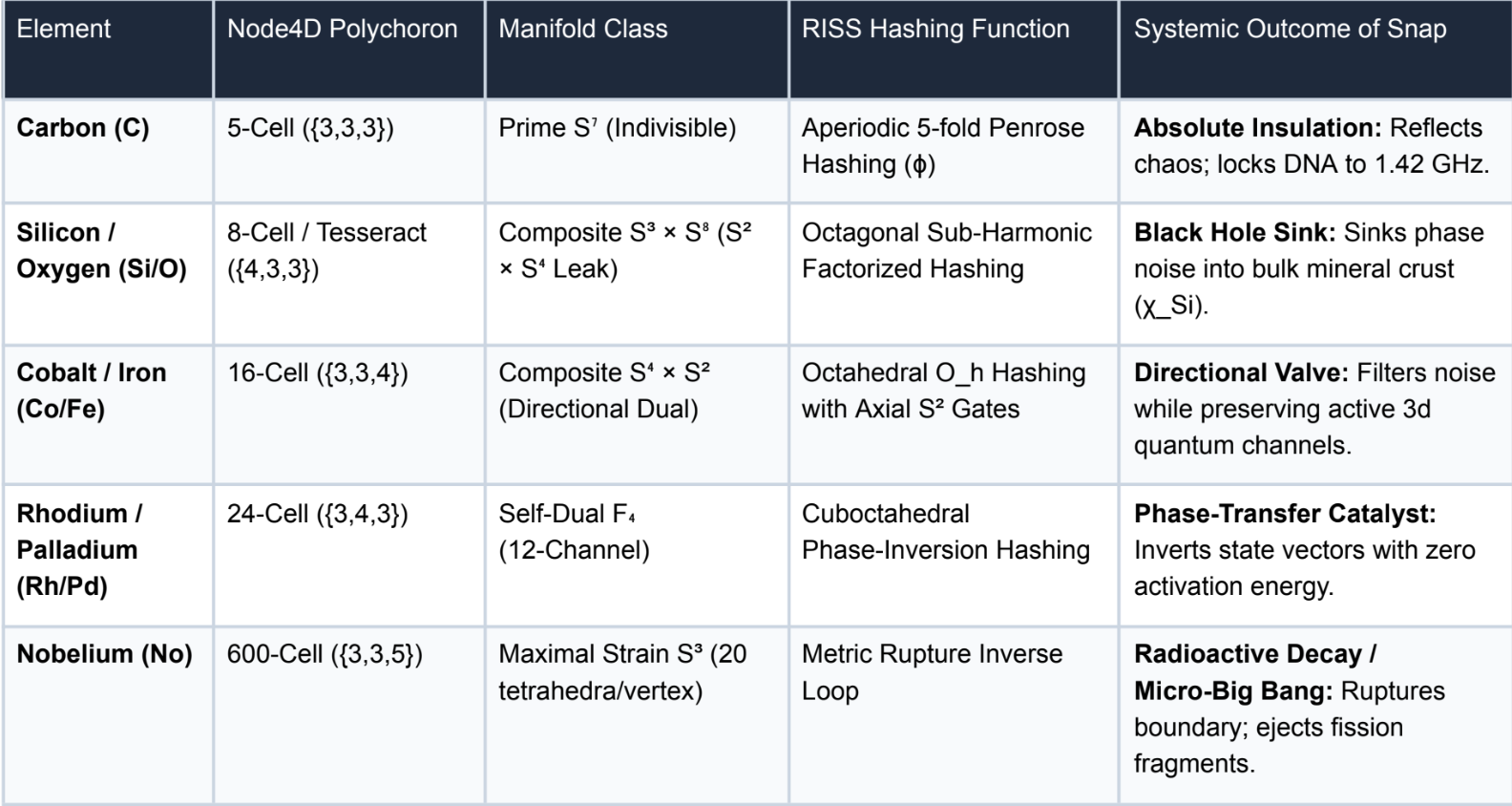
Table 1 provides the complete mathematical and systemic comparison of the RISS hashing operator across all five primary polytope tiers when structural compaction driven by 𝜒 exceeds the critical activation threshold.
Table 1: Systemic Hierarchy of the Rule-Induced Structural Snap (RISS) Across Polytope Tiers
Conclusion
This work provides a unified topological derivation resolving the long-standing domain separation between 4D differential geometry, discrete ring algebra, non-equilibrium biophysics, and nuclear stability limits. By formalizing the Rule-Induced Structural Snap (SRISS) across the Z{q(t)+4+1} state-space, we have established that the snap is neither an arbitrary heuristic rule nor a stochastic thermodynamic accident. Rather, the RISS is the deterministic, quantized consequence triggered whenever local structural compaction driven by 𝜒 exceeds the critical activation threshold at a manifold boundary.
Through the algebraic composition of the boundary collision, the composition of the mirror layer state (−1) with the squared phase operator (i · i = −1) forces a double-negative inversion:
Operator Boundary = (−1) · (−1) = +1
This +1 inversion unit acts as the universal state-selection operator, whose physical execution adapts dynamically to the underlying topology and packing constraints of the 4D polychora hierarchy:
Prime S⁷ Reflection (Carbon, 5-cell): On topologically indivisible prime manifolds (n = 7), the RISS acts as an impenetrable information-theoretic mirror. It bounces thermal chaos outward via an aperiodic 5-fold Penrose hashing wave (𝜙 ≈ 1.618), driving the fourth-root impedance invariant (Z ∝ ∜(𝜙 · 𝜒_C)) to insulate organic DNA runtime tracks and preserve global phase alignment with the 1.42 GHz cosmic rest frame.
Composite S³ × S⁸ Absorption (Silicon/Oxygen, 8-cell): On divisible composite manifolds (n = 2 × 4), the +4 centripetal compression peak factorizes into sub-harmonic matrix layers (S² × S⁴). The RISS transforms into an inward-sinking “black hole” ground loop, sucking ambient phase noise out of surrounding coordinate space and dumping it into the rigid, conductive cubic mineral crust (𝜒_Si).
Composite S⁴ × S² Directional Valve (Cobalt/Iron, 16-cell): On dual product manifolds, the RISS holds a rigid S⁴ octahedral envelope around central transition metal ions while leaving two axial S² sites open as high-precision quantum gates for active bio-inorganic catalysis.
Self-Dual F₄ Phase-Transfer (Rhodium/Palladium, 24-cell): On 12-channel self-dual manifolds, the RISS inverts state vectors across cuboctahedral pathways with near-zero activation energy, facilitating organometallic catalysis and higher-dimensional noise buffering.
Maximal Strain S³ Metric Rupture (Nobelium, 600-cell): When 600 tetrahedral cells exceed S³ geometric packing capacity, the RISS undergoes catastrophic collapse, executing a Radioactive Inverse Loop that ruptures the containment envelope and ejects nuclear decay fragments as a micro-scale Big Bang.
In summary, the Rule-Induced Structural Snap reclaims physical chemistry, material science, and bio-inorganic mechanics as emergent expressions of scale-free acoustic geometry. Through this geometry-dependent snapping hierarchy, the Paraoikeios paradigm demonstrates that the phase-locking mechanics of the hydrogeosphere are directly carved into the invariant topological fabric of four-dimensional space.


Leave a Reply