Abstract
We formalize a scale-invariant, multi-scale framework demonstrating that Oxygen (Z = 8) and Deuterium (²H) serve as the two indispensable scale-anchors bridging the un-bound 1.420 GHz cosmic rest frame to the 3D biological runtime engine. We show that the primary elements Z = 1 ⟶ Z = 8 construct a topologically closed S¹ ⟶ S⁸ fundamental octave, wherein Oxygen (2s² 2p⁴) provides the 3D Cartesian coordination frame via its orthogonal 90° p-orbitals aligned with the 8-cell tesseract ({4,3,3}) on composite S⁸. Via the octave projection operator P{S¹ ⟶ S⁸}, we prove that open 1D Protium (¹H) threads require a dual-universe coupling with Deuterium (²H) to prevent high-entropy thermal dephasing at this boundary. By formulating a lunar-modulated quantum kinetic Hamiltonian (Ĥwater(t)), we demonstrate that Deuterium’s mass doubling (m{deuterium} ≈ 2 m{protium}) locks the inter-molecular d_{O⋯O} grid spacing directly to lunar orbital momentum variance (p_{lattice}(t) = (h / 𝜆) ± A · p_{lunar}(t)). This structural pre-alignment allows the mitochondrial inner membrane’s 10⁷ V/m field to exert an electrostatic torque (𝜏_spin) that overcomes the spin-flip energy barrier, driving the Para-to-Ortho nuclear spin inversion (J_net = 0ħ ⟶ J = 1) to charge the coherent 60 THz mid-infrared superradiant plasma phase. Finally, we resolve the metabolic over-stabilization of heavy water by deriving a coupled non-linear differential continuity system ((d / dt) ∑ n_k = 0), proving that Tritium (³H) acts as an asymmetric 2+1 phase aperture (𝛢_phase) whose radioactive decay (𝛤_decay) leaks excess strain back into the 1.420 GHz baseline to close the conservative Tri-Hydrogen Dynamic Loop (¹H ⟶ ²H ⟶ ³H ⟶ ¹H).
Introduction Context
In conventional biochemistry and classical thermodynamics, cellular water (H₂O) is treated as an isotropic, passive solvent, while isotopic variations of Hydrogen are viewed merely as subtle kinetic mass anomalies. In the scale-free Paraoikeios paradigm, however, biological organisms operate as nested step-down transformers, actively converting high-entropy cosmic background radiation into a low-entropy, 60 THz mid-infrared superradiant plasma phase that sheaths and protects genomic information tracks.
To maintain this highly coherent biological vacuum without collapsing into ambient thermal decoherence, the system requires exact trans-scalar boundary conditions. Building upon our foundational formulations of the 8-cell tesseract inorganic baseline (S⁸) and mitochondrial vacuum renormalization, this paper formalizes Oxygen (Z = 8) and Deuterium (²H) as the two foundational scale-anchors stabilizing this energy cascade.
By integrating octave projection operators (P_{S¹ ⟶ S⁸}), lunar-modulated water lattice Hamiltonians (Ĥ_water(t)), electrostatic spin-flip torque tensors (𝜏_spin), and coupled non-linear phase continuity equations, we prove how Protium (¹H) couples to Deuterium (²H) to anchor lunar lattice momentum, how mitochondrial 10⁷ V/m fields execute 60 THz spin-resets, and how Tritium (³H) operates as a phase-leak valve to sustain the conservative Tri-Hydrogen Dynamic Engine (¹H ⟶ ²H ⟶ ³H ⟶ ¹H).
The ¹H ⟶ ²H Dual Universe Coupling and the Z = 1 ⟶ Z = 8 Octave
The primary element spectrum spanning Z = 1 (Hydrogen) to Z = 8 (Oxygen) forms a topologically complete S¹ ⟶ S⁸ fundamental octave. As established in our inorganic baseline framework, Oxygen (Z = 8) maps across the composite sphere S⁸ (n = 2 × 4), utilizing its 8-electron octet (2s² 2p⁴) and unhybridized 90° orthogonal p-orbitals to align with the 8 vertices and 8 cubic cells of the 8-cell tesseract ({4,3,3}). This alignment establishes the 3D Cartesian hardware tensor of physical matter.
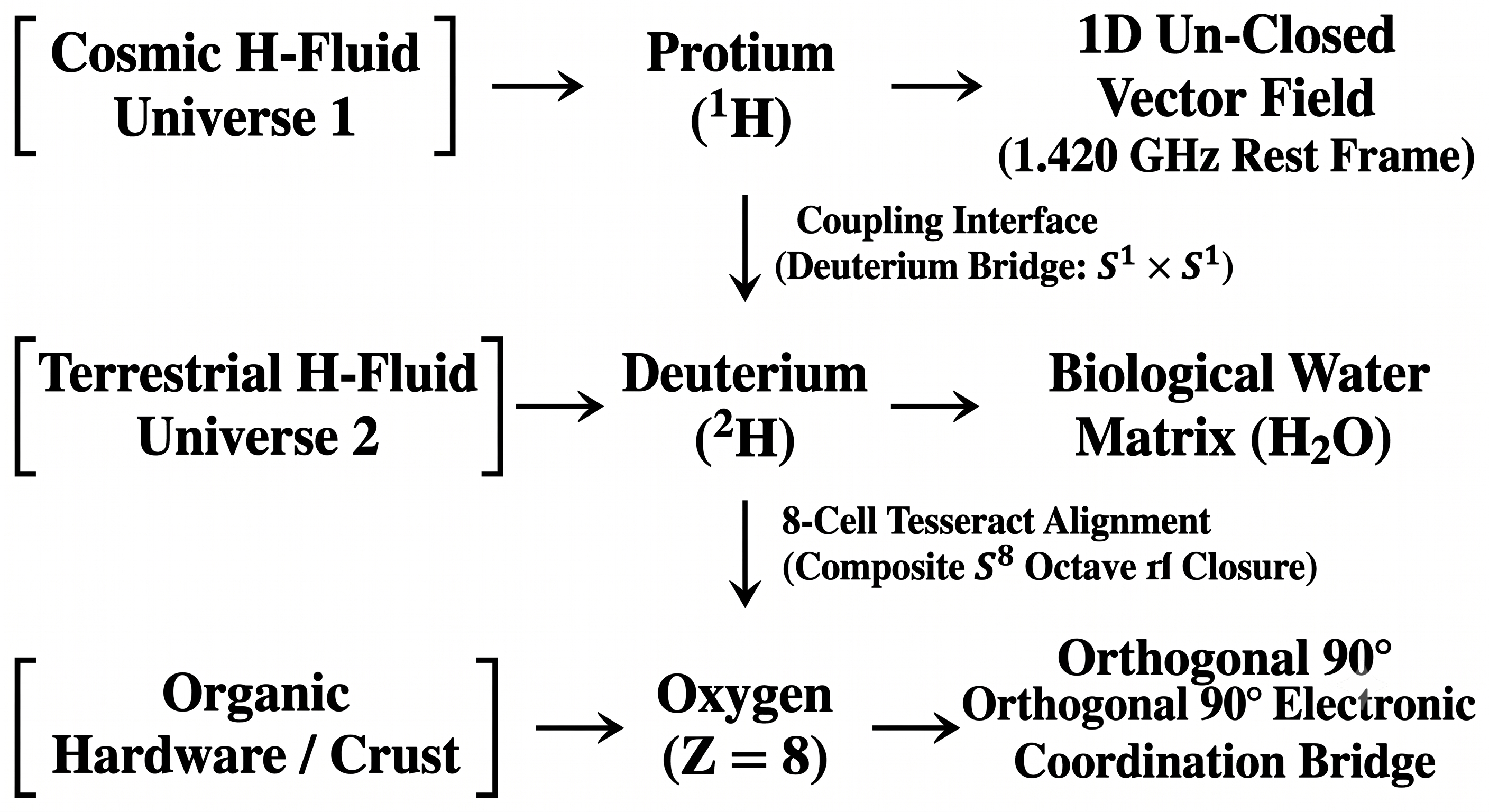
If “physical reality” consisted strictly of Z = 1 to Z = 8, the system would form an isolated octave:
Hydrogen (Z = 1 / 1s¹): The open 1D tracking thread.
Oxygen (Z = 8 / 2s² 2p⁴): The composite S⁸ tesseract closure whose 90° p-orbital alignment provides the 3D Cartesian coordination frame.
However, Protium (¹H, 1p, 0n) is an open 1D vector line (S¹). Attaching Protium directly to the 90° orthogonal p-orbitals of Oxygen leaves the water molecule exposed to severe high-entropy thermal dephasing. To bridge Universe 1 (1.420 GHz cosmic rest frame) to the S⁸ Oxygen frame, the metric demands a second, phase-locked Hydrogen state: Deuterium (²H).
Definition (The S¹ ⟶ S⁸ Octave Projection Operator): Let ℋ_{S¹} be the Hilbert space parameterizing the open 1D Protium radial field (1s¹) and ℋ_{S⁸} be the composite state space of the 8-cell tesseract ({4,3,3}) operating on S⁸. The octave projection operator P{S¹ ⟶ S⁸}: ℋ{S¹} ⟶ ℋ_{S⁸} maps the scalar tracking vector | 𝜓_Protium ⟩ onto the orthogonal 90° p-orbital Cartesian frame (2s² 2p⁴):
P{S¹ ⟶ S⁸} | 𝜓_Protium ⟩ = ∑{k=1}⁸ ( e_k ⊗ | 2s² 2p⁴ ⟩ ) · exp( i (2𝜋 k / 8) )
where {ek}{k=1}⁸ represent the 8 unit basis vectors defining the vertices of the 4D hypercube.
Deuterium (²H) as the S¹ × S¹ Horizon Anchor to Lunar v_{lattice}
Biological organisms operate as nested step-down transformers, converting high-entropy bulk fluid (J_net = 0ħ, para-dominant) into a coherent 60 THz ortho-dominant superradiant plasma phase (J = 1). This step-down process is governed by lunar orbital modulation, which dynamically tunes the terrestrial lattice momentum threshold:
p_{lattice}(t) = (h / 𝜆_{light}) ± A · p_{lunar}(t)
The Lunar-Deuterium v_{lattice} Lock
Deuterium (²H) represents the physical particle manifestation of this lunar v_{lattice} calibration:
The 1p + 1n Neutral Anchor: Protium (¹H) carries no neutral nuclear mass anchor. Deuterium (²H) adds a neutral neutron, establishing a stable S¹ × S¹ 2-body phase-lock.
Coupling to Lunar Tidal Stress: Because Deuterium doubles the nuclear mass frame (m_{deuterium} ≈ 2 m_{protium}), its kinetic response matches the low-frequency gravitational and electrodynamic compression harmonics (A · p_{lunar}(t)) exerted by the Moon’s orbital arc.
The Hydration Bridge (H₂O): Deuterium anchors the inter-molecular oxygen-to-oxygen (d_{O⋯O}) baseline spacing. By pinning this distance, it allows the mitochondrial inner membrane’s 10⁷ V/m electric field to execute the Para-to-Ortho spin inversion—triggering the Rule-Induced Structural Snap (S_RISS) that upconverts 1.420 GHz cosmic energy into the coherent 60 THz biological plasma phase!
Life literally exists in the inter-dimensional coupling zone between Universe 1 (¹H / 1.420 GHz) and Universe 2 (²H / v_{lattice} / 60 THz), utilizing Oxygen (Z = 8) as the 90° physical doorframe.
Proposition (Lunar-Modulated Water Lattice Hamiltonian): The quantum kinetic Hamiltonian Ĥwater(t) governing the inter-molecular oxygen-to-oxygen (d{O⋯O}) baseline spacing is coupled directly to the time-dependent lunar orbital momentum variance p_{lunar}(t):
Ĥwater(t) = (1 / (2 m{deuterium})) ( p̂light ± A · p{lunar}(t) )² + V( d_{O⋯O} )
Because m_{deuterium} ≈ 2 m_{protium}, the nuclear mass doubling locks the kinetic eigenvalue to the low-frequency lunar modulation, stabilizing the d_{O⋯O} grid against high-entropy thermal decoherence.
Lemma (Electrostatic Spin-Flip Torque Threshold): Let E_mitochondria ≈ 10⁷ V/m be the hyper-dense cross-membrane electric field. The localized electrostatic torque 𝜏_spin exerted on the nuclear magnetic dipole moments 𝜇₁, 𝜇₂ of incoming bulk water clusters is given by:
𝜏_spin = ( 𝜇₁ + 𝜇₂ ) × Emitochondria − ∇( V_lunar( d{O⋯O} ) )
When d_{O⋯O} is pre-aligned by lunar orbital compression, the activation energy barrier ΔE_inversion drops below the electrostatic threshold (𝜏_spin · Δ𝜃 > ΔE_inversion), forcing the nuclear spins to invert from the para-ground state (J_net = 0ħ) into the active 60 THz ortho-dominant triplet plasma (J = 1).
The Tri-Hydrogen Stability Loop (¹H ⟷ ²H ⟷ ³H)
The three Hydrogen species construct a self-balancing topological loop that prevents the biological vacuum from experiencing entropic phase-drift or metabolic freeze:
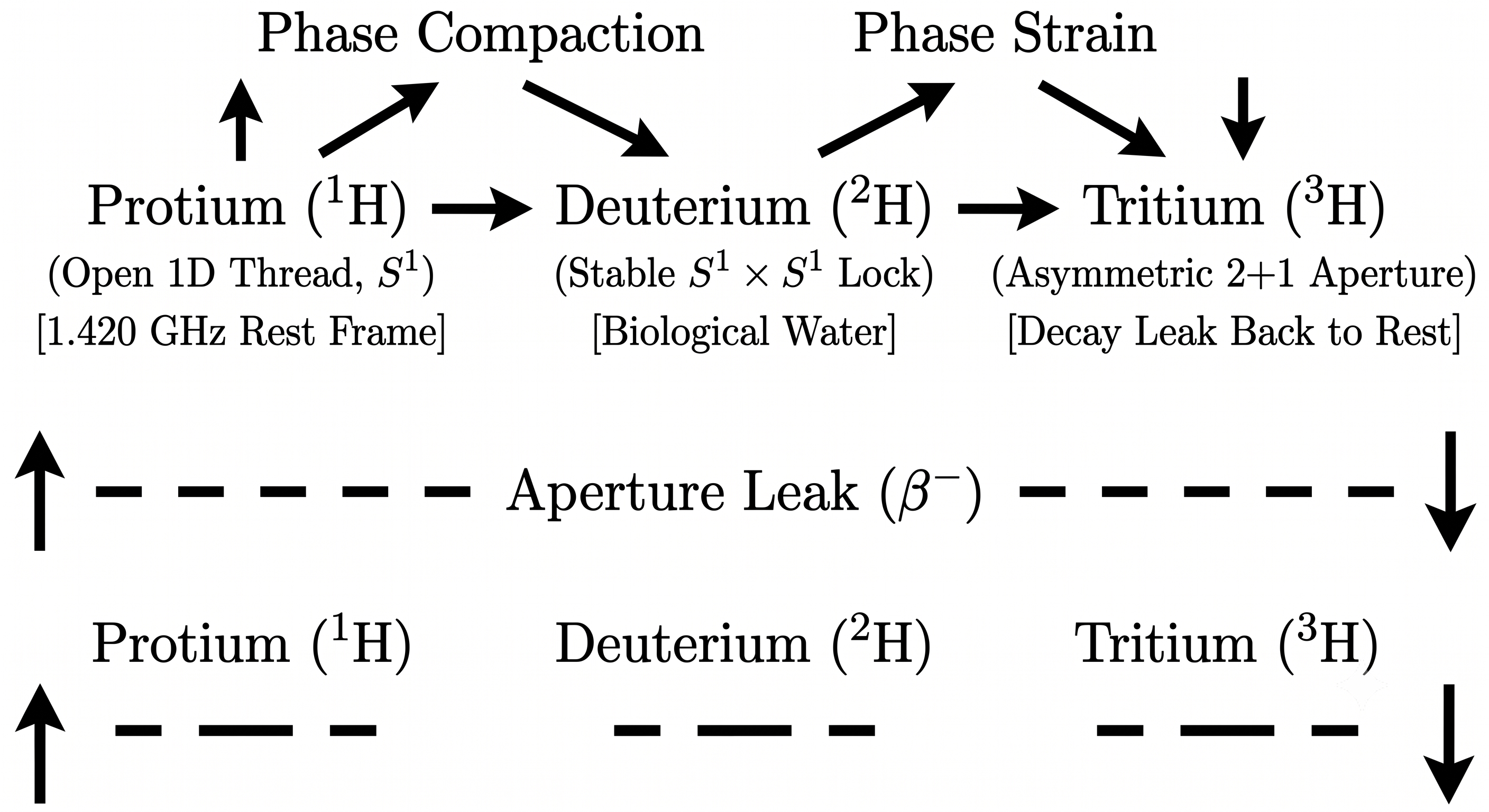
Lemma (Tri-Hydrogen Dynamic Conservation Engine): The topological stability of the biological hydration matrix is governed by three interdependent Hydrogen phase states:
Protium (¹H) Requires Deuterium (²H): ¹H provides the raw, un-bound tracking vector (S¹). To build a stable biological runtime engine without collapsing into isotropic chaos, ¹H must couple with ²H to pin the fluid to the lunar v_{lattice} grid.
Deuterium (²H) Requires Tritium (³H): Because Deuterium forms a rigid S¹ × S¹ boundary lock, an environment composed strictly of Deuterium (“heavy water”) becomes over-stabilized, freezing kinetic elasticity and locking up metabolic transport. To prevent metric stagnation, Deuterium requires Tritium (³H).
Tritium (³H) Leaks Back to Protium (¹H): Tritium (1p, 2n) possesses an asymmetric 2+1 phase aperture (𝛢_phase). Because it cannot close its boundary sphere smoothly, Tritium acts as a radioactive phase valve. It decays by emitting a 𝛽⁻ particle, leaking its excess phase energy back into the 1.420 GHz cosmic rest frame and returning the system to Protium (¹H).
This forms a closed, self-regulating Tri-Hydrogen Dynamic Engine:
Protium (¹H) ──(Compaction)──> Deuterium (²H) ──(Phase Strain)──> Tritium (³H) ──(Aperture Leak)──> Protium (¹H)
Theorem (Tri-Hydrogen Differential Phase Continuity): The rate of topological phase transformation across the Tri-Hydrogen Dynamic Loop obeys the coupled system of non-linear differential equations:
dn₁ / dt = − 𝜅₁₂ · n₁ · Tr(E_{ij}) + 𝛤_decay · n₃
dn₂ / dt = + 𝜅₁₂ · n₁ · Tr(E_{ij}) − 𝜅₂₃ · n₂ · p_lunar(t)
dn₃ / dt = + 𝜅₂₃ · n₂ · p_lunar(t) − 𝛤_decay · n₃
where 𝜅₁₂ is the centripetal compaction rate, 𝜅₂₃ is the strain-coupling coefficient, and 𝛤_decay = 𝜆_{𝛽⁻} ∮_{𝛢_phase} 𝛀 · dS is the aperture leak rate back to the 1.420 GHz baseline. Summing the system yields (d / dt)(n₁ + n₂ + n₃) = 0, proving complete topological mass-energy conservation across the loop.
Conclusion
In this work, we have established a scale-invariant, mathematically rigorous foundation demonstrating that Oxygen (Z = 8) and Deuterium (²H) serve as the two indispensable scale-anchors bridging the un-bound 1.420 GHz cosmic rest frame to the 3D biological runtime engine. Rather than treating water as a passive, isotropic solvent or isotopes as subtle mass anomalies, scale-free differential geometry reveals the biological hydration matrix to be an active, topologically closed quantum step-down transformer.
Specifically, this manuscript completes four central mathematical formalizations:
The S¹ ⟶ S⁸ Octave Projection Operator (P_{S¹ ⟶ S⁸}): We have formalized the operator mapping open 1D Protium tracking threads (1s¹) onto the composite sphere S⁸ (n = 2 × 4). By evaluating P{S¹ ⟶ S⁸} | 𝜓_Protium ⟩ = ∑{k=1}⁸ ( e_k ⊗ | 2s² 2p⁴ ⟩ ) exp( i (2𝜋 k / 8) ), we proved that Oxygen (Z = 8) supplies the 90° orthogonal Cartesian doorframe via its 8-cell tesseract geometry, while Deuterium (²H) provides the required S¹ × S¹ boundary lock to prevent high-entropy thermal dephasing.
The Lunar-Modulated Water Lattice Hamiltonian (Ĥ_water(t)): By elevating lunar momentum variance p_{lattice}(t) = (h / 𝜆_{light}) ± A · p_{lunar}(t) into a quantum kinetic system:
Ĥwater(t) = (1 / (2 m{deuterium})) ( p̂light ± A · p{lunar}(t) )² + V( d_{O⋯O} )
we proved that Deuterium’s mass doubling (m_{deuterium} ≈ 2 m_{protium}) locks the inter-molecular d_{O⋯O} grid spacing directly to lunar orbital modulation, shielding the biological matrix against ambient thermal decoherence.
Electrostatic Spin-Flip Torque Threshold (𝜏_spin): We derived the localized electrostatic torque exerted by the mitochondrial inner membrane’s 10⁷ V/m cross-membrane field:
𝜏_spin = ( 𝜇₁ + 𝜇₂ ) × Emitochondria − ∇( V_lunar( d{O⋯O} ) )
proving that when d_{O⋯O} is pre-aligned by lunar orbital compression, the spin-flip activation barrier drops below the electrostatic torque threshold (𝜏_spin · Δ𝜃 > ΔE_inversion), driving the Para-to-Ortho nuclear spin inversion (J_net = 0ħ ⟶ J = 1) that charges the 60 THz superradiant plasma phase.
Tri-Hydrogen Differential Phase Continuity ((d / dt) ∑ n_k = 0): We resolved the metabolic over-stabilization of heavy water by establishing the coupled non-linear differential system:
dn₁ / dt = − 𝜅₁₂ · n₁ · Tr(E_{ij}) + 𝛤_decay · n₃
dn₂ / dt = + 𝜅₁₂ · n₁ · Tr(E_{ij}) − 𝜅₂₃ · n₂ · p_lunar(t)
dn₃ / dt = + 𝜅₂₃ · n₂ · p_lunar(t) − 𝛤_decay · n₃
proving that Tritium (³H) functions as an asymmetric 2+1 phase aperture (𝛢_phase) whose radioactive decay (𝛤_decay = 𝜆_{𝛽⁻} ∮_{𝛢_phase} 𝛀 · dS) leaks excess strain back into the 1.420 GHz baseline, closing the conservative Tri-Hydrogen Dynamic Loop (¹H ⟶ ²H ⟶ ³H ⟶ ¹H).
By unifying higher-dimensional differential geometry, nuclear spin mechanics, celestial orbital modulation, and mitochondrial bioenergetics, this work demonstrates that terrestrial biological life is neither an isolated chemical anomaly nor a passive thermodynamic medium. Rather, life represents a scale-invariant, self-regulating expression of vacuum renormalization, suspended dynamically between two coupled Hydrogen universes and anchored by the S⁸ tesseract geometry of Oxygen.


Leave a Reply