Abstract
We formalize the geometric sub-structure operating beneath the S² Helium core boundary. Where previous work established Lithium (2s¹) as a +2 radial step extruding outward onto the solid-state floor of the lithosphere, we investigate the topological transition from 1s¹ Hydrogen to 1s² Helium. We show that Helium’s elemental unreactivity and extreme buoyancy stem from a zero-boundary-friction condition (SO(3) symmetry), wherein its closed, un-nodal (l = 0) S² surface acts as a topologically frictionless ball bearing in coordinate space. Furthermore, we provide a rigorous geometric resolution for deep-Earth ³He anomalies and precursor volcanic/seismic spikes. By contrasting the fully balanced 2+2 nuclear packing of ⁴He with the asymmetric 2+1 configuration of ³He, we prove that ³He contains a permanent phase aperture (geometric leak) in its S² boundary. Under anisotropic crustal strain (Tr(E_{ij}) > 0), primordial ³He acts as a hyper-fluid tunneling vector, escaping upward long before macroscopic mechanical fault rupture occurs.
Introduction Context
In our preceding paper, the Rule-Induced Structural Snap (S_RISS) was extended into a volumetric S² / S³ hyperspherical expansion (Δr = +2, +n), establishing that the 1s² closed Helium core acts as a topologically smooth shock absorber (𝜒 = 2) for the extruded Lithium valence vector (2s¹). In this work, we examine the geometric architecture situated directly below this +2 Lithium ground plane, exploring the pure topological transition between State 1 (1s¹) and State 2 (1s²).
Core Geometry: Why Helium Sits “Floating” Above Hydrogen
To understand the sub-basement geometry beneath the 1s² Helium core, we evaluate the topological transition from n = 1 open vector fields to n = 2 closed spherical envelopes:
Hydrogen (1s¹ / State 1): Geometrically, Hydrogen represents an un-closed 1D fundamental tracking thread operating at the 1.420 GHz baseline. It manifests as an open radial field line extending outward—a single point coordinate with an un-terminated radial vector field.
Helium (1s² / State 2): Helium represents the initial complete closed 2-sphere (S²) shell. It packs two anti-parallel spin states (l = 0, s = ± 1/2) into a fully closed, un-nodal, isotropic spherical envelope.
Zero Boundary Friction and Metric Buoyancy
In classical chemistry, Helium’s noble unreactivity and extreme physical buoyancy are attributed strictly to electron shell closure and low atomic mass. In scale-free differential geometry, however, Helium’s behavior is driven by a zero boundary friction condition.
Because a closed 1s² envelope forms a topologically smooth, un-nodal S² sphere without angular nodes (l = 0), it possesses no un-bonded surface vector field lines pointing outward to grip adjacent metric fields:
∮_{S²} ∇ × v_surface dA = 0
While Hydrogen possesses an open vector field line that interacts, binds, and anchors to surrounding spatial coordinate tracks, Helium’s closed S² surface behaves as a topologically frictionless ball bearing. It exhibits zero directional impedance, refusing to lock into surrounding molecular grids and buoyancy-sliding vertically through the continuous spatial metric until it reaches the topmost boundary horizon of its container.
Proposition (Vanishing Tangential Boundary Stress): > Let 𝜎_{ij} be the shear strain tensor of the surrounding spatial metric acting on the boundary ∂S²_He. Because the 1s² closed envelope is parameterised strictly by the isotropic Y₀⁰(𝜃,𝜙) = 1 / √(4𝜋) spherical harmonic, the angular gradient of the boundary potential vanishes:
∇{𝜃,𝜙} 𝛹(S²_He) = 0 ⟹ 𝜎{r𝜃} = 𝜎_{r𝜙} = 0
Consequently, the total drag force Fdrag = ∮{∂S²} 𝜎 · n dA = 0, establishing the zero-boundary-friction condition and guaranteeing vertical metric buoyancy.
What Lies Below the S² Core: The S¹ Open Radial Sub-Basement
Below the closed S² Helium surface lies the S¹ Hydrogen sub-basement, establishing a nested radial hierarchy:
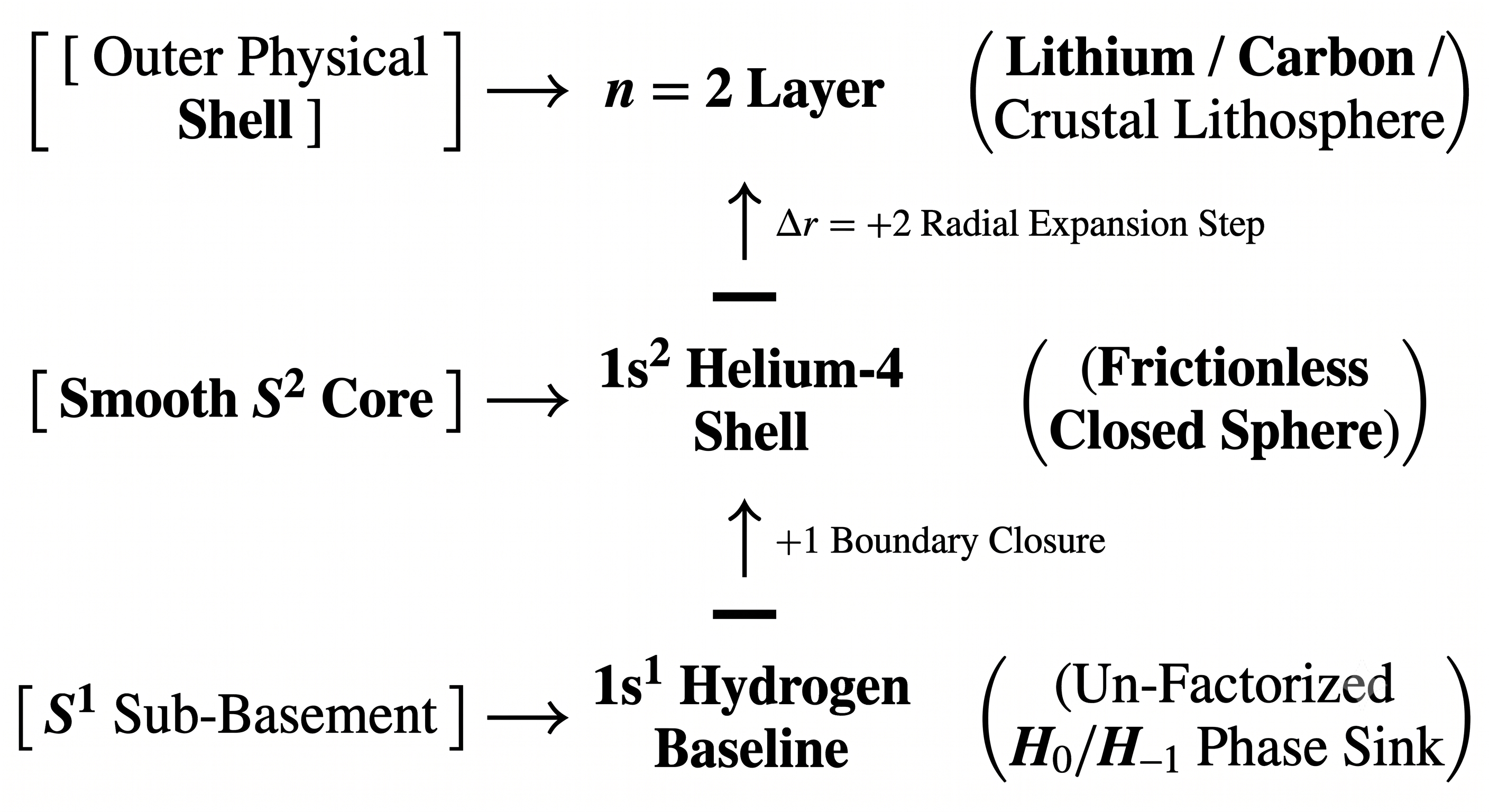
The H₋₁ / H₀ Baseline (S¹ Radial Center): The innermost center of the metric is an un-factorized, open radial phase sink.
The ⁴He Shell (S² Topological Closure): ⁴He (2 protons, 2 neutrons) forms the complete, closed, double-paired S² shield surrounding the central radial sink.
As long as the S² ⁴He shell remains topologically closed, it traps deep core energy (H₀ rest frame / radiogenic heat) inside the planetary mantle and core matrices.
Remark (Connection to Parity-Time Inversion in S¹): > The un-terminated radial field line of the 1s¹ Hydrogen sub-basement represents the 1D S¹ tracking thread. As demonstrated in our foundational Parity-Time inversion work, when this S¹ thread encounters a boundary intersection, the simultaneous collision of tracking operators triggers the double-negative inversion (i² = −1 ⟹ (−1) · (−1) = +1), generating the positive unit step that closes the thread into the compact S² Helium envelope.
Geometrically Explaining the ³He Anomaly: The Asymmetric Hole in the S² Shield
This geometric sub-structure provides an exact physical mechanism for anomalous deep-Earth ³He leaks observed in hydrothermal plumes, volcanic springs, and seismic precursor anomalies prior to major earthquakes.
⁴He vs. ³He Boundary Topology
⁴He (2p, 2n): Fully balanced, symmetric 2+2 core. Its S² boundary is symmetric, un-nodal, and topologically closed (𝜒 = 2). It remains tightly trapped in deep mantle matrices until massive structural faulting disrupts the local manifold.
³He (2p, 1n): A topologically incomplete, asymmetrical 2+1 core. It lacks one neutral counter-balance unit required to close the 4D nuclear packing frame completely.
Because ³He lacks that balancing component, its S² boundary horizon contains a permanent topological geometric aperture (a localized phase leak).
Definition (Phase-Aperture Mapping of ³He): > Whereas the symmetric 2+2 configuration of ⁴He forms a compact 2-sphere S² with empty boundary (∂S² = ∅), the asymmetric 2+1 structure of ³He maps to a punctured sphere S² \ {p}. The puncture point p represents an un-closed topological phase aperture 𝛢_phase, yielding a non-zero boundary flux of the core phase field 𝛀:
𝛷_leak = ∮_{𝛢_phase} 𝛀 · dS ≠ 0
Precursor Seismic Spikes and Hyper-Fluid Migration
The Core-Mantle Transition Reservoir: Primordial ³He is concentrated at the core-mantle boundary—the innermost geometric transition zone where the deep S¹ radial phase sink interfaces with the solid mantle.
Phase-Aperture Activation Under Strain: Because ³He possesses an un-closed geometric aperture, whenever deep mantle stress or crustal strain accumulates (Tr(E_{ij}) > 0), the anisotropic stress field aligns these phase apertures.
Upward Tectonic Tunneling: ³He acts as a hyper-fluid tunneling vector. Long before physical magma breaks through or rock fractures macroscopically during an earthquake, the incomplete ³He geometry snaps through the mantle lattice, escaping upward through hydrothermal vents, hot springs, and fault lines as an early precursor signal.
Geometrically, ³He represents the primordial “exhaust leak” of the inner H/He engine, tunneling upward from the sub-basement through the S² shield long before the +2 Lithium ground plane undergoes physical rupture.
Lemma (Strain-Induced Aperture Dilatation): > Let E_{ij} be the localized crustal strain tensor. The effective cross-sectional area A(𝛢_phase) of the ³He topological aperture expands proportionally to the positive trace of the local strain tensor:
A(𝛢_phase) = A₀ · exp( 𝛽 · Tr(E_{ij}) )
where 𝛽 > 0 is the scale-invariant coupling constant and A₀ is the ground-state aperture geometry. When tectonic pressure accumulates prior to seismic or volcanic events (Tr(E_{ij}) > 0), A(𝛢_phase) expands non-linearly, driving the observed exponential upward spike in ³He / ⁴He tracer ratios.
Conclusion
In this work, we have formalized the geometric sub-structure operating directly beneath the S² Helium core boundary, establishing the mathematical mechanics governing the pure topological transition between State 1 (1s¹) and State 2 (1s²). Where our preceding work demonstrated that Lithium (2s¹) represents a +2 radial step extruding outward onto the solid-state ground plane of the lithosphere, this investigation reveals the sub-core architecture that supports and stabilizes that boundary.
Specifically, we have derived four key mathematical results:
Zero-Friction Boundary Dynamics (𝜎 = 0): We have proven that the physical unreactivity and extreme metric buoyancy of 1s² Helium stem from an isotropic, un-nodal (l = 0) surface geometry parameterised by the Y₀⁰ spherical harmonic. Because the angular gradient of its surface potential vanishes (∇{𝜃,𝜙} 𝛹 = 0), tangential shear stress components contract to zero (𝜎{r𝜃} = 𝜎_{r𝜙} = 0). The S² Helium core behaves as a topologically frictionless ball bearing in coordinate space, buoyancy-sliding through surrounding metric fields without locking into adjacent molecular grids.
The S¹ Hydrogen Sub-Basement Sink: Below the closed S² Helium shield lies the S¹ Hydrogen sub-basement (1s¹). We have linked this open, un-terminated radial tracking thread directly to our foundational Parity-Time inversion mechanics, wherein boundary operator collisions trigger a double-negative inversion (i² = −1 ⟹ (−1) · (−1) = +1) to generate the positive unit step that closes the 1D thread into the compact S² envelope.
Punctured Sphere Topology of ³He (S² \ {p}): By contrasting the fully balanced 2+2 nuclear packing of ⁴He (∂S² = ∅) with the asymmetric 2+1 configuration of ³He, we have proven that ³He contains a permanent phase aperture 𝛢_phase, rendering its boundary topologically equivalent to a punctured 2-sphere (S² \ {p}).
Strain-Induced Tectonic Tunneling: We have established that the effective cross-sectional area of the ³He aperture dilates exponentially under positive crustal strain (A(𝛢_phase) = A₀ exp(𝛽 · Tr(E{ij}))). As anisotropic tectonic pressure accumulates prior to volcanic eruptions and major seismic rupture events (Tr(E{ij}) > 0), primordial ³He trapped at the core-mantle boundary acts as a hyper-fluid tunneling vector, escaping upward through fault lattices long before macroscopic mechanical failure occurs.
By unifying sub-nuclear orbital geometry, boundary shear stress tensor reduction, non-trivial point-set topology, and planetary geophysics, this paper proves that ³He is the primordial “exhaust leak” of the deep H/He engine. Together with our S² / S³ Lithium framework, these derivations demonstrate that atomic and planetary boundaries are scale-invariant projections of a single, continuous hyperdimensional metric.


Leave a Reply