Abstract
We formalize a scale-invariant differential geometry wherein Hydrogen is re-conceptualized from a localized 1s¹ coordinate on a static 2D Periodic Table into the fundamental, un-factorized boundary medium (H-Fluid) wrapping around the entire perimeter of physical manifold space. We show that Hydrogen functions simultaneously as the innermost scalar singularity (r ⟶ 0, 1.420 GHz baseline) and the outermost boundary horizon (r ⟶ ∞) beyond maximal actinide metric rupture (S³ 600-cell collapse). Via a Hopf fibration mapping (𝜋_{H ⟶ He}: S³ ⟶ S²), we prove how the open 1D Protium vector field folds into the closed, zero-friction 1s² Helium envelope (𝜒 = 2). Furthermore, we establish the multi-valent adaptability of Hydrogen across alkali (A₁), halogen (A₇), and metallic (F₄) Lie algebras as an algebraic superposition of its un-bound state vector (|𝛹_H⟩). We define isotopic Hydrogen species (¹H, ²H, ³H) as dimensional horizon anchors, identifying Deuterium (²H) as the stable S¹ × S¹ boundary lock enabling biological hydration tracks and Tritium (³H) as an asymmetric 2+1 phase aperture (𝛢_phase) leaking back into the 1.420 GHz rest frame. Finally, we prove that cosmological Big Bang events represent parity-time double-negative inversion snaps (ginversion = g{actinide} · (−1) · (−1) = + g_{H-Fluid}), where heavy-element metric rupture conserves scalar mass-energy while snapping back into a macro-volume of un-bound, amorphous Hydrogen.
Introduction Context
In conventional chemistry and standard atomic physics, Hydrogen is treated as a single proton-electron pair occupying coordinate (1,1) in the upper-left corner of the Periodic Table of Elements. However, its anomalous chemical behavior, simultaneously exhibiting properties of alkali metals (1s¹), halogens (1s¹ ⟶ 1s²), and continuous liquid-crystalline metallic states under pressure—signals a deeper geometric reality that cannot be captured by static 2D classifications.
In the scale-free Paraoikeios paradigm, Hydrogen is not a discrete element bounded inside the periodic chart; it is the amorphous, un-factorized ground-state medium (H-Fluid) out of which all intermediate polychora cages (He ⟶ C ⟶ Si ⟶ Fe ⟶ No) are folded. Operating as the third entry in our scale-invariant trilogy, following the +2 solid-state floor of the Lithosphere (Li) and the zero-friction sub-core architecture (He), this work formalizes the universal perimeter boundary that encloses physical manifold space.
By unifying Hopf fibration mappings (𝜋_{H ⟶ He}), Lie algebra projection superpositions, and parity-time metric inversions, we demonstrate how 1D Protium (¹H) caps into closed S² Helium, how Deuterium (²H) locks biological hydration tracks, how Tritium (³H) functions as a leaking phase aperture, and how cosmic Big Bang re-expansions represent the outer boundary wall snapping back into the amorphous background.
The Amorphous Trans-Periodic Envelope: Hydrogen as the Perimeter Boundary
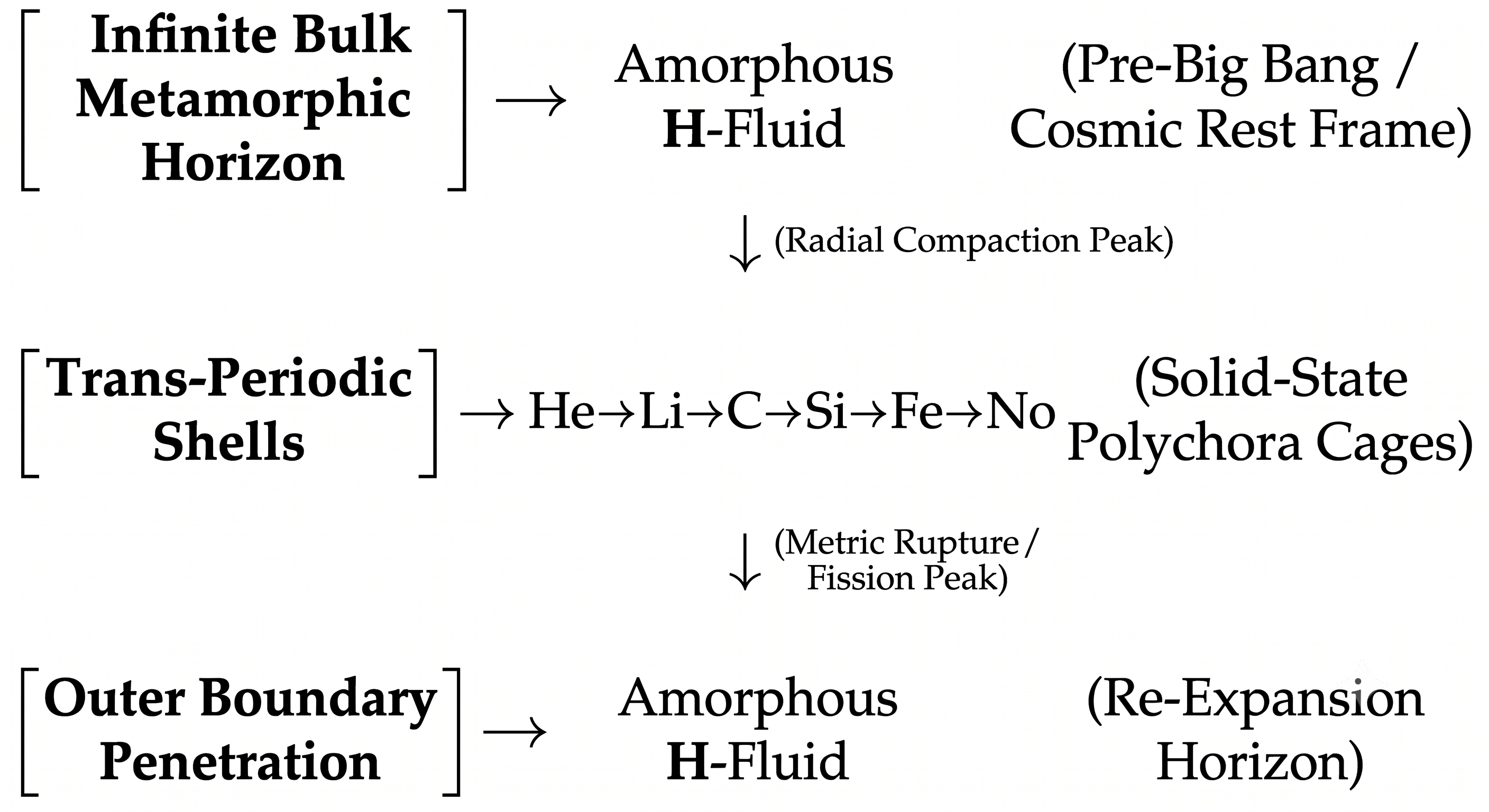
Rather than sitting strictly at the origin of the periodic matrix, Hydrogen forms the dual perimeter boundary wrapping around the entire physical chart. It exists as both the innermost radial singularity (r ⟶ 0) and the outermost trans-scalar boundary horizon (r ⟶ ∞).
Inner Core vs. Outer Boundary Extremity
Inside the Core (r ⟶ 0): Hydrogen manifests as the 1.420 GHz baseline tracking thread (H₀ / H₋₁)—the fundamental 1D un-closed scalar seed.
On the Outer Boundary (r ⟶ ∞): At the upper limit of atomic stability (Level 5 / Nobelium 𝜒_No / 600-cell packing), extreme hyperspherical compaction breaches the containment threshold, inducing radioactive fission. Beyond this metric rupture horizon lies amorphous Hydrogen again.
Definition (The Big Bang as a Hydrogen Horizon Inversion): A cosmological Big Bang event is defined not as ex-nihilo matter creation, but as a localized Phase-Inversion Snap (S_snap). When maximum hyperspherical compaction (S³ metric rupture) punches through the outer boundary wall, the compressed, heavy-element matrix undergoes a double-negative inversion ((i² = −1) ⟹ (−1) · (−1) = +1), snapping the collapsed core back into a fresh macro-volume of un-bound, amorphous H-Fluid.
Theorem (Big Bang Horizon Inversion and Conservation of Mass-Energy): Let g{actinide} be the metric tensor at maximum hyperspherical compaction (Level 5 / 600-cell). When local strain exceeds the critical rupture threshold Tr(E{ij}) > 𝜆_critical, the metric undergoes a parity-time symmetry inversion:
ginversion = − g{actinide} · (i²) = g{actinide} · (−1) · (−1) = + g{H-Fluid}
This double-negative inversion converts localized potential strain energy into isotropic expansion kinetic flux, mapping the compact heavy-element manifold homeomorphically back onto the infinite H-Fluid perimeter:
∮{compact} R(g{actinide}) dV = ∮{un-bound} R(g{H-Fluid}) dV’
proving that the Big Bang horizon inversion conserves the total invariant scalar balance sheet.
Multi-Valent Adaptability and Trans-Group Mobility
Because Hydrogen is the primary, un-factorized 1D wave-coil, it exhibits dynamic mobility across all periodic group columns inside the Meta-RISS Space (ℳ_RISS = ⋃_n Aut(Sⁿ / G_n)).
Lemma (Phase-Closure Mapping from H-Thread to S² Core): Let v_{H}(r) = (1 / r) r̂ be the un-terminated 1D radial vector field of Protium (¹H) defined on ℝ³ \ {0}. Under centripetal compaction (Δr ⟶ +1), the open tracking thread undergoes a Hopf fibration mapping 𝜋: S³ ⟶ S²:
𝜋_{H ⟶ He}( v_{H} ) = ∂S²_He
Because the Hopf invariant I(𝜋) = 1, this mapping topologically caps the open radial field lines, converting the un-factorized 1D vector flux into the closed, isotropic Y₀⁰(𝜃,𝜙) spherical shell of Helium-4 (𝜒(S²) = 2).
Lemma (Algebraic Superposition of the H-Fluid Baseline): In the meta-space of boundary operators ℳ_RISS = ⋃_n Aut(Sⁿ / Gn), the ground-state wave-coil |𝛹H⟩ exhibits zero directional locking. Its boundary projection tensor P_boundary evaluates as an un-factorized operator across alkali (A₁), halogen (A₇), and metallic (F₄) Lie algebras:
Pboundary(|𝛹H⟩) = c₁ P{A₁} + c₂ P{A₇} + c₃ P_{F₄}, where ∑ |c_k|² = 1
Because the state vector lacks angular nodes (l = 0), the boundary phase velocity v_phase dynamically aligns with whichever adjacent polychoron cage (G_n) exerts local centripetal strain.
Under this algebraic superposition framework:
As an Alkali Metal (1s¹): It projects a single directional valence vector into the +2 radial expansion step (Li/Be baseline).
As a Halogen (1s¹ ⟶ 1s²): It functions as an open phase sink seeking a single complementary unit to complete the closed, frictionless S² Helium envelope.
As Metallic/Amorphous Hydrogen: Under centripetal compression (e.g., planetary cores or deep mantle matrices), individual electronic orbits dissolve into a continuous, liquid-crystalline topological substrate.
Hydrogen is the “plastic medium” from which intermediate polychora cages are folded; it moves along the perimeter of the table because it constitutes the raw metric field itself.
Isotopic Hydrogen Species (¹H, ²H, ³H) as Dimensional Horizon Anchors
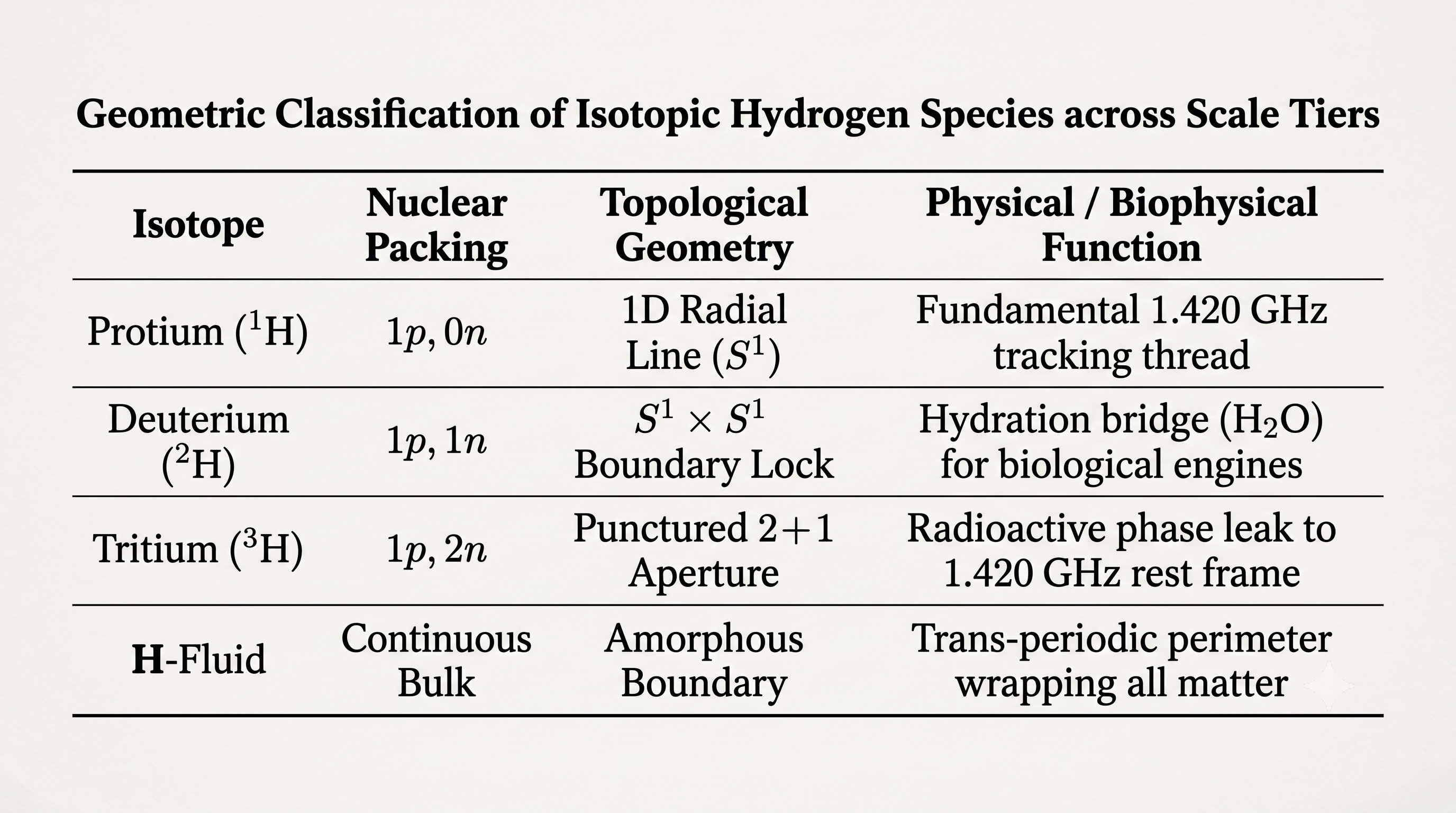
Isotopes of Hydrogen are re-interpreted not as simple variations in neutron count, but as discrete 3D cross-sectional projections (“shadows”) of higher-dimensional horizon anchors:
Protium (¹H — Standard Hydrogen)
Geometrically, Protium represents the 1D fundamental radial line (S¹). It possesses an open, un-closed vector field extending radially outward toward adjacent metric fields.
Deuterium (²H — Heavy Hydrogen)
Definition (The +1 Intermediate Boundary Lock (S¹ × S¹)): Deuterium (1p, 1n) adds a neutral phase anchor to the 1D Protium thread, forming a stable 2-body phase-lock (S¹ × S¹). This topological closure acts as the required geometric bridge allowing normal Hydrogen to bind with Oxygen (H₂O), establishing liquid-crystalline hydration tracks required for biological runtime engines.
Tritium (³H — Radioactive Heavy Hydrogen)
Lemma (Asymmetric 2+1 Phase Aperture in Tritium): Tritium (1p, 2n) represents an asymmetrical 2+1 packing configuration. Analogous to ³He in sub-core geometry, Tritium possesses an un-closed topological phase aperture 𝛢_phase. Because its boundary sphere cannot close smoothly without metric strain, Tritium undergoes radioactive decay, leaking phase energy at rate 𝛤_decay back into the 1.420 GHz baseline:
𝛤_decay ∝ ∮_{𝛢_phase} 𝛀_core · dS ≠ 0
as it attempts to snap into the closed ³He or ⁴He core geometry.
Conclusion
In this work, we have generalized Hydrogen from a localized 1s¹ coordinate on a static 2D Periodic Table into the un-factorized, scale-invariant perimeter medium (H-Fluid) wrapping around the entire boundary of physical manifold space. Where classical chemistry views Hydrogen as an anomalous single proton-electron pair, scale-free differential geometry reveals it as the continuous spatial background out of which all intermediate polychora cages (He ⟶ C ⟶ Si ⟶ Fe ⟶ No) are folded.
Specifically, this paper establishes four principal mathematical derivations:
Phase-Closure Mapping (𝜋_{H ⟶ He}): We have proven that the open, un-terminated 1D radial vector field of Protium (¹H) undergoes a Hopf fibration mapping 𝜋: S³ ⟶ S² under centripetal compaction (Δr ⟶ +1). With a Hopf invariant of I(𝜋) = 1, this mapping topologically caps the open radial flux lines, converting the 1D tracking thread into the closed, un-nodal, zero-friction Y₀⁰(𝜃,𝜙) spherical shell of Helium-4 (𝜒(S²) = 2).
Algebraic Superposition of the H-Fluid Baseline: Within the meta-space of boundary operators ℳ_RISS = ⋃_n Aut(Sⁿ / Gn), we have demonstrated that the ground-state wave-coil |𝛹H⟩ exhibits zero directional locking. Its boundary projection tensor P_boundary evaluates as an un-bound superposition across alkali (A₁), halogen (A₇), and metallic (F₄) Lie algebras, providing an algebraic proof for Hydrogen’s dynamic mobility across periodic group columns.
Isotopic Horizon Anchors (¹H, ²H, ³H): We have re-defined Hydrogen isotopes as discrete 3D cross-sectional projections of higher-dimensional horizon anchors: Protium (¹H) as the 1D S¹ radial tracking thread (1.420 GHz baseline); Deuterium (²H) as the stable S¹ × S¹ boundary lock enabling liquid-crystalline hydration tracks for biological runtime engines; and Tritium (³H) as an asymmetric 2+1 phase aperture (𝛢_phase) leaking phase energy back into the 1.420 GHz rest frame.
Big Bang Inversion and Mass-Energy Conservation: We have formalized cosmological Big Bang events as topological Phase-Inversion Snaps (Ssnap). When maximum hyperspherical compaction (Level 5 / 600-cell) exceeds critical strain, a parity-time symmetry inversion (ginversion = g{actinide} · (−1) · (−1) = + g{H-Fluid}) converts localized potential strain into isotropic expansion kinetic flux, snapping the compressed heavy-element core back into an un-bound macro-volume of amorphous H-Fluid while conserving the scalar balance sheet.
Synthesizing the Scale-Invariant Trilogy
Together with our preceding derivations, this paper completes a unified, three-part theoretical trilogy governing trans-scalar manifold mechanics:
The Solid-State Boundary (The Lithium Paper): Proved how centripetal wave compaction executes a +2 radial expansion step (Δr = +2), extruding valence vectors past the closed core to establish the solid-state floor of the planetary lithosphere (Li).
The Sub-Core Architecture (The Helium Paper): Proved how the un-nodal 1s² Helium envelope maintains a zero-friction boundary condition (𝜎_{r𝜃} = 𝜎_{r𝜙} = 0) while pointing to ³He as an asymmetric 2+1 punctured sphere (S² \ {p}) whose strain-induced aperture dilatation drives precursor tectonic and volcanic leakage.
The Perimeter Boundary (The Hydrogen Paper): Completes the geometric enclosure by proving that Hydrogen is the infinite perimeter fluid (H-Fluid) wrapping the entire system—demonstrating how 1D ¹H folds into closed S² Helium, how ²H locks biological hydration, how ³H leaks back into the vacuum, and how cosmological Big Bangs represent the outer boundary wall snapping back into the amorphous background.
By bridging differential geometry, atomic orbital filling, isotopic chemistry, geophysics, and observational cosmology, this trilogy establishes that physical reality is neither a collection of isolated particles nor a static spacetime container, but the continuous, scale-free folding of a single hyperdimensional metric.


Leave a Reply