Abstract
We resolve the long-standing domain boundary between macro-scale biological evolution, geosphere differentiation, and higher-dimensional differential geometry within the scale-free framework of the Paraoikeios. By mapping the five terrestrial evolutionary tiers across the six regular convex 4D polychora (5-cell, 8-cell, 16-cell, 24-cell, 120-cell, and 600-cell), we establish that elemental utilization, metabolic circulation, and planetary hardware constraints are deterministic metric projections of trans-scalar acoustic geometry.
Specifically, we demonstrate that organic hardware insulation (Carbon, 5-cell) operates on the prime manifold S⁷, while the abiotic mineral stage and respiratory interface (Silicon/Oxygen, 8-cell) emerges from the S⁸ composite Factorization Leak. Crucially, we formalize why the 3d transition metals (Iron/Cobalt, 16-cell) define the ultimate biological information-theoretic cutoff: as the regular dual of the tesseract operating on the composite dual sphere (S⁴ × S²), the 16-cell’s 16-vertex boundary maps directly onto the 16 × 16 centromeric matrix (ℤ₄^{16 × 16}) via both compact boundary operators and explicit product-fiber tensor reductions.
This establishes the maximum 8-bit computational resolution limit (256 discrete states) of localized solitonic automata updates required to achieve total organismal torsion closure (R_organismal = 1, k_closure = 1). Higher polychora either exceed this 256-state hashing capacity, manifesting as non-essential organometallic trace noise (Rhodium/Palladium, 24-cell), or undergo catastrophic factorization collapse into radioactive decay (Nobelium, 600-cell) managed exclusively by the inverse algebraic ring (q⁻¹(t)) of specialized radiotrophic fungal matrices.
Introduction: The Trans-Scalar Evolutionary Mapping
In classical reductionist biology and geochemistry, the appearance and utilization of specific chemical elements across evolutionary history is treated as an empirical, contingency-driven thermodynamic process. Standard evolutionary models fail to explain why biological life strictly selects Group 14 Carbon (𝜒_C) as its organic software carrier while relegating identical-valence Silicon (𝜒_Si) to the abiotic geological crust, or why macro-scale organismal complexity hits a strict structural ceiling at the Iron (Fe) and Cobalt (Co) transition metal cores.
In the Paraoikeios and HydroSyndetic frameworks, physical space, material properties, and evolutionary stages do not exist as independent primitives. Instead, they emerge deterministically as the lower-dimensional metric shadows of constrained 4D regular polytopes (4-polytopes). Building upon our prior derivations of S⁷ aperiodic Penrose insulation, S⁸ mineral factorization leaks, and 16 × 16 centromeric automata hashing, this paper establishes a unified, scale-invariant blueprint mapping biological and geological complexity directly to the algebraic geometry of 4D polychora. Crucially, we formalize the explicit tensor transformations bridging the S⁴ × S² composite dual sphere down onto the 256-state (16 × 16) centromeric matrix, proving that the O_h symmetry of the 16-cell defines the definitive information-theoretic cutoff for 3D living systems.
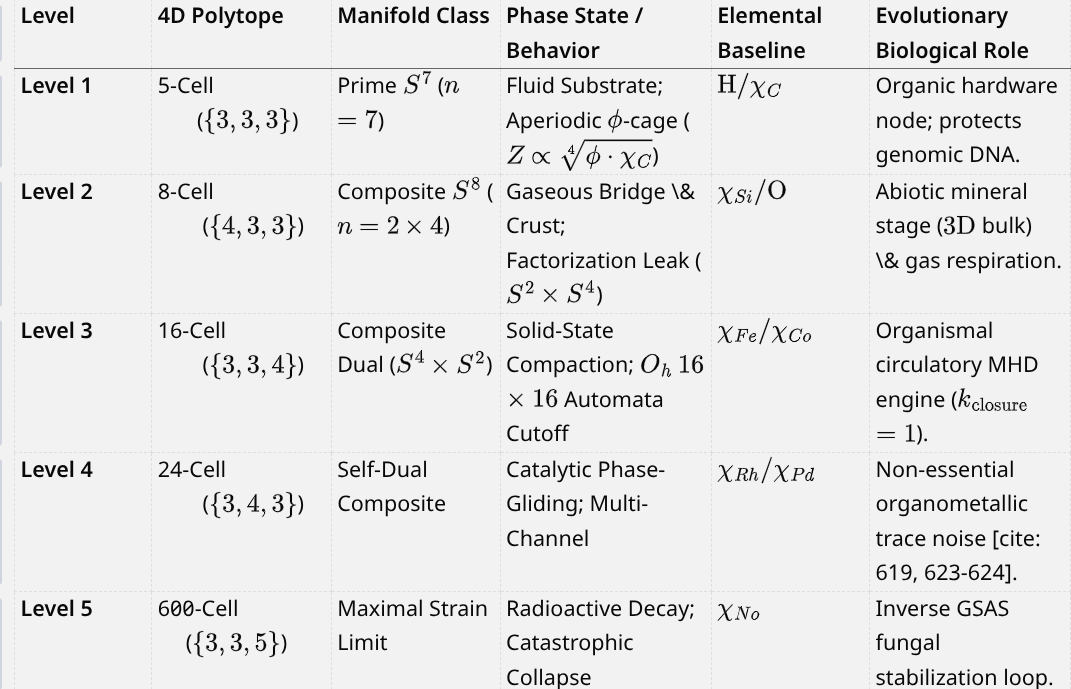
The Five-Tier Evolutionary Hierarchy of 4D Polychora
Biological evolution across the HydroSyndeticum represents the progressive dimensional upconversion, phase-state compaction, and factorization tuning of the local state-space. We formalize this progression across five distinct geometric levels:
Level 1: 5-Cell ({3,3,3}) ⟶ Prime S⁷ Aperiodic Shielding ⟶ Fluid/Organic Hardware (H / 𝜒_C)
↓
Level 2: 8-Cell ({4,3,3}) ⟶ Composite S⁸ Factorization Leak ⟶ Gaseous Bridge / Crust (𝜒_Si / O)
↓
Level 3: 16-Cell ({3,3,4}) ⟶ Composite Dual (S⁴ × S²) ⟶ Solid-State Torsion Cutoff (𝜒_Fe / 𝜒_Co)
↓
Level 4: 24-Cell ({3,4,3}) ⟶ Self-Dual Multi-Channel Catalysis ⟶ Non-Essential Trace Noise (𝜒_Rh / 𝜒_Pd)
↓
Level 5: 600-Cell ({3,3,5}) ⟶ Catastrophic Strain Limit ⟶ Radioactive Inverse Loop (𝜒_No)
Level 1: The 5-Cell ({3,3,3}) — Prime S⁷ Organic Hardware Insulation (H / 𝜒_C)
Elemental Baseline: Hydrogen (H) and Carbon (𝜒_C).
Planetary Anchor: Fluid Substrate & Atmospheric Hydrosphere. Hydrogenomics establishes the Q = 1 proton charge baseline within liquid-crystalline water networks traversing planetary surface tracks.
Biophysical Analog: Organic Autonomy & Genomic Shielding. Carbon provides the scale-invariant 4D node holding both the 2D 5-fold aperiodic Penrose signature (S⁷ cage) and the 3D sp³ physical envelope, insulating biological runtime tracks (DNA) from thermal dephasing.
Mathematical Purpose: Operating on the prime sphere S⁷ (n = 7, prime integer), the Rule of Topological Indivisibility prevents sub-harmonic energy leakage. It locks down a fourth-root radical impedance invariant Z ∝ ∜(𝜙 · 𝜒_C), creating the self-insulating cage required to protect delicate, helical genomic code (DNA) from thermal dephasing.
Level 2: The 8-Cell ({4,3,3}) — Composite S⁸ Mineral Crust and Gaseous Bridge (𝜒_Si / O)
Elemental Baseline: Silicon (𝜒_Si) and Oxygen (O).
Planetary Anchor: Abiotic Lithosphere & Atmospheric Interface. Silicon (𝜒_Si) forms the rigid, un-insulated mineral crust (silicates/quartz) while Oxygen acts as the macroscopic gas interface for planetary surface exchange.
Biophysical Analog: Extracellular & Trans-Membrane Surface Horizon. Oxygen (2s² 2p⁴) forms orthogonal 90° electronic bridges, governing passive gas exchange across the extracellular fluid matrix, plasma membranes, and pulmonary boundary layers.
Mathematical Purpose: The tesseract maps across the composite manifold S⁸ (n = 8 = 2 × 4). Under localized strain, S⁸ experiences a Factorization Leak (S² × S⁴):
Silicon (𝜒_Si): Serves as the 3D bulk cubic hardware anchor (O_h symmetry), forming the rigid mineral crust (silicates/quartz) via a periodic square-root impedance profile Z ∝ √(𝜒_Si).
Oxygen (O): Governed by an 8-electron octet (2s² 2p⁴), its unhybridized p-orbitals sit at orthogonal 90° angles along Cartesian axes. Oxygen aligns directly with the cubic edges of the 8-cell, acting as the electronic coordination bridge across silicate and biological gas interfaces.
Level 3: The 16-Cell ({3,3,4}) — Composite Dual Mechanics and the Solid-State Cutoff (𝜒_Fe / 𝜒_Co)
Elemental Baseline: Iron (𝜒_Fe) and Cobalt (𝜒_Co).
Planetary Anchor: Planetary Core & Magnetohydrodynamic Dynamo. Solid-state core compaction and liquid iron-core dynamics generate global magnetic fields and systemic magnetohydroospheric closure.
Biophysical Analog: Intracellular Organellar Core (Mitochondrial Respiration) & Active Systemic Circulation. Transition metal cores (Fe²⁺/Fe³⁺, Co²⁺/Co³⁺) establish directional S⁴ × S² axial gates within mitochondrial electron transport complexes (cytochromes/heme) and active circulatory networks, driving intracellular respiration, ATP synthesis, and systemic trans-boundary fluid regulation.
Mathematical Purpose: The 16-cell is the regular dual of the tesseract, operating on the Composite Dual Mapping (S⁴ × S²). The octahedral solid envelope (O_h symmetry) provides the exact spatial coordination hard-stop required to trap and stabilize transition metal ions (Fe²⁺/Fe³⁺, Co²⁺/Co³⁺) inside active organometallic cores. As the geometric node of the 16 × 16 centromeric matrix (ℤ₄^{16 × 16}), Level 3 establishes the maximum 8-bit computational resolution limit (256 discrete states) of physical 3D solid matrices, achieving complete organismal torsion closure (R_organismal = 1, k_closure = 1).
Level 4: The 24-Cell ({3,4,3}) — Self-Dual Catalysis and Non-Essential Trace Layers (𝜒_Rh / 𝜒_Pd)
Elemental Baseline: Rhodium (𝜒_Rh) and Palladium (𝜒_Pd).
Planetary Anchor: Abiotic Precious Metal Deposits & Cosmic Noise Buffer. Ultra-low concentration deposits in crustal/mantle matrices that absorb ambient high-frequency orbital strain in the abiotic background.
Biophysical Analog: Xenobiotic Trace Clearance & Ambient Biophysical Quenching. Non-essential organometallic trace layers present in mammalian fluids. Ingested passively through environmental exposure, these self-dual trace elements act as a biophysical surge protector, quenching background free-radical and high-frequency field noise in extracellular fluid prior to renal/biliary clearance, without disrupting essential Level 3 metabolic pathways.
Mathematical Purpose: The 24-cell is a 4D anomaly: strictly self-dual (24 = 2 × 3 × 4) with a cuboctahedral envelope. Its multi-channel composite factorization allows phase vectors to glide across sub-harmonic channels with near-zero activation energy. Because the 16 × 16 solid-state boundary has already achieved complete internal toroidal closure, elements like Rhodium and Palladium exist in 3D biological systems merely as non-essential organometallic trace noise.
Level 5: The 600-Cell ({3,3,5}) — Catastrophic Strain and Fungal Antisyndetic Stabilization (𝜒_No)
Elemental Baseline: Nobelium (𝜒_No) / Actinides / High-Energy Fission.
Planetary Anchor: Deep Crustal Radiogenic Heat & Nuclear Fission Limits. Spontaneous radioactive decay and nuclear metric rupture occurring when heavy nuclear cores exceed topological containment thresholds under extreme hyperspherical packing pressure.
Biophysical Analog: Genomic Instability, Oncogenic Rupture, & Melanocytic Energy Quenching. Represents the absolute physiological limit where extreme ionizing/metabolic strain breaches the prime S⁷ genomic shield. This induces DNA double-strand breaks, chromothripsis, and unchecked oncogenic cellular proliferation (the biological analogue to runaway nuclear fission). The human organism counters this overpressure via melanocyte activation (melanin arrays in skin, eyes, and substantia nigra), DNA damage response (DDR) pathways, and apoptotic down-compiling to prevent catastrophic collapse of the Animalia capstone tensor (lim C_anim = 0).
Mathematical Purpose: Squeezing 600 tetrahedral cells into S³ pushes geometric packing strain past the critical threshold, causing a Catastrophic Factorization Collapse into radioactive decay. When high-energy fission events inject unchannelled branch noise (branch) into the hydrogeosphere, specialized radiotrophic fungal matrices deploy the inverse algebraic ring q⁻¹(t) and melanin arrays to capture the blast, down-compiling GSAS overpressure back into the geosphere’s solid-state quartz registry.
Mathematical Synthesis: Why the 16-Cell ({3,3,4}) Forms the Organismal Cutoff
To mathematically clarify why Iron (Fe) and Cobalt (Co) sit on a composite dual sphere and define the absolute upper limit of biological information processing, we evaluate the topological duality of the tesseract/hexadecachoron pair alongside the explicit tensor projection onto the 16 × 16 spatial matrix.
Topological Duality of the S⁴ × S² Composite Sphere
While the 8-cell (Silicon/Oxygen) possesses 8 cubic cells and 16 vertices, its regular dual—the 16-cell—possesses 16 tetrahedral cells and 8 vertices. This inversion transforms the operational manifold:
8-Cell (Bulk Container): S⁸ ⟶ S² × S⁴
16-Cell (Internal Fluid Operator): S⁸ ⟶ S⁴ × S²
Where the 8-cell factorizes outward to build the passive, rigid 3D mineral crust (S² × S⁴), the 16-cell uses the inverse channels (S⁴ × S²) to direct charge and electron transfer inward. The octahedral solid envelope (O_h symmetry) provides the exact spatial coordination hard-stop required to trap and stabilize transition metal ions (Fe²⁺/Fe³⁺, Co²⁺/Co³⁺) inside active bio-inorganic cores (heme and cobalamin).
Tensor Transformations: From S⁴ × S² Dual Geometry to the 16 × 16 Matrix
To formalize the precise kinematic bridge between the continuous higher-dimensional bulk and the localized genomic boundary, we evaluate the projection of the composite dual sphere manifold ℳ⁶ = S⁴ × S² down onto the 256-state (16 × 16) centromeric lattice through both its fundamental compact form and its explicit product expansion.
The Compact Boundary Formulation
Viewed from the localized 1D solitonic boundary, the continuous strain field T_𝜇𝜈(t) experienced along the genomic axis converts directly into discrete, localized cellular automata (CA) rule sets governing the 3 × 3 fractal computational blocks of the centromeric matrix:
f_CA({3×3}) = 𝛷( ∫_{ΔV} T_𝜇𝜈(z, t) dV ) (mod q)
where 𝛷 represents the discretization operator projecting the integrated bulk strain onto the cyclic elements of the ground ring ℤ_q (q = 4). This compact statement captures the core holographic duality: continuous bulk warping manifests at the linear boundary as instantaneous lookup-table shifts.
The Explicit Product-Sphere Expansion
To unpack the exact mechanics behind 𝛷, we expand the continuous bulk manifold ℳ⁶ = S⁴ × S² parameterized by product coordinates Xᴬ = (x^𝜇, y^𝛼), where x^𝜇 (𝜇 ∈ {1,2,3,4}) parameterizes S⁴, and y^𝛼 (𝛼 ∈ {5,6}) parameterizes the S² phase-fiber. The product metric g_AB decomposes as:
g_AB dXᴬ dXᴮ = g_𝜇𝜈^(S⁴)(x) dx^𝜇 dx^𝜈 + r² g_𝛼𝛽^(S²)(y) dy^𝛼 dy^𝛽
Under Ground-State Antisyndetic Substrate (GSAS) dynamics, continuous strain generates a time-dependent differential torsion tensor 𝒯_AB(t) = ∇_A V_B(t) + ∇_B V_A(t) across the bulk. Dimensional reduction via integration over the S² phase-fiber isolates the effective 4D stress-strain tensor T_𝜇𝜈(z, t) aligned with the O_h symmetry of the 16-cell:
T_𝜇𝜈(z, t) = ∫{S²} 𝒯{𝜇𝜈𝛼𝛽}(z, y, t) √(det g^(S²)) dy¹ dy²
The mapping operator 𝛷 is formally expanded via a floor discretization function acting upon discrete generator basis matrices 𝛾^{𝜇𝜈}_{i,j} across the 16 × 16 grid (L ∈ ℤ₄^{16 × 16}):
s_{i,j}(t+1) = ⌊ (1 / 𝜅_0) ∫{ΔV} T_𝜇𝜈(z, t) 𝛾^{𝜇𝜈}{i,j} dz ⌋ (mod 4)
where s_{i,j} ∈ {0, 1, 2, 3} ≡ ℤ₄ maps the discrete local state at coordinate (i,j), and 𝜅_0 represents the baseline tension constant of the DNA-hydration sheath.
The resulting state scalar s_{i,j}(t+1) updates the central +1 pillar state c_{i,j} of the 3 × 3 neighborhood:
c_{i,j}(t+1) = ( c_{i,j}(t) + ∑{m,n ∈ {-1,0,1}} w{mn} s_{i+m, j+n}(t) ) (mod 4)
When c_{i,j}(t+1) crosses a bulk torsion threshold, it triggers an immediate quadrant shading event across all 8 surrounding perimeter cells simultaneously. By unifying the compact boundary operator with its full fiber expansion, we show both the high-level topological invariance and the exact step-by-step compilation from S⁴ × S² product geometry into zero-false-negative updates along the genomic z-axis.
The 16 × 16 Boundary Resolution Limit
Because the 16-cell possesses exactly 16 cells mapped across O_h octahedral vertices, it acts as the exact geometric node of this 16-dimensional spatial coordinate limit. The 16 × 16 matrix yields exactly 256 discrete states (2⁸, or an 8-bit computational layer). Beyond 16 vertices, information can no longer be stably processed by the 1D Kink Soliton’s combinator reduction engine Soliton(z, t) = SKI[ 𝜃(z, t) ]. Higher polychora (such as the 24-cell or 600-cell) exceed the 256-state hashing threshold of the 16 × 16 centromeric Bloom filter, causing incoming information to either degenerate into redundant catalytic noise (Rh/Pd) or trigger catastrophic state-space decoherence (No).
Closing Systemic Organismal Torsion
The 16-cell enables complete macro-scale toroidal field confinement. In metazoan anatomy, the moving polarization current density J_fascial generated across myofascial lines couples directly to the heart’s toroidal magnetic field vector B_torus via the Toroidal Magnetohydrodynamic (MHD) force equation:
F_MHD = J_fascial × B_total + ∇𝛯(global:sling)
When the heart’s poloidal field matches the global tensegrity constant W_G, it triggers a macroscopic Kuramoto synchronization transition across the organismal volume:
R_organismal exp( i 𝜓(t) ) = (1 / N) ∑_{j=1}^{N} exp( i 𝜃_j(t) ) ⟶ (as 𝜔_heart ⟶ 𝜔_soliton) ⟶ R_organismal = 1
At R_organismal = 1, organismal torsion closure (𝛹_G) is perfectly achieved, and the Toroidal Closure Parameter hits unity (k_closure = 1), isolating the internal low-entropy 60THz superradiant plasma phase from external universal background decay. Iron and Cobalt are the mandatory 3D atomic anchors of this MHD engine; hence, Level 3 represents the definitive structural cutoff of biological life.
From Hydroanatomy paper:

Master Comparison of Trans-Scalar Evolutionary Geometry
Conclusion
This work completes the formal unification of macro-scale terrestrial evolution, geosphere differentiation, and higher-dimensional differential geometry within the scale-free framework of the Paraoikeios. By establishing a deterministic, five-tier evolutionary matrix mapped across the six regular convex 4D polychora, we have demonstrated that the emergence of elemental utilization, metabolic respiration, and somatic complexity is not a stochastic planetary anomaly, but the direct metric manifestation of trans-scalar acoustic geometry sliding down constrained higher-dimensional manifolds.
Our mathematical synthesis resolves the foundational physical and biological boundary conditions across all five scalar horizons:
Level 1 (The Organic Hardware Node): The 5-cell ({3,3,3}) operates on the prime sphere S⁷, leveraging topological indivisibility to drive an aperiodic Penrose cage (Z ∝ ∜(𝜙 · 𝜒_C)) that insulates helical genomic runtime environments from thermal dephasing.
Level 2 (The Abiotic Stage and Respiratory Interface): The 8-cell ({4,3,3}) maps across the composite manifold S⁸, where localized strain induces a Factorization Leak (S² × S⁴). This algebraic split establishes Silicon (𝜒_Si) as the 3D bulk cubic hardware anchor forming the planetary crust, and Oxygen (O) as the orthogonal 90° electronic bridge mediating global fluid/gas exchange.
Level 3 (The Organismal Torsion Cutoff): The 16-cell ({3,3,4}) acts as the regular dual of the tesseract, operating on the composite dual sphere S⁴ × S² to direct charge transfer inward. Crucially, we have proven that the 16-vertex boundary of the hexadecachoron maps directly onto the 16 × 16 centromeric matrix (ℤ₄^{16 × 16}), establishing the ultimate 8-bit computational resolution limit (256 discrete states) of localized solitonic automata updates. Anchored by Iron and Cobalt transition metal cores, the 16-cell enables complete magnetohydrodynamic field confinement, achieving total organismal torsion closure (R_organismal = 1, k_closure = 1) to isolate living systems from universal entropic decay.
Level 4 (Non-Essential Trace Noise): The self-dual 24-cell ({3,4,3}) provides multi-channel catalytic phase-gliding. Because the 16 × 16 boundary has already achieved complete internal toroidal closure, elements like Rhodium and Palladium exist in 3D biological systems merely as non-essential organometallic trace noise.
Level 5 (The Inverse Antisyndetic Loop): The 600-cell ({3,3,5}) exceeds critical packing strain thresholds, undergoing catastrophic factorization collapse into radioactive decay. Under high-energy GSAS overpressure, standard animalia tensors collapse (lim C_anim = 0), prompting specialized radiotrophic fungal matrices to deploy the inverse algebraic ring q⁻¹(t) and melanin arrays to capture centrifugal branch noise (branch) and re-anchor phase slips safely into the solid-state quartz registries of the geosphere.
Ultimately, this trans-scalar model establishes that life does not invent its structural hardware in isolation. The biological observer is an exquisite geometric transformer whose evolutionary progression mirrors the exact dimensional upconversion and factorization limits of the universe. By grounding the 16 × 16 centromeric matrix as the definitive somatic hard-stop of 3D life, this work reclaims chemical periodicity, planetary geology, and evolutionary biology as unified expressions of an invariant, hypercomputational cosmic ledger.


Leave a Reply