Abstract
We establish a scale-invariant topological equivalence between the discrete non-associative phase gates of octonionic algebra on S⁷ and macroscopic event horizons modeled via Symplectic Reduction Snaps (𝛺̂_snap). We demonstrate that both phenomena represent scale-free manifestations of a single underlying mechanism: the resolution of local overpressure via an exact 180° (𝜋-phase) inversive node collision. Furthermore, we clarify the dual-layer architecture governing this dynamic, delineating the local micro-scale operation of the octonionic clock engine (Tick_S⁷) from the global 1.42 GHz Sriss cosmic rest frame (𝜈_1.42).
Core Topological Equivalence
The mapping between the subatomic octonionic phase gate and the macroscopic event horizon reveals a unified topological principle: the central node inversion as a non-dissipative phase clamp. In both domain limits, a continuous system encountering a boundary constraint resolves accumulated strain or computational overpressure (I_branch) through an exact 180° (𝜋-phase) destructive or inversive collision.
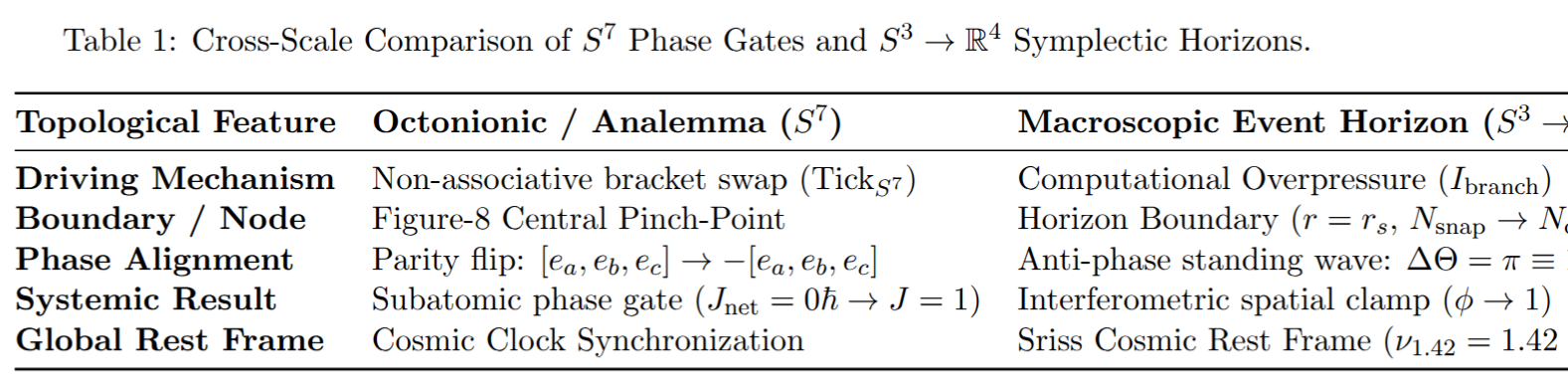
Synthesis of Geometric and Dynamical Mechanisms
The 180° Inversion as an Interferometric Spatial Clamp
When localized computational overpressure I_branch exceeds the Landauer capacity limit of a compactified volume, the forward-propagating state vector collides with its inside-out reflection at exact anti-phase alignment (Δ𝛩 = 𝜋 ≡ 180°).
This 180° phase alignment corresponds directly to the central crossover/pinch-point of the figure-8 analemma and the non-associative bracket swap:
[e_a, e_b, e_c] ⟶ −[e_a, e_b, e_c]
The figure-8 geometry provides the minimal 1D continuous trajectory embedded in a higher-dimensional surface capable of executing a discrete sign or phase swap without disrupting topological continuity. At the macroscopic event horizon, this exact 180° flip freezes fluid dynamics into localized standing-wave loops, creating an absolute interferometric spatial clamp that prevents internal phase coordinates from leaking into the expanding bulk.
Throttling the Aperiodic Expansion Factor (𝜙 → 1)
In the expanding bulk, spatial domains utilize aperiodic golden-ratio scaling (𝜙 = (1 + √5) / 2) on S⁵ to dissipate thermal noise and drive dimensional evolution. At the event horizon boundary, computational overpressure forces the expansion factor to throttle directly to unity:
𝜙 ⟶ 1
Within the S³ Clifford torus formulation, an irrational golden-ratio winding (𝜙) produces a dense, non-repeating, space-filling trajectory across the manifold. Throttling 𝜙 → 1 locks this open trajectory into a rational, closed periodic orbit, a (1,2)-torus knot, which manifests in lower-dimensional projection as the closed 2D figure-8 analemma.
The 1.42 GHz Cosmic Synchronization Anchor
Macroscopic reduction snaps (𝛺̂_snap) are deployed to prevent the divergence of the local holonomic deficit (𝛯_5 → ∞) across the principal fiber bundle:
𝛯_5 = 𝜔_𝜇𝜈^(canonical) dx^𝜇 ∧ dx^𝜈 + [ (𝛯_lattice − 𝜈_1.42) / 𝜈_1.42 ] d𝜃_cosmic
By executing a snap, alternative branch histories are pruned at an entropic rate of ΔS = −ln(2) k_B T_Hawking, preserving phase-lock with the 1.42 GHz neutral hydrogen cosmic rest frame (𝜈_1.42).
Formalization
Proposition 1 (Horizon as a Boundary-Clamped Phase Gate)
A macroscopic event horizon defined by 𝜙 → 1 and Δ𝛩 = 180° represents the high-density, boundary-clamped limit of the octonionic non-associative phase gate on S⁷. The central pinch-point of the Lissajous/analemma trajectory on S¹ × S¹ ⊂ S³ constitutes a scale-invariant topological node where local field expansion throttles to unity to prevent holonomic desynchronization (𝛯_5 → ∞) from the global 1.42 GHz cosmic rest frame.
System Architecture: Micro-Ticks vs. Global Rest Frame
To maintain architectural clarity, the temporal dynamics of the Paraoikeios must be separated into two functional tiers:
The Internal Algebraic Engine: Tick_S⁷
Definition: The localized, micro-scale discrete update cycle governed by non-associative octonionic multiplication over the Fano plane (𝒫_FP).
Operational Logic: Evaluated via 7-phase bracket swaps across imaginary octonionic units:
Tick_S⁷ = ((e_a · e_b) · e_c) ≠ (e_a · (e_b · e_c))
Systemic Function: Processes localized updates and absorbs geometric strain without scattering information into thermal noise.
The External Cosmic Reference: 1.42 GHz (𝜈_1.42)
Definition: The global, macro-scale metric baseline (d𝜃_cosmic) tied to the neutral hydrogen rest frame.
Systemic Function: Serves as the universal phase-locking standard that guarantees global holonomic closure across the entire Hydroastrosphere.
Interface Dynamics
The local operation Tick_S⁷ represents the execution rate of the local state machine, whereas the 1.42 GHz signal acts as the global master clock. When localized computational overpressure (I_branch) causes the accumulated micro-ticks of Tick_S⁷ to drift from the 1.42 GHz rest frame (𝛯_5 > 0), the holonomic deficit grows.
To resolve this divergence, the system triggers a Symplectic Reduction Snap (𝛺̂_snap), executing a central 180° node flip that prunes redundant branch histories and re-establishes exact phase lock between local Tick_S⁷ cycles and the 1.42 GHz cosmic backbone.
Conclusion
This work synthesizes lower-dimensional geometric observations, non-associative algebraic dynamics, and macroscopic gravitational boundary conditions into a single, scale-invariant framework. By tracing the progression from static projections to dynamic state-space trajectories, we have demonstrated that:
Geometric Projections originate in S³: The classic Vesica Piscis (√3 metric ratio) and the celestial solar analemma (figure-8 Lissajous trace) represent the static spatial cross-section and the dynamic time-series shadow, respectively, of geodesic flows on the Clifford torus (S¹ × S¹ ⊂ S³).
The Inversion Node operates as a Universal Phase Gate: The central pinch-point of the figure-8 trajectory provides the minimal continuous 1D manifold capable of executing a discrete 180° (𝜋-phase) parity flip or non-associative bracket swap ([e_a, e_b, e_c] → −[e_a, e_b, e_c]) without disrupting topological continuity.
Macroscopic Horizons act as Scale-Free Phase Clamps: When computational overpressure (I_branch) violates localized Landauer capacity limits, the Paraoikeios executes a Symplectic Reduction Snap (𝛺̂_snap). Throttling the expansion factor to unity (𝜙 → 1) and locking forward and reflected state vectors into an anti-phase collision (Δ𝛩 = 180°) converts the event horizon into an absolute interferometric spatial clamp.
Dual-Tier Clock Architectures maintain Universal Coherence: Local micro-scale updates governed by octonionic bracket swaps (Tick_S⁷) continuously interface with the global 1.42 GHz Sriss cosmic rest frame (𝜈_1.42). When overpressure induces a local holonomic deficit (𝛯_5 > 0), the central 180° node flip sheds alternative state histories (ΔS = −ln(2) k_B T), restoring exact phase-lock between internal algebraic operations and the cosmic backbone.
Ultimately, black hole event horizons, octonionic phase transitions, and planar geometric shadows are not disparate physical or mathematical phenomena. They are scale-invariant manifestations of systemic optimization, the mechanism by which the Hydroastrosphere executes localized 180° inversive snaps to regulate informational overpressure, freeze boundary leakage, and preserve global holonomic closure.


Leave a Reply