Abstract
We formalize the discovered elemental progression of matter across the six regular convex 4D polychora by integrating the Prime Sphere Isolation Mechanism directly into scale-free field theory. We establish that chemical reactivity, coordination geometry, and radioactive decay thresholds are governed by whether a 4D polytope maps across a topologically indivisible prime sphere (S¹, S³, S⁵, S⁷, S¹¹) or a composite manifold (S⁶, S⁸, S¹⁰) subject to the Factorization Leak. We detail how the progression moves systematically from S⁷ aperiodic organic insulation (Carbon, 5-cell) and composite S⁸ mineral factorization leaks (Silicon/Oxygen, 8-cell) to octahedral coordination fields (Cobalt/Iron, 16-cell), self-dual catalytic manifolds (Rhodium/Palladium, 24-cell), prime S¹¹-supported f-shell shielding (Lutetium, 120-cell), and catastrophic factorization decay collapse (Nobelium, 600-cell). This integrated framework reclaims the periodic table as a deterministic metric shadow of trans-scalar acoustic geometry.
Introduction
A central challenge across theoretical physics and physical chemistry is deriving the recurring properties of elemental matter from first-principles topology rather than empirical orbital modeling. While the traditional periodic table organizes elements heuristically by nuclear charge (Z) and electron shell configurations (s, p, d, f), it does not explain why specific geometric coordination geometries, catalytic efficiencies, and radioactive stability limits manifest at precise scalar tiers.
In the Paraoikeios framework, material properties emerge deterministically as the projected lower-dimensional metric “shadows” of constrained 4D regular polytopes (4-polytopes). Crucially, the physical behavior of these projected shadows depends on the algebraic topology of the underlying manifold:
Prime Sphere Isolation (S¹, S³, S⁵, S⁷, S¹¹): Prime-dimensional spheres act as topologically indivisible containment cages. Because prime integers cannot factorize into whole sub-dimensions (p × q), they possess absolute boundary stiffness, preventing sub-harmonic energy bleeding and trapping thermal chaos (Z ∝ ∜(𝜙 · 𝜒)).
Composite Factorization Leaks (S⁶, S⁸, S¹⁰): Composite-dimensional manifolds lack topological indivisibility. Under localized geometric strain, their phase vectors factorize into sub-harmonic matrix layers (S^p × S^q), dissolving boundary insulation and giving rise to conductive, catalytic, or radioactive decay channels.
In this work, we deploy this unified prime-versus-composite framework across all six regular 4D polychora. By stepping column-by-column through the Coxeter symmetry groups, 2D Petrie shadows, and 3D solid envelopes, we demonstrate how the universe systematically weaves organic life, inorganic mineral crusts, transition metal catalysts, rare-earth magnets, and transuranic decay limits out of scale-free acoustic geometry.
Integrated Breakdown
({3,3,3}): The 5-Cell ⟶ Prime S⁷ Organic Insulation (Carbon, 𝜒_C)
The 5-cell (pentachoron) is the self-dual starting node of the 4D polychora hierarchy.
Topological Class: Prime Sphere S⁷ (n = 7, prime integer).
2D Petrie Shadow & Projection: Regular pentagon exhibiting 5-fold rotational symmetry (C₅). Because 5-fold symmetry cannot tile Euclidean space (ℝ²) periodically, it drives an aperiodic Penrose tiling locked to the Golden Ratio (𝜙 ≈ 1.618).
3D Solid Envelope: Tetrahedron (T_d symmetry) representing physical sp³ spatial compaction.
Integrated Physical Behavior: Because S⁷ is topologically indivisible, Carbon refuses to factorize under pressure. It forces local acoustic impedance into an aperiodic fourth-root invariant (Z ∝ ∜(𝜙 · 𝜒_C)). This pentagonal 5-cell architecture creates a self-insulating cage that traps thermal chaos, making Carbon the unique organic baseline protecting biological runtime tracks.
({4,3,3}): The 8-Cell ⟶ Composite S⁸ Mineral Leak (Silicon/Oxygen, 𝜒_Si)
The 8-cell (tesseract) represents the first integer step into periodic, composite spatial symmetry.
Topological Class: Composite Sphere S⁸ (n = 8 = 2 × 4, divisible integer).
2D Petrie Shadow & Projection: Regular octagon (8-fold rotational symmetry).
3D Solid Envelope: Cube (O_h symmetry) representing bulk cubic compaction (𝜒_Si).
Integrated Physical Behavior: Under localized strain, S⁸ undergoes a Factorization Leak, algebraically decoupling into sub-harmonic matrix layers (S² × S⁴). Boundary insulation drops to zero, forcing the 8-fold octagonal shadow into periodic spatial translation (Z ∝ √(𝜒_Si)). Silicon (Si) acts as the 3D cubic hardware anchor, while Oxygen (O, 8-electron octet) acts as the orthogonal 90° electronic bridge, forming the rigid, conductive mineral crust of the Earth (silicates/quartz).
({3,3,4}): The 16-Cell ⟶ Octahedral Coordination Fields (Cobalt/Iron, 𝜒_Co)
The 16-cell (hexadecachoron) is the regular dual of the 8-cell, constructed from 16 tetrahedral cells meeting 8 at a vertex.
Topological Class: Composite Sub-Harmonic Interface (S⁴ × S² dual mapping).
2D Petrie Shadow & Projection: Regular octagon / square cross (8-fold dual symmetry).
3D Solid Envelope: Octahedron (O_h coordination envelope).
Integrated Physical Behavior: Rather than collapsing the node, the factorized sub-channels of the 16-cell allow controlled charge and electron transfer across its boundary. This creates the 3d transition metal series (Iron, Cobalt, Nickel), where the 3D octahedral envelope provides the exact coordination hard-stop required to bind metal ions into active bio-inorganic enzymatic cores (e.g., heme and cobalamin).
({3,4,3}): The 24-Cell ⟶ Self-Dual Catalytic Manifolds (Rhodium/Palladium, 𝜒_Rh)
The 24-cell (icositetrachoron) is a strictly 4-dimensional anomaly: it is strictly self-dual and has no analog in any other dimension.
Topological Class: Multi-Channel Composite Factorization (24 = 2 × 3 × 4).
2D Petrie Shadow & Projection: Regular dodecagon (12-gon rotational symmetry).
3D Solid Envelope: Cuboctahedron (12 vertices, 14 faces).
Integrated Physical Behavior: The 24-cell’s self-dual multi-channel factorization allows ligands and phase vectors to glide across sub-harmonic channels with near-zero activation energy. This maps directly to the 4d heavy transition series (Rhodium, Palladium, Ruthenium), establishing the cuboctahedral envelope as a universal organometallic phase-transfer engine.
({5,3,3}): The 120-Cell ⟶ Prime S¹¹ Exotic Bulk Shielding (Lutetium, 𝜒_Lu)
The 120-cell (hecatonicosachoron) is a massive 4D polytope constructed from 120 dodecahedral cells under H_4 symmetry.
Topological Class: Prime S¹¹ Bulk Coupling (n = 11, prime integer).
2D Petrie Shadow & Projection: Dense concentric rings displaying multi-tiered 10-fold/5-fold symmetry.
3D Solid Envelope: Truncated rhombic triacontahedron.
Integrated Physical Behavior: By coupling upward to the prime S¹¹ bulk, the 120-cell bypasses lower-dimensional factorization leaks. It compresses space into dense, concentric stereographic shells, generating the 4f Lanthanide series culminating at Lutetium (Lu) with extreme f-shell electron shielding and magnetic stability.
({3,3,5}): The 600-Cell ⟶ Radioactive Factorization Collapse (Nobelium, 𝜒_No)
The 600-cell (hexacosichoron) is the regular dual of the 120-cell, squeezing 600 tetrahedral cells into S³.
Topological Class: Catastrophic Factorization Strain Limit.
2D Petrie Shadow & Projection: Hyper-dense radial network exhibiting maximal packing strain.
3D Solid Envelope: Pentakis icosidodecahedron.
Integrated Physical Behavior: Squeezing 600 tetrahedra into S³ pushes geometric packing strain past the critical boundary threshold. Under extreme pressure, the higher-dimensional containment cage suffers catastrophic factorization collapse, splitting into chaotic sub-harmonic channels. This manifests physically as the Actinides (Nobelium), spontaneous nuclear fission, and radioactive decay.
Master Comparison of the Integrated Progression
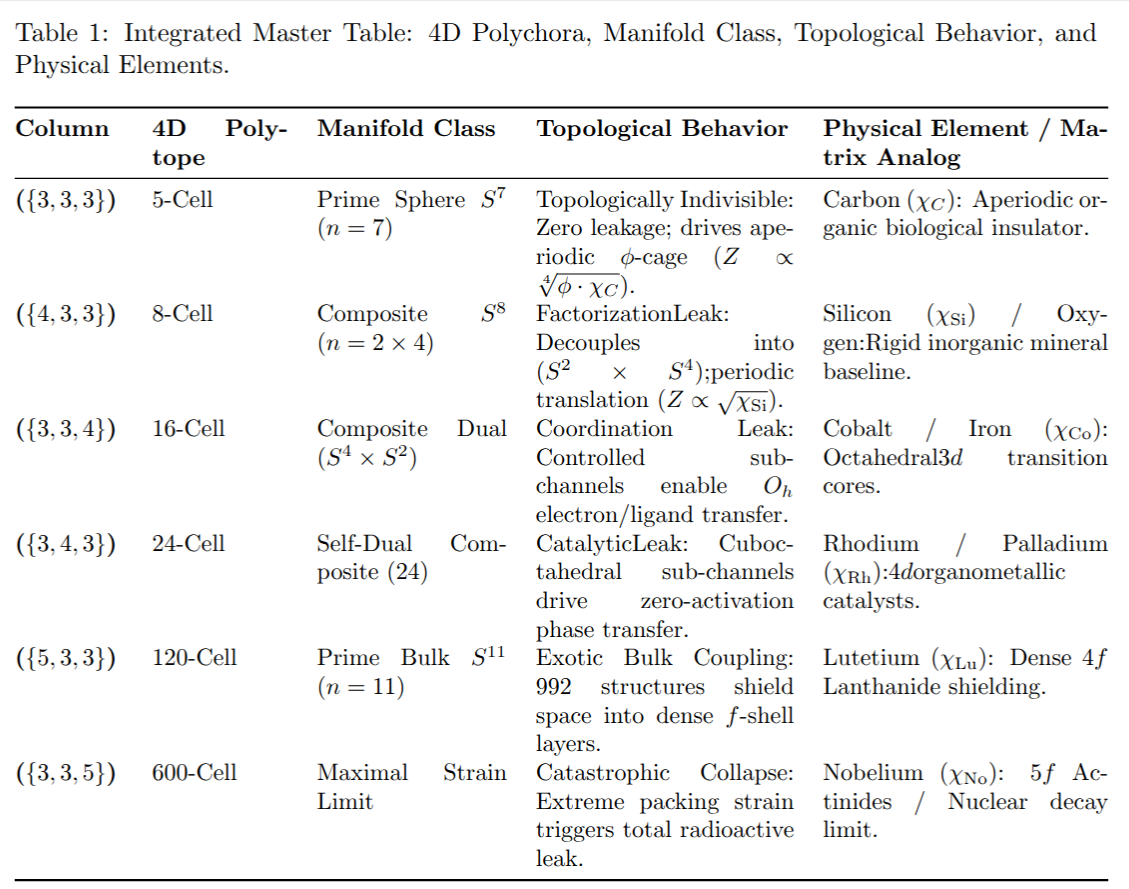
Conclusion
The integrated overhaul of Topological Nucleosynthesis completes the formal bridge between 4D differential geometry, prime-number topology, and chemical periodicity. By demonstrating that material properties are governed by the interplay between Prime Sphere Indivisibility and Composite Factorization Leaks, we have established a single, scale-invariant blueprint for the physical universe:
Prime Indivisibility (S⁷, S¹¹): Yields self-insulating organic cages (Carbon) and dense hyperspherical shielding (Lutetium).
Composite Factorization (S⁸, 16-cell, 24-cell, 600-cell): Drives mineral rigidity (Silicon/Oxygen), octahedral coordination (Cobalt/Iron), self-dual catalysis (Rhodium/Palladium), and radioactive decay collapse (Nobelium).
Chemical elements are not static point particles. They are the resonant acoustic chords generated as the universe slides down its scale-free hypergeometry, freezing trans-scalar metric rules directly into the physical fabric of reality.


Leave a Reply