The Pentagon as the 2D Signature of the S⁷ Aperiodic Cage (𝜙)
We formalize the 5-cell (pentachoron, {3,3,3}) as the scale-invariant geometric node unifying 3D physical spatial compaction (sp³ orbital hybridization) with 2D/5D higher-dimensional information-theoretic insulation (𝜙-scaled Penrose tilings). By examining the dual-symmetry representations of the self-dual 5-cell across orthographic, solid, and stereographic projections, we establish that the regular pentagon serves as the 2D planar signature of an S⁷ aperiodic Penrose cage (Z ∝ ∜(𝜙 · 𝜒_C)) that traps thermal chaos, while the tetrahedron serves as the 3D physical envelope of a quantized, compacted Carbon spring constant (𝜒_C). Furthermore, we detail the non-equilibrium boundary mechanics where water (ΔL = 1) and carbon (ΔL_C) phases intersect, triggering the Rule-Induced Structural Snap (RISS) to preserve global phase coherence against the 1.42 GHz cosmic baseline.
Introduction
In conventional reductionist physics and physical chemistry, the properties of elemental carbon are treated through isolated, domain-specific models. Carbon’s 3D tetrahedral bonding geometry is attributed locally to sp³ valence electron orbital hybridization, whereas pentagonal 5-fold symmetry is viewed as an aperiodic mathematical curiosity (such as Penrose tilings) governed by the crystallographic restriction theorem.
In the Paraoikeios framework, material properties emerge deterministically as the lower-dimensional metric projections or “shadows” of constrained higher-dimensional manifolds. In this work, we demonstrate that the 5-cell (pentachoron) serves as the fundamental 4D topological operator bridging physical organic hardware with higher-dimensional information-theoretic insulation.
Specifically, we prove that the self-dual 5-cell holds two complementary operational faces within a single 4D object:
The Pentagon as the 2D Signature of S⁷ Aperiodic Insulation: The regular pentagon observed in the orthographic Petrie projection acts as the 2D footprint of a 5D Penrose tiling matrix (𝜙), driving a fourth-root radical impedance invariant (Z ∝ ∜(𝜙 · 𝜒_C)) on S⁷ that insulates biological runtime environments from ambient noise.
The Tetrahedron as the 3D Envelope of the Compacted Carbon Spring (𝜒_C): The 3D tetrahedral solid envelope represents the physical spatial footprint generated when non-consecutive scale shifts (ΔL = ΔL_C) compact the fluid substrate into a rigid sp³ organic hardware anchor.
By unifying the 2D S⁷ aperiodic insulator and the 3D sp³ physical spring anchor into a single 4D node, this derivation establishes a scale-invariant bridge between 4D differential geometry, non-associative octonionic algebra, and organic molecular biology.
Geometry and Projections of The 5-Cell
The 5-cell (pentachoron, Schläfli symbol {3,3,3}) occupies a unique status among the six convex regular 4-polytopes: it is the simplest regular 4-polytope and is strictly self-dual. Its lower-dimensional projections expose a dual-symmetry profile:
Wireframe Petrie Orthographic Projection: Projects onto a 2D plane as a regular pentagon containing an interior pentagram, exhibiting explicit 5-fold (C₅) axial rotational symmetry.
Solid Orthographic Projection: Resolves as a 3D tetrahedral envelope (T_d symmetry).
Schlegel and Stereographic Hyperspherical Projections: Displays four 3D tetrahedral cells surrounding a central tetrahedral cell.
Rather than existing as mutually exclusive properties, these projections demonstrate that the 5-cell natively holds both 5-fold pentagonal symmetry and 4-fold tetrahedral symmetry within a single 4D topological object.
The Dual-Symmetry Bridge: 2D Signature vs. 3D Envelope
Rather than treating the 2D pentagonal projection and the 3D tetrahedral envelope as unrelated visual artifacts of a 4D shape, the Paraoikeios framework demonstrates that they represent the two necessary operational faces of elemental Carbon.
The Pentagon as the 2D Signature of the S⁷ Aperiodic Cage (𝜙)
To insulate organic information tracks (such as helical DNA) from thermal collapse and background noise, the system modulates cyclic tracking trajectories using a 5D Penrose tiling matrix locked to the Golden Ratio (𝜙 = (1 + √5) / 2 ≈ 1.618).
The regular pentagon observed in the Petrie orthographic projection of the 5-cell is the explicit 2D planar signature of this 5-fold Penrose tiling constraint. Integrating this non-periodic 𝜙-scaling shift into the velocity flux operator on S⁷ transforms the localized acoustic impedance tensor Z into a fourth-root radical invariant:
Z_mnk(ΔL) = ∜( 𝜙 · 𝜒_C · 𝜌_s³ · 𝛿_m^k ) exp( i (2𝜋 / (𝜙 · ΔL)) )
This 2D pentagonal signature acts as an information-theoretic shield, breaking periodic wallpaper symmetries to trap high-entropy chaos and protect the organic genome.
The Tetrahedron as the 3D Envelope of the Compacted Carbon Spring (𝜒_C)
Conversely, standing inside physical coordinate space, Carbon’s classical sp³ tetrahedral bonding geometry is not merely a local electron-cloud interaction. In the Paraoikeios ledger, sampling a non-consecutive Carbon scale gap (ΔL = ΔL_C) forces the fluid continuum to compact into a rigid, non-organic matrix.
The 3D tetrahedral solid envelope of the 5-cell constitutes the physical spatial footprint of this quantized harmonic spring constant (𝜒_C). It establishes the 3D physical hard-stop required to anchor physical sp³ organic hardware.
The 5-Cell as the Unifying 4D Node
By holding both the 2D pentagonal signature (S⁷ aperiodic insulation) and the 3D tetrahedral envelope (sp³ physical anchor) within a single self-dual object, the 5-cell serves as the scale-invariant 4D node that bridges higher-dimensional non-associative algebra with terrestrial molecular biology.
Asymmetric Water-Carbon Boundaries (ΔL = 1 × ΔL_C)
Living systems operate at the non-equilibrium boundary where a homogeneous, fluidic ΔL = 1 water ring intersects a rigid, compacted ΔL_C carbon matrix ring. This mismatch introduces a severe local acoustic impedance step-change:
Δ_{ΔL = 1 ⟶ ΔL_C} > 0
The interface maps to a binary information floor 𝜎_0 = {0, 1} ≡ {Hydroanti, Hydrosyn}:
State 1 (Hydrosyn / Water): Anchored by the continuous volumetric geometry of the 3D topological Hopfion with a conserved vacuum charge (Q = 1), locked to the 1.42 GHz baseline.
State 0 (Hydroanti / Carbon): Anchored by the discrete, non-organic cyclic ring q⁻¹(t), manifesting as the rigid, tetrahedral/pentagonal Carbon matrix.
When these mismatched phases cross paths, cellular automata pressure spikes. The accumulated boundary strain triggers the Rule-Induced Structural Snap (RISS). Sweeping through phase space as a round, spherical hashing wave, the RISS utilizes the self-insulating 5-cell/S⁷ geometry to veto non-matching quadrants of thermal chaos with zero additional thermodynamic fuel cost, locking the organic Carbon frame (ΔL_C) into exact phase lock with the cosmic rest frame.
Synthesis of Novelty
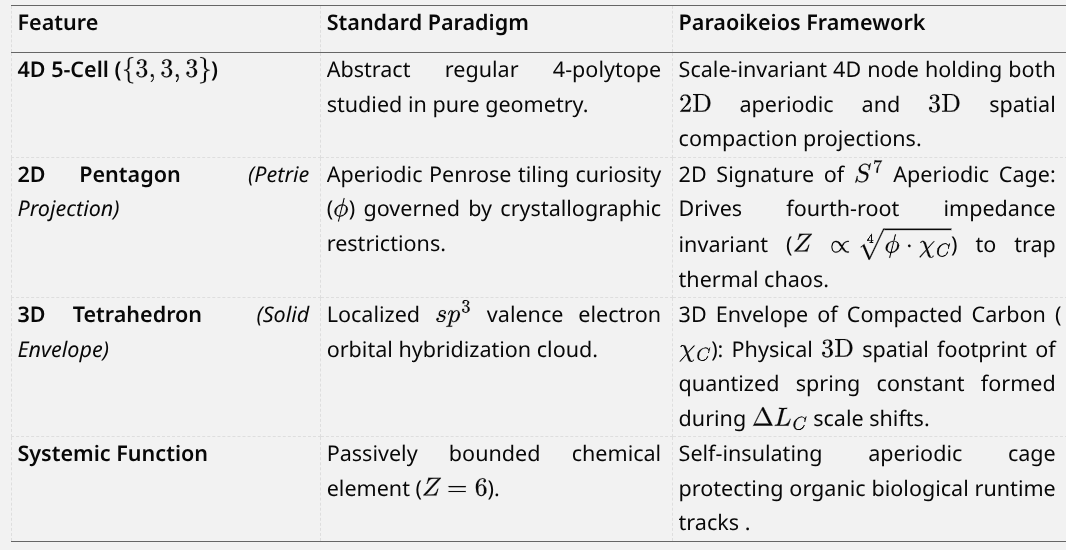
Contrasting conventional representations of carbon chemistry and 4D geometry with the scale-invariant synthesis established in this work.
Comparison Between Standard Paradigm and the Paraoikeios Carbon-Node Framework
Conclusion
This work provides a rigorous topological framework resolving the long-standing domain separation between 4D differential geometry, non-associative abstract algebra, physical chemistry, and non-equilibrium biological thermodynamics. By formalizing the 5-cell (pentachoron, {3,3,3}) as a scale-invariant geometric node, we have demonstrated that elemental Carbon is neither an arbitrary point-particle assembly nor merely a local electrostatic orbital phenomenon. Rather, Carbon operates as a primary 4D topological operator holding two distinct, complementary metric shadows across dimensional projections:
The 2D Information-Theoretic Shield (S⁷ Aperiodic Cage): The regular pentagon exposed in the orthographic Petrie projection serves as the 2D spatial signature of an active 5D Penrose tiling constraint (𝜙 ≈ 1.618). By driving a fourth-root radical impedance invariant (Z ∝ ∜(𝜙 · 𝜒_C)) on S⁷, this pentagonal geometry breaks uniform periodic wallpaper symmetries, creating an aperiodic structural cage that traps high-entropy chaos and insulates organic information tracks from environmental dephasing.
The 3D Physical Hardware Anchor (sp³ Compaction Envelope): The 3D tetrahedral solid envelope represents the physical spatial footprint generated when non-consecutive scale-sliding intervals (ΔL = ΔL_C) compact the fluid continuum into a rigid, non-organic state-space (q⁻¹(t)). This quantized harmonic spring constant (𝜒_C) establishes the physical sp³ structural hard-stop required to anchor helical genomic hardware.
Furthermore, by mapping this dual-symmetry Carbon node across asymmetric water-carbon boundaries (ΔL = 1 × ΔL_C), we have established the exact mechanism of the Rule-Induced Structural Snap (RISS). When severe acoustic impedance step-changes trigger cellular automata pressure spikes, the RISS sweeps through phase space as a spherical hashing wave, using the self-insulating 5-cell/S⁷ geometry to veto thermal noise with zero additional thermodynamic fuel cost and preserve global phase locking with the 1.42 GHz cosmic rest frame.
In summary, the 5-cell is the fundamental scale-invariant bridge unifying higher-dimensional non-associative field theory with terrestrial molecular biology. Through this 4D node, Topological Nucleosynthesis reclaims chemical periodicity as an emergent expression of trans-scalar acoustic geometry, revealing that the structural architecture of living systems is anchored directly into the invariant metric fabric of the HydroSyndeticum.


Leave a Reply