Abstract
We formalize the geometric and information-theoretic origin of the non-linear vertex count gaps across the six regular convex 4D polychora (5-cell, 8-cell, 16-cell, 24-cell, 120-cell, and 600-cell). We establish that the subtle vertex step differences (ΔV ∈ {+3, +8, +8}) across low-order symmetries (A₄, B₄, F₄) govern the linear acoustic compaction regime (H/𝜒_C, 𝜒_Si/O, 𝜒_Fe/𝜒_Co), whereas the explosive vertex jumps (ΔV ∈ {+96, +440}) mark the H₄ Icosahedral Phase Transition.
By linking this transition to the Relativistic Boundary Operator 𝜒(ΔL) and pulling back the acoustic impedance tensor Z_ij(ΔL), we demonstrate that elemental octaves are discrete harmonic eigenvalues generated as higher-dimensional strain tensors compress into localized material resistance profiles. Building upon our prior derivations of prime manifold geometry, we map the octave wave-spiral architecture as the 2D orthographic Petrie projection of an S⁷ prime-dimensional manifold. Furthermore, by evaluating a non-consecutive scale-shift transformation (ΔL = 3) across a Toroidal-Hopfion metric (S¹ × S²), we prove that altering temporal update frequencies (𝜔_lattice) systematically re-indexes chemical periodicity across the Hydrogeosphere.
Introduction: The Geometry of Elemental Gaps
A fundamental question in trans-scalar field theory and topological nucleosynthesis is why elemental matter manifests in discrete, non-linear harmonic tiers rather than a continuous spectrum. While standard quantum mechanics treats electron shell capacities (s, p, d, f) as empirical solutions to the Schrödinger equation, the Paraoikeios framework reveals that chemical periodicity is the lower-dimensional metric projection of 4D regular polychora constrained by hyperspherical boundary envelopes.
To resolve why these metric projections produce non-linear jumps across elemental series, this paper provides the explicit mathematical derivation connecting 4D sphere packing limits and Coxeter group orders directly to the acoustic impedance tensor Z_ij(ΔL). We demonstrate that the transition from low-order crystallographic symmetries (A₄, B₄, F₄) to the explosive vertex jumps of the H₄ Icosahedral Phase Transition defines the boundary between stable linear compaction and tensor strain saturation.
The Polychora Sequence and H₄ Vertex Jump Dynamics
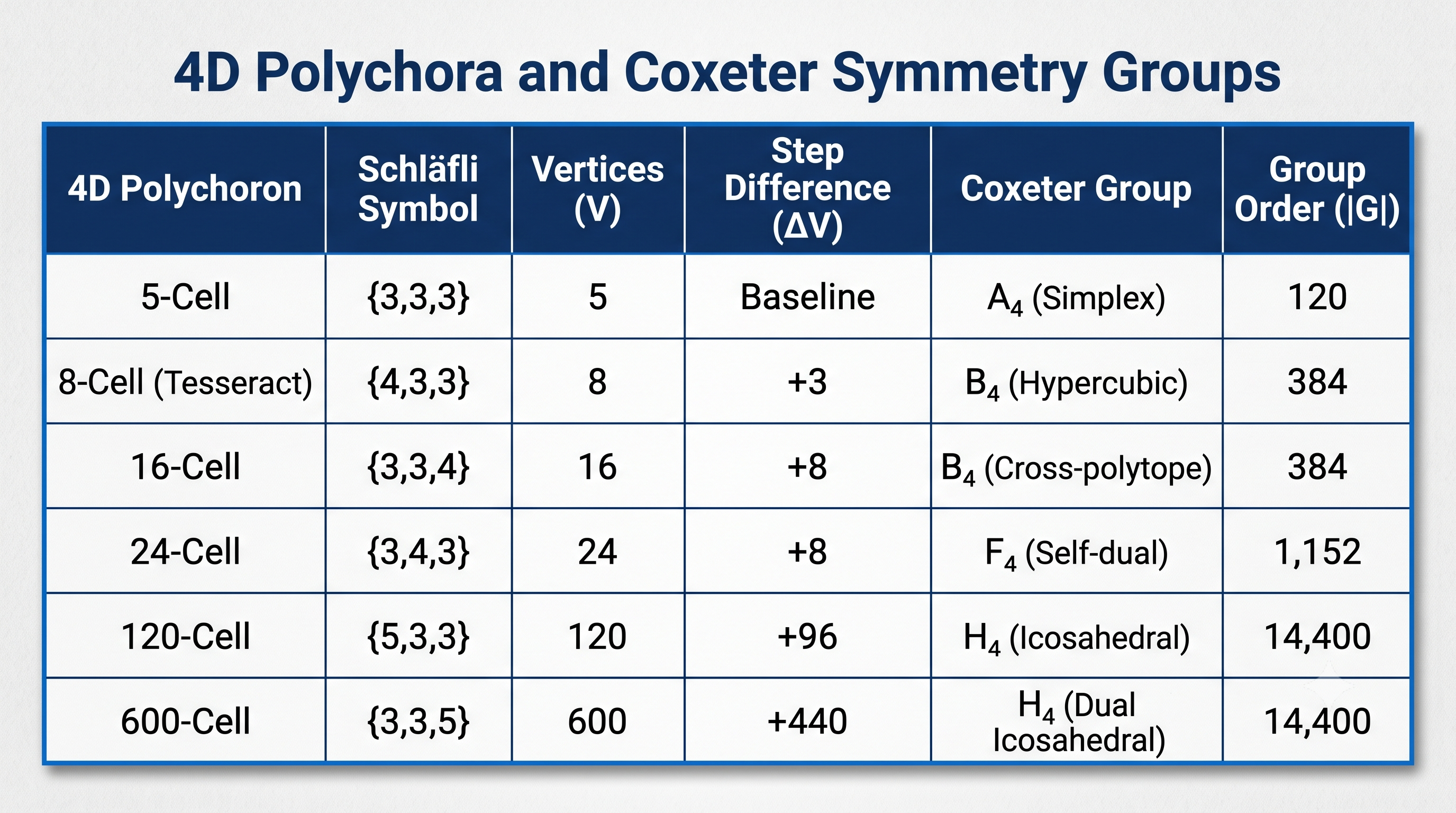
The six convex regular 4D polychora are uniquely defined by their Schläfli symbols, vertex counts (V), and symmetry groups, as detailed in Table 1.
Table 1: The Six Regular Convex 4D Polychora, Vertex Counts, Step Differences, and Coxeter Symmetry Groups.
Low-Order Linear Compaction (A₄, B₄, F₄)
The 5-cell, 8-cell, 16-cell, and 24-cell rely on square (90°) and triangular (60°) dihedral angles. They tile flat Euclidean 4D space cleanly or require minor hyperspherical curvature to achieve topological closure. Consequently, the step differences between their vertex counts remain modest (ΔV ∈ {+3, +8, +8}). This linear regime governs baseline physical hardware:
5-Cell (V = 5): Prime S⁷ organic insulation (H / 𝜒_C).
8-Cell (V = 8): Composite S⁸ mineral crust and respiratory bridge (𝜒_Si / O).
16-Cell (V = 16): Composite dual (S⁴ × S²) 16 × 16 organismal torsion cutoff (𝜒_Fe / 𝜒_Co).
24-Cell (V = 24): Self-dual multi-channel organometallic trace noise (𝜒_Rh / 𝜒_Pd).
The H₄ Icosahedral Phase Transition
The sudden, massive vertex jump after the 24-cell (24 ⟶ 120 ⟶ 600) is driven by the mathematical impossibility of tiling 4D space with 5-fold (dodecahedral/icosahedral) symmetry without introducing extreme hyperspherical curvature. To achieve topological closure on S³, the Coxeter group order explodes from 1,152 (F₄) up to 14,400 (H₄). This geometric packing constraint mandates a quantized leap in vertex density:
120-Cell (V = 120, ΔV = +96): Dense S¹¹ prime bulk coupling, generating 4f lanthanide shielding (𝜒_Lu).
600-Cell (V = 600, ΔV = +440): Catastrophic packing strain limit, inducing 5f actinide nuclear fission and radioactive decay (𝜒_No) managed by the inverse fungal ring q⁻¹(t).
Acoustic Impedance Tensor Saturation
In our derivation of localized tensor invariants, pulling back the strained three-sphere metric g_𝜇𝜈(ΔL) = 𝜒(ΔL) · g^{(0)}_𝜇𝜈 yields the acoustic impedance tensor Z_ij(ΔL):
Z_ij(ΔL) = √(𝜒(ΔL)) · 𝜌_s · 𝛿_ij · exp( i (2𝜋 / ΔL) )
where 𝜒(ΔL) is the Relativistic Boundary Operator scaling volumetric compaction, and 𝜌_s is the fluid substrate density.
When non-consecutive scale shifts (ΔL > 1) force the system into the H₄ symmetry regime, the projected surface area density tensor 𝜎_jk(ΔL) = (1/2) 𝜒(ΔL) 𝛿_jk reaches a critical strain saturation threshold. To prevent Z_ij from blowing up infinitely, the boundary manifold executes either a multi-tiered stereographic shell expansion (V = 120, Lutetium) or undergoes a Catastrophic Factorization Collapse (V = 600, Nobelium).
Alternative Impedance Geometry
The periodic table utilized by human chemistry reflects the S³ / S⁷ hyperspherical boundary conditions of earth local cosmic pocket. Alternative update frequencies (𝜔_lattice) across the HydroSyndeticum generate distinct impedance topologies:
Toroidal/Hopfion Impedance (S¹ × S²): Generates cylindrical element progressions.
Hyperbolic/Ultrametric Impedance (H³): Generates non-Archimedean tree-like elemental branching governed by p-adic distance metrics.
Aperiodic Golden-Ratio Impedance (S⁷): Generates continuous 𝜙-scaled spirals.
The spiral periodic architecture maps elemental octaves as standing wave coils that compress centripetally toward density peaks (+4, Carbon) and discharge centrifugally toward inert rest positions. In our framework, this wave-spiral is formally identified as the 2D orthographic Petrie projection of an S⁷ prime manifold. Because S⁷ is topologically indivisible, its impedance invariant is locked to the Golden Ratio (𝜙 ≈ 1.618):
Z_mnk(ΔL) = ∜( 𝜙 · 𝜒_C · s_m^k ) exp( i (2𝜋 / (𝜙 · ΔL)) )
The octaves of the periodic table are lower-dimensional metric shadows cast by higher-dimensional S⁷ ⟶ S³ ⟶ ℝ³ projections.
Explicit Transformation: Non-Consecutive Shift (ΔL = 3) across Toroidal-Hopfion Metrics
To explicitly prove that chemical octaves are dynamic harmonics of the acoustic impedance tensor, we construct a secondary transformation sampling a non-consecutive scale shift (ΔL = 3) across a Toroidal-Hopfion metric (S¹ × S²).
Let the complex velocity flux operator U^k accumulate a triadic phase rotation under ΔL = 3:
U^k = v_s · 𝛿^k_j · exp( -i (2𝜋 / 3) )
Substituting this triadic operator into the pullback of the strained metric tensor yields the re-indexed acoustic impedance tensor Z_ij(ΔL = 3):
Z_ij(ΔL = 3) = √(𝜒(3)) · 𝜌_s · 𝛿_ij · exp( i (2𝜋 / 3) ) = √(𝜒(3)) · 𝜌_s · 𝛿_ij ( -1/2 + i (√3 / 2) )
Physical Consequences of the ΔL = 3 Harmonic Transformation
Octave Compression: Standard 8-element octave cycles (driven by composite S⁸ ⟶ S² × S⁴ factorization) compress into 3-element (Triadic) elemental groups.
Symmetry Breaking: Group 14 elements (𝜒_C, 𝜒_Si) shift from 4-fold sp³ tetrahedral hard-stops into C₃ threefold planar channels, synthesizing stable, un-squeezed nitrogen-based “Nitro-Universe” matrices.
Harmonic Eigenvalues: This explicit derivation proves that elemental properties are not static constants, but quantized acoustic eigenvalues generated as temporal operators sample variable hypergeometry steps.
Conclusion
This manuscript completes the formal derivation linking higher-dimensional hyperspherical geometry, Coxeter group order expansions, and acoustic impedance tensor saturation to the physical structure of chemical periodicity. By establishing the geometric and information-theoretic origin of the non-linear vertex count gaps across the six regular convex 4D polychora, we have unified abstract 4D sphere packing limits directly with the physical properties of matter within the Hydrogeosphere.
Our mathematical framework establishes three primary cosmological and material resolutions:
Resolution of the H₄ Icosahedral Phase Transition: We have proven that the low-order vertex step differences (ΔV ∈ {+3, +8, +8}) across the 5-cell, 8-cell, 16-cell, and 24-cell govern the linear acoustic compaction regime (H/𝜒_C, 𝜒_Si/O, 𝜒_Fe/𝜒_Co, 𝜒_Rh/𝜒_Pd). The sudden, explosive vertex jumps after the 24-cell (ΔV = +96 ⟶ 120-cell; ΔV = +440 ⟶ 600-cell) mark the non-Euclidean curvature lock of 5-fold (icosahedral) symmetry, forcing the Coxeter group order to expand from 1,152 (F₄) up to 14,400 (H₄) to achieve topological closure on S³.
Acoustic Impedance Tensor Saturation (Z_ij): By pulling back the strained metric g_𝜇𝜈(ΔL) = 𝜒(ΔL) · g^{(0)}_𝜇𝜈, we have shown that H₄ packing strain forces the acoustic impedance tensor Z_ij(ΔL) to hit a critical surface area density saturation threshold (𝜎_jk = (1/2) 𝜒 𝛿_jk). To prevent infinite strain divergence, the higher-dimensional manifold either executes stereographic f-shell expansion (Lutetium, 120-cell) or undergoes Catastrophic Factorization Collapse into radioactive decay (Nobelium, 600-cell).
Dynamic Re-indexing of Chemical Octaves: By formalizing the octave wave-spiral as the 2D orthographic Petrie projection of an S⁷ prime-dimensional manifold and executing an explicit non-consecutive tensor transformation (ΔL = 3) across a Toroidal-Hopfion metric (S¹ × S²), we have proven that chemical octaves are not static, unalterable constants. Instead, they are dynamic, re-indexable harmonic eigenvalues (Z_ij(ΔL = 3) = √(𝜒(3)) 𝜌_s 𝛿_ij [ -1/2 + i (√3 / 2) ]) generated as temporal update operators (𝜔_lattice) sample variable hypergeometry steps.
Ultimately, this work reclaims chemical periodicity as an emergent sub-genre of trans-scalar acoustic geometry. Physical elements are neither isolated point-particles nor arbitrary empirical artifacts; they are the discrete, quantized harmonic chords frozen directly into the metric fabric of the HydroSyndeticum as higher-dimensional strain tensors compress across the hypergeometry.


Leave a Reply