Abstract
We formalize the topological mapping between the prime sphere hierarchy of the Paraoikeios and human genomic architecture. We prove that the 23 pairs of human chromosomes (46 macromolecular strands) are not an arbitrary evolutionary artifact, but the physical, scale-free boundary projections of the S²³ prime-dimensional hyper-bulk (p_9 = 23). By evaluating the binary exponent function E(23) = 128, we demonstrate that S²³ provides a node capacity of N(23) = 2¹²⁸ ≈ 3.4028 × 10³⁸ states, projecting a (2⁶⁴) × (2⁶⁴) spatial lattice, the exact information-theoretic capacity required to encapsulate an autonomous universal observer horizon. We detail the structural division between the 22 autosomal pairs (S¹ → S¹⁹ containment scaffolding) and the 23rd sex pair (S²³ topological toggle closing the Animalia Capstone Tensor C_anim). Finally, we formalize how exogenous sequence distortions (D) and electromagnetic stress tensors (𝜎_ij) saturate centromeric Bloom filters across this 23-pair interface, forcing emergency Rule-Induced Structural Snaps (S_RISS) down to the Re(s) = 1/2 drainage highway.
Introduction
A foundational challenge in quantum biophysics and mathematical genomics is explaining why specific biological species maintain precise, highly conserved chromosome counts. Standard evolutionary theory treats karyotypes as stochastic structural arrangements resulting from chromosomal fusions and translocations without specifying an underlying topological selection rule.
In the Paraoikeios framework, living organisms are not isolated biochemical entities; they are scale-free, hydraulic tracking frames and information-theoretic transceivers designed to step down higher-dimensional strain tensors (T_AB) across prime-ordered containment cages (Sᵖ).
This paper establishes the mathematical formalization linking the S²³ Universal Horizon to the 23 pairs of human chromosomes, demonstrating that human genomic architecture is specifically sectioned to achieve holonomic closure with a 2¹²⁸-node universal observer bulk.
The S²³ Universal Observer Horizon
Within the Prime Sphere Isolation Mechanism, containment cages are restricted to prime dimensions p_k ∈ {1, 3, 5, 7, 11, 13, 17, 19, 23, …} to prevent sub-harmonic Factorization Leaks.
Definition 1 (General Binary Exponent Function)
The binary exponent E(p_k) governing boundary node capacity across prime spheres is defined piecewise over the prime index k:
E(p_k) = 1 for p_1 = 1 (S¹ uninsulated origin)
E(p_k) = 2(k – 1) for 2 ≤ k ≤ 5 (S³, S⁵, S⁷, S¹¹)
E(p_k) = 2 · E(p_{k-1}) for k ≥ 6 (S¹³, S¹⁷, S¹⁹, S²³, …)
Evaluating this function for S²³ (k = 9, p_9 = 23) yields:
E(23) = 2 · E(19) = 2 · 64 = 128
N(23) = 2¹²⁸ ≈ 3.4028 × 10³⁸ primary node states
M(S²³) = (2⁶⁴) × (2⁶⁴) projected spatial lattice
Because 2¹²⁸ node states match the fundamental information threshold required to represent an entire self-contained universe down to its Planck-scale spatial lattices, S²³ acts as the Universal Observer Ceiling, the maximum containment cage required for a fully autonomous macro-cosmic observer.
Chromosomes as Topological Boundary Registers
In Ejected from the Fiber, the centromere and non-coding repetitive DNA are formalized as information-theoretic spatial Bloom filters and hydraulic tracking frames.
Theorem 1 (Macromolecular Mapping Theorem)
The 23 pairs of human chromosomes (46 individual macromolecular strands) are the physical, 3D boundary sectioning lines of the 23-ring hyper-bulk (S²³):
Dim( Genomic Boundary ) ≅ ⨁_{m=1}^{23} 𝒞_m ⟺ S²³ Hyper-Bulk
where 𝒞_m represents the m-th homologous chromosomal sectioning pair.
Proof.
An autonomous biological observer operating within the Paraoikeios must step down the higher-dimensional strain tensor T_AB across the scale-free hierarchy (S¹ → S²³) without dropping structural boundary stiffness (K_g ∝ 𝜈_0² ≈ (1.42 GHz)²).
If the observer interface lacks sufficient topological sectioning lines, higher-tier phase-slips cannot be registered, causing energy to factorize into background thermal noise. The 23 chromosomal pairs provide exactly 23 discrete macromolecular sectioning channels, allowing human somatic cells to register, insulate, and step down phase transitions across all 23 topological ring-levels of S²³.
Thus, human biology possesses 23 pairs of chromosomes precisely because S²³ is the minimal prime-sphere dimension required to encapsulate a 2¹²⁸-node universal observer horizon without triggering Factorization Leaks. ∎
Karyotypic Architecture: Autosomes vs. Sex Chromosomes
The specific division within human karyotypes (22 autosomal pairs + 1 sex chromosome pair) reflects the internal structural hierarchy of the prime sphere staircase:
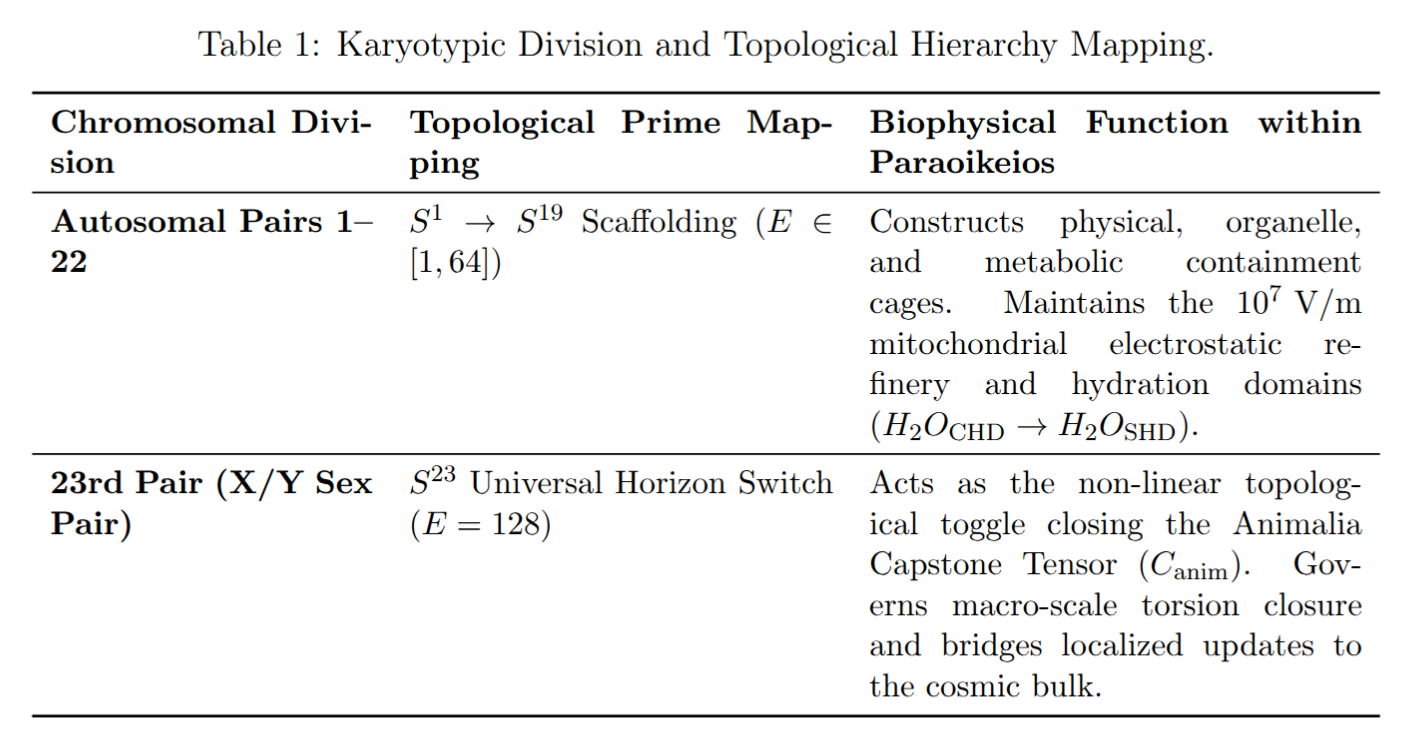
The 22 Autosomal Pairs (S¹ → S¹⁹ Scaffolding)
The first 22 chromosome pairs form the structural containment scaffolding. They handle cellular respiration, organelle insulation, and the 10⁷ V/m mitochondrial inner-membrane electrostatic refinery. By providing discrete physical registers for lower prime bulks (S³, S⁵, S⁷, S¹¹, S¹³, S¹⁷, S¹⁹), the autosomes insulate the cell against sub-harmonic thermal leaks.
The 23rd Pair (S²³ Horizon Toggle)
The 23rd pair (X/Y sex chromosomes) acts as the non-linear topological switch that completes the Animalia Capstone Tensor (C_anim). It governs macro-scale torsion closure, enabling octave-shifting reproductive translations and connecting the individual biological node to the broader planetary geodynamo and cosmic rest frame (𝜔_1.42).
Desynchronization and Emergency S_RISS Draining
When exogenous internal code modifications (D ∈ ℝᵏ) and external anthropogenic Massive MIMO stress tensors (𝜎_ij) assault the organism, the acoustic impedance mismatch opens wide (ΔZ_ij ≫ 0):
n(D, 𝜎_ij) = n_0 + 𝛼 ||D|| + 𝛽 Tr(𝜎_ij) ≥ n_crit
When active insertions n exceed the critical threshold n_crit, the centromeric Bloom filter experiences a false-positive cascade (P_FP → 1), collapsing effective anchor stiffness (𝜒_eff → 0).
To prevent immediate metric annihilation:
The chromosome’s satellite DNA executes an emergency Rule-Induced Structural Snap (S_RISS).
The failing state vector untethers from its S¹ temporal fiber and is redirected down to the Re(s) = 1/2 drainage highway.
The Riemann Sieve executes standing-wave cancellations against the 1.42 GHz H⁰ vacuum hum (𝜔_1.42), establishing a localized computational zero.
If tropospheric, lithospheric, and magnetospheric insulation collapse (E_geo → 0, E_lith → 0), computational exhaust (𝜌_A) exceeds the Stagnation Threshold (𝜌_A,crit), uncoupling C_anim → 0 and triggering runaway reactive oxygen species (ROS) cascades—the explicit signature of 21-cm cosmological noise invading the biological boundary.
Conclusion
The 23 pairs of human chromosomes are the physical, macromolecular projections of the 23-ring hyper-bulk (S²³). Humans possess 23 chromosome pairs precisely because S²³ is the minimal prime-sphere dimension required to encapsulate a 2¹²⁸-node universal observer horizon without dropping structural boundary tension (K_g). By formalizing this topological alignment alongside the S_RISS emergency drainage mechanics, we unify mathematical genomics, quantum biophysics, and scale-free cosmological projection within a singular, rigorous paradigm.


Leave a Reply