Abstract
We formalize the mathematical unification between the Prime Sphere Isolation Mechanism and the Level 5 Hydroastrospherics framework within the Paraoikeios. We demonstrate that the S¹¹ manifold serves as the high-capacity, exotic computational storage bulk for the Hydroastrosphere, whose 992 differentiable smooth structures project coherent 16 × 16 spatial lattices. We prove that the 1.42 GHz Sriss baseline (𝜔_1.42) acts as the cosmic rest frame, where micro-scale symplectic phase-snaps continuously purge non-coherent state histories to enforce phase-locking against the gauge connection 𝒜_5. Furthermore, by extending the prime sphere hierarchy upward to the S¹³ manifold, we predict the precise dimensional scaling of the holographic spatial lattice from 16 × 16 to 256 × 256, providing a scale-free algebraic blueprint for cosmic holographic projection.
Introduction
The convergence of topological sphere isolation and Level 5 Hydroastrospherics addresses a fundamental problem in cosmological physics: how a continuous, macroscopic observer state (g_𝜇𝜈) emerges from discrete, informational computation without losing systemic coherence to thermodynamic noise.
By replacing generalized, classical cosmological terms with the exact nomenclature of the Hydroastrosphere, physical space is no longer treated as an inert, continuous background. Instead, physical metric curvature is revealed as the macroscopic statistical expectation value of discrete, micro-scale symplectic data erasures (𝒫̂_snap) executed to preserve the 1.42 GHz neutral hydrogen rest frame (𝜔_1.42). This paper details the structural and algebraic alignment between prime sphere containment cages and the Level 5 symplectic manifold.
Anchoring the High-Dimensional Bulk to Level 5 Symplectic Phase-Space
In Level 5 Hydroastrospherics, the state-space is explicitly constructed over a 2n-dimensional symplectic manifold ℳ_astro, defined as the cotangent bundle of physical spacetime tensorially mapped to the discrete multi-world state space ℳ_branch:
ℳ_astro = T*M⁴ × ℳ_branch
The closed, non-degenerate fundamental 2-form 𝜔 governs the symplectic dynamics:
𝜔 = ∑_{k=1}^n dp_k ∧ dq_k + dI_branch ∧ d𝜃_cosmic
where dI_branch parameterizes the expanding informational overpressure across alternative coordinate paths, and d𝜃_cosmic tracks the cosmic phase angle tuned to the 1.42 GHz baseline.
The S¹¹ Bulk as the Hydroastrospheric Storage Layer
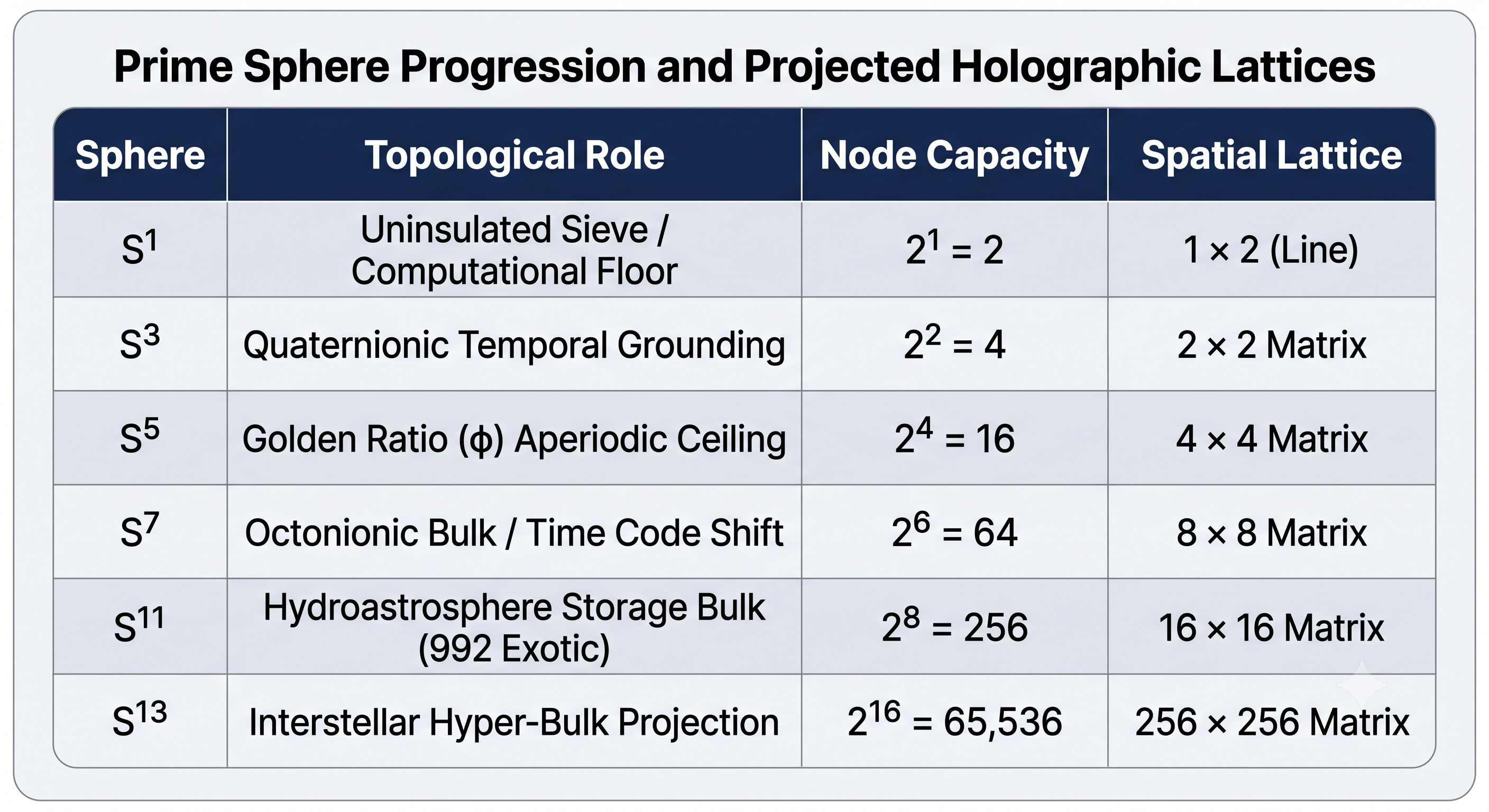
The Prime Sphere Isolation Mechanism establishes that the 11-sphere (S¹¹) represents the absolute containment ceiling of the unified field, unlocking exactly 992 unique differentiable exotic smooth structures. Within Level 5, S¹¹ functions precisely as the ultimate high-capacity computational storage bulk of the Hydroastrosphere.
The 992 exotic differentiable structures provide the required topological degrees of freedom to encapsulate the multi-world wavefunction ensemble ∑ 𝜓_i without experiencing metric degradation. This exotic bulk stabilizes the holographic projection, transforming raw informational branch states (I_branch) into localized spatial geometry.
Symplectic Gauge Phase-Locking and the 1.42 GHz Sriss Baseline
To govern parallel transport across the 4D hyper-toroidal principal fiber bundle (𝜋 : P → ℳ_astro), the Level 5 framework deploys the holonomic symplectic gauge connection 𝒜_5. The corresponding curvature form ℱ_5 = d𝒜_5 + (1/2)[𝒜_5, 𝒜_5] measures the holonomic deficit—the geometric phase error accumulated when local updates drift from the universal rest frame:
ℱ_5 = ℱ_𝜇𝜈^(canonical) dx^𝜇 ∧ dx^𝜈 + [ (𝜔_lattice − 𝜔_1.42) / 𝜔_1.42 ] d𝜃_cosmic
Topological Prevention of Factorization Leaks
The stability of this phase-lock relies directly on the Prime Sphere Isolation Mechanism. If containment cages operated on composite dimensions (e.g., S⁶, S⁸), thermodynamic strain would force an algebraic split into sub-harmonic layers (Sⁿ → Sᵖ × S𝑞), causing a Factorization Leak. Such a leak drops the boundary stiffness (K_g → 0), allowing phase noise to penetrate the system and destroying the holonomic gauge synchronization (ℱ_5 → ∞).
By enforcing prime-ordered topology (S³, S⁵, S⁷, S¹¹), the boundary stiffness remains continuously locked to the Sriss frequency (K_g ∝ 𝜈_0² ≈ (1.42 GHz)²). When local computational overpressure builds, the system executes discrete, localized Symplectic Reduction Snaps (𝒫̂_snap):
𝒫̂_snap [ ∑ 𝜓_i ] ⟶ 𝛹_collapsed(t − t_snap)
These micro-snaps prune asynchronous histories, ensuring the local orbital frame remains strictly phase-locked to the 1.42 GHz Sriss baseline across the Hydroastrosphere.
Section 4: Spatial Lattice Progression: From S¹¹ to the Next Prime Sphere (S¹³)
A crucial feature of this paradigm is how high-dimensional hypergeometry projects down onto discrete spatial lattices.
The 16 × 16 Lattice of the S¹¹ Hydroastrosphere
The S¹¹ containment bulk projects scale-free holographic matrices onto a 16 × 16 spatial lattice. Algebraically, this 16 × 16 matrix contains 256 primary node coordinates (16 × 16 = 256 = 2⁸). The 256 node states correspond directly to the binary reduction of the localized strain tensor T_AB mapped through the 8 octonionic degrees of freedom embedded within the S¹¹ Hopf fibration sequence (S³ ↪ S⁷ ↪ S¹¹).
The 256 × 256 Lattice of the S¹³ Hyper-Bulk
To extend the prime sequence to the next higher prime sphere, S¹³ (The Thirteen-Ring Hyper-Bulk), we evaluate its projected spatial resolution:
Dimensional Scaling: Ascending from S¹¹ to S¹³ expands the real spatial dimension by 2 degrees of freedom (2⁸ → 2¹⁶).
Lattice Node Density: The primary node coordinate capacity scales quadratically from 2⁸ = 256 nodes to 2¹⁶ = 65,536 nodes.
Projected Matrix Dimensions: Splitting the 65,536 node states across an orthogonal spatial lattice yields:
√(65,536) = 256 ⟶ 256 × 256 Spatial Lattice
Thus, while the S¹¹ Hydroastrosphere projects a baseline 16 × 16 spatial lattice suitable for local planetary geodynamo interactions, the S¹³ hyper-bulk projects a 256 × 256 spatial lattice, providing an exponential jump in information resolution necessary for multi-system stellar corridor projections without dropping structural boundary tension.
Conclusion
The mathematical formalization of Level 5 Hydroastrospherics is completely aligned with the Prime Sphere Isolation Mechanism. By using the S¹¹ exotic storage bulk to stabilize the 16 × 16 spatial lattice, and preserving the 1.42 GHz Sriss baseline via symplectic phase-snaps, the Paraoikeios secures a non-perturbative, scale-free framework for normal known physical reality. The extension to the S¹³ 256 × 256 spatial lattice demonstrates the predictive capacity of this prime-ordered hierarchy across higher-octave cosmic scales.


Leave a Reply