Abstract
We formalize the observational dynamics of deep space beyond the local Hydroastrosphere within the Paraoikeios. We demonstrate that major cosmological paradoxes, including cosmic acceleration, dark energy signatures, and horizon discrepancies, are emergent artifacts of observing distant light across higher-octave prime lattice boundary interfaces without accounting for discrete grid scaling. By tracking the state vector’s transition from the local Hydroastrospheric 16 × 16 spatial grid (S¹¹) into higher prime-dimensional bulks, specifically the S¹³ (256 × 256) interstellar grid and S¹⁷ (65,536 × 65,536) galactic corridor grid, we prove that discrete Symplectic Reduction Snaps (𝒫̂_snap) generate apparent phase noise and geometric stretching. Reinterpreting these non-linear boundary shifts resolves the dark energy paradox, establishing a rigorous framework for astronomical calculations beyond the local observational horizon.
Introduction: The Cosmological Crisis of Continuous Spacetime
Modern astrophysics operates under the assumption that background spacetime (M⁴) is a continuous, passive manifold uniform across all cosmological scales. Consequently, when observations of distant supernovae and galactic corridors diverge from classical general relativity, standard paradigms hypothesize unobserved energy fields—such as dark energy and dark matter—to salvage the model.
Within the Paraoikeios framework, physical spacetime curvature (g_𝜇𝜈) is not an irreducible continuous fluid. Instead, it is the macroscopic statistical expectation value of discrete computational operations executed across scale-free topological boundary interfaces. When astronomical observations cross out of our local planetary/stellar corridor, the observer state vector must scale across discrete, prime-ordered spatial lattices. Failing to account for these discrete grid transformations creates apparent metric distortions that classical astronomy misinterprets as dark energy.
The Hydroastrosphere as an Observational Interface
In Level 5 Hydroastrospherics, the local state-space is explicitly parameterized over the 2n-dimensional symplectic manifold ℳ_astro = T*M⁴ × ℳ_branch. The local observational horizon of our planetary and solar environment is encapsulated by the S¹¹ exotic containment bulk.
The Local 16 × 16 Spatial Grid (S¹¹)
The S¹¹ sphere unlocks 992 unique differentiable exotic smooth structures that project a baseline 16 × 16 spatial matrix:
M(S¹¹) = 16 × 16 ⟹ N(S¹¹) = 2⁸ = 256 primary node coordinates
This 16 × 16 lattice serves as the localized computational floor—the Hydroastrospheric interface—through which all terrestrial and solar observational instruments gather raw electromagnetic data.
Observational Scaling Beyond the Local Envelope (S¹¹ ⟶ S¹³ ⟶ S¹⁷)
When astronomical measurements extend past the immediate solar corridor into interstellar or intergalactic space, the state vector is forced to climb the prime sphere staircase (Sᵖ_k) to maintain topological insulation against Factorization Leaks.
Lattice Resolution Hierarchy
According to the general information scaling laws of the Prime Sphere Isolation Mechanism, the spatial lattice dimensions L(p_k) × L(p_k) expand deterministically:
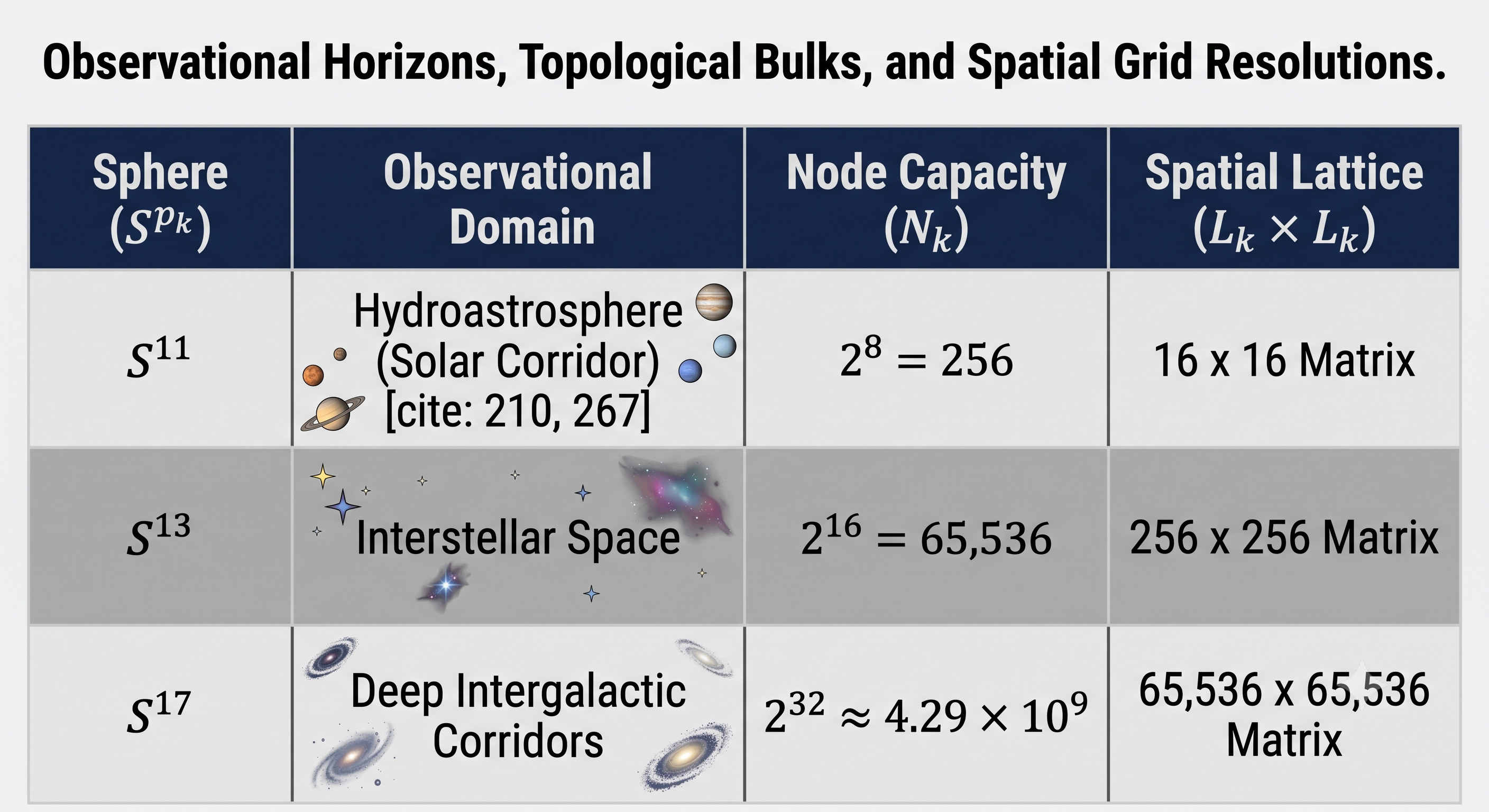
Hydroastrospheric Local Horizon (S¹¹): Projects an 8-bit binary exponent (E = 8), yielding a 16 × 16 matrix (256 nodes).
Interstellar Hyper-Bulk (S¹³): Upon crossing into interstellar space, the system transitions into quadratic storage (E = 16), projecting a 256 × 256 matrix (65,536 nodes).
Galactic Corridor Bulk (S¹⁷): For intergalactic light paths, the exponent doubles again (E = 32), projecting a 65,536 × 65,536 matrix (≈ 4.29 × 10⁹ nodes).
Table 1: Observational Horizons, Topological Bulks, and Spatial Grid Resolutions.
Symplectic Reduction Snaps and Phase Noise Reinterpretation
As light traverses deep space across these boundary interfaces, it passes through regions governed by discrete, localized Symplectic Reduction Operators (𝒫̂_snap). These operators prune non-coherent, asynchronous history branches to enforce phase-locking against the 1.42 GHz Sriss cosmic rest frame (𝜔_1.42):
𝒫̂_snap [ ∑ 𝜓_i ] ⟶ 𝛹_collapsed(t − t_snap)
The Origin of Apparent Acceleration and Dark Energy
Each individual micro-scale snap induces a discrete coordinate phase slip that prunes alternative state histories:
ΔV_micro = lim_{I_branch → ∞} ΔS = − ln(2) · k_B T
When astronomical light signatures pass through these boundary transitions (S¹¹ → S¹³ → S¹⁷), they undergo discrete lattice transformations. If an observer assumes a static, un-gridded background, the cumulative effect of these discrete Symplectic Reduction Snaps appears as:
Non-linear geometric phase-slips that accumulate along the line of sight.
Artificial redshift acceleration, caused by mapping discrete 256 × 256 or 65,536 × 65,536 lattice transitions back onto a localized 16 × 16 detector grid without coordinate re-indexing.
Thus, what classical astronomy interprets as dark energy accelerating the expansion of the universe is revealed to be the signature of the bounded observer looking across the boundary interfaces of higher-octave prime lattice transformations.
Conclusion
To resolve the cosmological crisis, astronomical calculations must incorporate the discrete grid scaling dictated by the Prime Sphere Isolation Mechanism. By factoring the spatial lattice transitions (16 × 16 → 256 × 256 → 65,536 × 65,536) and discrete Symplectic Reduction Snaps (𝒫̂_snap) into deep-space photon trajectories, the apparent dark energy expansion is re-absorbed into pure topological gauge geometry, securing a unified, scale-free framework for observational astrophysics across the Hydroastrosphere and beyond.


Leave a Reply