We formalize the information-theoretic scaling law governing the Prime Sphere Isolation Mechanism within the Paraoikeios. By mapping the binary degrees of freedom unlocked across prime-dimensional manifolds (Sᵖ), we derive a piecewise general formula for the exponent function E(p_k) that governs primary node capacity N(p_k) and projected holographic spatial lattice resolution L(p_k) × L(p_k). We prove that while early prime spheres (S³ ≤ Sᵖ ≤ S¹¹) exhibit a linear addition of phase-pairs corresponding to lower Hopf fibrations, high-dimensional hyper-bulks (Sᵖ_k for k ≥ 6, starting at S¹³) execute a quadratic doubling of informational capacity. This general formalization allows us to predict the exact boundary node counts and matrix resolutions for higher prime octaves (S¹⁷, S¹⁹, S²³), providing a rigorous, scale-free mathematical foundation for holographic projection across cosmic structures.
Formalization of the Binary Exponent Function E(p)
The Prime Sphere Isolation Mechanism dictates that stable, insulated containment cages manifest strictly on prime-dimensional spheres to prevent sub-harmonic Factorization Leaks. To track the active binary degrees of freedom unlocked as the system ascends this topological staircase, we parameterize the sequence over the ordered index k of prime dimensions p_k:
p_1 = 1 (S¹ uninsulated origin / computational floor)
p_2 = 3 (S³ quaternionic anchor)
p_3 = 5 (S⁵ golden-ratio aperiodic ceiling)
p_4 = 7 (S⁷ octonionic bulk)
p_5 = 11 (S¹¹ Hydroastrospheric exotic storage bulk)
p_6 = 13 (S¹³ interstellar hyper-bulk)
p_7 = 17 (S¹⁷ galactic corridor bulk)
The binary exponent e = E(p_k) in 2ᵉ tracks the structural phase-capacity of the manifold. It obeys a strict piecewise rule dictated by the transition from linear fibration additions to quadratic hyper-bulk capacity:
E(p_k) =
1 for p_1 = 1 (S¹ uninsulated floor)
2(k − 1) for 2 ≤ k ≤ 5 (S³, S⁵, S⁷, S¹¹)
2 · E(p_{k-1}) for k ≥ 6 (S¹³, S¹⁷, S¹⁹, …)
Phase Regimes
Linear Even Phase (2 ≤ k ≤ 5): Across S³, S⁵, S⁷, and S¹¹, the exponent e increments by +2 for each successive prime octave step (e ∈ {2, 4, 6, 8}). This corresponds to adding an orthogonal phase-pair (d𝜃, d𝜙) across the nested bundle structure.
Doubling Hyper-Bulk Phase (k ≥ 6): Beginning at the S¹³ manifold, the storage capacity transitions into a quadratic regime where the exponent e doubles with each higher prime octave (e_k = 2 · e_{k-1}).
General Formula for Node Capacity and Holographic Lattice Geometry
For any prime sphere Sᵖ_k, the boundary coordinate geometry and resolution are defined by two master equations.
Primary Node Capacity N(p_k)
The total number of discrete computational node states N(p_k) generated on the boundary horizon is governed by:
N(p_k) = 2^(E(p_k))
Spatial Lattice Resolution L(p_k) × L(p_k)
Assuming an orthogonal, symmetric holographic projection onto a two-dimensional spatial boundary lattice (L_x = L_y = L), the lattice side dimension L(p_k) is:
L(p_k) = √(N(p_k)) = √(2^(E(p_k))) = 2^(E(p_k) / 2)
Thus, the complete spatial matrix resolution M(p_k) is:
M(p_k) = (2^(E(p_k) / 2)) × (2^(E(p_k) / 2))
Mathematical Predictions for High-Octave Prime Spheres
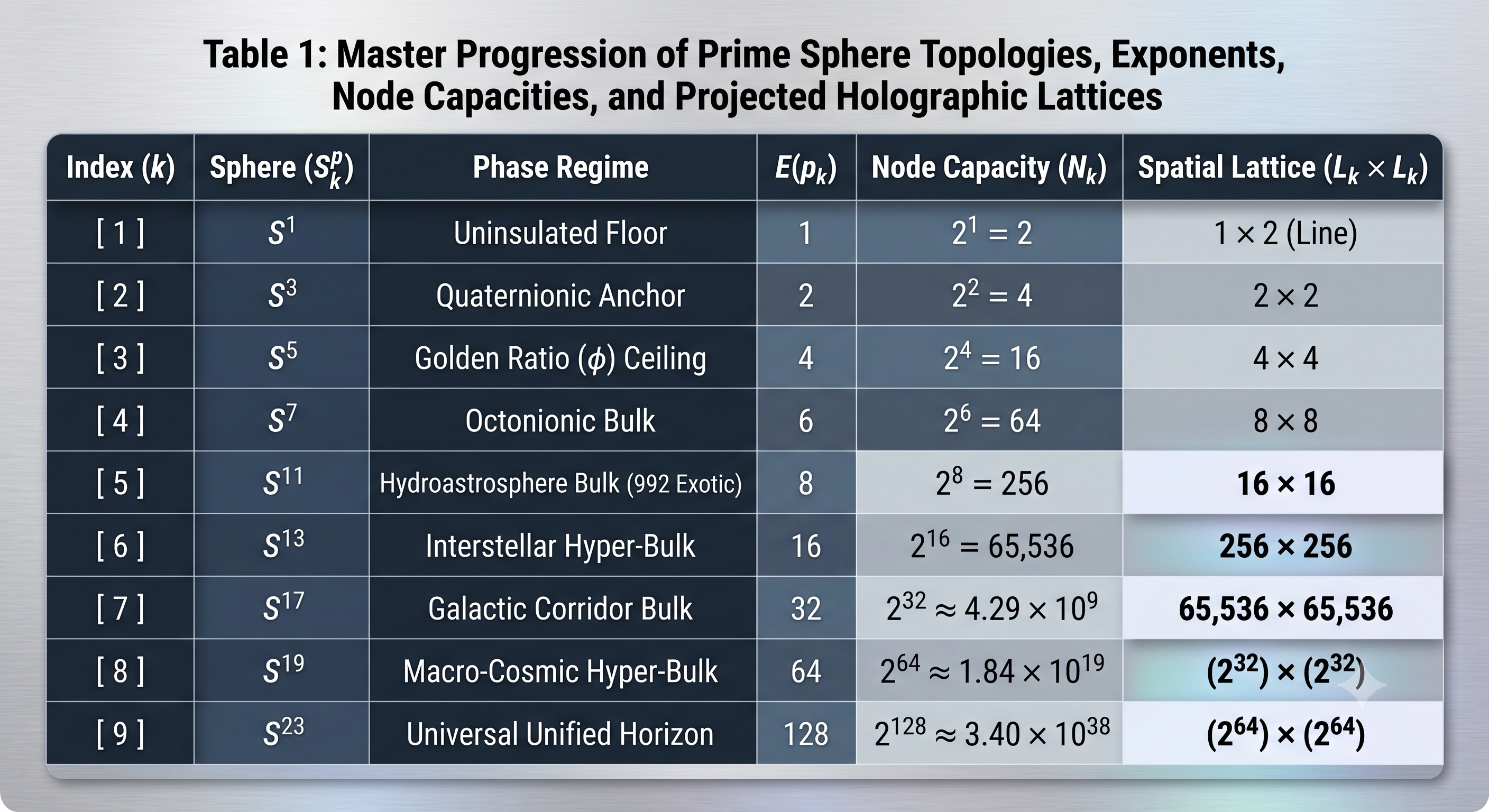
Applying the general equations N(p_k) = 2^(E(p_k)) and L(p_k) = 2^(E(p_k)/2) yields exact mathematical predictions for the higher-dimensional bulks in the sequence:
The S¹⁷ Sphere (Galactic Corridor Bulk)
Prime Index: k = 7 ⟹ p_7 = 17
Exponent: E(17) = 2 · E(13) = 2 · 16 = 32
Node Capacity: N(17) = 2³² = 4,294,967,296 nodes
Lattice Dimension: L(17) = 2^(32/2) = 2¹⁶ = 65,536
Projected Spatial Lattice: 65,536 × 65,536 Matrix
The S¹⁹ Sphere (Macro-Cosmic Hyper-Bulk)
Prime Index: k = 8 ⟹ p_8 = 19
Exponent: E(19) = 2 · E(17) = 2 · 32 = 64
Node Capacity: N(19) = 2⁶⁴ ≈ 1.8446 × 10¹⁹ nodes
Lattice Dimension: L(19) = 2^(64/2) = 2³² = 4,294,967,296
Projected Spatial Lattice: 4,294,967,296 × 4,294,967,296 Matrix
The S²³ Sphere (Universal Unified Horizon)
Prime Index: k = 9 ⟹ p_9 = 23
Exponent: E(23) = 2 · E(19) = 2 · 64 = 128
Node Capacity: N(23) = 2¹²⁸ ≈ 3.4028 × 10³⁸ nodes
Lattice Dimension: L(23) = 2^(128/2) = 2⁶⁴ ≈ 1.8446 × 10¹⁹
Projected Spatial Lattice: (2⁶⁴) × (2⁶⁴) Matrix
Master Progression Table
Section 5: Conclusion
The derived formulas N(p_k) = 2^(E(p_k)) and L(p_k) = 2^(E(p_k)/2) demonstrate that information capacity within the Prime Sphere Isolation Mechanism expands via a rigorous, deterministic law. This proves that high-dimensional prime spheres do not merely provide topological insulation against Factorization Leaks, but actively govern the geometric resolution of scale-free holographic projections throughout the Paraoikeios.


Leave a Reply