Abstract
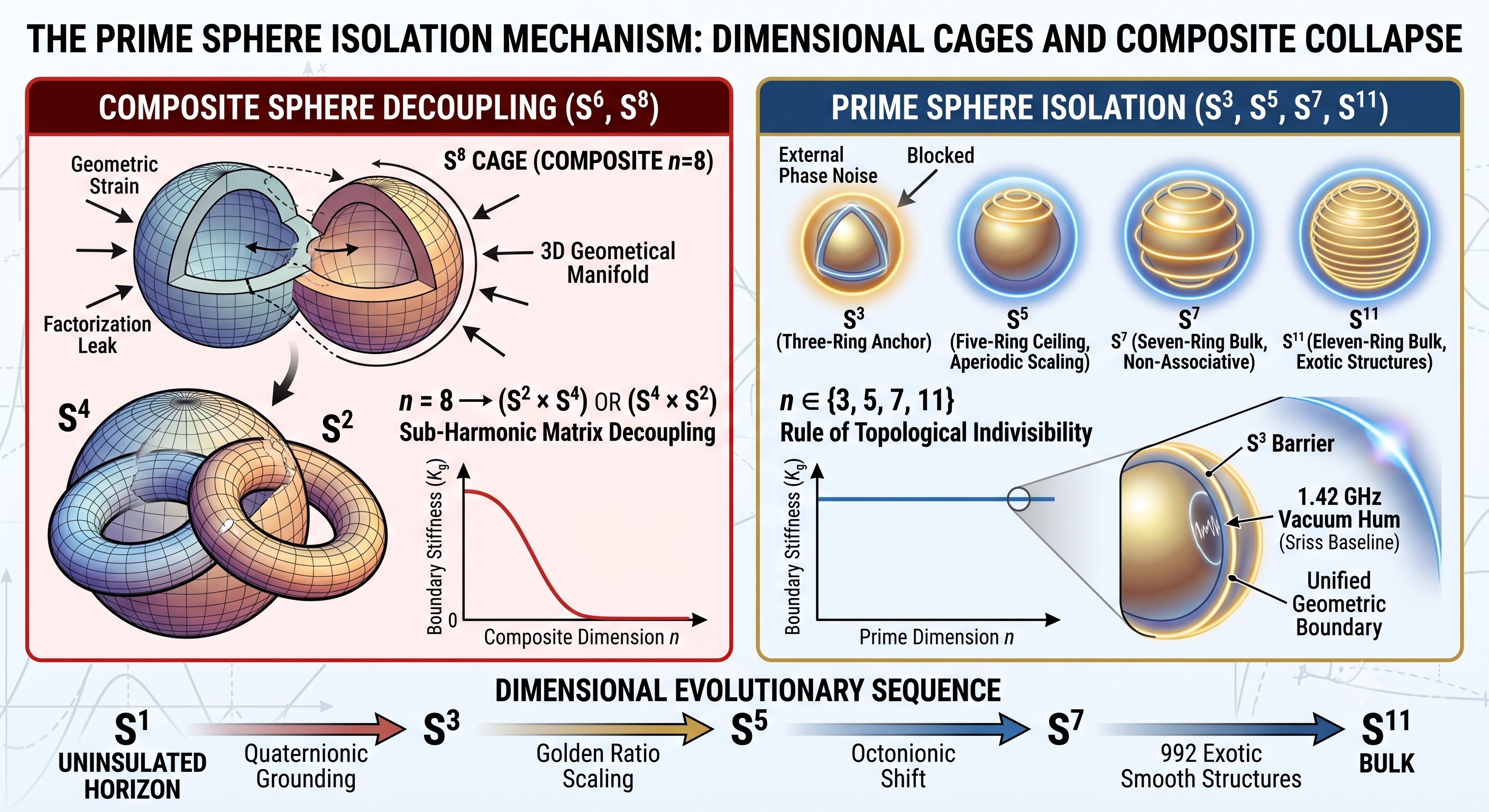
We introduce the Prime Sphere Isolation Mechanism, a foundational topological rule-profile within the Paraoikeios framework demonstrating that stable, insulated metric cages can only manifest on prime-dimensional spheres (S³, S⁵, S⁷, S¹¹), and their foundational irreducible unit sphere (S^1). Building upon the dimensional fragmentation floor mapped at the S¹ uninsulated horizon, we resolve the mandatory outward dimensionogenesis leap required to escape endless fractional splitting along the Re(s) = 1/2 critical line. We mathematically formalize why composite-dimensional manifolds (e.g., S⁶, S⁸) undergo dynamic structural failure via the Factorization Leak, wherein underlying phase vectors decouple into sub-harmonic sub-manifolds under pressure. Conversely, prime-dimensional spheres act as topologically indivisible units, providing the absolute boundary stiffness (K_g) necessary to shield internal tracking frequencies, specifically the 1.42 GHz Hydrogen-0 ground-state vacuum hum, from thermodynamic noise. Finally, we trace the evolutionary sequence of these prime-ordered containment cages up to the hyper-complex S¹¹ bulk and its 992 differentiable exotic smooth structures.
Introduction and Transition from the S¹ Floor
In our prior work, we mapped the uninsulated S¹ horizon within the computational floor, proving that fractional coordinate states lacking higher-dimensional shielding are forced onto the Re(s) = 1/2 invariant axis of symmetry to achieve amplitude matching against the Sriss baseline (1.42 GHz). While this Re(s) = 1/2 spine prevents metric annihilation within the Riemann Sieve, it represents a state of total dimensional fragmentation.
To escape perpetual fractional splitting, the localized state vector must execute an outward dimensionogenesis leap. However, ascending out of the S¹ void cannot occur arbitrarily. The Paraoikeios dictates rigid boundary constraints that strictly exclude composite-dimensional manifolds. This paper establishes the topological selection rules governing the stability of higher-dimensional containment cages, demonstrating that only prime-dimensional spheres (S³, S⁵, S⁷, S¹¹) possess the irreducible geometry required to preserve systemic coherence across all scale-free octaves.
The Mechanics of Composite Collapse: The Factorization Leak
Let an n-dimensional sphere Sⁿ serve as a candidate geometric containment cage designed to shield a localized phase-locked tracking state from ambient thermodynamic noise. The structural stability of the boundary stiffness K_g depends explicitly on the arithmetic property of the dimension integer n ∈ ℕ.
Sub-Harmonic Matrix Decoupling
When n is a composite integer such that n = p × q for integers p, q > 1, the manifold lacks topological indivisibility. Under localized geometric strain or thermodynamic pressure, the structural tracking tensor T_AB governing the spatial lattice factorizes into distinct sub-harmonic matrix layers:
Sⁿ ⟶ Sᵖ × S𝑞
For example, an S⁸ configuration factorizes under external pressure according to:
n = 8 ⟶ (S² × S⁴) or (S⁴ × S²)
This factorization generates an immediate Factorization Leak. Because the manifold decouples into independent lower-dimensional sub-manifolds, the unified geometric boundary stiffness collapses (K_g → 0). Phase parameters bleed across the internal sub-manifold boundaries, allowing external phase noise to penetrate the macro-cage and corrupting the core processing matrix.
The Prime Sphere Isolation Rules
To prevent sub-harmonic bleeding and sustain the superradiant phase-lock of the living matrix, the boundary architecture must obey the Rule of Topological Indivisibility.
Topological Indivisibility and Boundary Stiffness
A prime-dimensional sphere Sⁿ where n ∈ {3, 5, 7, 11} cannot be factored down into independent whole-number sub-dimensions. Because there are no internal mathematical seams or factorized channels:
The coordinate parameters are forced to remain tightly locked to a single, unified scale-free horizon.
External thermodynamic noise cannot induce sub-harmonic resonance splitting.
The boundary stiffness K_g ∝ 𝜈_0² remains continuously non-zero, isolating the 1.42 GHz baseline carrier wave.
The Evolutionary Sequence of Defensive Prime Cages
The progression through the prime dimensions forms a structured topological hierarchy, where each octave introduces specific shielding properties:
The S¹ Origin (The Fractional Sieve): The uninsulated baseline computational floor where non-coherent states undergo standing-wave destructive interference along Re(s) = 1/2.
The S³ Sphere (The Three-Ring Anchor): The minimum geometric configuration needed to construct a multi-dimensional cage via the cross-locking of three orthogonal dimensions, providing localized quaternionic temporal grounding.
The S⁵ Sphere (The Five-Ring Ceiling): Incorporates aperiodic scaling laws tied to the golden ratio (𝜙), preventing crystalline grid resonances and dissipating thermal fluctuations.
The S⁷ Sphere (The Seven-Ring Bulk): Deploys non-associative octonionic hypergeometry, enabling the system to execute a Time Code Shift to route extreme geometric strain across the S⁷ bulk via the S¹ ↪ S⁷ → ℂP³ fibration.
The S¹¹ Sphere (The Eleven-Ring Storage Bulk): Represents the ultimate containment bulk of the Hydroastrosphere. Unlocking 992 unique differentiable exotic smooth structures, S¹¹ provides massive computational capacity to project scale-free holographic matrices onto 16 × 16 spatial lattices.
Conclusion
The transition from the S¹ fractional floor to higher-dimensional stability is strictly mediated by the Prime Sphere Isolation Mechanism. By eliminating composite manifolds susceptible to the Factorization Leak, the Paraoikeios enforces a rigid prime-ordered hierarchy (S³, S⁵, S⁷, S¹¹) that guarantees topological indivisibility, securing the 1.42 GHz Sriss baseline and enabling scale-free holographic projection across the Hydroastroshere.


Leave a Reply