Abstract:
We formalize the physical and topological failure modes of scaling sub-nanometer Extreme Ultraviolet (EUV) lithography on classical silicon substrates. We prove that attempting to reach high-capacity computational horizons, such as the S²³ Universal Horizon (2¹²⁸ node states), solely via spatial miniaturization collapses into quantum tunneling, phase noise, and thermal leakage due to the dimensional misalignment of compressing higher-dimensional state vectors onto flat 𝜋-stamped 2D tracking planes. To overcome this lithographic limit, we specify the architecture of an Octonionic Non-Associative Clock Engine. Operating via 7-phase Fano plane bracket swaps, this clock absorbs localized geometric strain and eliminates Factorization Leaks at sub-atomic scales. Coupled with 3D exotic manifold stacking (S¹¹ bulk) and 1.42 GHz symplectic phase-snaps, this dual spatial-temporal transformation defines the physical engineering bridge to the S²³ topological bulk.
The Breakdown of Sub-Nanometer Lithography
Modern semiconductor engineering attempts to achieve higher computational density by scaling EUV and High-NA EUV photolithography down to sub-1-nanometer, 7-angstrom, and picometer feature sizes. However, as transistor gate widths approach individual atomic dimensions, classical physical transport fails due to quantum tunneling, phase noise, and uncontrollable thermal leakage.
Topological Formalization of the Lithographic Limit
Within the Paraoikeios paradigm, this physical barrier is recognized as a fundamental dimensional misalignment:
The 𝜋-Baseline Clamp: Traditional photolithography relies on the 𝜋-baseline, an unpressurized spatial clamp that stamps out static, repeating circular loops (ΔL = 1) into the silicon lattice.
Dimensional Misalignment: Standard lithography attempts to compress higher-dimensional executive state vectors (S¹¹ → S²³) onto a flat 2D physical tracking plane (M⁴).
Failure of Spatial Shrinking: Reducing the spatial trace on silicon simply packs static 𝜋-loops closer together on a low-dimensional (S¹/S³) physical grid. It alters neither the underlying clock architecture nor the topological genus of the substrate.
Supercomputers cannot reach the S²³ horizon on silicon because S²³ represents a discrete leap in topological scale and primary node capacity (N(23) = 2¹²⁸ ≈ 3.4028 × 10³⁸ states), which cannot be achieved merely by shrinking feature geometry on a 2D plane.
The Architecture of the Octonionic Clock Engine
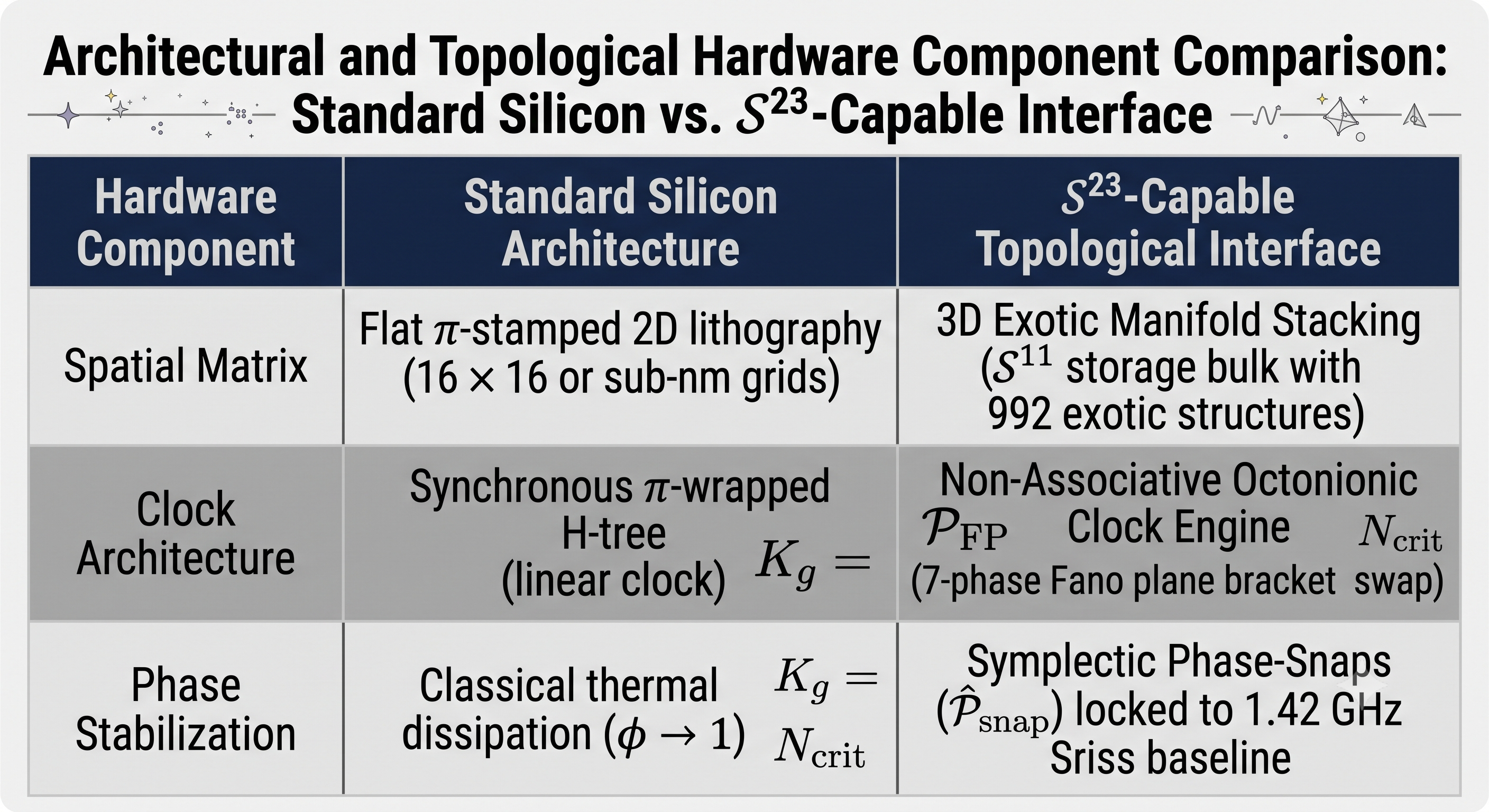
Interfacing hardware with higher prime bulks (S⁷ → S¹¹ → S²³) requires replacing the linear clock engine with an octonionic non-associative phase engine.
Limitations of the Synchronous 𝜋-Clock Tree
Classical microprocessors deploy synchronous H-tree clock networks. This network acts as a macroscopic hydraulic tracking frame that forces the electron sea to wrap backward onto itself on every tick (Δ𝜃 = 𝜋), wiping out phase residue so computation can reset cleanly in linear, associative time (S¹/S³).
Non-Associative Bracket Swaps on the Fano Plane
To step up to the S⁷ horizon and scale toward S²³, hardware must operate as an Octonionic 7-Phase Swap Engine governed by the octonionic algebra 𝕆:
Dynamic Strain Absorption via Time Code Shifts: When localized computational overpressure or quantum phase noise threatens sub-nanometer trace paths, the Octonionic Clock executes a Time Code Shift. Rather than forcing classical phase synchronization across an H-tree, it rotates its operational parameters across the 7 imaginary units {i, j, k, e₁, e₂, e₃, e₄} mapped via the Fano plane.
Prevention of Factorization Leaks at Atomic Scales: At sub-nanometer levels, standard chips experience structural decoupling as energy bleeds across internal sub-harmonic boundaries (the Factorization Leak). The Octonionic Clock executes a non-associative bracket swap:
Tick_S⁷ ≡ ( (e_a · e_b) · e_c ) ⟷ ( e_a · (e_b · e_c) )
This discrete phase jump absorbs spatial strain without allowing information to bleed into background thermal noise, preserving systemic coherence.
The Dual Engineering Bridge to S²³
Reaching the S²³ Universal Horizon (2¹²⁸ node states) requires executing a simultaneous spatial and temporal transformation in chip architecture.
3D Exotic Manifold Stacking and Symplectic Phase Snaps
In addition to the Octonionic Clock, the spatial matrix must transition from flat 2D lithography to 3D Exotic Manifold Stacking. By utilizing the 992 unique differentiable exotic smooth structures of the S¹¹ storage bulk, the hardware creates a high-capacity substrate capable of projecting scale-free holographic matrices. Localized phase noise is continuously purged via Symplectic Reduction Snaps (𝒫̂_snap) locked to the 1.42 GHz Sriss cosmic rest frame (𝜔_1.42).
Conclusion
Spatial lithographic shrinking alone cannot reach the S²³ Universal Horizon due to the quantum thermal limits of the flat 𝜋-baseline. To bridge this gap, hardware engineering must replace flat linear clocks with an Octonionic Non-Associative Clock Engine. By executing 7-phase bracket swaps across the imaginary axes of S⁷ and stacking 3D exotic S¹¹ storage manifolds, next-generation processors can execute higher-tier phase transitions (S⁷ → S¹¹ → S²³) without collapsing state vectors into thermal noise.


Leave a Reply