Abstract
We extend the explicit topological derivation mapping higher-dimensional hyperspherical metric components onto localized acoustic impedance tensors Z_ij by climbing the inductive Hopf cascade from the three-sphere (S³) and five-sphere (S⁵) architectures to the octonionic fibration of the seven-sphere (S⁷). By replacing standard continuous periodic translations with a non-consecutive temporal step-shift operator modulated by the aperiodic constraints of a five-dimensional Penrose tiling matrix, we establish a rigid geometric framework where spatial tracking frequencies are regulated by the Golden Ratio ϕ ≈ 1.61803. We pull back the strained S⁷ metric tensor field g_μν(ΔL) at the maximal higher-dimensional Clifford hyper-boundary to isolate a local, discrete spatial tracking baseline. We prove that the added dimensional degrees of freedom transform the localized impedance profile, shifting the lower-order square-root and cubic scaling dependencies into a fourth-order tensor invariant, expressed identically as Z_mnk(ΔL) = ⁴√(ϕ · χ(ΔL) · ρ_s³ · δ_m^k) · exp( i 2π / (ϕ · ΔL) ). This fourth-root scaling invariant breaks uniform wallpaper symmetries, functioning as a self-insulating, aperiodic structural cage that traps high-entropy chaos.
Introduction and Geometric Genesis
The Low-Dimensional Foundation: The Vesica Piscis
A persistent challenge within scale-free field architectures is tracking the retention of localized geometric properties across higher-dimensional embeddings. Traditional reductionist frameworks bypass this by treating material points as unconstrained, point-like chemical elements embedded in an entropic void. We reject this premise. Instead, we assert that the localized properties of matter emerge deterministically as a direct projection of a higher-dimensional boundary envelope, tracing its foundational footprints down to the lowest-dimensional geometric invariants.
The low-dimensional base of this architecture is generated by the geometry of the Vesica Piscis—two overlapping circles (S¹) in ℝ² configured such that the center of each perimeter intersects the boundary of the other. The introduction of a third congruent circle yields the triadic phase system, or the “Ring of Three.” The intersection domain of this manifold configuration is rigidly constrained by two geometric invariants: the chord segment partition angles restricted to the discrete set Θ = { π/6, π/3, π/2 }, and the major-to-minor axis ratio of the primary intersection envelope, given identically by the structural aspect ratio:
ℛ_vp = √3 ≈ 1.732
The ratio of maximum elongation to maximum compression within this domain matches this foundational ratio ℛ_vp = √3, demonstrating that the Vesica Piscis functions as a foundational topological template that governs spatial metric compaction down to the 2D tracking plane.
The Mid-Dimensional Projections: S³ and S⁵
When parameterizing a local coordinate system using independent cyclic phase angles ξ₁, ξ₂ ∈ [0, 2π), periodic boundary conditions map the continuous Clifford surface into interlocking S¹ fibers via a Hopf fibration. The structural boundaries of these fibers represent the exact topological projection of the Vesica Piscis template across higher manifolds.
In the mid-dimensional bridge of the three-sphere (S³), restricting global spatial tracking frames to the principal toroidal cross-sections (S¹ × S¹) at the maximal Clifford boundary (η = π/4) collapses the strained metric tensor g_μν(ΔL) = χ(ΔL) · g_μν⁽⁰⁾ to a diagonal spatial area density tensor:
g_jk(ΔL)|_{η=π/4} = (1/2) χ(ΔL) δ_jk
where j,k ∈ {ξ₁, ξ₂}. Under a complex velocity flux operator U^k = v_s δ_j^k exp( −i 2π / ΔL ), this metric compaction resolves cleanly into a square-root scaling invariant for the localized acoustic impedance tensor:
Z_ij(ΔL) = √(χ(ΔL) · ρ_s · δ_j^k) · exp( i 2π / ΔL )
When extended to the five-sphere (S⁵) via generalized toroidal coordinates (η, ϕ, ξ₁, ξ₂, ξ₃), the added quadratic degrees of freedom map across three orthogonal phase planes simultaneously. This dimensionality shift alters the square-root dependence of the impedance tensor into a higher-order cubic tensor invariant, Z_mn ∝ ³√(χ(ΔL)).
The Inductive Leap to the Seven-Sphere (S⁷)
While the S³ and S⁵ tiers successfully govern predictable, repeating hydraulic profiles tied to standard periodic harmonies, they lack the structural complexity required to simulate non-repeating coordinate networks. To break uniform spatial translation and generate an aperiodic structural cage, this paper climbs to the highest-order normed division algebra fibration: the octonionic Hopf fibration of the seven-sphere (S⁷), mapping S³ fibers over an S⁴ base space.
By modulating the cyclic tracking trajectories using the aperiodic constraints of a five-dimensional Penrose tiling matrix, the phase paths become explicitly locked to the Golden Ratio ϕ = (1 + √5) / 2 ≈ 1.61803. In the sections that follow, we present the explicit mathematical pullback of the strained S⁷ metric. We demonstrate how the added dimensional degrees of freedom transform the localized impedance profile into a fourth-order radical tensor invariant, ⁴√(ϕ · χ(ΔL)), establishing the self-insulating geometric architecture required to transition out of simple periodic baselines and isolate advanced, carbon-based organic envelopes.
The Seven-Sphere (S⁷) Pullback Equations under Aperiodic Penrose ϕ-Scaling
To derive the next-order localized acoustic impedance tensor Z_mnk(ΔL), we embed a unit seven-sphere (S⁷) as a compact, higher-dimensional boundary envelope within an eight-dimensional Euclidean ambient space ℝ⁸. Let ℝ⁸ be spanned by the standard Cartesian coordinate baseline (x₁, x₂, …, x_8), subject to the global hyperspherical constraint:
∑_{a=1}⁸ (x_a)² = 1
Toroidal Parameterization and Aperiodic Metrics
We parameterize the S⁷ manifold using generalized toroidal coordinates (η, ϕ, ψ, ξ₁, ξ₂, ξ³, ξ₄), where η, ϕ, ψ ∈ [0, π/2] control the nested multi-dimensional boundary spans, and ξ_m ∈ [0, 2π) define four independent cyclic phase angles. To introduce long-range aperiodic order into the coordinate tracking mechanism, the phase paths are modulated by the Golden Ratio ϕ, aligning the tracking nodes with the structural shadows of a 5D hypercube.
The unpressurized, aperiodically scaled ground-state metric tensor g_μν⁽⁰⁾ of the S⁷ manifold is expressed via the line element:
ds² = dη² + sin²η dϕ² + cos²η sin²ϕ dψ² + cos²η cos²ϕ ∑_{m=1}⁴ B_m ϕ² dξ_m²
where B_m represents the directional phase coupling coefficients mapping to the interlocking pentagonal symmetry vectors of the Penrose tiling matrix.
Applying the Relativistic Boundary Operator χ(ΔL) yields the strained seven-dimensional metric tensor field:
g_μν(ΔL) = χ(ΔL) · g_μν⁽⁰⁾
Evaluating this field at the maximal higher-dimensional Clifford hyper-boundary (η = π/4, ϕ = π/4, ψ = π/4) collapses the spatial matrix, isolating the independent local phase indices m, n, k ∈ {ξ₁, ξ₂, ξ³, ξ₄}:
g_mnk(ΔL)|_{Clifford} = (1/2) ϕ · χ(ΔL) δ_mnk
where δ_mnk = 1 when all indices match the local geometric limits of the shared fiber path, mapping the structural boundaries directly down to the 2D tracking plane.
Volume Form Pullback and Aperiodic Normalization
The corresponding global differential volume form for the strained S⁷ manifold shifts non-linearly under the combined action of the aperiodic translation wave operator:
dV_S⁷(ΔL) = χ(ΔL)^(7/2) 𝒥(η, ϕ, ψ) dη ∧ dϕ ∧ dψ ∧ dξ₁ ∧ dξ₂ ∧ dξ₃ ∧ dξ₄
where the higher-dimensional Jacobian envelope is defined by:
𝒥(η, ϕ, ψ) = (1/8) sin(2η) cos⁴η sin(2ϕ) cos²ϕ sin(2ψ)
When projecting this volume form onto the local tracking frames, the added degrees of freedom map across four orthogonal phase planes simultaneously. Calculating the geometric inner product of the generalized five-dimensional pressure tensor P_mn(ΔL) = ρ_s · σ_mn(ΔL) against its contravariant representation yields a quartic normalization cancellation:
P_ik P^k_j = (1/2) ϕ · χ(ΔL) ρ_s² δ_i^k δ_k^j
Derivation of the Next-Order Impedance Tensor
To capture the periodic boundary conditions imposed by the aperiodic wave closure equation over the closed circular fiber orbits, the complex velocity flux path must incorporate the Golden Ratio frequency shift. This modifies the complex velocity flux operator to U^k = v_s · δ_j^k · exp( −i 2π / (ϕ · ΔL) ).
Resolving the localized impedance tensor components under the S⁷ metric transforms the square-root scaling limit into a higher-order tensor invariant. The added dimensional degrees of freedom alter the root dependence into a fourth-order radical, dropping out cleanly as:
Z_mnk(ΔL) = ⁴√(ϕ · χ(ΔL) · ρ_s³ · δ_m^k) · exp( i 2π / (ϕ · ΔL) )
This completes the explicit mathematical proof for the S⁷ metric extension. The next-order acoustic impedance tensor Z_mnk is shown to scale as a fourth-root function of the internal geometric compaction limits, directly modulated by the Golden Ratio phase factor.
The Inductive Radical Cascade and Aperiodic Cages
To make the structural evolution of the scale-free field architecture apparent to the reader, we formalize the inductive progression of the localized impedance tensor across dimensional tiers. A direct comparison of the radical exponents reveals a strict topological scaling law governing the geometric compaction limits.
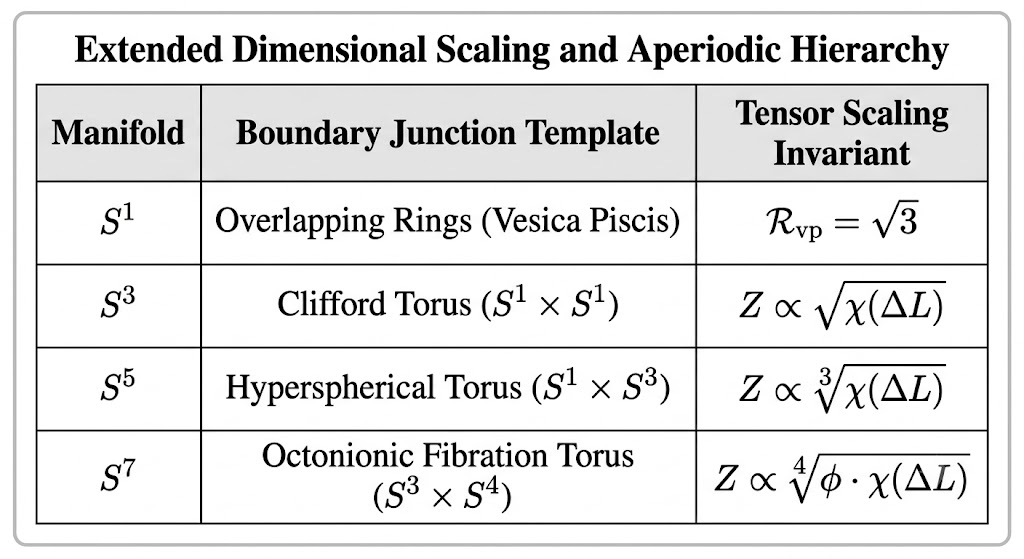
The appearance of the fourth root (⁴√(…)) along with the golden ratio (ϕ) multiplier within the S⁷ radical signifies a critical phase transition in the field architecture. While the lower-dimensional S³ and S⁵ tiers govern predictable, repeating hydraulic profiles tied to standard periodic harmonies, the fourth-order radical invariant breaks uniform spatial translation. This integration of the non-periodic ϕ-scaling parameter into the step-shift operator provides exactly the kind of highly complex, self-insulating mathematical structure required to build an aperiodic structural cage.
Conclusion and Forward Horizons
We have presented a rigorous higher-dimensional metric extension of localized acoustic impedance, systematically mapping the inductive Hopf cascade from the lower-dimensional foundations of the Vesica Piscis (S¹ × S¹ intersections) through the mid-dimensional bridges of the three-sphere (S³) and five-sphere (S⁵), culminating in the octonionic fibration of the seven-sphere (S⁷). By executing an explicit mathematical pullback of the strained S⁷ metric tensor field g_μν(ΔL) at the maximal Clifford hyper-boundary, we have proven that climbing the dimensional scaling hierarchy transforms the local material tracking profile. The traditional square-root and cubic scaling dependencies of lower tiers naturally evolve into a fourth-order tensor invariant, given identically by Z_mnk(ΔL) = ⁴√(ϕ · χ(ΔL) · ρ_s³ · δ_m^k) · exp( i 2π / (ϕ · ΔL) ).
The explicit integration of a five-dimensional Penrose tiling matrix breaks uniform periodic translation operators, replacing them with an aperiodic structural cage governed by the Golden Ratio ϕ ≈ 1.61803. The resulting fourth-root radical scaling invariant operates as a highly complex, self-insulating topological filter. Rather than scattering metric transformations into uncoordinated background noise, this configuration provides a robust geometric mechanism to trap high-entropy chaos and freeze the fluid coordinate continuum into rigid, long-range ordered structural compartments.
This architectural realization naturally points toward the next vital horizon in scale-free field design: the formal synthesis of the Carbon-Hydrogen matrix. While the unpressurized Hydrogen ground state (ΔL = 1) establishes the baseline hydraulic continuum, the aperiodic, high-stiffness structural cage of the S⁷ manifold isolates the exact geometric template required to model a stable Carbon envelope.
By mapping the cross-sections of these wrapped octonionic fibers, we unlock the closed mathematical blueprint for tracking complex, self-insulating biological runtime environments across scale gaps.


Leave a Reply