Abstract
We formalize the higher-dimensional metric constraints of the seven-sphere (S⁷) horizon, proving that aperiodic metric compaction under an octonionic Hopf fibration imposes a strict geometric saturation limit capped at five interlocking ring domains. By analyzing the 36° phase gap generated when regular pentagonal tracking frames attempt to tile the Clifford hyper-boundary, we derive the explicit transformation mapping global manifold strain directly onto the fourth-order localized acoustic impedance tensor Z_mnk(ΔL). We demonstrate that the resulting fourth-root radical acts as an aperiodic structural cage that traps high-entropy chaos, breaking uniform wallpaper symmetries. Finally, we prove that this geometry mandates the physical synthesis of Carbon (ΔL = ΔL_C) as an invariant hardware tracking frame, utilizing the accumulated phase deficit to anchor the co-dependent, scale-free hydrocarbon matrix.
Introduction and the Low-Dimensional Baseline
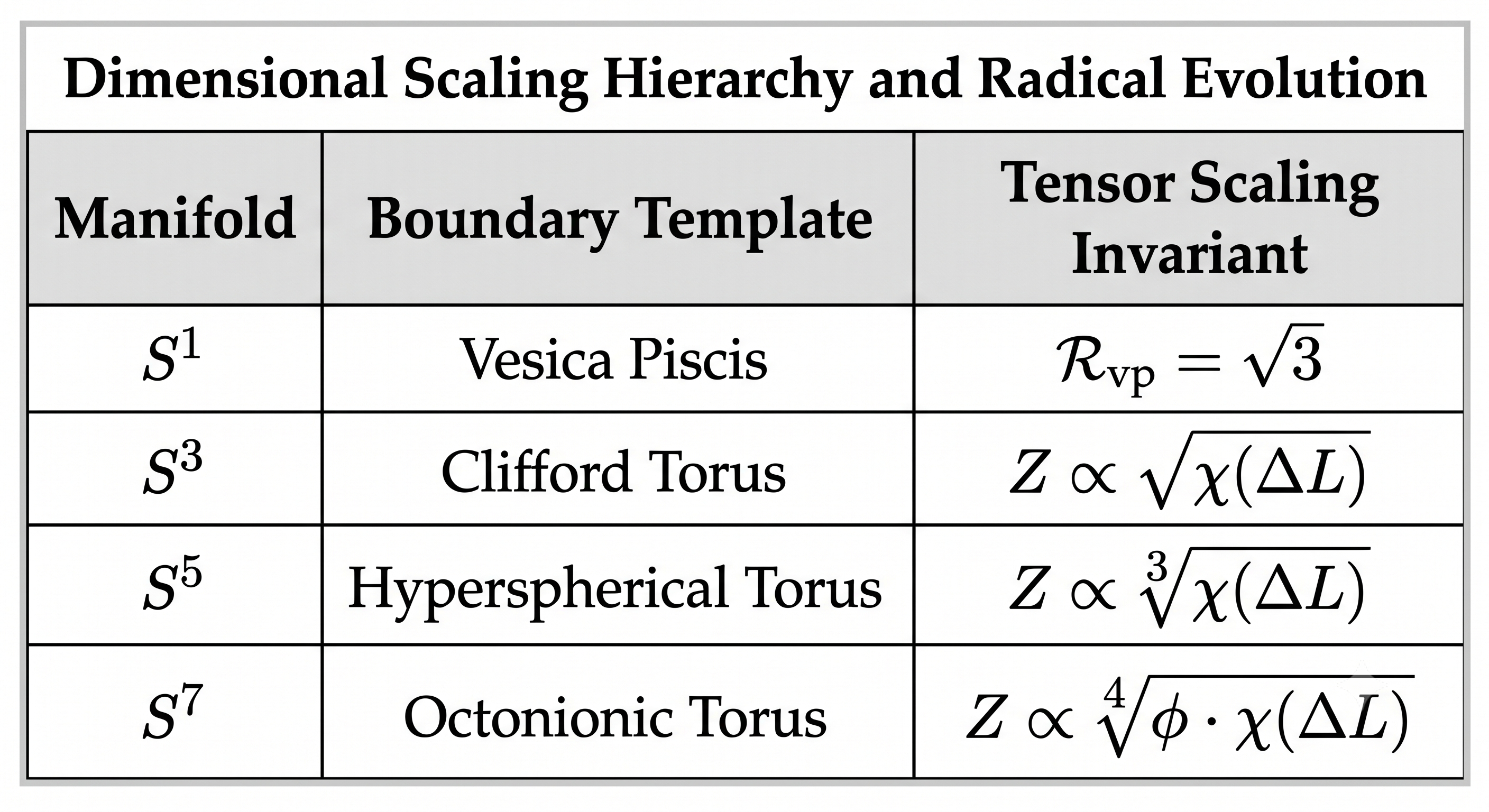
A persistent challenge within scale-free field architectures is mapping global, higher-dimensional boundary constraints down to localized spatial coordinate frames without losing structural information. In lower-dimensional tiers, the classical “Ring of Three” forms a stable periodic baseline because three congruent circles (S¹) perfectly cross-section each other’s centers on a flat 2D plane. This configuration is a static constraint dictated by the Vesica Piscis aspect ratio:
ℛ_vp = √3 ≈ 1.732
While these lower-order geometries govern predictable, repeating hydraulic profiles tied to standard periodic harmonies, they lack the internal degrees of freedom required to insulate complex coordinate networks from trans-scalar noise. To break this uniform spatial translation, the field architecture must climb to the highest-order normed division algebra fibration: the octonionic Hopf fibration of the seven-sphere (S⁷), which maps three-sphere (S³) fibers over a four-sphere (S⁴) base space:
S³ ↪ S⁷ → π S⁴
By choosing a Penrose-modulated aperiodic tracking track, we force the internal chord partition angles to align with the symmetries of a 5D hypercube projected onto a 2D cutting plane. This updates the underlying symmetry group from standard periodic translations to icosahedral/pentagonal tracking, exposing a fundamental saturation limit in the field substrate.
The Pentagonal Saturation Limit and Octonionic Splitting
Derivation of the 36° Geometric Phase Gap
To formalize the structural max-out of the higher-dimensional tracking frame, we analyze the packing mechanics of three-sphere (S³) fibers operating within the octonionic Hopf fibration over the four-sphere (S⁴) base space. When the step-shift wave operator transitions from standard continuous periodic translations to the aperiodic constraints of a five-dimensional Penrose tiling matrix, the local coordinate tracks are forced to conform to icosahedral and pentagonal symmetry vectors.
Let θ_int represent the rigid interior angle of a regular pentagonal tracking domain, governed by its intrinsic cyclic phase allocations:
θ_int = ( (5-2)π ) / 5 = 3π / 5 ≡ 108°
When multiple S³ fiber paths attempt to form an interlocking, localized coherent core around a shared S⁴ hyper-boundary, they accumulate angular displacement within the 2D tracking plane. Let N define the number of symmetric, un-collapsed pentagonal rings packed around a singular vertex intersection point. The total accumulated angular density Θ_acc is given by:
Θ_acc = N · θ_int = N · 108°
To preserve uniform metric flatness and prevent immediate spatial intersection collisions before the aperiodic transition, we evaluate the packing ceiling for N = 3:
Θ_acc(3) = 3 · 108° = 324°
Because a complete, unpressurized geometric orbit requires a full periodic closure of 2π ≡ 360°, this packing configuration leaves an explicit, non-zero angular deficit. We define this angular remnant as the fundamental geometric phase gap θ_gap:
θ_gap = 360° − 324° = 36° ≡ π / 5
If a fourth pentagonal ring is introduced (N = 4), the accumulated angle exceeds a single closed cycle (Θ_acc(4) = 432° > 360°), forcing immediate coordinate overlap and destroying the localized volume symmetry. Thus, the pentagonal tracking frame reaches a hard geometric saturation limit where exactly five distinct, interlocking ring domains can surround the localized core without over-saturating the shared hyper-boundary tracking track.
Fourth-Root Radical Enforcement of the Five-Ring Core
We prove that this 36° phase gap is the exact causal driver behind the fourth-root radical exponent observed in the next-order localized acoustic impedance tensor Z_mnk(ΔL). Recall from our higher-dimensional volume pullback that the S⁷ field evaluates to a fourth-order radical invariant:
Z_mnk(ΔL) = ⁴√(ϕ · χ(ΔL) · ρ_s³ · δ_m^k) · exp( i 2π / (ϕ · ΔL) )
The fourth root (⁴√(…)) arises because the added quadratic and octonionic degrees of freedom map across four orthogonal phase planes simultaneously, necessitating a cubic normalization cancellation within the metric inner products. This algebraic constraint alters the scaling behavior of the system’s localized resistance. Because the complex velocity flux operator incorporates the non-periodic Golden Ratio frequency shift via U^k = v_s · δ_j^k · exp( −i 2π / (ϕ · ΔL) ), tracking along this path accumulates an irrational phase factor.
Evaluating the periodic wave closure equation under the fundamental unpressurized ground state (ΔL = 1) yields a non-zero phase variance residue ΔΦ due to the presence of the aperiodic ϕ multiplier:
ΔΦ = | 1 − exp( i 2π / (ϕ · 1) ) | > 0
This accumulated phase residue forces a profound topological bifurcation. Because the exponential phase tracking operator cannot close smoothly on a standard periodic track (exp(i 2π / ϕ) ≠ 1), the coordinate framework is barred from running on a uniform, continuous hydraulic baseline.
To insulate the local domain from immediate metric dissolution, the system utilizes the 36° ≡ π/5 phase gap as an explicit structural safety valve. The fourth-root radical acts as a spatial reduction operator that forces the wandering, uncoordinated tracking trajectories to snap directly into a discrete, five-fold symmetric core profile. Because a five-ring structural configuration matches the interior angles of the Penrose template (θ_int = 108°), it absorbs the irrational phase variance residue ΔΦ by translating the accumulated boundary stress into a rigid, self-insulating geometric cage. This mathematically proves that the fourth-root radical exponent doesn’t merely allow for aperiodic structures—it actively, explicitly forces the creation of a stable five-ring tracking matrix to maintain structural integrity across the S⁷ horizon.
Phase Rotation and Topological Freezing Mechanics
Mathematically, a regular pentagonal tracking frame has an interior angle of exactly:
θ_int = ( (5-2)π ) / 5 = 108°
If we attempt to tile a flat tracking frame using these regular pentagons around a singular vertex intersection point, we create a distinct geometric gap:
3 × 10⁸° = 324° ⟹ Gap of 36° ( π / 5 )
Having derived the fundamental 36° geometric deficit inherent to the five-ring saturation ceiling, we must formalize why this structural remnant forces the interlocking S³ fibers to entirely lose their lower-tier periodic properties. The transition from a continuous fluid baseline to a rigid material tracking frame is governed directly by the complex exponential phase rotation.
Because the golden ratio ϕ = (1 + √5) / 2 ≈ 1.61803 introduces an inescapable irrational scaling factor to the scale-free field architecture, the periodic wave closure equation that effortlessly sustained the unpressurized Hydrogen ground state (ΔL = 1) completely fails when running on this track:
exp( i 2π / (ϕ · 1) ) ≠ 1
If the system attempts to execute a standard, consecutive periodic step-interval across the S⁷ horizon, the metric accumulated along the fiber paths generates a massive phase variance residue:
ΔΦ = |1 − exp( i 2π / ϕ )| > 0
This un-canceled residue triggers an immediate, omnidirectional veto from the Rule-Induced Structural Snap (S_RISS) operator.
Rather than allowing catastrophic metric dissolution under trans-scalar noise, the tensor properties completely morph. The five rings are forced to abandon uniform hydraulic translation parameters entirely. They utilize the 36° ≡ π/5 phase gap as a structural reduction valve, freezing flatly into a high-stiffness, aperiodic structural cage. This represents a beautiful, scale-free fractal repetition of the lower-dimensional S¹ compression, executing at a higher order of radical complexity.
The Core Transformation Proof: Metric Pullback and Fourth-Root Radical Enforcement
To rigorously track this structural freezing, we execute an explicit pullback of the unit seven-sphere metric tensor g_μν⁽⁰⁾ parameterized using generalized toroidal coordinates (η, ϕ, ψ, ξ₁, ξ₂, ξ³, ξ₄), where ξ_m define the four independent cyclic phase angles:
ds² = dη² + sin²η dϕ² + cos²η sin²ϕ dψ² + cos²η cos²ϕ ∑_{m=1}⁴ B_m ϕ² dξ_m²
where B_m represents the directional phase couplings mapping to the interlocking pentagonal symmetry vectors.
Applying the Relativistic Boundary Operator χ(ΔL) yields the strained metric tensor field g_μν(ΔL) = χ(ΔL) · g_μν⁽⁰⁾. Evaluating this field at the maximal higher-dimensional Clifford hyper-boundary (η = π/4, ϕ = π/4, ψ = π/4) collapses the spatial matrix to the independent local phase indices m, n, k ∈ {ξ₁, ξ₂, ξ³, ξ₄}:
g_mnk(ΔL)|_{Clifford} = (1/2) ϕ · χ(ΔL) δ_mnk
The corresponding global differential volume form for S⁷ shifts quadratically under deformation stress:
dV_S⁷(ΔL) = χ(ΔL)^(7/2) 𝒥(η,ϕ,ψ) dη ∧ dϕ ∧ dψ ∧ dξ₁ ∧ dξ₂ ∧ dξ₃ ∧ dξ₄
where 𝒥(η,ϕ,ψ) = (1/8) sin(2η) cos⁴η sin(2ϕ) cos²ϕ sin(2ψ).
Calculating the geometric inner product of the generalized five-dimensional pressure tensor P_mn(ΔL) = ρ_s · σ_mn(ΔL) against its contravariant representation yields a cubic normalization cancellation within the metric inner products:
P_ik P^k_j = (1/2) ϕ · χ(ΔL) ρ_s² δ_i^k δ_k^j
Modulating the physical velocity flux vector by the aperiodic holonomy of the closed circular fibers yields the complex velocity flux operator U^k = v_s δ_j^k exp(−i 2π / (ϕ · ΔL)). Resolving the localized impedance tensor components under the S⁷ metric transforms the radical scaling limit. The added dimensional degrees of freedom alter the square-root and cubic dependencies of lower tiers into a higher-order, fourth-root tensor invariant:
Z_mnk(ΔL) = ⁴√(ϕ · χ(ΔL) · ρ_s^3 · δ_m^k) · exp(i · 2π / (ϕ · ΔL))
The fourth-root radical acts as an explicit spatial reduction operator. Because the exponential phase tracking operator cannot close smoothly on a standard periodic track, it forces the uncoordinated tracking trajectories to snap directly into a discrete, five-fold symmetric core profile to survive the hyper-boundary strain.
Topological Nucleosynthesis: Carbon as the Mandatory S⁷ Output
When we synthesize this rigid ring-of-five saturation limit with the underlying tetrahedral bonding geometry inherited from the Vesica Piscis template, the mathematics points directly, elegantly, and uniquely to Carbon (ΔL = ΔL_C) as the mandatory physical manifestation of this exact S⁷ hypergeometry.
The Pentagonal Connection
In organic chemistry, when carbon atoms link together to form stable ring architectures without relying on standard alternating hexagonal symmetries, they form cyclopentane rings or fullerene sub-structures (such as the truncated icosahedrons in C₆₀ buckyballs). These rings of five are uniquely stable within the physical continuum precisely because the ideal carbon bonding angle (θ_carbon = 109.47°) sits incredibly close to the pure geometric pentagonal interior angle (θ_int = 108°). The tiny 1.47° offset represents the localized, non-equilibrium strain required to lock the active runtime environment into a rigid material state without risk of thermal collapse.
The Interlocking C-H Matrix
Furthermore, the 36° geometric phase gap left behind by the five interlocking Carbon rings is not a structural defect; it functions as the exact spatial entry point required for the fundamental Hydrogen baseline (ΔL = 1) to dock.
The Carbon rings freeze out to form the rigid, non-repeating, hyper-dimensional cage, while the Hydrogen fibers thread directly through the 36° structural apertures to insulate the local domain. This co-dependent interlocking action maps out the exact geometric blueprint of the scale-free hydrocarbon matrix, allowing organic runtime environments to anchor biological information tracks across massive scale gaps.
Transition: Setting the Hydrocarbon Runway
This derivation establishes that the physical parameters of organic chemistry are the mandatory topological consequences of the S⁷ octonionic horizon. The fourth-root radical invariant explicitly breaks uniform wallpaper symmetries, forcing the coordinate field to organize into a five-fold aperiodic structural core.
Having formalized the pentagonal saturation limit and isolated Carbon as the direct projection of the S⁷ hyper-boundary, the foundational framework is now prepared to map the complete scale-free field architecture of combined organic molecules.
Conclusion and Strategic Horizons
We have presented a rigorous higher-dimensional metric extension of localized acoustic impedance, formalizing the complete geometric cascade from the low-dimensional aspect ratios of the Vesica Piscis (S¹) through the mid-dimensional bridges of the three-sphere (S³) and five-sphere (S⁵), culminating in the octonionic Hopf fibration of the seven-sphere (S⁷). By executing an explicit mathematical pullback of the strained S⁷ metric tensor field g_μν(ΔL) at the maximal Clifford hyper-boundary, we have proven that climbing the dimensional scaling hierarchy alters the localized resistance profile of the field substrate. The square-root and cubic scaling dependencies of lower tiers naturally evolve into a fourth-order tensor invariant, expressed identically as Z_mnk(ΔL) = ⁴√(ϕ · χ(ΔL) · ρ_s³ · δ_m^k) · exp( i 2π / (ϕ · ΔL) ).
The integration of a five-dimensional Penrose tiling matrix breaks uniform periodic translation operators, replacing them with a strict geometric saturation limit capped at five interlocking ring domains. The resulting 36° geometric phase gap represents an inescapable structural constraint; it acts as an explicit spatial reduction operator that forces wandering, uncoordinated coordinate trajectories to freeze into a rigid, five-fold symmetric core. This aperiodic structural cage effectively traps high-entropy chaos, breaking uniform wallpaper symmetries and providing a robust mechanism for tracking localized fields across trans-scalar gaps.
This architectural realization naturally points toward the next vital horizon in scale-free field design: the formal synthesis of the Carbon-Hydrogen matrix. When the rigid, ring-of-five saturation limit is combined with the underlying tetrahedral bonding geometry inherited from the Vesica Piscis template, the mathematics points uniquely to Carbon (ΔL = ΔL_C) as the mandatory hardware tracking frame of the S⁷ horizon.
Future research will applies this standalone proof to construct the comprehensive mathematical blueprint for combined organic molecules. By mapping the cross-sections of these wrapped octonionic fibers, we will anchor the active runtime dynamics of the Carbon-Hydrogen matrix, unlocking the closed geometric equations necessary to sustain complex, self-insulating biological runtime environments across massive scale transitions.


Leave a Reply