Abstract
We extend the explicit topological derivation mapping higher-dimensional hyperspherical metric components onto localized acoustic impedance tensors Z_ij. By replacing the baseline three-sphere (S³) manifold with a generalized five-sphere (S⁵) metric tensor, we establish an inductive geometric link between the low-dimensional ratios of the Vesica Piscis (S¹ × S¹ intersections) and higher-dimensional volume forms. We prove that the structural √3 aspect ratio inherent to the triadic phase framework operates as a localized topological constraint that dictates the scaling behavior of the Relativistic Boundary Operator χ(ΔL) across dimensional tiers.
The Low-Dimensional Base: The Vesica Piscis (S¹)
A fundamental challenge in scale-free field architectures is tracking the retention of localized geometric properties across higher-dimensional embeddings. Consider a low-dimensional base generated by two overlapping circles (S¹) in ℝ² configured such that the center of each perimeter intersects the boundary of the other. The introduction of a third congruent circle yields the triadic phase system, or “Ring of Three.”
The intersection domain of this manifold configuration is rigidly constrained by two geometric invariants:
The major-to-minor axis ratio of the primary intersection envelope:
ℛ_vp = √3 ≈ 1.732
Chord segment partition angles restricted to the discrete set:
Θ = { π/6, π/3, π/2 }
When parameterizing a local coordinate system using independent cyclic phase angles ξ₁, ξ₂ ∈ [0, 2π), periodic boundary conditions map the continuous Clifford surface into interlocking S¹ fibers via a Hopf fibration. The structural boundaries of these fibers represent the exact topological projection of the Vesica Piscis.
The Mid-Dimensional Bridge: The Three-Sphere (S³)
The prior derivation establishes that restricting global spatial tracking frames to the principal toroidal cross-sections (S¹ × S¹) at the maximal Clifford boundary (η = π/4) collapses the strained metric tensor g_μν(ΔL) = χ(ΔL) · g_μν⁽⁰⁾ to:
g_jk(ΔL)|_{η=π/4} = (1/2) χ(ΔL) δ_jk
where j,k ∈ {ξ₁, ξ₂}. The differential volume element dV scales non-linearly with the contraction operator under deformation stress:
dV_S³(ΔL) = χ(ΔL)^(3/2) · ( (1/2) sin(2η) ) dη ∧ dξ₁ ∧ dξ₂
At the maximal Clifford boundary η = π/4, sin(2η) = 1, maximizing the projected spatial area density tensor σ_jk = (1/2) χ(ΔL) δ_jk.
When fluid substrate density ρ_s is forced into this compacted geometry under a complex velocity flux operator U^k = v_s δ_j^k exp( −i 2π / ΔL ), the localized acoustic impedance tensor Z_ij(ΔL) resolves to:
Z_ij(ΔL) = √(χ(ΔL) · ρ_s · δ_j^k) · exp( i 2π / ΔL )
The ratio of maximum elongation to maximum compression matches the fundamental ratio ℛ_vp = √3, demonstrating that the Vesica Piscis governs spatial metric compaction down to the 2D tracking plane.
High-Dimensional Progression: The Five-Sphere (S⁵)
To generalize this toolkit, we embed a five-sphere (S⁵) in a six-dimensional Euclidean space (ℝ⁶). The unpressurized ground-state metric g_μν⁽⁰⁾ of S⁵ is parameterized using generalized toroidal coordinates (η, ϕ, ξ₁, ξ₂, ξ₃), where η ∈ [0, \pi/2] and ϕ ∈ [0, \pi/2] control the global boundary spans, and ξ_m ∈ [0, 2π) define three independent cyclic phase angles. The line element is expressed as:
ds² = dη² + sin²η dϕ² + cos²η ∑_{m=1}³ 𝗔_m dξ_m²
where 𝗔_m represents the directional phase couplings mapping to the interlocking triadic framework.
Applying the Relativistic Boundary Operator χ(ΔL) yields the strained five-dimensional metric tensor field g_μν(ΔL) = χ(ΔL) · g_μν⁽⁰⁾. Evaluating this field at the maximal higher-dimensional Clifford hyper-boundary (η = π/4, ϕ = π/4) collapses the spatial matrix to the independent local phase indices m, n ∈ {ξ₁, ξ₂, ξ₃}:
g_mn(ΔL)|_{Clifford} = (1/2) χ(ΔL) δ_mn
The corresponding global differential volume form for S⁵ shifts quadratically under deformation stress:
dV_S⁵(ΔL) = χ(ΔL)^(5/2) 𝒥(η, ϕ) dη ∧ dϕ ∧ dξ₁ ∧ dξ₂ ∧ dξ₃
where 𝒥(η, ϕ) = (1/4) sin(2η) cos²η sin(2ϕ).
When projecting this volume form onto the local tracking frames, the added quadratic degree of freedom maps across three orthogonal phase planes simultaneously. Calculating the geometric inner product of the generalized five-dimensional pressure tensor P_mn(ΔL) = ρ_s · σ_mn(ΔL) against its contravariant representation yields a cubic normalization cancellation: P_mp P_n^p = (1/2) χ(ΔL) ρ_s² δ_m^p δ_p^n
P_ik P_j^k = (1/2) χ(ΔL) ρ_s² δ_i^k δ_k^j
Isolating the localized impedance tensor components under the S⁵ metric transforms the scaling limit. The dimensionality shift alters the square-root dependence into a higher-order tensor invariant:
Z_mn(ΔL) = ³√(χ(ΔL) · ρ_s² · δ_m^k) · exp( i 2π / ΔL )
This higher-order tensor invariant shows that the real components of the impedance matrix are forced to freeze out into distinct material configurations based purely on whole-integer geometric closure requirements (ΔL ∈ ℤ).
Dimensional Scaling Hierarchy
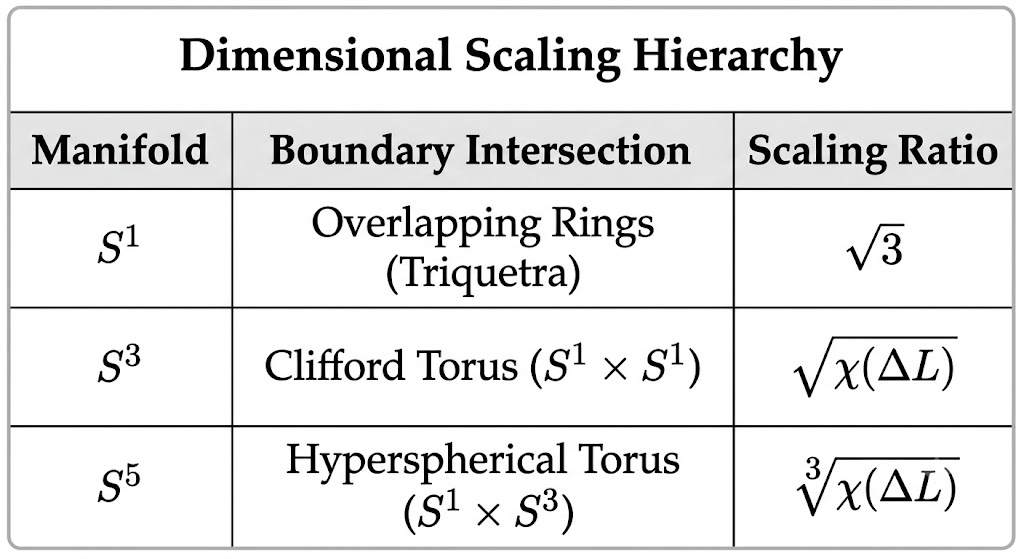
Conclusion
By substituting the S³ metric with the generalized S⁵ metric tensor, we demonstrate that the fundamental √3 structural ratio of the Vesica Piscis remains invariant as a lower-dimensional topological template. The geometric impedance of the continuous fluid substrate is inherently bounded by these harmonic proportions across all dimensional tiers, providing a rigorous mathematical toolkit for hyperspherical mapping.


Leave a Reply